Comments on 4/16 DAME Configurable Parameters Working Group Meeting

Day-ahead market enhancements

Print
Comment period
Apr 20, 03:00 pm - Apr 30, 05:00 pm
Submitting organizations
View by:

California Energy Storage Alliance (CESA)
Submitted 04/30/2026, 03:21 pm

Contact

Donald Tretheway (donald.tretheway@gdsassociates.com)

1. Please provide any comments on the April 16, 2026 DAME Configurable parameters implementation working group material and discussion.

The California Energy Storage Alliance (CESA) appreciates the opportunity to discuss the 4/16 DAME Configurable Parameters Working Group.  CESA acknowledges the significant work CAISO staff has performed in evaluating the impact of imbalance reserve market design parameters. CESA does not oppose the changes to configurable parameters for DAME go-live on May 1, 2026.  However, as discussed in prior CESA comments, the changes to configurable parameters will undermine the effectiveness of imbalance reserve in ensuring that capacity procured in the day-ahead market is deliverable and available to address real-time uncertainty, which is the core purpose of imbalance reserves.

By reducing requirements and loosening parameters, the current approach increases the likelihood that imbalance reserves will be awarded to resources that cannot perform as expected in real time. This creates a disconnect between day-ahead awards and real-time deliverability, which will erode operator confidence in imbalance reserves as a reliable tool. As a result, system operators across the EDAM will have low confidence in the availability of imbalance reserves to be dispatched as energy in the real-time market, thus system operators will continue to rely on out-of-market actions such as biasing the residual unit commitment (RUC) load forecast. The RUC biasing may be more costly to load than the initial values of the configurable parameters to imbalance reserve costs. This outcome runs counter to a central objective of DAME, which is to shift uncertainty management into the integrated forward market (IFM) and enable transparent co-optimization of energy, ancillary services, and reserves.

Suppliers that are awarded imbalance reserves will be more likely to incur deviation settlements with the flexible ramping product because the market optimization can knowingly award imbalance reserves to resources that are undeliverable, have insufficient state-of-charge, or are incapable of providing the full imbalance reserve award in 15 minutes. When the market optimization over-awards based on parameter assumptions rather than true operational capability, resources are either penalized for non-performance or forced to bid conservatively to manage risk. Both outcomes distort price signals, reduce participation, and diminish overall market efficiency.

CESA looks forward to CAISO’s continued evaluation of imbalance reserve performance in actual operations. CAISO should evaluate imbalance reserve performance using actual operational data, including the frequency and magnitude of awards that are not dispatchable in real time.   A more appropriate approach to address concerns of imbalance reserve costs would be through the imbalance reserve demand curve, which is designed to limit procurement when costs exceed real-time benefits. Preserving this framework will better support reliable operations, efficient market outcomes, and transparent pricing of uncertainty.

California ISO - Department of Market Monitoring
Submitted 04/30/2026, 04:31 pm

Contact

Aprille Girardot (agirardot@caiso.com)

1. Please provide any comments on the April 16, 2026 DAME Configurable parameters implementation working group material and discussion.

Comments on Day-Ahead Market Enhancements Configurable Parameters

Working Group Presentation on April 16, 2026

Department of Market Monitoring

April 30, 2026

Summary

The Department of Market Monitoring (DMM) appreciates the opportunity to comment on the Day-Ahead Market Enhancements - Configurable Parameters Implementation Working Group presentation on April 16, 2026.[1] DMM continues to support the use of the lowest possible values for imbalance reserve (IR) requirements, envelope multipliers, and the deployment reserve factor at go-live to help minimize the risk associated with implementing new products in a new market structure. DMM recommends the ISO be prepared to lower any of these parameters if market results indicate inefficiently high imbalance reserve or reliability capacity prices.

DMM supports the ISO’s proposal to use reduced imbalance reserve (IR) requirements by using a lower percentile of net load uncertainty. DMM continues to recommend the ISO be prepared to use a net load uncertainty value lower than the 90th percentile to determine IR requirements in the integrated forward market (IFM) if early market results indicate inefficient outcomes. DMM acknowledges that IR requirements are also part of the day-ahead resource sufficiency evaluation, which may have different implications for non-CAISO balancing areas that do not have resource adequacy programs with must-offer obligations. DMM recommends the ISO allow different percentiles of net load uncertainty to be used across market runs and balancing authority areas.

DMM does not oppose the ISO increasing the envelope multiplier in the residual unit commitment (RUC) process. However, it is unclear whether changing the envelope multiplier will have significant impact in RUC given the way state-of-charge is considered when awarding reliability capacity to storage resources. Further, a higher envelope multiplier may be unnecessary in RUC due to the lack of evidence that this parameter improves real-time deliverability. While the potential for adverse market impacts resulting from a higher envelope multiplier in RUC may be less than in IFM, DMM recommends the ISO consider lowering this parameter if market results indicate issues from the envelope multiplier being too high in RUC.

Comments

While DMM supports the parameter values the ISO has selected for go-live, DMM recommends the ISO be prepared to quickly lower any of these parameter values based on market results

DMM continues to support the use of the lowest possible values for the IR requirements, envelope multipliers, and deployment reserve factor. While DMM supports the parameter values the ISO has selected for go-live, DMM recommends the ISO be prepared to lower any of these parameter values if market results indicate inefficiently high imbalance reserve or reliability capacity prices. DMM also recommends the ISO only consider increasing these parameter values if operational data demonstrates a clear need for procuring additional IR capacity or improving real-time deliverability that justifies any increase in IR procurement cost.

DMM supports the ISO using a reduced net load uncertainty percentile to establish the imbalance reserve requirement and recommends the ISO consider reducing it further depending on market results

DMM continues to support using a lower level of net load uncertainty percentile in order to lower IR requirements in the IFM. While DMM supports the use of the 90th percentile of net load uncertainty at go-live, using a lower requirement at go-live could help further mitigate market risk and allow the ISO to gain operational experience procuring IR without much additional operational risk.[2]

The ISO’s results comparing imbalance reserve requirements across the 90th and 97.5th percentile indicate that using the 90th percentile does significantly reduce IR requirements across all balancing areas.[3] However, the results also suggest that even with the 90th percentile, IR prices may be higher than the true value of the product. DMM continues to recommend the ISO start with the lowest feasible IR requirement in order to minimize market risk, and recommends the ISO be prepared to further reduce the IR requirements if market results after go-live indicate inefficient market outcomes or inefficiently high IR prices. DMM continues to also recommend the ISO only consider increasing IR requirements if market results demonstrate a clear need to do so.

DMM’s comments on the imbalance reserve requirement here and in previous comments are focused on the IFM procurement of imbalance reserves. However, DMM acknowledges that IR requirements are also part of the day-ahead resource sufficiency evaluation, which may have different implications for non-CAISO balancing areas that do not have resource adequacy programs with must-offer obligations. DMM recommends the ISO allow different percentiles of net load uncertainty to be used across market runs if market results indicate that inefficiently high IR requirements are leading to adverse outcomes in the IFM. The ISO could also allow different net load uncertainty percentiles to be used across balancing areas. This added flexibility could help guard against unnecessarily high IR requirements in the IFM while still allowing a sufficiently high percentile of uncertainty in the resource sufficiency evaluation to support the reliability needs of non-CAISO balancing areas.

DMM does not oppose increasing the envelope multiplier in RUC, but this change may be unnecessary and may not have a substantial impact on the real-time availability of reliability capacity awarded to storage resources

DMM does not agree that a higher envelope multiplier is necessary in RUC. As previously noted, the envelope constraint multiplier does not guarantee availability of storage resources in real-time as there is no mechanism in the real-time market to preserve state-of-charge to deliver imbalance reserve or reliability capacity awards. However, due to how storage resources receive reliability capacity awards, it is unclear whether changing the envelope multiplier in RUC will have a meaningful impact. DMM’s understanding is that storage resources will only be awarded reliability capacity awards based on their modeled state-of-charge (SOC) in the IFM. If RUC takes SOC as given from the IFM and does not award charging or discharging awards to position batteries’ SOC to meet future reliability capacity awards, then the pricing effects of a higher envelope multiplier in RUC are likely to be more limited than the effects of a higher envelope multiplier for imbalance reserves. While DMM does not oppose the ISO using a higher envelope multiplier in RUC at go-live, DMM recommends the ISO consider adjusting this parameter if market results indicate it may be too high.


[1]  Day-Ahead Market Enhancements: Configurable Parameters Implementation Working Group presentation, California ISO, April 16, 2026: https://stakeholdercenter.caiso.com/InitiativeDocuments/Presentation-Day-Ahead-Market-Enhancements-DAME-Configurable-Parameters-Implementation-Working-Group-Apr-16-2026.pdf   

[2] Comments on Day-Ahead Market Enhancements Configurable Parameters Working Group Presentation on March 24, 2026, Department of Market Monitoring, April 7, 2024: https://www.caiso.com/documents/dmm-comments-on-dame-configurable-parameters-mar-24-2026-working-group-presentation-apr-07-2026.pdf

[3]  Day-Ahead Market Enhancements: Configurable Parameters Implementation Working Group presentation, California ISO, April 16, 2026, pp 22-27: https://stakeholdercenter.caiso.com/InitiativeDocuments/Presentation-Day-Ahead-Market-Enhancements-DAME-Configurable-Parameters-Implementation-Working-Group-Apr-16-2026.pdf   

CPUC
Submitted 04/28/2026, 05:09 pm

Contact

Jordan Miner (jordan.miner@cpuc.ca.gov)

1. Please provide any comments on the April 16, 2026 DAME Configurable parameters implementation working group material and discussion.

Summary

Energy Division staff (ED staff or staff) of the California Public Utilities Commission (CPUC) develops and administers energy policy and programs to serve the public interest, advises the CPUC, and ensures compliance with CPUC decisions and statutory mandates. ED staff provides objective and expert analyses that promote reliable, safe, and environmentally sound energy services at just and reasonable rates for the people of California.[1]

ED staff appreciates the opportunity to submit comments on the Day-Ahead Market Enhancements (DAME) configurable parameters implementation working group. ED staff also appreciates the considerable amount of material analyzed and released for discussion as the working group has progressed over the last several months in advance of the scheduled EDAM go-live on May 1, 2026.  

ED staff mostly supports CAISO’s current plan for configurable parameters for EDAM go-live because it is a significant improvement over prior combinations. Prior combinations of the configurable parameters produced estimated annual costs in the range of $1-$2 billion for these new DAME products, which have been reduced to approximately $508 million a year in additional costs based on recent tuning, i.e. adjustments.[2]  ED staff continue to be concerned that these additional costs for these new products are large and unnecessary, as described below. ED staff notes that the projected benefits of EDAM are in the $100-$200 million range for the CAISO BAA – so  ideally the tuning of these configurable parameters will preserve reliability while allowing the CAISO BAA’s ratepayers to capture the net benefits of the new expanded market.[3] Therefore, ED continues to encourage CAISO to use lower values for the Imbalance Reserve requirements and configurable parameters.

Double Payment for Resource Adequacy Capacity

ED staff is concerned that EDAM’s new Imbalance Reserve product, as designed, could cause CAISO BAA customers to double-pay for capacity resources that must bid into CAISO markets: first through capacity contracts for resource adequacy (RA) resources that have day-ahead and real-time must offer obligations by definition, and a second time for those same capacity resources when if they bid into and are  selected as Imbalance Reserves.  All California RA resources have a must-offer obligation in the day ahead and real-time by definition. The capacity resources that are awarded for Imbalance Reserves are paid to bid into the real-time market, so these Imbalance Reserve awards have the appearance of creating a duplicative capacity payment to the same resource for the same action.  The Imbalance Reserves will be procured based on the amounts determined by the configurable parameters but do not necessarily improve reliability if the resources are designated for RA and already have a day-ahead market (DAM) and real-time market (RTM) must offer obligation (MOO).

CAISO stated on April 15th: “Further implications related to the RA program are not within the scope of the implementation working group for configurable parameters.”[4] Nonetheless, the CPUC is interested in the Imbalance Reserve design operation alongside the statutory rules from Public Utilities Code 380 that requires the California RA program, since a critical variable when discussing the size of a reserve capacity product is that a substantial majority of CAISO resources already have  a MOO.[5] CPUC jurisdictional load serving entities (LSEs) own or have contracted with the overwhelming share of CAISO resources, as well as specified imports with maximum import capability (MIC) allocations, that will be bidding into the extended day ahead market (EDAM) for at least the first year.[6] In addition, through the CPUC’s adopted planning reserve margin (PRM)of 18 percent, and the effective planning reserve margin above the currently adopted PRM, the CPUC has ensured a significant amount of surplus resources (both RA and additional resources beyond RA resources) to be available in the day ahead and real time markets, which should reduce any need for substantial amounts of Imbalance Reserves.[7]  The CPUC is statutorily mandated (See Public Utilities Code 380(8)(4)) to ensure that the RA resources provided to the CAISO can “reasonably maintain a standard measure of reliability, such as a one-day-in-10-year loss-of-load expectation or a similarly robust reliability metric adopted by the commission,” and so any Imbalance Reserve capacity procurement via EDAM in exceedance of CPUC RA resources may be in excess of the statutorily mandated level of reliability.

Specific revenue return proposals are in the scope of the current RA Proceeding R.25-10-003, but ED staff notes CAISO has also developed the DAME Transitional Measures which have some opt-in revenue return mechanisms.[8] In the long-term, CAISO should ensure the Imbalance Reserve design does not leave customers double-paying for reliability capacity.

Net Load Uncertainty Adjustments

CAISO’s revised plan for EDAM go-live highlights a large gap between market policy and actual operational actions. The data shown below (extracted from parallel operations and production OASIS pages), shows that CAISO’s procurement of Imbalance Reserves at 97.5%, and 90% percentile (as of 4/1/2026) of uncertainty is much higher than the uncertainty adjustments made by CAISO operators in the production environment.

image(106).png

CAISO made RUC adjustments in the production environment on only a handful of days since the start of parallel operations. On these few days when RUC adjustments were made, the awards were significantly smaller than the proposed amounts for imbalance reserve up (IRU). ED staff continue to recommend CAISO use a lower percentile of uncertainty for Imbalance Reserve procurement. CAISO has reduced the percentile from 97.5% to 90%, which ED staff believes is still not an adequate reduction.

In 2024, 97% of all hours were covered by a RUC adjustment percentile of uncertainty of 75% or less. Given this, the rationale for the minimal decrease from 97.5% to 90% percentile of uncertainty remains unclear. Market operational experience illustrates that a large requirement remains largely unnecessary. CAISO’s Department of Market Monitoring’s (DMM) March 24th Configurable Parameter Working Group Comments supports this as well. In those comments, DMM stated: “DMM recommends the ISO further reduce the net load uncertainty percentile used to establish the Imbalance Reserve requirement.”[9]

Analysis from DMM has shown that the 97.5% percentile of uncertainty has hardly ever been used in recent years for the RUC adjustment, for a variety of reasons, and notably, there have been many days/hours with no adjustment at all.[10] In fact, in 2024 – 97% of all hours were covered by a RUC adjustment percentile of uncertainty of 75% or less.   CAISO’s Day-Ahead Market Operating Procedure as designed will allow for these specific rare occurrences, when a higher amount is needed.[11] CAISO’s DMM published the chart below illustrating RUC adjustments in 2024. [12]
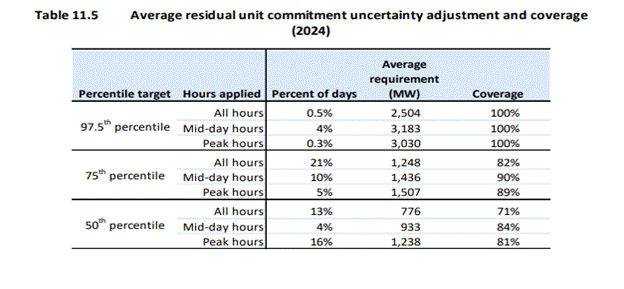
image-20260428170311-2.png

When these values are converted to hourly figures, the results for 2024 show that CAISO used a 97.5% percentile uncertainty adjustment in only 3% of hours.

Percentile of uncertainty

Number of Hours

Percentage of Hours

97.5%

288

3%

75%

2,533

29%

50%

1,723

20%

No adjustment

4,216

48%


More recently, CAISO reduced its RUC adjustments even further, as shown in the slide below, demonstrating that the 97.5% uncertainty level is too high.
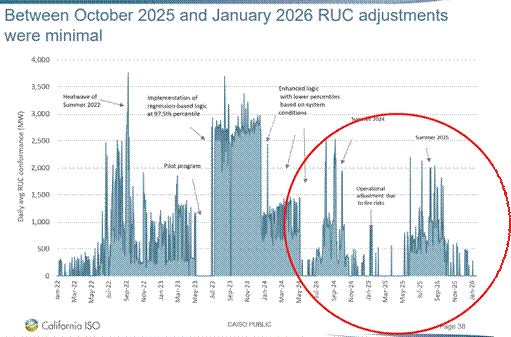
image-20260428170311-3.png

In addition, DMM has presented the graph below that shows that the 97.5% percentile of uncertainty has been used only infrequently and thus even the 90% uncertainty level will be unnecessary on the vast majority of days:
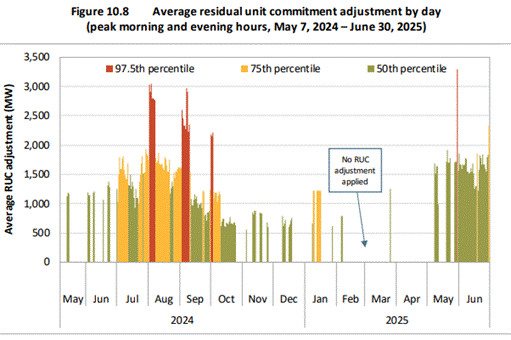
image-20260428170311-4.png[13]

CAISO has acknowledged there may be rare instances where operator adjustments would need to occur with Day-Ahead Market Procedure 1210.[14] The DAM operating procedure provides CAISO with the ability to procure uncleared Imbalance Reserves if grid conditions warrant it. This trigger mechanism can prevent any potential harm if CAISO uses a lower percentile of uncertainty most of the year. Ultimately the efficiency of the market will be measured in market costs and annual production cost savings. Therefore, using a lower percentile of uncertainty reduces overall market costs, which will improve the efficiency of EDAM. CAISO released a new Day Ahead Market Procedure 1210 on April 27, 2026, and ED staff are reviewing the procedure.

ED staff recognizes that the reduction of Imbalance Reserve requirements to 90% has a non-linear impact on the size of Imbalance Reserve awards (approximately in the 30-40% range). Based on the data presented in the March 26th working group meeting, a 90% percentile of uncertainty can still produce large Imbalance Reserve up/Imbalance Reserve down (IRU/IRD) award spreads. Prices result from a low-load day in the middle of March, which is not the time of year when CAISO’s markets typically experience high market prices. The costs for Imbalance Reserve in the middle of spring might be significantly lower than in the summer months, but are also likely unneeded, as there are generally few reliability concerns on low-load days. Therefore, ED staff remains concerned that even a smaller award spread would produce unnecessary amounts of ratepayer cost exposure since on a higher-load day, one would reasonably anticipate IRU/IRD and energy prices clearing significantly higher, therefore producing higher costs.

However, data extracted from OASIS for April 21, 2026 reflected a 22,000 MW load day that presents an award spread of around 7,500 MW between IRU/IRD. This spread represents around 34% of the CAISO BAA’s total load.  While the 90% level of Imbalance Reserve procurement does reduce Imbalance Reserve procurement, it does not seem plausible that the CAISO BAA would ever need such large amounts of awards in the middle of April – when solar production is plentiful.

Ultimately, instability or uncertainty in the new market model or the new DAME products could translate into higher electricity prices for California ratepayers. If the market model is unstable and not producing consistently realistic results, the market  go live scheduled for May1st could produce high bills for California ratepayers without a clear reliability benefit.

Envelope Constraint Multiplier

ED staff supports CAISO’s using the 45% envelope constraint multiplier (ECM), but ED staff recommends reducing the ECM to 30% at EDAM go-live. Of the tunable configurable parameters, the ECM has the largest impact on Imbalance Reserves prices. ED staff would like to better understand the reasoning behind setting the envelope constraint multiplier to 45% rather than a lower value (e.g., 30%). In their comment response matrix, CAISO referenced sensitivity studies from prior rounds of analysis but has not modeled the 30% ECM when a 90% or lower level of uncertainty for the procurement of Imbalance Reserves is used. For example, are there any downsides to pursuing a 30% envelope constraint multiplier? It would be helpful to understand if CAISO staff identified any issues with battery storage resources not being charged sufficiently at the 30% envelope constraint multiplier, and if this made these resources not deployable as a result. If CAISO staff did not identify any battery charging sufficiency issues at a 30% envelope constraint multiplier, then what are the reasons for not using 30%?

ED staff is also concerned that the tuning of the envelope constraint multiplier for the Residual Unit Commitment (RUC) process may result in detrimental consequences since it was scoped late in the initiative and has not been fully evaluated by stakeholders. Thus, it is unclear to ED staff what impact tuning this parameter to 100% for RUC will have on overall market results.

Deployed Imbalance Reserve Factor

ED staff supports CAISO’s proposal to reduce the deployed Imbalance Reserve factor (DIR) from 60% to 45%, but would recommend reducing it further to 30%. Of the two tunable configurable parameters presented during the March 24th meeting, the deployable Imbalance Reserve factor has minimal impact on prices.  ED staff continues to support the most conservative combination of parameters possible to minimize the cost impact of duplicative products.

So far, analysis of RTM results has been limited, so it remains unclear whether this parameter has any impact or improves deliverability. ED staff has requested further explanation to better understand any tradeoffs, for instance, whether there are any reliability or deliverability issues in the RTM if the DIR is 30%. From our understanding, CAISO has not tested this lower DIR value in combination with a lower percentile of uncertainty. ED staff look forward to EDAM go-live to more fully understand the impact of this parameter.

IR Bidding Capabilities

ED staff is monitoring the rollout of Imbalance Reserves during actual market operations, currently scheduled for May 1, 2026, including monitoring IOU participation in EDAM to ensure consistency with CPUC rules for bundled procurement plans. In a recent Market Simulation and Parallel Operations stakeholder call, CAISO staff indicated CAISO was seeding, i.e. placing bids in the absence of some market participants participation in the parallel operations process, over 50% of Imbalance Reserve bids.  It is unclear to ED staff whether scheduling coordinators will be ready to place bids on Day 1 of actual market operation if CAISO is seeding over 50% of the Imbalance Reserve bids and only 120 out of nearly 300 scheduling coordinators have participated in parallel operations.  Instability in IR bidding could introduce scarcity into the Imbalance Reserve and energy supply stacks, potentially resulting in artificially inflated prices or providing generators an opportunity to exercise market power.

Phase 2 Schedule  

ED staff does not support CAISO’s proposal of a “flexible and adaptive schedule” to phase 2 of EDAM go-live. In prior rounds of comments, ED staff recommended that CAISO keep these more conservative configurable parameters and lower Imbalance Reserve requirements through September and only make changes after discussions with stakeholders and the CAISO’s Market Surveillance Committee (MSC).  ED staff continues to support this approach for two reasons. First, August and September are typically high-load months. Thus, unintended results from design changes in those months could have very significant ratepayer and market impacts. It would be prudent to wait until October to make any changes.  The EDAM go-live plan or low-prices may mitigate the impact of these new DAME products, but this should not be taken as a rationale to increase any of the configurable parameters or the Imbalance Reserve requirement, especially during summer. Second, ED staff recommends CAISO consult with the MSC before changing the configurable parameters in Phase 2 because this would allow further input on these important parameters before they are implemented in the market. This would provide an opportunity for CAISO and stakeholders to assess the parameters and requirements and the effects on market efficiency and costs more broadly.

Reliability Capacity

Finally, ED staff is concerned about the magnitude of reliability capacity up (RCU) awards and corresponding prices. ED staff have been tracking the RCU prices emerging out of parallel operations, specifically tied to the PGAE DLAP, and have noticed a large price range from ($3) all the way up to $239 – a spread of almost $250. It is unclear to ED staff why RCU prices should be materializing so high during the spring when there are little to no reliability concerns.

OASIS issues

In addition, ED staff continue to encounter data population issues with CAISO’s OASIS application as recently as April 21, 2026, such as locational marginal prices and DAM summary report not populating long after the market should have completed — which further reduces confidence the market model is producing accurate results.  


[1] More information about the CPUC Energy Division is available at: https://www.cpuc.ca.gov/about-cpuc/divisions/energy-division. 

[2] CAISO’s revised combination of configurable parameters along with a lower percentile used for the procurement of imbalance reserves was implemented 4.1.2026. ED staff took the daily costs of 4.1,4.2,4.9,4.14, and 4.21 to produce an unweighted average of $508 million a year in new cost exposure because of these new DAME products. ED staff isolated 4.13 from our calculations due to the abnormal results on 4.13.2026, as highlighted by CAISO.

[3] TN261300_20250127T085542_Presentation - Preliminary Day-Ahead Market Impacts Study.pdf

[4] CAISO Comment Response Matrix, 4.15.2026, pg. 8: Comment-Responses-Day-Ahead-Market-Enhancements-(DAME)-Configurable-Parameters-Working-Group-Apr-15-2026 (1).pdf

[5] Flexible RA was established by D.13-06-024 which requires “Resources will be considered as “flexible capacity” if they can sustain or increase output, or reduce ramping needs, during the hours of the ramping period of “flexible need.” In addition, all Flexible RA resources carry a must-offer obligation, pg. 21 “PG&E contends is unneeded because flexible RA resources will have to meet the flexible RA Must Offer Obligation (MOO) requirements in the ISO tariff.

[6] The CAISO BAA is the largest of all EDAM BAAs, and will form a majority of the market at EDAM Go-Live, but market share will decline as more BAAs join EDAM. WWGPI Pathways Step 1 Trigger (2025-07-01).xlsx

[7] D.25-06-048 adopted a 18% percent PRM for LSEs under the Slice of Day (SOD) framework and an effective PRM of 22.5% to provide additional summer reliability procured by the Joint IOUs, Fact Sheet on the Decision in Track 3 of Resource Adequacy Proceeding (R.23-10-001).

[8] Pg. 43, DAME Transitional Measures FERC-Approved-Tariff-Language-Extended-Day-Ahead-Market-and-Day-Ahead-Market-Enhancements (1).pdf

[9] Department of Market Monitoring, 3/24 Configurable Parameter Working Group Comments, California ISO - All comments

[10] Pg. 121, Department of Market Monitoring Quarter 2 Report on Market Issues and Performance, 2025-second-quarter-report-on-market-issues-and-performance.pdf

[11]  Day-Ahead Market Operating Procedure 1210, pg.12.

[12] Pg. 259, 2024 Department of Market Monitoring Annual Report, 2024-annual-report-on-market-issues-and-performance-aug-07-2025.pdf

[13] DMM’s Q2 Report on Market Issues and Performance, pg.119, 2025-second-quarter-report-on-market-issues-and-performance.pdf

[14] Day-Ahead Market Operating Procedure 1210, pg.12.

Pacific Gas & Electric
Submitted 04/30/2026, 04:42 pm

Contact

Sam Johnson (sam.johnson@pge.com)

1. Please provide any comments on the April 16, 2026 DAME Configurable parameters implementation working group material and discussion.

PG&E appreciates the CAISO’s responsiveness to stakeholder feedback.  

PG&E recognizes the tremendous amount of work the CAISO is juggling: the tuning analysis, monitoring parallel operations, patching parallel operations, on-boarding PacifiCorp, and many other EDAM-launch related activities on top of running and monitoring production. These efforts are appreciated, and we look forward to the CAISO's continued analysis and reporting. 

PG&E supports the CAISO’s decision to use lower initial parameter values.  

PG&E encourages launching with these lower parameters as a prudent approach for the imbalance reserve requirements, deployment factor, and envelope multiplier. 

PG&E agrees with the CAISO’s Go-Live plan.  

As with previous comments, PG&E reiterates, if after launch, evidence indicates parameter values are still too high, we expect the CAISO to evaluate further relaxations of the values as well as other alternatives to ensure we provide a safe, reliable, and affordable energy system.

San Diego Gas & Electric
Submitted 04/30/2026, 01:47 pm

Contact

Pamela Mills (pmills@sdge.com)

1. Please provide any comments on the April 16, 2026 DAME Configurable parameters implementation working group material and discussion.

San Diego Gas & Electric (SDG&E) appreciates CAISO’s continued leadership in maintaining an open, transparent, and collaborative implementation working group process. SDG&E acknowledges CAISO’s demonstrated willingness to consider stakeholder input and to adjust the set of enforced constraints to reflect the evolving needs of the market and its participants. SDG&E believes that the proposed plan, including the two-phased approach for configurable parameters, represents a constructive step toward enhanced regional coordination and meeting system demand in a cost-effective manner.

SDG&E notes areas of positive progress discussed in the Day-Ahead Market Enhancements (DAME) configurable parameters working group. Specific areas of improvement include:

  • Envelope constraint multiplier/ deployed imbalance reserve factor: Over the last several working group meetings, CAISO has discussed the impacts of these parameter interactions and evaluated the market outcomes from using more conservative values in parallel operations. SDG&E is encouraged that the value for this constraint will be set at 45% in phase 1 of production, which should allow for more cost-effective use of the storage resource fleet to provide imbalance reserves to the market.
  • Imbalance reserve requirement: SDG&E strongly supports CAISO’s plan to reduce the IR requirements at go-live, which will allow market participants to better understand how the market will procure IR at a lower uncertainty percentile. Parallel operations results with lowered uncertainty requirements showed less extreme procurement of IRD/IRU. This more conservative procurement level should help balance some cost concerns with reliability. SDG&E supports using the 90th percentile for go-live, but as we see more operational production data that include DAME products, along with full market participation, additional adjustments may be needed to IRD/IRU procurement levels.

While we are supportive of these changes, SDG&E continues to have concerns about certain aspects of CAISO’s plan for go-live and the interaction between RC and IR procurement:

  • Monitoring and reporting: CAISO has outlined its action plan for monitoring the configurable parameters in go-live in their Release Activation Review for DAME/EDAM meeting on April 23. SDG&E believes it will be critical for CAISO to monitor and report on the same data points presented in the DAME Configurable Parameters working group meetings, as these metrics will help show whether these parameters are working and whether the market is operating efficiently. CAISO’s commitment to regular checkpoints is helpful, but we strongly urge them to include assessments on the parameters, as well as IR/RC procurement in the extended market simulation and operations call which CAISO has committed to continuing for the first several weeks after go-live.
  • Interdependency with RC and updated operating procedure 1210: SDG&E recently learned that while CAISO has adjusted the uncertainty percentile for IR, the 97.5 level of procurement may be pursued via automatic RUC adjustments on high load days as detailed in the recently updated operating procedure 1210. We are concerned that this operating procedure may undo the efforts and benefits made in the Configurable Parameters working group process. EDAM and increased regional coordination in this market should result in net savings to customers, and SDG&E has concerns that we could see significant cost increases on high load days without proven corresponding reliability benefits. SDG&E is also concerned that this interdependency was not discussed by CAISO earlier in the stakeholder process. SDG&E plans to observe this potential issue. We request CAISO do the same and include reporting on these outcomes in future configurable parameters meetings.

SCE
Submitted 04/29/2026, 12:44 pm

Contact

Jonathan Lawson Rumble (jonathan.rumble@sce.com)

1. Please provide any comments on the April 16, 2026 DAME Configurable parameters implementation working group material and discussion.

Southern California Edison appreciates the opportunity to provide comments on the DAME Configurable parameters WG meeting held on April 16.  The meeting was the successful culmination of a collaborative effort over the last year.  This success was due to the willingness of all participants, both stakeholders and the CAISO, to discuss important and technically difficult issues involving the upcoming implementation of DAME.  SCE fully supports the CAISO's decision to implement DAME with an initial set of parameter values that is generally less stringent than those intially contemplated.  These less stringent parameters will allow the CAISO and stakeholders to evaluate the market outcomes involving the IR and RC products in the production environment with less pressure to achieve perfect performance from the start and opportunities to adjust either up or down, depending on those experienced outcomes, furthering optimization of the products.

SCE looks forward to DAME/EDAM go-live in the coming days and weeks and to continuing to work with the CAISO and stakeholders in ensuring the long-term success of these new products and the broader market footprint. 

Six Cities
Submitted 04/30/2026, 03:18 pm

Submitted on behalf of
Cities of Anaheim, Azusa, Banning, Colton, Pasadena, and Riverside, California

Contact

Bonnie Blair (bblair@thompsoncoburn.com)

1. Please provide any comments on the April 16, 2026 DAME Configurable parameters implementation working group material and discussion.

Six Cities’ Comments:  The Six Cities do not object to the CAISO’s plan to apply the configurable parameter settings identified on the 36th slide of the presentation for the 4/16/26 working group meeting for the initial implementation period for the Extended Day-Ahead Market (“EDAM”), subject to evaluation of EDAM outcomes and possible modification of the parameter settings.  The Six Cities support and appreciate the CAISO’s commitment to provide monthly evaluations of EDAM performance following the go-live date.

However, the Six Cities are concerned that the CAISO’s plans for procurement of capacity in the RUC process as described during the 4/16 working group meeting and in Version No. 20 of Operating Procedure 1210 significantly undermine the operation of the demand curve for the Imbalance Reserve (“IR”) product as well as the determination to set the IR procurement targets at the 90 percentile/10 percentile levels for the initial EDAM implementation period.  As the Six Cities understand the CAISO’s plans, the RUC process will target additional procurement of capacity to 100 percent of IR requirements at the 97.5 percentile uncertainty level when peak load is expected to be greater than 42,000 MW.  It is unclear to the Six Cities what hours in a day with a projected peak load greater than 42,000 MW will be affected and whether the increased procurement of IR in RUC on such days will be discretionary with the CAISO BAA operator or automatic.  It also is not clear whether application of the described RUC procurement policy for the CAISO BAA but not for other EDAM participating BAAs (which the Six Cities understand to be CAISO’s plan) could result in CAISO BAA customers paying for capacity that may be used to support reliability in other BAAs.  What is clear is that increasing RUC procurement to 100 percent of IR requirements at the 97.5 percentile uncertainty level functionally eliminates the demand curve for IR procurement and reverses the decision to adopt initial settings for IR requirements at the 90 percentile level on days (or some portion of days) with expected peak loads greater than 42,000 MW.  The Six Cities request that the CAISO closely monitor the impacts of the proposed RUC procurement policy, including both reliability impacts and cost impacts, include information on such impacts in market performance reports, and be prepared to modify the RUC procurement practice promptly if it results in procurement of capacity that is not necessary to meet CAISO BAA needs.

The Energy Authority
Submitted 04/29/2026, 01:03 pm

Contact

Dan Williams (dwilliams2@teainc.org)

1. Please provide any comments on the April 16, 2026 DAME Configurable parameters implementation working group material and discussion.

The Energy Authority (TEA) continues to support CAISO's selected configurable parameters for EDAM go-live, including the 90/10 parameter for IRU and the selected envelope constraints and deployment factors, and appreciates CAISO's additional analysis and considerations presented at the April 16, 2026, WG meeting, especially given the many demands on staff time in the final weeks before EDAM go-live.

In its last comments and in comments submitted to the CAISO Board and WEM GB for their April 29, 2026, meeting, TEA suggested CAISO should consider "tuning" the parameters for the load-based component of the EDAM RSE that is set at the BA-level and sub-allocated to EDAM LSEs within the non-CAISO EDAM areas. TEA's suggestion to reduce the confidence interval for the load forecast used in the EDAM RSE requirement establishment process was based on an assumption that the EDAM RSE calculation functioned similar to how the WEIM RSE does; however, we now suspect (but have been unable to confirm) that CAISO is using a P50 DA forecast of CAISO / EDAM demand to set the baseline RSE requirement and then adding the 90/10-calc'd IRU requirement as an hourly adder to that baseline. Regardless the details behind the setting of the requirement, which we hope will be documented and discussed in more depth going forward, the spirit of TEA's request holds: the EDAM RSE requirement as experienced by EDAM LSEs within the non-CAISO EDAM areas is proving in testing to be overly stringent and costly even with the softening of the IRU component and it would be appropriate for CAISO to find ways to reduce the severity of the net EDAM RSE requirement during a two-year transition period, pending increased EDAM BAA participation and market enhancements that would improve the short-term procurement and curing environment for these entities.

TEA would welcome a post-go live opportunity to discuss these issues further with the CAISO and other EDAM load and generation SCs, whenever or wherever it best fits in the stakeholder process. For TEA, a great place to start this discussion would be a review of the EDAM RSE hourly requirement sub-allocation experienced by the non-CAISO EDAM BAA LSEs, the penalties they are exposed to if they are unable to cure a forecasted shortfall, and the bilateral pre-market procurement hurdles faced in the current market.

Back to top