Appian Way Energy Partners
Submitted 03/02/2026, 04:11 pm
1.
Submission title
Western Market Seams Coordination
2.
Has this issue previously been submitted? If yes, please provide a reference.
The MSC has raised this issue prominently as has the market expert for the WEM. WPTF has also raised this issue in the past.
Appian Way notes and was heartened by the presentation by Anna McKenna at the EDAM town hall meeting on February 4, indicating that CAISO has begun discussions with neighboring BAAs (both BAAs considering EDAM and those in Markets+) on Seams Coordination. This effort by CAISO is in response to the needs of the broader regional market and in acknowledgement of the important FERC Staff White Paper issued November 21, 2025, “Seams Coordination in the Western Interconnection.” However, this activity is only at the very priliminary stage and we believe requires greater urgency.
3.
Issue Description: Briefly provide a description of the market design issue that the proposed initiative is intended to address.
Over the past number of years, electricity customers throughout CAISO and neighboring Western markets have wanted to develop, contract for and access the significant wind and solar resources located in the Desert Southwest. The development of these resources has helped states throughout the region reduce greenhouse gases, but transmission to deliver power from the southwest has become constrained with the growth of renewable generation in this region. This dynamic may be leading to non-CAISO entities causing ever-increasing loop flows on the CAISO grid.
We believe that the lack of better SEAMS coordination may result in non-CAISO entities (whether EDAM or Markets+) usage of CAISO’s grid on congested paths related to path 15. This can erode CAISO transmission customers/ratepayers’ right to use the transmission network (that they pay for) year after year, and this dynamic likely has perhaps accelerated since 2019. This is not to say that non-CAISO entities should be allocated zero rights to flow on CAISO’s grid. Rather, the point is that these entities should not be allocated unlimited and ever-increasing share of the transfer capacity on CAISO’s grid, whilst not paying for the congestion they cause and whilst displacing CAISO market participants’ right to use the CAISO grid. Ultimately, it is necessary to have a system in which all parties (whether in EDAM or not) agree to a fair allocation of transmission rights, likely based upon historical usage from an agreed-on baseline (a key takeaway from the FERC Seams White Pater). Entities that overuse their assigned rights should be charged for the congestion they cause.
4.
Proposed Initiative Description: Discuss the scope of the proposed initiative. What specific elements of existing ISO market design does your initiative propose to address?
Seams coordination with neighbors and allocation of rights to flow power over coodinated flowgates.
Loops flow issues will only grow over time as Western markets expand. A key aspect of this initiative would be to quantify for CAISO stakeholders what has been happening with loop flows and identify potential physical transmission solutions and/or market design solutions.
5.
Market Impact: To the extent possible, discuss any anticipated impacts to market efficiency or system reliability.
There are multiple potential impacts.
- External BAAs should not be advantaged in terms of there usage of the CAISO grid by joining Markets+ over EDAM.
- External BAAs should not have unlimited and increasing over time congestion-free access to flow on CAISO's grid.
- External entities that are provided congestion free access may displace and crowd out more economical dispatch. Not explicity allocating rights can lead to the "use or lose" and uneconomic dispatch scenarios raised by the MSC and the WEM expert.
- CAISO has identified that transmission flows outside of CAISO can flow 40% onto the CAISO grid (the loop flow problem), and this results in reduced access to CAISO's grid by CAISO participants in the form of reduced CRR allocations and deminshed financial integrity of CRR contracts.
6.
Timing and Urgency: Are there regulatory requirements for implementation dates, or time-sensitive reliability impacts? Are there consequences to not addressing this issue?
The time is overdue to begin addressing this problem. The Western Markets cannot work effectively without better SEAMS coordination and proper incentives for resources to follow economic dispatch.
7.
Data: Identify existing data and missing data needed to analyze the issue and develop solutions.
We would like CAISO to quantify the change over time in CAISO participants’ access to transmission usage on the CAISO grid in terms of both CRR quantities and funding, and whether such usage may be increasingly crowded out by non-CAISO market participants.
Further analysis would not only be helpful, but is critical, to educate CAISO stakeholders on the materiality of the loop flow problem, and how it has evolved in recent years. Specifically, it would not be difficult to quantify the annual auction transfer capability associated with auctioned and allocated CRRs on the key south to north constraints, consider also the revenue inadequacy caused by loop flows and calculate how this has changed over time. This would provide a metric regarding how much CAISO participants are and have been able to use their own transmission network vs. how much is being used by non-CAISO BAA driven loop flows that crowd out CAISO congestion hedges and are not contributing to the congestion collected by the CAISO needed to fund CRRs.
Understanding the extent of the problem will assist CAISO stakeholders in prioritzing the importance of developing a business solution to assign transmission rights across the Western markets that are prerequisite for more efficient/least-cost dispatch and creating the proper incentives for broader and more successful interregional coordination that benefits all stakeholders. These issues have been highlighted by both the MSC and the WEM markets expert.
8.
Submission title
9.
Has this issue previously been submitted? If yes, please provide a reference.
10.
Issue Description: Briefly provide a description of the market design issue that the proposed initiative is intended to address.
11.
Proposed Initiative Description: Discuss the scope of the proposed initiative. What specific elements of existing ISO market design does your initiative propose to address?
12.
Market Impact: To the extent possible, discuss any anticipated impacts to market efficiency or system reliability.
13.
Timing and Urgency: Are there regulatory requirements for implementation dates, or time-sensitive reliability impacts? Are there consequences to not addressing this issue?
14.
Data: Identify existing data and missing data needed to analyze the issue and develop solutions.
15.
Submission title
16.
Has this issue previously been submitted? If yes, please provide a reference.
17.
Issue Description: Briefly provide a description of the market design issue that the proposed initiative is intended to address.
18.
Proposed Initiative Description: Discuss the scope of the proposed initiative. What specific elements of existing ISO market design does your initiative propose to address?
19.
Market Impact: To the extent possible, discuss any anticipated impacts to market efficiency or system reliability.
20.
Timing and Urgency: Are there regulatory requirements for implementation dates, or time-sensitive reliability impacts? Are there consequences to not addressing this issue?
21.
Data: Identify existing data and missing data needed to analyze the issue and develop solutions.
Bonneville Power Administration
Submitted 03/02/2026, 08:24 pm
1.
Submission title
Market-to-Market Seams
2.
Has this issue previously been submitted? If yes, please provide a reference.
No
3.
Issue Description: Briefly provide a description of the market design issue that the proposed initiative is intended to address.
As the regional landscape evolves, Bonneville encourages CAISO to allocate roadmap capacity to proactively identify and address emergent seams issues between the EDAM and SPP Markets+ footprints. Bonneville acknowledges that the nascency of Markets+ makes it currently infeasible to identify specific seams-related stakeholder initiatives, but leaving space in the roadmap – particularly later in the roadmap horizon – will help ensure that all stakeholders in the western interconnection are positioned to engage fully in seams initiatives when they arise.
4.
Proposed Initiative Description: Discuss the scope of the proposed initiative. What specific elements of existing ISO market design does your initiative propose to address?
Scope to be determined pending design details of market adjacencies.
5.
Market Impact: To the extent possible, discuss any anticipated impacts to market efficiency or system reliability.
Proactively identifying and finding effective solutions for seams issues can reduce any inefficiencies or competitive frictions across multiple Western markets.
6.
Timing and Urgency: Are there regulatory requirements for implementation dates, or time-sensitive reliability impacts? Are there consequences to not addressing this issue?
Seams issues and their resolution are ongoing considerations.
7.
Data: Identify existing data and missing data needed to analyze the issue and develop solutions.
Data requirements to be determined pending design details of market adjacencies.
8.
Submission title
9.
Has this issue previously been submitted? If yes, please provide a reference.
10.
Issue Description: Briefly provide a description of the market design issue that the proposed initiative is intended to address.
11.
Proposed Initiative Description: Discuss the scope of the proposed initiative. What specific elements of existing ISO market design does your initiative propose to address?
12.
Market Impact: To the extent possible, discuss any anticipated impacts to market efficiency or system reliability.
13.
Timing and Urgency: Are there regulatory requirements for implementation dates, or time-sensitive reliability impacts? Are there consequences to not addressing this issue?
14.
Data: Identify existing data and missing data needed to analyze the issue and develop solutions.
15.
Submission title
16.
Has this issue previously been submitted? If yes, please provide a reference.
17.
Issue Description: Briefly provide a description of the market design issue that the proposed initiative is intended to address.
18.
Proposed Initiative Description: Discuss the scope of the proposed initiative. What specific elements of existing ISO market design does your initiative propose to address?
19.
Market Impact: To the extent possible, discuss any anticipated impacts to market efficiency or system reliability.
20.
Timing and Urgency: Are there regulatory requirements for implementation dates, or time-sensitive reliability impacts? Are there consequences to not addressing this issue?
21.
Data: Identify existing data and missing data needed to analyze the issue and develop solutions.
California Department of Water Resources
Submitted 03/03/2026, 12:24 pm
1.
Submission title
Flexible RA Phantom Obligation due to delayed Commercial Operation Date
2.
Has this issue previously been submitted? If yes, please provide a reference.
It was not submitted in the Catalog; however, CDWR-SWP did reach out to CAISO on the issue in 2022.
3.
Issue Description: Briefly provide a description of the market design issue that the proposed initiative is intended to address.
In the current flexible Resource Adequacy (RA) structure, LSEs are allocated their respective flexible RA obligation in an annual process based on the variable energy resources, provided by the LSE , in their portfolio during the Flexible Capacity Need (FCN) study and allocations. The information, provided by the LSE, is several months ahead of the effective allocation and compliance months; this information includes solar and wind resources coming online during the allocation month. However, it has been observed that the commercial operation date (COD) of new projects can shift to later dates than the COD provided in the FCN study; in some cases with the COD being delayed by over a year. If the COD of the resource shifts by 1 year (compared to COD reflected in the data provided in the FCN study), then the LSE will be left with a phantom flexible RA allocation due to non-operational solar / wind resource for the whole year. To be fully compliant, the LSE would have to show all of its allocated flexible RA allocations irrespective of the new resource not being operational and not causing a flexible capacity need. Contrary to cost causation, this situation creates inefficiency and causes unnecessarily significant costs to the LSE. To follow cost causation, the LSE should not be subject to the phantom flexible RA obligation due to delayed COD.
4.
Proposed Initiative Description: Discuss the scope of the proposed initiative. What specific elements of existing ISO market design does your initiative propose to address?
Adjustment to the allocation of flexible RA obligation to the LSE with resources having a delayed COD during the compliance year. The impact of a delayed COD for a resource on the initial flexible RA allocation can be estimated and the reduction to the initial flexible RA allocation can be done so that LSE is not burdened with phantom requirements with significant cost.
5.
Market Impact: To the extent possible, discuss any anticipated impacts to market efficiency or system reliability.
There would be no impact on reliability because it would be a phantom obligation if the COD is delayed. Adjustment to lowering the obligation would apply only to the affected LSE (with a resource that has a delayed COD) and would not have systemwide allocation true up. It also enhances cost causation.
6.
Timing and Urgency: Are there regulatory requirements for implementation dates, or time-sensitive reliability impacts? Are there consequences to not addressing this issue?
It could be addressed sooner so that LSEs can be free of the phantom obligation. If not resolved, LSEs remains exposed to undesired costs contrary to cost causation.
7.
Data: Identify existing data and missing data needed to analyze the issue and develop solutions.
CAISO could collect information on the COD of the delayed resources that were part of the FCN study and the quantity of MWs that will have a delayed COD for a compliance year and estimate the impact on the LSEs if lowering adjustments were applied to those individual LSEs with COD delayed resources.
As part of lowering adjustments, prorated obligations among types of resources could be determined. Assuming that original solar MWs were 100 MW and initial flexible RA allocation due to solar was 80 MW (split into 3 categories), if 50 MW out of 100 MW solar MWs has a COD delay of a year, then adjustment to the flexible RA obligation (due to the solar resource with a delayed COD) would be prorated to 40 MW (split into 3 categories in the same proportion as original). This way, the LSE would be free of 40 MW phantom obligation and free of backstop cost exposure of about $300k for that month associated with the delayed COD.
8.
Submission title
Rising costs to LSEs with Real-Time Congestion Offset (RTCO) Charges
10.
Issue Description: Briefly provide a description of the market design issue that the proposed initiative is intended to address.
The RTCO charges allocated to Load Serving Entities’ (LSE) measured demand have been increasing rapidly within the CAISO Balancing Authority Area (BAA) over the years, as shown in Figure 1 below. For example, for CDWR-SWP, there was a significant increase, that amounted to over a 1500% increase in Real-Time Congestion costs since 2011. This increasing cost to LSEs is determined by the RTCO charge per GWh of load, irrespective of an LSE’s load growth. These RTCO charges have incurred significant costs to CDWR-SWP and many other LSEs, shown in Figure 2, which are then passed down to be paid by their ratepayers. As a result, CDWR-SWP has been allocated RTCO charges which have more than doubled since 2019. Figure 1 below demonstrates the yearly increasing RTCO trend for CDWR-SWP compared to 2011:
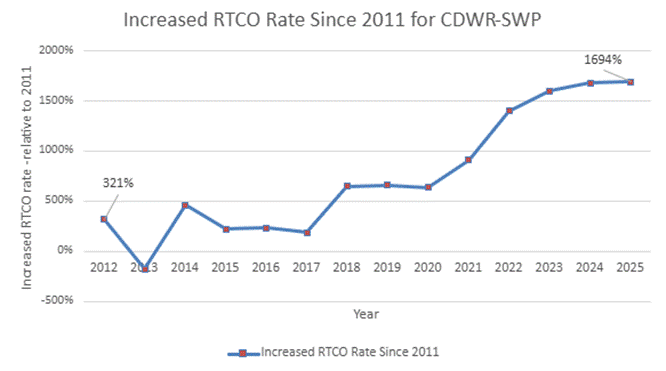
Figure 1: Increased RTCO Rate % Over the Years Compared to 2011 for CDWR-SWP
Furthermore, the Department of Market Monitoring (DMM) 2025 Q3 report[1] aligns with the market design issue proposed by CDWR-SWP within this 2026 Market Policy catalog that the RTCO costs incurred by LSE’s have indeed been increasing within the past few years, as seen in the figure below:
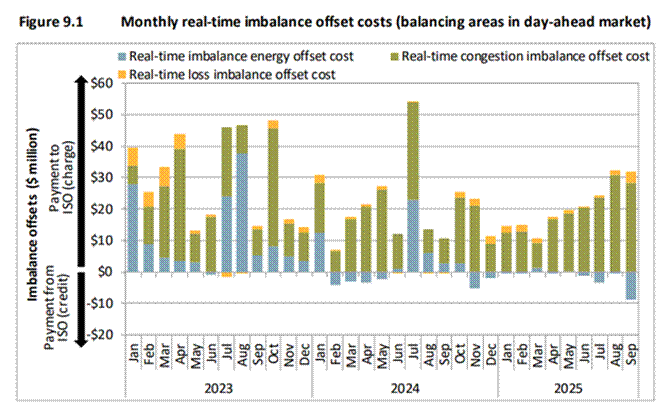
Figure 2: Increasing RTCO Charges at the CAISO Level2
[1] Department of Market Monitoring, “2025 Q3 Report on Market Issues and Performance.” Page 98, Figure 9.1, 2025-third-quarter-report-on-market-issues-and-performance.pdf
11.
Proposed Initiative Description: Discuss the scope of the proposed initiative. What specific elements of existing ISO market design does your initiative propose to address?
Based on Figure 2 from the DMM and Figure 1 from CDWR-SWP, it is evident that RTCO remains a consistent escalating charge to CDWR-SWP and other LSEs. CDWR-SWP raised concerns on increasing RTCO costs (without any control measure in place to contain such costs) to highlight it as a major issue. It needs attention from CAISO to find a solution.
CDWR-SWP recommends CAISO initiate a new stakeholder process to discuss what can be done to transform the current RTCO into a true neutrality charge code that includes LSEs and that reverses the respective LSE’s Hour-Ahead (HA) and Real-Time (RT) congestion rents.
12.
Market Impact: To the extent possible, discuss any anticipated impacts to market efficiency or system reliability.
CDWR-SWP believes that the main objective of the RTCO settlement mechanism is to reverse the HA and RT congestion rents collected from a market participant. However, the RTCO charge code does not provide the CAISO stated neutrality by including additional larger charges than the reverse of the HA and RT congestion rents collected from the market participants[1].
[1] Department of Market Monitoring, “2024 Q1 Report on Market Issues and Performance.” Page 50, Section 1.9, 2024-first-quarter-report-on-market-issues-and-performance-oct-11-2024.pdf
13.
Timing and Urgency: Are there regulatory requirements for implementation dates, or time-sensitive reliability impacts? Are there consequences to not addressing this issue?
CDWR-SWP observes that not addressing this issue has led to higher RTCO charges over time for impacted LSEs, and CDWR-SWP believes that postponing the issue will result in continued increased charges to LSEs.
Further investigations by CAISO will identify the severity of impacts to market participants in the past and potential impacts in the future with the current RTCO construct.
14.
Data: Identify existing data and missing data needed to analyze the issue and develop solutions.
Existing data:
- RTCO data from 2011 – 2025.
Missing data:
- Reasons for spikes in the RTCO observed in 2021 and 2022 and increasing magnitude of RTCO costs from 2011 until 2025.
- Models for future market impacts analysis
15.
Submission title
Transmission Access Charge (TAC) Structure Enhancements
16.
Has this issue previously been submitted? If yes, please provide a reference.
Yes, this issue has been previously discussed through the CAISO Policy Initiative Process, where it received support from numerous stakeholders. It was subsequently formally submitted by stakeholders for further consideration, including the California Department of Water Resources' State Water Project (CDWR-SWP).
CAISO first initiated formal examination of potential changes to the Transmission Access Charge (TAC) beginning in 2015–2016, through the Transmission Access Charge Options Initiative and the Review Transmission Access Charge Wholesale Billing Determinant Initiative. Stakeholders expressed concerns that the existing purely volumetric TAC, assessed on each MWh of metered internal end-use load and exports, no longer reflected transmission system cost causation, given changes in system usage, increasing reliance on flexible resources, and growing divergence between energy consumption and contribution to coincident system peak.
Building on those efforts and to address stakeholder requests for a comprehensive review, CAISO launched the Transmission Access Charge Structure Enhancements Initiative in 2017 to conduct a comprehensive technical and policy evaluation of alternative TAC billing determinants. The initiative examined whether continued reliance on a volumetric-only charge appropriately aligned transmission cost recovery with the drivers of transmission investment and usage, and whether incorporating coincident peak demand and other non-energy-based factors could improve cost causation, equity among load-serving entities, and consistency with other CAISO cost allocation frameworks, including Resource Adequacy capacity obligations.
The initiative culminated in a Draft Final Proposal issued in September 2018, which recommended a hybrid TAC structure that would retain a volumetric component while introducing a demand-based element tied to the coincident system peak[1]. The proposal also evaluated whether the billing determinant for internal load should be modified to account for load offset by distributed energy resources, recognizing that behind-the-meter generation reduces volumetric energy consumption without necessarily reducing contribution to system peak or long-term transmission investment needs. CAISO’s analysis concluded that a hybrid approach would better align TAC recovery with transmission cost drivers, improve rate stability, and reduce cost shifts among transmission users.
The Draft Final Proposal reflected extensive stakeholder engagement and technical analysis and received broad support from a wide range of stakeholders, including CAISO’s Department of Market Monitoring, the California Public Utilities Commission, investor-owned utilities, municipal utilities, and customer and public power interests. Rather than advancing the proposal for Board consideration, CAISO placed the initiative on hold in late 2018 to prioritize the development and implementation of the Extended Day-Ahead Market (EDAM), citing the need to ensure consistent treatment of transmission cost recovery as the market footprint expanded. The initiative was neither rejected nor withdrawn, and no other policy initiative superseded it.
In the 2020 Final Policy Initiatives Catalog, the initiative was included under Section 5: Initiatives Currently Underway and Planned as a committed item, with anticipated Board consideration identified for 2020. The catalog description reiterated the technical scope of the initiative, including evaluation of whether the TAC should remain purely volumetric or incorporate other factors such as peak demand, and whether the internal load billing determinant should be modified to account for load offset by distributed energy resources[2]. CAISO stated that the Draft Final Proposal was complete but on hold pending policy development for the Extend Day-Ahead Markets to EIM Entities initiative to ensure consistent treatment of transmission cost recovery across an expanded market footprint.
In 2021, CAISO again carried TAC Structure Enhancements forward in the 2021 Policy Initiatives Catalog under Section 5: Initiatives Currently Underway and Planned, maintaining its committed status and continuing to describe the draft final proposal as complete but on hold pending policy development for the Extend Day-Ahead Markets to EIM Entities policy. CAISO’s Updated 2021–2023 Policy Initiatives Roadmap also listed TAC Structure Enhancements as a named roadmap item, demonstrating that CAISO continued to view the TAC billing determinant questions as a relevant and unresolved market policy design topic during this period, rather than as an issue that had been resolved on the merits.
Following this period, TAC Structure Enhancements was included in the 2022[3] and 2023[4] Policy Initiatives Catalogs, but was moved to Section 7: Discretionary Initiatives, under Section 7.1: Energy and Ancillary Services Markets. In these catalogs, CAISO continued to describe the initiative’s technical scope, whether the volumetric TAC structure should be retained or modified to include peak demand, and whether the billing determinant for internal load should be adjusted to account for load offset by distributed energy resources, and reiterated that the draft final proposal was complete and on hold pending policy development of the Extend Day-Ahead Markets to EIM Entities initiative.
Consistent with this designation, the TAC Structure Enhancements Initiative was not included in the Final 2022–2024 Policy Initiatives Roadmap, reflecting CAISO’s continued deferral of TAC structural changes while EDAM-related policy development was underway. Importantly, exclusion from the Roadmap did not reflect a substantive rejection of the Draft Final Proposal or a determination that the underlying cost causation issues had been resolved.
CAISO subsequently implemented a new submission-based process for the 2024 Annual Policy Initiatives Catalog and Roadmap, under which stakeholders were required to submit new or renewed proposals for CAISO consideration. The TAC Structure Enhancements Initiative was not submitted during that cycle and therefore did not appear in the 2024 Catalog. No technical reassessment of the Draft Final Proposal or its underlying cost causation analysis was conducted.
In 2025, CDWR-SWP submitted a proposal to revisit and restart the TAC Structure Enhancements Initiative, citing the continued relevance of the technical issues evaluated in the 2016–2018 process, including misalignment between volumetric charges and coincident peak demand and the increasing importance of load flexibility, demand response, and efficient use of existing transmission infrastructure. CAISO did not include the initiative in the 2025 Policy Initiatives Catalog[5] and instead routed it to the 2025–2026 Transmission Planning Process (TPP) as an infrastructure-related item. At the September 25, 2025, TPP stakeholder meeting, CAISO dismissed the proposal, stating that the issue had been considered in 2018, placed on hold to enable EDAM development, and that changes to the TAC structure were no longer necessary because behind-the-meter solar generation had stabilized. This dismissal did not include a technical reassessment of the Draft Final Proposal, nor did it address the initiative’s original focus on coincident peak demand, rate design, or cost allocation principles.
In December 2025, Joint Commenters representing CDWR-SWP, Bay Area Municipal Transmission Group (BAMx), and the State Water Contractors (SWC) submitted a joint letter to the CAISO Board of Governors and the WEM Governing Body requesting directions to CAISO staff to revive the TAC Structure Enhancements initiative through a transparent stakeholder process[6]. The Joint Commenters emphasized that the initiative had already undergone extensive technical analysis and stakeholder vetting during the 2016–2018 period, resulting in a Draft Final Proposal that was never presented for Board consideration, and that subsequent procedural deferrals did not constitute a substantive evaluation of whether the existing volumetric TAC remains aligned with transmission cost causation, coincident peak demand, or evolving system usage. In addition, CDWR-SWP and other Joint Commenters submitted detailed comments on the 2026-2028 Annual Policy Initiatives Roadmap[7], explaining that TAC Structure Enhancements raises fundamentally market policy questions related to rate design and cost allocation, rather than infrastructure planning issues, and therefore falls squarely within the scope of the Market Policy Catalog and Roadmap process. The Joint Commenters requested that CAISO initiate a dedicated stakeholder process to reassess the Draft Final Proposal in light of current system conditions, rather than relying on continued deferral or summary dismissal, to ensure that transmission cost recovery remains aligned with cost causation, market efficiency, and California’s evolving clean energy and load flexibility objectives.
While TAC-related items were noted as appropriate for the Infrastructure Policy process during the January 26, 2026, kick-off meeting, TAC Structure Enhancements fall into a gray area. The initiative is fundamentally about rate design and cost allocation, which are core market policy elements. For this reason, CDWR-SWP believes it is important to submit this proposal through both the Market Policy Catalog and Roadmap and Infrastructure Policy Catalog and Roadmap processes to ensure these considerations receive proper attention.
[1] “Modifications to TAC Structure: Hybrid Billing Determinant Proposal.” Transmission Access Charge Structure Enhancements Draft Final Proposal, September 2018, pp. 9-18, Section 7, https://stakeholdercenter.caiso.com/InitiativeDocuments/DraftFinalProposal-TransmissionAccessChargeStructureEnhancements.pdf
[2] CAISO, 2020 Final Policy Initiatives Catalog, “Section 5: Initiatives Currently Underway and Planned – Transmission Access Charge Structure Enhancements.” pp. 14, https://www.caiso.com/documents/2020finalpolicyinitiativescatalog.pdf
[3] CAISO, 2022 Revised Policy Initiatives Catalog, “Section 7.1.15: Discretionary Items - Transmission Access Charge Structure Enhancements.” pp. 18, https://stakeholdercenter.caiso.com/InitiativeDocuments/2022RevisedDraftPolicyInitiativesCatalog.pdf
[4] CAISO, 2023 Final Policy Initiatives Catalog, “Section 6.1.14: Discretionary Items - Transmission Access Charge Structure Enhancements.” pp. 26, https://stakeholdercenter.caiso.com/InitiativeDocuments/Final2023PolicyInitiativesCatalog.pdf
[5] CAISO, 2025 Annual Policy Initiatives Catalog, “Appendix B: Non-Catalog Items.” https://stakeholdercenter.caiso.com/InitiativeDocuments/Appendix-B-Non-Catalog-Items.xlsx
[6] Joint ISO Board of Governors and WEM Governing Body General Session, “Joint Public Comment Letter - Briefing on Policy Roadmap.” https://www.caiso.com/documents/joint-public-comment-letter-briefing-on-policy-roadmap-dec-2025.pdf
[7] CAISO, 2026-2028 Annual Policy Initiatives Roadmap, “Joint Commenters: Submitted on behalf of
California Department of Water Resources – State Water Project (CDWR), Bay Area Municipal Transmission Group (BAMx), and State Water Contractors (SWC).” https://stakeholdercenter.caiso.com/Comments/AllComments/efa23f79-fc99-4e24-ac86-eded29e74d06#org-338b2919-b344-43ed-a584-6cfe8f3c24d3
17.
Issue Description: Briefly provide a description of the market design issue that the proposed initiative is intended to address.
CDWR-SWP believes that TAC Structure Enhancements will address certain areas of market inefficiencies related to transmission usage and cost allocation, as previously identified by CAISO in the Draft Final Proposal for the 2018 TAC Structure Enhancements.
CAISO noted two fundamental issues: (1) how to measure transmission usage, and (2) where to measure it. Since 2001, CAISO has used a volumetric-only approach to allocating TAC costs. However, changes in California’s resource mix, load patterns, and the overall evolution of the electric system have reduced the effectiveness of this methodology in reflecting cost causation, system utilization, and the benefits of the transmission system.
CAISO concluded that a hybrid approach, combining both coincident peak-demand and volumetric measurements, better captures the transmission system's dual functions, energy delivery and capacity/reliability—while aligning cost allocation with the benefits users receive. The initiative therefore addresses the policy question of whether the current volumetric-only TAC methodology remains appropriate or should be enhanced to a hybrid framework that more accurately reflects usage, system benefits, and investment drivers.
CAISO determined that the existing volumetric-only Transmission Access Charge may no longer accurately reflect transmission cost causation or system utilization given significant changes in California’s resource mix, load patterns, and overall grid operations. CAISO therefore identified the need to reexamine both how transmission usage is measured and how transmission costs are allocated among users.
Based on this assessment, CAISO concluded that a hybrid TAC structure combining volumetric and coincident peak demand components would better align transmission cost recovery with the system’s energy delivery, capacity, and reliability functions. CAISO found that retaining a volumetric component continues to reflect energy-delivery benefits, while adding a peak-demand component better captures cost drivers associated with system peak conditions and reliability needs. Compared to a volumetric-only approach, a hybrid framework more accurately reflects transmission usage, cost drivers, and the benefits users receive from the transmission system.
18.
Proposed Initiative Description: Discuss the scope of the proposed initiative. What specific elements of existing ISO market design does your initiative propose to address?
The scope of the TAC Structure Enhancement initiative addresses several elements of the existing TAC assessments, as CAISO noted in the Draft Final Proposal for the 2018 TAC Structure Enhancements.
Through this initiative, CAISO would evaluate whether the existing transmission access charge billing determinant should be modified to reflect better customer utilization of, and benefits derived from the transmission system, including how load offset by distributed generation is treated. The initiative would also assess whether the current volumetric-only TAC structure accurately reflects the causation of transmission costs and customer benefits by examining alternative approaches, including demand-based, time-differentiated, volumetric, or hybrid billing structures.
19.
Market Impact: To the extent possible, discuss any anticipated impacts to market efficiency or system reliability.
CDWR-SWP believes that a Hybrid TAC with charges for both Volumetric and Peak Demand would impact on market efficiency and system reliability as follows:
- Utilities would increasingly move load away from Peak Demand to reduce transmission costs.
- Lowering Peak Demand would reduce the need for new transmission infrastructure development to accommodate increasing load forecasts.
- System Reliability would increase as less Peak Demand reduces the physical strain on current transmission lines, leading to decreased maintenance and replacement costs.
- Congestion would decrease and improve market efficiency.
20.
Timing and Urgency: Are there regulatory requirements for implementation dates, or time-sensitive reliability impacts? Are there consequences to not addressing this issue?
If the TAC Structure Enhancement initiative is not addressed in a timely manner, it could have direct economic implications for ratepayers and load-serving entities. Entities with flexible load profiles, in particular, may benefit from a Hybrid TAC structure that better reflects actual system usage and peak cost drivers. Delays in reform could therefore perpetuate cost allocation outcomes that do not fully align with evolving system conditions or policy direction.
21.
Data: Identify existing data and missing data needed to analyze the issue and develop solutions.
In the Draft Final Proposal for the TAC Structure Enhancements Initiative 2018, the CAISO provided background on prior and current transmission costs and forecasted different Hybrid TAC balances for estimated future costs through 2022[1]. The Draft Final Proposal is the latest, most thorough, and richest public data set and analysis that exists at this point focusing only on the CAISO Market. The review in the Proposal focuses on improving cost allocation to better reflect both energy delivery and reliability functions of the transmission system. The current volumetric-only approach is being evaluated against a hybrid billing determinant that combines volumetric (MWh) and peak demand (MW) measurements. To respond to question 7, CDWR-SWP has outlined the key design elements, analysis, and data sources from the Proposal:
Key design elements include:
- Splitting the High Voltage Transmission Revenue Requirement (HV-TRR) using a system-wide annual gross load factor.
- Using 12-month coincident peak (12CP) measurements for the demand component.
- Maintaining the point of measurement at the end-use customer meter.
The review uses multiple datasets and analytical methods to validate the hybrid approach:
- Data Sources:
- Historical hourly load data (2014–2017) and monthly coincident peaks for 12CP calculations.
- Filed annual HV-TRR values (e.g., $2.165 billion for 2017) and PTO-specific gross load forecasts.
- Analysis Performed:
- Load Factor Calculation: Determines the split between volumetric and demand charges based on average vs. peak load.
- Sensitivity Testing: Compares bifurcation ratios (40/60 to 60/40) and peak measurement frequencies (1CP, 4CP, 12CP).
- Historical Variability: Confirms low volatility (<3.5% variance) in annualized 12CP demand, supporting a one-year historic period without weather normalization.
The following figures give one example of the coincident peak measurement frequency scenario for a hybrid TRR split that is equally 50% volumetric and 50% peak demand. It looks at 11 utility areas in the CAISO BAA and for 2018 - 2022 forecasts their gross hybrid TAC payment amounts, the gross amount difference between those hybrid payments and the current TAC payments along with the percentage differences between them.

Figure 1: Proposed TAC Charges for California Utilities using Hybrid TRR Split
50% Volumetric – 50% Peak Demand[2]

Figure 2: Differences for California Utilities between Proposed Hybrid TAC and Existing TAC
in Dollars (top) and Percentages (bottom)[3]
Furthermore, it is important to review the implementation of a hybrid TAC in other markets by reviewing the rollouts, refinements, and impacts/benefits of the implementation. In the Issue Paper for Review Transmission Access Charge Structure Enhancements Initiative from 2017, the CAISO summarizes different approaches to transmission charges for the Independent System Operators (ISOs) and Regional Transmission Owners (RTOs) in the United States: CAISO, NYISO, MISO Multi Value Projects (MVPs), SPP Network Integration Transmission Service (NITS), ISO-NE NITS, MISO NITS, ERCOT (4 summer months), and PJM NITS[4].
Looking into how other markets have implemented hybrid TAC, seeing the impacts of changing their TACs, and updating the TAC data at this time shows a longer history of their implementation and would be informative for stakeholders and beneficial for further discussions. To respond to question 7, CDWR-SWP has outlined the key design elements and summary of other markets rates from the Paper:
Key design elements include:
- A very high-level overview of how transmission charges are structured in other ISOs and RTOs for network transmission service so that it is intelligible and useful for the scope of this initiative.
The review uses no datasets or analytical methods. CAISO says:
- “Providing a comprehensive discussion of every detail of their rate designs would span hundreds of pages.”
- “Different ISOs/RTOs may provide different market services (e.g., network integration service, firm point-to-point service, non-firm service), so a direct apples-to-apples comparison with the CAISO is challenging.”
- “These challenges are compounded by highly varying terms and definitions used in the various RTOs.”
The Figure 3. Summary of ISO/RTO approaches to transmission charges has a breakdown to compare the Volumetric ISO/RTOs and the Demand ISO/RTOs:
- The basis of the charge.
- Either a Volumetric charge of MWh/Gross Load, or a Demand Charge which is divided into Monthly peak, Annual peak, or Variable.
- Examples of the ISO/RTOs that use each type of basis.
- Network Integration Transmission Service (NITS) allows an electric transmission customer to integrate, plan, economically dispatch and regulate its network reserves in a manner comparable to that in which the Transmission Owner serves Native Load customers.
- Multi Value Projects (MVPs) are regional transmission projects designed to support public policy, provide economic value, or provide economic value and reliability.
- The Intent of the charges.
- Correlation with either beneficiaries for Volumetric charge or cost causation for demand charge
- The Pros of using the different types of charges.
- The Cons of using the different types of charges.
The Figure 3. Summary of ISO/RTO approaches to transmission charges separates the ISO/RTOs based on whether they use a Volumetric charge of MWh/Gross Load, or a Demand Charge which is divided into Monthly peak, Annual peak, or Variable.

Figure 3: Summary of ISO/RTO Approaches to Transmission Charges[5]
[1] “Appendix B – Hybrid billing determinant proposal TAC cost impact modeling analysis with
additional sensitivities.” Transmission Access Charge Structure Enhancements Draft Final Proposal, September 2018, pp. 51, https://stakeholdercenter.caiso.com/InitiativeDocuments/DraftFinalProposal-TransmissionAccessChargeStructureEnhancements.pdf
[2] “Coincident Peak measurement frequency scenarios Scenario: 12CP frequency (12 demand measurements, Hybrid TRR split: 50% Volumetric - 50% Peak Demand) Proposed TAC Charge for Hybrid - Gross Load ($ million).” Transmission Access Charge Structure Enhancements Draft Final Proposal, September 2018, pp. 52, Appendix B, https://stakeholdercenter.caiso.com/InitiativeDocuments/DraftFinalProposal-TransmissionAccessChargeStructureEnhancements.pdf
[3] “Coincident Peak measurement frequency scenarios Scenario: 12CP frequency (12 demand measurements, Hybrid TRR split: 50% Volumetric - 50% Peak Demand) Difference between Proposed TAC Charge and Existing TAC Charge ($).” Transmission Access Charge Structure Enhancements Draft Final Proposal, September 2018, pp. 53, Appendix B, https://stakeholdercenter.caiso.com/InitiativeDocuments/DraftFinalProposal-TransmissionAccessChargeStructureEnhancements.pdf
[4] “Section 4: Structure of transmission cost recovery in other ISOs/RTOs.” Review Transmission Access Charge Structure Enhancements Issue Paper, June 2017, pp. 12–18, https://stakeholdercenter.caiso.com/InitiativeDocuments/IssuePaper-ReviewTransmissionAccessChargeStructure.pdf
[5] “Table 2. Summary of ISO/RTO approaches to transmission charges.” Review Transmission Access Charge Structure Enhancements Issue Paper, June 2017, pp. 18, Section 4, https://stakeholdercenter.caiso.com/InitiativeDocuments/IssuePaper-ReviewTransmissionAccessChargeStructure.pdf
California Public Utilities Commission
Submitted 03/02/2026, 04:13 pm
1.
Submission title
Liquidity of bilateral indices used in FERC Order 831 implementation
2.
Has this issue previously been submitted? If yes, please provide a reference.
Staff of the California Public Utilities Commission in the Energy Division (ED Staff or Staff)[1] submitted a proposal in 2024 with the same title.
CAISO did not select this initiative for consideration. In Appendix B, 2024 Final Dispositions of CAISO’s Policy Initiative Roadmap, CAISO explained:
The ISO is not considering changes to the bilateral price indices used in the CAISO market at this time. The ISO will continue to use the best available bilateral price indices meeting Federal Energy Regulatory Commission liquidity requirements. Interested parties may resubmit alternative indices to the ISO in the 2025 Catalog process.[2]
CAISO proposed relying on bilateral indices in the initiative “FERC Order 831 – Import bidding and market parameters.”[3] Energy Division Staff recommends revisiting the issue given the illiquidity of the bilateral indices and the removal of the WECC soft offer bid cap.
[1] More information about the CPUC Energy Division is available at: https://www.cpuc.ca.gov/about-cpuc/divisions/energy-division.
[2] Appendix B of the 2024 Final CAISO Policy Initiatives Roadmap, December 12, 2024, available at: https://stakeholdercenter.caiso.com/InitiativeDocuments/Appendix-B-2024-Final-Dispositions.xlsx.
[3] Available at: https://stakeholdercenter.caiso.com/StakeholderInitiatives/FERC-Order-831-Import-bidding-and-market-parameters.
3.
Issue Description: Briefly provide a description of the market design issue that the proposed initiative is intended to address.
ED Staff recommends CAISO consider alternatives to the bilateral indices for determining whether to allow the maximum import bid price to surpass $1,000/MWh in the CAISO markets. As discussed further below, the bilateral indices are often determined based on as few as 5 trades. With more participants entering EDAM and the launch of SPP Markets +, there will be fewer trades in the bilateral markets. Further, on February 19, 2026, FERC removed the WECC soft offer bid cap.[1] Suppliers will no longer be required to submit cost justifications to FERC for prices above $1,000/MWh, and will no longer risk being required to issue refunds if FERC finds the costs above the soft offer bid cap were not justified. ED Staff is concerned that this will enable more instances where prices in the bilateral markets surpass $1,000/MWh.
Additionally, certain penalties, like the penalty for failing the Resource Sufficiency Evaluation (RSE) are tied to prices in the bilateral indices. ED Staff recommends CAISO consider alternatives in order to protect EDAM customers from unnecessarily high and inefficient prices. As an initial idea, the alternative methodology could be based on some mark-up over prices in the CAISO markets.
FERC Order 831 Implementation and the Liquidity of Bilateral Indices.
CAISO previously held an initiative to address FERC Order 831 which led to tariff revisions.[2] In its tariff filing, CAISO noted that the Palo Verde bilateral index met CAISO’s liquidity criteria, but noted that it would evaluate the indices periodically, as noted below:
The FERC’s current liquidity policy for daily or hourly indices requires that at least one of the following conditions should be met, on average, for all non-holiday weekdays within a 90-day review period:
- Average daily volume traded of at least 25,000 MMBtus for gas or 2,000 MWh for power;
- Average daily number of transactions of five or more; or
- Average daily number of counterparties of five or more.
The CAISO analyzed both hubs under these criteria at the time of this filing. The Mid-Columbia index had, across non-holiday weekdays within the 90- day review period, an average of 11,000 MWh, 23 transactions, and 8 counterparties per day. Palo Verde had an average of 2,700 MWh and 5 transactions per day. Based on the analysis, at least one criterion for each hub meets or exceeds the Commission’s established criteria. Therefore, the Mid-Columbia and Palo Verde hubs can be considered sufficiently liquid and appropriate for use in the CAISO’s tariff and calculated parameters. The CAISO notes that these levels of liquidity also would satisfy the Commission’s proposed revised liquidity criteria. In any case, the CAISO will evaluate these indices periodically to ensure they remain sufficiently liquid. In the event they become insufficiently liquid, the CAISO will re-evaluate these tariff provisions. (emphasis added)[3]
In this evaluation, CAISO was looking at the published indices, however, in its implementation, CAISO does not use published indices for establishing the maximum import bid prices, but the index prices that are available at 10 am. These transactions could be far less than the number of published transactions. In particular, although the tariff states that at the maximum import bid price is calculated as “110 percent of the greater of the published bilateral index pries for the Mid-Columbia or Palo Verde trading hub locations, multiplied by the hourly shaping factor,” the Business Practice Manual for Market Instruments, Appendix P, uses the transactions that are available, as explained in footnote 97:
For the DAM calculation, the day-ahead electric hub index prices are a snapshot of the volume weighted average electric hub prices from the Intercontinental Exchange (ICE). The CAISO captures these prices on non-holiday weekdays between 8 AM – 9 AM Pacific Time. If the ICE electric hub prices are not available between 8 AM – 9 AM Pacific Time for the DAM calculation for any reason, the CAISO will use the most recently available price. For the RTM calculation, the day-ahead electric hub index prices are obtained from the settled volume weighted average electric hub prices from ICE, available the evening prior to the trade date.[4] (Emphasis added).
Thus, Energy Division Staff requests CAISO examine the liquidity of the indices, at the time that these snapshots occur. Given that the Palo Verde index in some cases only has 5 transactions on average (as reported by CAISO in its tariff filing) and that CAISO is taking a snapshot between 8 and 9 am, CPUC staff are concerned about the liquidity of the index at the time of the snapshot.
When the maximum import bid price is above $1,000/kWh, it allows the bid cap to double from $1,000/MWh to $2,000/MWh and, thus, has a profound impact on the outcome of market runs. Further, CPUC Staff suggest that the lack of liquidity and the ability for a small number of entities to potentially manipulate this figure, provides sufficient grounds for CAISO to explore this issue further.
[1] FERC Order on Section 206 Proceeding, Docket No. EL10-56-000, February 19, 2026, available at: https://www.ferc.gov/media/e-2-el10-56-000.
[2] CAISO’s cover letter to its FERC filing “Tariff Amendment to Enhance Market Parameters and Import Bidding Related to Order No. 831,” FERC Docket ER21-1192, page 22, available at: https://www.caiso.com/Documents/Feb22-2021-TariffAmendment-PricingParameters-OrderNo831-ER21-1192.pdf.
[3] Id. at 22. Footnotes omitted.
[4] CAISO’s Business Practice Manual for Market Instruments, Section P.2, page 486, available at: https://bpmcm.cafiso.com/BPM%20Document%20Library/Market%20Instruments/BPM_for_Market%20Instruments_V84_Clean.doc.
4.
Proposed Initiative Description: Discuss the scope of the proposed initiative. What specific elements of existing ISO market design does your initiative propose to address?
ED Staff recommends CAISO examine the liquidity of the bilateral indices and consider alternatives for determining whether to allow the maximum import bid price to surpass $1,000/MWh in the CAISO markets. The bilateral indices are often determined based on as few as 5 trades. With more participants entering EDAM and the launch of SPP Markets +, there will be fewer trades in the bilateral markets. Further, FERC removed the WECC soft offer bid cap,[1] and suppliers will no longer be required to submit cost justifications to FERC for prices above $1,000/MWh.
Additionally, certain penalties, like the penalty for failing the Resource Sufficiency Evaluation (RSE) are tied to prices in the bilateral indices. ED Staff recommends CAISO consider alternatives in order to protect EDAM customers from unnecessarily high and inefficient prices. As an initial idea, the alternative methodology could be based on some mark-up over prices in the CAISO markets.
[1] FERC Order on Section 206 Proceeding, Docket No. EL10-56-000, February 19, 2026, available at: https://www.ferc.gov/media/e-2-el10-56-000
.
5.
Market Impact: To the extent possible, discuss any anticipated impacts to market efficiency or system reliability.
Market efficiency will increase because the CAISO would no longer rely on a thinly traded market to determine the maximum import bid price.
6.
Timing and Urgency: Are there regulatory requirements for implementation dates, or time-sensitive reliability impacts? Are there consequences to not addressing this issue?
Given the importance of markets free of any undue influence, CPUC Staff believe that this issue is time-sensitive. The potential consequence of not addressing this is that an illiquid bilateral market, potentially subject to manipulation given the small number of trades at Palo Verde, could unduly and profoundly affect market clearing prices.
7.
Data: Identify existing data and missing data needed to analyze the issue and develop solutions.
CAISO staff would need to provide data on the trades that are used in the “snapshot” for the greater of the Palo Verde or Mid-C bilateral price indices that are used in calculating the maximum import bid prices, which affect whether the bid cap is raised from $1,000/MWh to $2,000/MWh.
8.
Submission title
EDAM and DAME Assessment
9.
Has this issue previously been submitted? If yes, please provide a reference.
ED Staff has not previously submitted this topic.
10.
Issue Description: Briefly provide a description of the market design issue that the proposed initiative is intended to address.
ED Staff recommends CAISO consider assessing and potentially re-evaluating various aspects of EDAM and DAME such as:
- Whether the net export constraint is working as intended and, if not, whether additional enhancements are necessary;
- Whether there are any issues with low-priority exports and any adverse effects on the reliability in the CAISO market - e.g., low priority export e-tags are approved upon submission, but are infeasible low priority exports withdrawing e-tags in a timely fashion and, if not what fixes should be considered both in the day-ahead and Hour Ahead Scheduling Process (HASP)?
- Whether the DAME imbalance reserves and reliability capacity products are working as intended and whether the benefits are greater than the potential costs, including but not limited to consideration of:
- The level of the imbalance reserve requirements and whether different levels should be set at different times of the year or times of the day;
- The requirements for resources to qualify to provide imbalance reserves (e.g., 15 minute start-up and the 30 minute dispatchable quantity used);
- The level of all five configurable parameters;
- Whether the imbalance reserves are needed and used in real-time;
- Whether the demand curve is appropriately set;
- Whether the GHG factor is working as intended;
- Whether the new design is affecting participation of virtual resources and what effect this may have on the market.
11.
Proposed Initiative Description: Discuss the scope of the proposed initiative. What specific elements of existing ISO market design does your initiative propose to address?
This initiative is intended to address all of the new products introduced as a result of EDAM and DAME and assess whether the new designs provide the efficiency and reliability that were expected as a result of the market redesign and consider changes, if necessary.
12.
Market Impact: To the extent possible, discuss any anticipated impacts to market efficiency or system reliability.
The purpose of the initiative would be to assess the impacts to market efficiency and system reliability and, if there any issues, to address them expeditiously so that efficiency and reliability are achieved.
13.
Timing and Urgency: Are there regulatory requirements for implementation dates, or time-sensitive reliability impacts? Are there consequences to not addressing this issue?
This issue is time sensitive given the issues seen in market simulation and parallel operations.
14.
Data: Identify existing data and missing data needed to analyze the issue and develop solutions.
The data needed would be from market simulation, parallel operations, and go-live as well as a number of scenario assessments (e.g., the impacts on the imbalance reserves and reliability capacity procurement and prices of various levels of procurement).
15.
Submission title
16.
Has this issue previously been submitted? If yes, please provide a reference.
17.
Issue Description: Briefly provide a description of the market design issue that the proposed initiative is intended to address.
18.
Proposed Initiative Description: Discuss the scope of the proposed initiative. What specific elements of existing ISO market design does your initiative propose to address?
19.
Market Impact: To the extent possible, discuss any anticipated impacts to market efficiency or system reliability.
20.
Timing and Urgency: Are there regulatory requirements for implementation dates, or time-sensitive reliability impacts? Are there consequences to not addressing this issue?
21.
Data: Identify existing data and missing data needed to analyze the issue and develop solutions.
NextEra Energy Resources
Submitted 02/25/2026, 09:49 am
1.
Submission title
Streamlined Augmentation of Operational Batteries
2.
Has this issue previously been submitted? If yes, please provide a reference.
No.
3.
Issue Description: Briefly provide a description of the market design issue that the proposed initiative is intended to address.
NextEra Energy Resources, LLC (“NextEra Energy Resources”), appreciates the opportunity to submit a policy proposal into the 2026 Infrastructure Policy Catalog. NextEra Energy Resources proposes a process change related to “augmentation” of operational battery storage resources that would not subject these actions to the CAISO’s material modification amendment (MMA) process if conditions are met. This change would reduce unnecessary administrative burden for routine maintenance activities while improving grid reliability for CAISO ratepayers by helping ensure that necessary battery augmentations are completed on schedule.
“Augmentation” in this proposal refers to the addition of new power conversion systems (PCS) and new battery containers to an operational project, necessary to maintain the originally-contracted capacity for all lithium ion-based battery storage resources, which experience natural capacity degradation over time. Augmentations are routine maintenance actions that do not increase the power output at the Point of Interconnection (POI). Battery storage operators plan for several (generally at least four) augmentations throughout a typical battery storage project’s contract.
The CAISO’s MMA process currently assesses augmentations using the same process as any other proposed modification, despite the by-definition limited scope of these maintenance actions. NextEra Energy Resources believes this creates an administrative burden for the CAISO and creates potential delays for routine battery storage maintenance. With the increased deployment of contracted battery storage on the CAISO grid, the CAISO is expected to become increasingly burdened with augmentation requests, since each operational battery energy storage resource expects at least four augmentations over the duration of a typical energy storage contract.
NextEra Energy Resources proposes a streamlined notification and approval process allowing battery storage operators to provide 12-month advance notice of planned augmentations to the CAISO, with technical documentation demonstrating compliance with existing interconnection requirements, thereby enabling timely capacity maintenance without compromising grid reliability or interconnection standards and sustaining dependable capacity for the benefit of CAISO ratepayers.
4.
Proposed Initiative Description: Discuss the scope of the proposed initiative. What specific elements of existing ISO market design does your initiative propose to address?
NextEra Energy Resources believes the proposed initiative impacts Section 6.5.5.2 of the Business Practice Manual for Generator Management, with the proposed changes allowing for the approval of augmentations via a streamlined process, distinct from the existing MMA process. NextEra Energy Resources does not believe that a corresponding tariff change is required given that an augmentation operation that complies with the proposed requirements would be deemed to not change the electrical characteristic of the resource in such a way as to violate any Applicable Reliability Criteria.
The scope of NextEra Energy Resources’ proposal would establish that operational battery storage resources seeking augmentation shall be deemed immaterial by default and not subject to the full MMA process under the circumstance of adding inverters and/or PCS to maintain original capacity, without any increases to the POI injection capacity, if executed within a set of requirements, detailed below.
In order to qualify for the streamlined process, the following conditions must be met:
- The battery storage resource must be operational. Any battery storage resource that is not yet operational will continue to follow the processes laid out in CAISO Tariff Appendix DD or Appendix KK.
- The Interconnection Customer (IC) must provide a 12-month advance notice before the planned augmentation in-service date, with a final 60-day notice of the intended synchronization date or window
- The IC shall provide engineering design documentation that the new inverters will comply with the resource’s existing LGIA Appendix H requirements, demonstrate the presence of an existing adequate control scheme to limit power injection to the POI limit, confirm reactive power capability, and provide updated load flow and dynamic models
- The combined incremental short circuit fault current contribution from the new inverters shall be less than 100 Amps per augmentation action at the POI • Documentation of commissioning testing results may be requested by the Participating Transmission Owner, with documentation requested within 90 days of placing the new equipment in service
- The battery storage resource’s LGIA shall be updated after the completion of the augmentation action to reflect to the updated configuration
The battery operator will be permitted to proceed upon notification to the CAISO of an upcoming augmentation action and the submittal of the required documentation. NextEra Energy Resources believes this approach will maintain the interconnection standards while establishing a standardized process for battery storage maintenance.
5.
Market Impact: To the extent possible, discuss any anticipated impacts to market efficiency or system reliability.
This streamlined process recognizes California’s accelerated interconnection of battery storage resources onto the grid. Battery storage capacity grew from about 500 MW in 2020 to 13,000 MW in December 2024.1 Battery storage resources experience capacity degradation due to repeated charge/discharge cycling in addition to steady-state degradation that is independent of cycling. The resource’s output can be maintained by augmentations over the duration of their energy storage contracts. Without a streamlined process, the CAISO’s queue management team is expected to receive a continually increasing volume of MMAs to augment battery storage resources, clogging the MMA queue for requests that may have material impacts on the system. The current MMA process creates time and execution barriers to properly maintain battery storage and may cause battery storage to underproduce during real time operations.
1 CAISO. 2024 Special Report on Battery Storage. May 29, 2025. Available at: https://www.caiso.com/documents/2024-special-report-on-battery-storage-may-29-2025.pdf
6.
Timing and Urgency: Are there regulatory requirements for implementation dates, or time-sensitive reliability impacts? Are there consequences to not addressing this issue?
As noted above, the CAISO’s battery storage fleet is increasing and maturing. Without a streamlined process, there will be an influx of MMAs that are administrative by nature that may cause delays in proper maintenance of the battery storage resources, potentially reducing the effective battery storage capacity on the grid. Timely augmentation is essential to maintain contracted capacity levels. Without it, battery storage resources may underdeliver, creating resource adequacy gaps as Load Serving Entities' procurement plans assume full contract performance that cannot be achieved with degraded assets. Ensuring that routine augmentations can proceed without unnecessary administrative delay will help preserve dependable capacity on the CAISO grid, support system reliability, and protect ratepayers from the costs and risks associated with unexpected resource adequacy shortfalls.
7.
Data: Identify existing data and missing data needed to analyze the issue and develop solutions.
NextEra Energy Resources believes CAISO has all the existing data to help CAISO identify the magnitude of the issue, including:
- Operational battery storage Megawatts (MWs) within CAISO system
- Battery storage MWs within the CAISO interconnection queue and their CODs
- Appendix H requirements
- Manufacturer specifications for inverter/PCS capabilities
- MMA Processing Timeline
- Past MMA submissions related to battery storage augmentation project
8.
Submission title
9.
Has this issue previously been submitted? If yes, please provide a reference.
10.
Issue Description: Briefly provide a description of the market design issue that the proposed initiative is intended to address.
11.
Proposed Initiative Description: Discuss the scope of the proposed initiative. What specific elements of existing ISO market design does your initiative propose to address?
12.
Market Impact: To the extent possible, discuss any anticipated impacts to market efficiency or system reliability.
13.
Timing and Urgency: Are there regulatory requirements for implementation dates, or time-sensitive reliability impacts? Are there consequences to not addressing this issue?
14.
Data: Identify existing data and missing data needed to analyze the issue and develop solutions.
15.
Submission title
16.
Has this issue previously been submitted? If yes, please provide a reference.
17.
Issue Description: Briefly provide a description of the market design issue that the proposed initiative is intended to address.
18.
Proposed Initiative Description: Discuss the scope of the proposed initiative. What specific elements of existing ISO market design does your initiative propose to address?
19.
Market Impact: To the extent possible, discuss any anticipated impacts to market efficiency or system reliability.
20.
Timing and Urgency: Are there regulatory requirements for implementation dates, or time-sensitive reliability impacts? Are there consequences to not addressing this issue?
21.
Data: Identify existing data and missing data needed to analyze the issue and develop solutions.
Pacific Gas & Electric
Submitted 03/02/2026, 04:28 pm
1.
Submission title
2028 EDAM Review
2.
Has this issue previously been submitted? If yes, please provide a reference.
No
3.
Issue Description: Briefly provide a description of the market design issue that the proposed initiative is intended to address.
As with the introduction and enhancements in the early days of the EIM, EDAM is a new market that is expected to rapidly evolve both in terms of participation and market design. In the current Policy Roadmap, the CAISO has budgeted time for urgent EDAM Enhancements. Similarly, we believe CAISO should budget time for a more comprehensive evaluation of EDAM, to ensure all of its novel mechanisms are working as intended.
PG&E encourages CAISO to develop a set of success metrics and to initiate an initial evaluation of EDAM performance. How will we know if EDAM is working well and what data would reveal room for improvement? Stakeholders should have an opportunity to review both qualitative and quantitative metrics of market performance against pre-go live status quo and counterfactual scenarios (WEIM only), and to provide feedback as to whether the new market is living up to expectations. PG&E anticipates that this review will help inform the development and prioritization of EDAM Enhancements and other Roadmap priorities from that point forward.
4.
Proposed Initiative Description: Discuss the scope of the proposed initiative. What specific elements of existing ISO market design does your initiative propose to address?
As discussed above, the 2028 EDAM Review is intended to inform stakeholders as to how the EDAM design has performed. There is currently a series of “known unknowns” heading into go live, as well as an expectation of further “unknown unknowns” that will be encountered in early operations, especially as the number of market participants grows. The initiative is intended to provide a useful checkpoint, to ensure that early performance issues are flagged and any course corrections identified for future EDAM Enhancements (which are already contemplated in the Roadmap).
5.
Market Impact: To the extent possible, discuss any anticipated impacts to market efficiency or system reliability.
There are no immediate impacts to market efficiency or system reliability.
6.
Timing and Urgency: Are there regulatory requirements for implementation dates, or time-sensitive reliability impacts? Are there consequences to not addressing this issue?
The timing is driven by early experience of EDAM operation. Importantly, the ultimate success of EDAM hinges upon maintaining and attracting widespread participation. It is therefore critical that CAISO address and correct issues that arise with the initial design. The EDAM Review will allow stakeholders an opportunity to identify and discuss concerns, and to prioritize the next set of EDAM Enhancements.
7.
Data: Identify existing data and missing data needed to analyze the issue and develop solutions.
As discussed above, PG&E expects that CAISO will collect a wide range of market performance data in order to compare the EDAM experience against benchmarks of pre-go live and perhaps counterfactual scenarios (WEIM only).
8.
Submission title
Ancillary Services Real-time Re-optimization
9.
Has this issue previously been submitted? If yes, please provide a reference.
No
10.
Issue Description: Briefly provide a description of the market design issue that the proposed initiative is intended to address.
CAISO currently has the capability to procure incremental AS in the FMM if it is short of sufficient capacity to meet an AS requirement. This initiative would expand the re-procurement process to include co-optimization of real time ancillary service and energy bids, allowing buyback of day ahead ancillary service awards when other supply is available to meet requirements.
11.
Proposed Initiative Description: Discuss the scope of the proposed initiative. What specific elements of existing ISO market design does your initiative propose to address?
Elements of ancillary service re-optimization should include: rules for bidding/re-bidding, limitations, horizon over which procurement can be re-optimized, re-settlements processes, determination of whether re-optimization can make use of current real time market processes or requires changes to those processes, and a determination of whether existing real time market constraints (e.g., ASSOC constraints, regulation attenuation factor SOC constraints, imbalance reserve and reliability capacity envelope constraints) can be modified or eliminated based on ancillary service re-optimization.
12.
Market Impact: To the extent possible, discuss any anticipated impacts to market efficiency or system reliability.
Re-optimization may be particularly beneficial for energy-constrained resources such as hydro and battery storage, and may allow heuristic fixes constraining battery storage operations (e.g., ASSOC constraint dispatch and even use of attenuation and envelope factors as storage buffers) to be eliminated or their use reduced, as well as to encourage more efficient solutions to ancillary service provision across the market footprint.
13.
Timing and Urgency: Are there regulatory requirements for implementation dates, or time-sensitive reliability impacts? Are there consequences to not addressing this issue?
The proposed initiative is intended to increase the efficiency of real time procurement and dispatch. It may also facilitate a uniform market for ancillary services across balancing areas.
14.
Data: Identify existing data and missing data needed to analyze the issue and develop solutions.
Analysis should at a minimum identify potential efficiency and feasibility benefits based on historical data. If possible, future efficiency benefits should be estimated.
15.
Submission title
16.
Has this issue previously been submitted? If yes, please provide a reference.
17.
Issue Description: Briefly provide a description of the market design issue that the proposed initiative is intended to address.
18.
Proposed Initiative Description: Discuss the scope of the proposed initiative. What specific elements of existing ISO market design does your initiative propose to address?
19.
Market Impact: To the extent possible, discuss any anticipated impacts to market efficiency or system reliability.
20.
Timing and Urgency: Are there regulatory requirements for implementation dates, or time-sensitive reliability impacts? Are there consequences to not addressing this issue?
21.
Data: Identify existing data and missing data needed to analyze the issue and develop solutions.
PacifiCorp
Submitted 03/02/2026, 01:35 pm
1.
Submission title
Imbalance reserve product enhancements.
2.
Has this issue previously been submitted? If yes, please provide a reference.
No. While the Imbalance Reserve Product was approved as part of the Day-Ahead Market Enhancements (DAME) and the Extended Day-Ahead Market (EDAM) design, this initiative would focus on post-implementation performance evaluation and refinements based on operational experience after EDAM go-live.
3.
Issue Description: Briefly provide a description of the market design issue that the proposed initiative is intended to address.
The imbalance reserve product was designed to address uncertainty between the day-ahead and real-time markets by reserving flexible capacity to manage net load forecast error. With the launch of the EDAM, stakeholders will gain the first operational evidence on how this product performs across a broader, multi-balancing-authority footprint. Early EDAM operations are expected to provide new insights into whether imbalance reserves are appropriately sized, efficiently priced, and effectively utilized in real-time. In particular, observed outcomes may show that the level of reserves needed varies across hours and system conditions, creating an opportunity for targeted refinements based on actual operating experience.
4.
Proposed Initiative Description: Discuss the scope of the proposed initiative. What specific elements of existing ISO market design does your initiative propose to address?
The initiative could use data from the EDAM to understand whether the imbalance reserve product is meeting the goals of the Day-Ahead Market Enhancements initiative. The scope could include, but not be limited to:
- How often imbalance reserve capacity awarded in the day-ahead market is actually dispatched as energy in real-time.
- Whether imbalance reserve capacity awarded in the day-ahead market is available to be dispatched in real-time when needed.
- Analysis of imbalance reserve costs, including allocation of costs to load and payments to providing resources.
- Review of the interaction between imbalance reserves and market operator load adjustments, including changes in the frequency and magnitude of adjustments following EDAM implementation.
- Examination of uplift costs and RUC commitments associated with operator load adjustments before and after EDAM go-live.
- Consideration of whether the percentile-based uncertainty coverage (e.g., 97.5th percentile) is appropriate for all hours, or whether alternative approaches could better reflect time-varying uncertainty and available WEIM diversity.
This initiative proposal is to focus on identifying targeted refinements rather than fundamental redesign, with the goal of improving efficiency while preserving reliability.
5.
Market Impact: To the extent possible, discuss any anticipated impacts to market efficiency or system reliability.
If enhancements are identified, the initiative has the potential to improve market efficiency by better aligning imbalance reserve procurement with actual system needs in addition to reducing unnecessary costs to load and holding back capacity that BAAs may need to plan for during peak conditions. More accurate sizing and pricing of imbalance reserves could improve price signals, reduce uplift, and increase confidence in day-ahead schedules. At the same time, maintaining or improving system reliability would remain a core objective, ensuring that sufficient flexibility is available to manage real-time uncertainty.
6.
Timing and Urgency: Are there regulatory requirements for implementation dates, or time-sensitive reliability impacts? Are there consequences to not addressing this issue?
There is no time-sensitivity at this stage. However, urgency may arise shortly after EDAM go-live if imbalance reserve costs are materially higher than expected or if stakeholders observe limited real-time utilization of procured reserves. Concerns have already been raised by market participants and regulators regarding the potential cost impacts of imbalance reserves, suggesting value in initiating this work early in the 2027–2029 roadmap period.
7.
Data: Identify existing data and missing data needed to analyze the issue and develop solutions.
Existing data expected to be available includes:
- Day-ahead imbalance reserve awards by resource, location, and hour.
- Real-time dispatch outcomes for resources awarded imbalance reserves.
- Real-time net load deviations relative to day-ahead forecasts.
- Imbalance reserve clearing prices and total procurement costs.
- RUC commitment, uplift, and market operator load adjustment data.
8.
Submission title
9.
Has this issue previously been submitted? If yes, please provide a reference.
10.
Issue Description: Briefly provide a description of the market design issue that the proposed initiative is intended to address.
11.
Proposed Initiative Description: Discuss the scope of the proposed initiative. What specific elements of existing ISO market design does your initiative propose to address?
12.
Market Impact: To the extent possible, discuss any anticipated impacts to market efficiency or system reliability.
13.
Timing and Urgency: Are there regulatory requirements for implementation dates, or time-sensitive reliability impacts? Are there consequences to not addressing this issue?
14.
Data: Identify existing data and missing data needed to analyze the issue and develop solutions.
15.
Submission title
16.
Has this issue previously been submitted? If yes, please provide a reference.
17.
Issue Description: Briefly provide a description of the market design issue that the proposed initiative is intended to address.
18.
Proposed Initiative Description: Discuss the scope of the proposed initiative. What specific elements of existing ISO market design does your initiative propose to address?
19.
Market Impact: To the extent possible, discuss any anticipated impacts to market efficiency or system reliability.
20.
Timing and Urgency: Are there regulatory requirements for implementation dates, or time-sensitive reliability impacts? Are there consequences to not addressing this issue?
21.
Data: Identify existing data and missing data needed to analyze the issue and develop solutions.
The Energy Authority
Submitted 03/02/2026, 09:22 am
1.
Submission title
EDAM BAA Transactional Market Seams Enhancements.
The initiative should identify and address barriers to implementing non-resource specific, bilaterally-initiated economic intertie bidding for hourly Firm energy imports and exports at EDAM External Interties for the non-CAISO EDAM areas that would function on par with CAISO's IFM intertie market and real-time HASP market. The initiative should address congestion price risk, RA/RSE counting, and flow-priority, at a minimum. And it should result in consistent policy that will be expected to be adopted by all EDAM BAs in their Tariffs. The initiative should be run in two phases, first focusing on bilateral-market to EDAM transactional seams, and then focusing on organized-market to EDAM transactional seams. Implementation of Phase 1 functionality should be pursued as soon as possible but no later than Q2-2027. Implementation of Phase 2 functionality should be targeted for Q4-2027 to align with the Wave 1 go-live of Markets+.
2.
Has this issue previously been submitted? If yes, please provide a reference.
This issue was referenced more generally in Western Power Trading Forum's 2024 and 2025 EDAM Seams initiative requests. It also was referenced as WEIM External Resource Participation in the CAISO stakeholder catalog in the late 2010s and never addressed there.
3.
Issue Description: Briefly provide a description of the market design issue that the proposed initiative is intended to address.
Phase 1: Bilateral Market Transactional Seams -
Existing EDAM Entity BAs (PacifiCorp and Portland General) have chosen through their EDAM Tariffs to prevent unaffiliated supply and demand from participating economically in EDAM at EDAM External Interties. This unilateral policy decision made by the EDAM Entity BAs despite requests from their Transmission and BA-services customers directly harms third-party Load Serving Entities in these non-CAISO EDAM BAAs and overall negatively impacts EDAM outcomes. It significantly undermines market liquidity and competition, and leads to increased self-scheduling. It increases the risk that these LSEs will be exposed to unhedged congestion price settlements and RSE failure penalities levied from either/both CAISO and the EDAM Entity BAs. It limits forward contracting optionality and dissuades available third-party supply in the West from choosing to sell RA capacity to LSEs in non-CAISO EDAM areas. And it increases the risk of transmission cost-shifts due to decreased sales of short-term transmission to support economy-energy transactions.
These and other existing WEIM Entities have failed to address the lack of hourly or sub-hourly intertie bidding and other bilateral market seams issues in the WEIM for nearly a decade, leading to uncompetitive market outcomes and bifurcated market participation between Participating and Non-Participating WEIM resources across the West. Without CAISO leading a stakeholder initiative to set consistent policy that can be adopted by these entities in their EDAM OATTs, it is unlikely the entities will take up the effort themselves. CAISO has demonstrated through its 2025 EDAM Congestion Revenue Allocation initiative that it has the capacity and authority to work with EDAM BAAs to develop coordinated policy and Tariff revisions that benefit EDAM as a whole and should do the same here.
Phase 2: Organized Market Transactional Seams -
Immediately following successful identificaiton and implementation planning of functionality to support transactions between bilateral markets and EDAM, CAISO should address transactional seams at CAISO and non-CAISO EDAM BAA interfaces with Markets+ and RTOE. For all of the reasons stated above, it is imperative that CAISO provide an efficient, reliable, and stable platform for entities to move power between adjacent organized markets and CAISO's market. This should be focused on hourly commitments made in the day-ahead market, or pre-DAM, and maintained through real-time. The initiative should address congestion price risk, RA/RSE counting, and flow-priority, at a minimum. And it should result in consistent policy that will be expected to be adopted by all EDAM BAs in their Tariffs.
4.
Proposed Initiative Description: Discuss the scope of the proposed initiative. What specific elements of existing ISO market design does your initiative propose to address?
See above.
5.
Market Impact: To the extent possible, discuss any anticipated impacts to market efficiency or system reliability.
See above.
6.
Timing and Urgency: Are there regulatory requirements for implementation dates, or time-sensitive reliability impacts? Are there consequences to not addressing this issue?
See above.
7.
Data: Identify existing data and missing data needed to analyze the issue and develop solutions.
It should be expected that initial EDAM market results will demonstrate a need for additional market liquidity.
8.
Submission title
9.
Has this issue previously been submitted? If yes, please provide a reference.
10.
Issue Description: Briefly provide a description of the market design issue that the proposed initiative is intended to address.
11.
Proposed Initiative Description: Discuss the scope of the proposed initiative. What specific elements of existing ISO market design does your initiative propose to address?
12.
Market Impact: To the extent possible, discuss any anticipated impacts to market efficiency or system reliability.
13.
Timing and Urgency: Are there regulatory requirements for implementation dates, or time-sensitive reliability impacts? Are there consequences to not addressing this issue?
14.
Data: Identify existing data and missing data needed to analyze the issue and develop solutions.
15.
Submission title
16.
Has this issue previously been submitted? If yes, please provide a reference.
17.
Issue Description: Briefly provide a description of the market design issue that the proposed initiative is intended to address.
18.
Proposed Initiative Description: Discuss the scope of the proposed initiative. What specific elements of existing ISO market design does your initiative propose to address?
19.
Market Impact: To the extent possible, discuss any anticipated impacts to market efficiency or system reliability.
20.
Timing and Urgency: Are there regulatory requirements for implementation dates, or time-sensitive reliability impacts? Are there consequences to not addressing this issue?
21.
Data: Identify existing data and missing data needed to analyze the issue and develop solutions.
The Joint Parties
Submitted 03/02/2026, 12:43 pm
Submitted on behalf of
(1) ACP – California; (2) the Bay Area Municipal Transmission Group (BAMx), comprised of the City of Palo Alto Utilities and the City of Santa Clara, dba Silicon Valley Power; (3) the California Community Choice Association; (4) the California Municipal Utilities Association; (5) the Six Cities, comprised of the cites of Anaheim, Azusa, Banning, Colton, Pasadena, and Riverside California; (6) Shell Energy North America (US), L.P.; and (7) the Regents of the University of California (UC Regents).
1.
Submission title
Maximum Import Capability (MIC) Enhancements
2.
Has this issue previously been submitted? If yes, please provide a reference.
Yes, the California Community Choice Association, Shell Energy North America (US), L.P., and the Six Cities (Cities of Anaheim, Azusa, Banning, Colton, Pasadena, and Riverside, California) submitted this issue into the 2024 stakeholder catalog.[1] As a result, the CAISO scoped this issue into the Resource Adequacy (RA) Modeling and Program Design (RAMPD) initiative,[2] but has yet to address it.
[1] https://stakeholdercenter.caiso.com/Comments/AllComments/7229828e-d159-4450-b317-4026172a6b55#org-06ad7cfb-56c8-4d6a-a396-a13aa8e57de0.
[2] https://stakeholdercenter.caiso.com/InitiativeDocuments/Appendix-B-2024-Final-Dispositions.xlsx.
3.
Issue Description: Briefly provide a description of the market design issue that the proposed initiative is intended to address.
California Public Utilities Commission (CPUC)-jurisdictional and non-CPUC-jurisdictional load serving entities (LSE) are facing challenges in contracting out-of-state (OOS) resources due to the lack of available MIC and uncertainty around the availability of MIC in the future. The CAISO should address these challenges urgently given the significant role OOS resources are anticipated to play in meeting reliability and clean energy needs.
The CPUC’s recently adopted Preferred System Plan (PSP) includes 19 gigawatts (GW) of new OOS wind by 2045.[1], [2] These OOS resources will require MIC to count towards LSEs’ Resource Adequacy (RA) and Integrated Resource Plan (IRP) obligations. Non-CPUC jurisdictional utilities may also be developing resource portfolios that include imported RA resources. Uncertainty regarding whether MIC will be available to support these projects is a significant barrier to LSEs moving forward with Power Purchase Agreements (PPA) for OOS projects. Enhancements in the efficiency of MIC allocations and increasing the availability of MIC should help make import capacity more available to enable meeting RA and IRP requirements.
The Joint Parties have identified several problem statements regarding the MIC calculation and allocation processes that should be addressed in this initiative. These problem statements include, but should not be limited to, the following:
- The long-term MIC process is not conducive to PPAs with future commercial operation dates beyond the immediate year;
- There may be insufficient MIC to meet LSE demand on popular interties; and
- Available MIC may go unused because of either: (1) a cumbersome trading mechanism; (2) parties not making their unused allocations available for trade, and/or (3) parties making unused MIC available at unusable locations.
Other potential questions to explore could include, but should not be limited to: (1) how to balance limited internal and external deliverability; (2) how well does a methodology based on historical import levels support future needs and capabilities; and (3) how should a potential multi-year need be addressed (e.g. multi-year RA)?
[1] Proposed Decision Requiring 2029-2032 Electric Resource Procurement And Transmitting Portfolios For 2026-2027 Transmission Planning Process, R.25-06-019 (Feb. 26, 2026) at 56: https://docs.cpuc.ca.gov/PublishedDocs/Published/G000/M600/K854/600854771.pdf.
[2] The CAISO’s 2026-2027 Transmission Planning Process (TPP) Base portfolio includes 17 gigawatts (GW) of new OOS wind by 2041 as reported in the CAISO DRAFT Study Plan 2026-2027 Transmission Planning Process (Feb. 17, 2026) at 45: https://stakeholdercenter.caiso.com/InitiativeDocuments/2026-2027-Transmission-Planning-Process-Unified-Planning-and-study-Plan-Draft-Feb-2026.pdf.
4.
Proposed Initiative Description: Discuss the scope of the proposed initiative. What specific elements of existing ISO market design does your initiative propose to address?
The Joint Parties recommend exploring enhancements to the MIC calculation and allocation methodology to address the problem statements in section 3 above, and any additional, related problem statements that may arise through stakeholder working group discussions. These enhancements should recognize that MIC is fundamentally a transmission deliverability and interface capability issue that affects all CAISO market participants, regardless of regulatory jurisdiction. The CAISO should continue to scope this initiative into the RAMPD initiative, given the many policy implications MIC enhancements initiative has with respect to the RA program.
While the Joint Parties recommend this initiative remain within the scope of the RAMPD initiative, we are submitting this initiative in both the market design policy catalog and the infrastructure policy catalog. The bulk of the issues in this proposal are squarely market design issues in the RA program. However, there may be a subset of issues, such as calculation methodology changes, that fit best within an infrastructure-driven initiative. If so, these issues could be bifurcated as the stakeholder process develops.
5.
Market Impact: To the extent possible, discuss any anticipated impacts to market efficiency or system reliability.
The CPUC has recently identified a 6,000 MW[1] reliability need between 2029-2032 and has ordered CPUC-jurisdictional LSEs to procure new resources to meet this reliability need.[2] In addition to CPUC-identified reliability timelines, non-CPUC-jurisdictional LSEs face immediate contracting timelines that require greater certainty around future MIC availability several years in advance of commercial operation dates. California has historically depended on contracted import capacity to maintain reliability.[3] This trend is likely to continue in the coming years, as demonstrated by the CPUC’s recently adopted PSP, described above. Uncertainty regarding whether MIC will be available to support these projects is a barrier to the development of OOS projects that could be needed to support system reliability in the near and long term. Enhancements in the efficiency of MIC allocations and increasing the availability of MIC should help make import capacity more available to meet these reliability needs.
[1] The need is denominated in Net Qualifying Capacity and since the resources are likely to come from non-emitting resources, the amount of installed capacity will be significantly greater.
[2] Id., at 2.
[3] Analysis in the Joint Parties prior catalog submission shows that LSEs are dependent on imports to meet RA requirements, and from 2020-2023, CAISO interconnected resources alone were insufficient to meet RA requirements in total: https://stakeholdercenter.caiso.com/Comments/AllComments/7229828e-d159-4450-b317-4026172a6b55#org-06ad7cfb-56c8-4d6a-a396-a13aa8e57de0.
6.
Timing and Urgency: Are there regulatory requirements for implementation dates, or time-sensitive reliability impacts? Are there consequences to not addressing this issue?
This issue should be addressed immediately, as it is one of the most urgent issues scoped into the RAMPD initiative. As discussed above, the CPUC has found a reliability need in 2029-2032.[1] The ability to obtain the MIC necessary to support imports could make the difference between having enough RA-eligible supply to meet reliability targets and coming up short.
LSEs are contracting to meet IRP requirements, including the recently proposed CPUC procurement order,[2] their own IRPs which will be updated this year,[3] and the CPUC’s PSP, which includes 19 GW of OOS wind by 2045.[4] Non-CPUC jurisdictional LSEs are likewise actively engaged in planning and procurement to meet long-term needs. Some OOS projects are currently in the process of contracting to provide capacity to California,[5] but the lack of available MIC is hampering those efforts. In addition, transmission projects are under development using Subscriber Participating Transmission Owner (SPTO) Model and a review of MIC policy is necessary to ensure MIC availability is aligned with the in-service date of SPTO projects. The CAISO should urgently begin a MIC Enhancements initiative to ensure reliable delivery of supply now and in the future.
[1] Proposed Decision Requiring 2029-2032 Electric Resource Procurement And Transmitting Portfolios For 2026-2027 Transmission Planning Process, R.25-06-019 (Feb. 26, 2026) at 2: https://docs.cpuc.ca.gov/PublishedDocs/Published/G000/M600/K854/600854771.pdf.
[2] Ibid.
[3] Administrative Law Judge’s Ruling Setting Requirements For Individual Integrated Resource Plans Due June 1, 2026, R.25-06-019 (Jan. 16, 2026): https://docs.cpuc.ca.gov/PublishedDocs/Efile/G000/M595/K085/595085015.PDF.
[4] Proposed Decision Requiring 2029-2032 Electric Resource Procurement And Transmitting Portfolios For 2026-2027 Transmission Planning Process, R.25-06-019 (Feb. 26, 2026) at 56: https://docs.cpuc.ca.gov/PublishedDocs/Published/G000/M600/K854/600854771.pdf.
[5] Cumulative New Resources included in Non-CPUC Jurisdictional IRP Plan, as reported in CAISO 2026-2027 Transmission Planning Process –Draft Transmission Plan Stakeholder Meeting, February 24, 2026 at 71: https://stakeholdercenter.caiso.com/InitiativeDocuments/Presentation-2026-2027-Transmission-Planning-Process-Feb-24-2026.pdf.
7.
Data: Identify existing data and missing data needed to analyze the issue and develop solutions.
The CAISO has the data needed to analyze this issue. OASIS includes monthly MIC rights allocated by intertie and LSE, monthly MIC used in RA showings by intertie and LSE, monthly MIC made available to trade by intertie, and monthly MIC traded by intertie. This information can be used to investigate the severity of the following two main sources of MIC availability challenges: (1) insufficient MIC to meet LSE demand on popular interties; and (2) unused MIC either because of a cumbersome trading mechanism, MIC not being made available, or unusable location. Analysis of this data should be used to prioritize solutions that can address the most pressing issues.
8.
Submission title
9.
Has this issue previously been submitted? If yes, please provide a reference.
10.
Issue Description: Briefly provide a description of the market design issue that the proposed initiative is intended to address.
11.
Proposed Initiative Description: Discuss the scope of the proposed initiative. What specific elements of existing ISO market design does your initiative propose to address?
12.
Market Impact: To the extent possible, discuss any anticipated impacts to market efficiency or system reliability.
13.
Timing and Urgency: Are there regulatory requirements for implementation dates, or time-sensitive reliability impacts? Are there consequences to not addressing this issue?
14.
Data: Identify existing data and missing data needed to analyze the issue and develop solutions.
15.
Submission title
16.
Has this issue previously been submitted? If yes, please provide a reference.
17.
Issue Description: Briefly provide a description of the market design issue that the proposed initiative is intended to address.
18.
Proposed Initiative Description: Discuss the scope of the proposed initiative. What specific elements of existing ISO market design does your initiative propose to address?
19.
Market Impact: To the extent possible, discuss any anticipated impacts to market efficiency or system reliability.
20.
Timing and Urgency: Are there regulatory requirements for implementation dates, or time-sensitive reliability impacts? Are there consequences to not addressing this issue?
21.
Data: Identify existing data and missing data needed to analyze the issue and develop solutions.
Vitol Inc.
Submitted 03/02/2026, 04:24 pm
1.
Submission title
Economic Intertie bidding under the Extended Day-Ahead Market (E-DAM)
2.
Has this issue previously been submitted? If yes, please provide a reference.
Yes. Vitol submitted this improvement in the 2025 process and WPTF submitted this improvement in the 2024 process as part of the its E-DAM enhancements.
3.
Issue Description: Briefly provide a description of the market design issue that the proposed initiative is intended to address.
Today, the CAISO EDAM tariff grants EDAM Entities the flexibility—but not the obligation—to allow economic bidding at the interties between EDAM Balancing Area Authorities (BAAs) and non-EDAM BAAs. EDAM will be implemented on May 1, 2026; therefore, CAISO should have sufficient data and operational experience this year to inform an assessment of this improvement.
4.
Proposed Initiative Description: Discuss the scope of the proposed initiative. What specific elements of existing ISO market design does your initiative propose to address?
The proposal is limited to enabling economic bidding between EDAM BAAs and a non-EDAM BAAs. CAISO has experience with economic intertie bidding and this would be a matter of extending the same functionality to the other BAAs participating in E-DAM.
5.
Market Impact: To the extent possible, discuss any anticipated impacts to market efficiency or system reliability.
Price sensitive bidding is stabilizing to markets whereas self-schedules impede risk management by not permitting an entity to reflect its willingness to buy or sell power at a specified price. Moreover, enabling intertie bidding across the E-DAM would help improve coordination along market seams, as today this market functionality is only operating at the CAISO external interties.
6.
Timing and Urgency: Are there regulatory requirements for implementation dates, or time-sensitive reliability impacts? Are there consequences to not addressing this issue?
Yes, the enhancing EDAM would help ensure the long-term viability of the market
7.
Data: Identify existing data and missing data needed to analyze the issue and develop solutions.
none
8.
Submission title
9.
Has this issue previously been submitted? If yes, please provide a reference.
10.
Issue Description: Briefly provide a description of the market design issue that the proposed initiative is intended to address.
11.
Proposed Initiative Description: Discuss the scope of the proposed initiative. What specific elements of existing ISO market design does your initiative propose to address?
12.
Market Impact: To the extent possible, discuss any anticipated impacts to market efficiency or system reliability.
13.
Timing and Urgency: Are there regulatory requirements for implementation dates, or time-sensitive reliability impacts? Are there consequences to not addressing this issue?
14.
Data: Identify existing data and missing data needed to analyze the issue and develop solutions.
15.
Submission title
16.
Has this issue previously been submitted? If yes, please provide a reference.
17.
Issue Description: Briefly provide a description of the market design issue that the proposed initiative is intended to address.
18.
Proposed Initiative Description: Discuss the scope of the proposed initiative. What specific elements of existing ISO market design does your initiative propose to address?
19.
Market Impact: To the extent possible, discuss any anticipated impacts to market efficiency or system reliability.
20.
Timing and Urgency: Are there regulatory requirements for implementation dates, or time-sensitive reliability impacts? Are there consequences to not addressing this issue?
21.
Data: Identify existing data and missing data needed to analyze the issue and develop solutions.
Western Resource Advocates
Submitted 03/05/2026, 02:46 pm
1.
Submission title
Intertie Bidding with EDAM
2.
Has this issue previously been submitted? If yes, please provide a reference.
No, WRA has not submitted this issue before.
3.
Issue Description: Briefly provide a description of the market design issue that the proposed initiative is intended to address.
In the current FERC-approved EDAM design, only a narrow subset of external resources can bid at EDAM interties, and exports out of EDAM can only self-schedule. Enabling intertie bidding with Markets+ would allow for the seams between EDAM and Markets+ to be better managed, and absent intertie bidding, EDAM may not be able to efficiently export (or import) supply from the adjacent market footprint and will instead rely on price-taking import and export schedules. Expanding the opportunities for economic bidding at EDAM interties would foster greater competition, and could lead to the dispatch of lower cost, lower emissions resources, leading to cost savings and environmental benefits.
See the full attached proposal.
4.
Proposed Initiative Description: Discuss the scope of the proposed initiative. What specific elements of existing ISO market design does your initiative propose to address?
Please see the full attached proposal. WRA proposes to address the EDAM external resource participation model with near- to long-term enhancements. Expanding the opportunities for economic bidding at EDAM interties would foster greater competition, and could lead to the dispatch of lower cost, lower emissions resources, leading to cost savings and environmental benefits.
5.
Market Impact: To the extent possible, discuss any anticipated impacts to market efficiency or system reliability.
Enabling intertie bidding may increase the efficiency of imports and exports with the adjacent Markets+ footprint. Some level of certainty from supply that is coming from another day-ahead market should help mitigate reliability-related concerns.
See the full attached proposal.
6.
Timing and Urgency: Are there regulatory requirements for implementation dates, or time-sensitive reliability impacts? Are there consequences to not addressing this issue?
There may not be any regulatory requirements for implementation dates or time-sensitive reliability impacts. However, not developing a market design and structure to facilitate intertie bidding will only exacerbate seams and reduce the flexibility of cost-effective energy transfers between the two day-ahead markets in the future. It would also assist with reducing the EDAM access charge for EDAM participants in the long run and maximize transmission usage.
7.
Data: Identify existing data and missing data needed to analyze the issue and develop solutions.
WRA proposes that the issue be analyzed and data collected as EDAM becomes operational and participants gain experience with the market.
8.
Submission title
9.
Has this issue previously been submitted? If yes, please provide a reference.
10.
Issue Description: Briefly provide a description of the market design issue that the proposed initiative is intended to address.
11.
Proposed Initiative Description: Discuss the scope of the proposed initiative. What specific elements of existing ISO market design does your initiative propose to address?
12.
Market Impact: To the extent possible, discuss any anticipated impacts to market efficiency or system reliability.
13.
Timing and Urgency: Are there regulatory requirements for implementation dates, or time-sensitive reliability impacts? Are there consequences to not addressing this issue?
14.
Data: Identify existing data and missing data needed to analyze the issue and develop solutions.
15.
Submission title
16.
Has this issue previously been submitted? If yes, please provide a reference.
17.
Issue Description: Briefly provide a description of the market design issue that the proposed initiative is intended to address.
18.
Proposed Initiative Description: Discuss the scope of the proposed initiative. What specific elements of existing ISO market design does your initiative propose to address?
19.
Market Impact: To the extent possible, discuss any anticipated impacts to market efficiency or system reliability.
20.
Timing and Urgency: Are there regulatory requirements for implementation dates, or time-sensitive reliability impacts? Are there consequences to not addressing this issue?
21.
Data: Identify existing data and missing data needed to analyze the issue and develop solutions.