ACP-California
Submitted 08/05/2026, 04:21 pm
Submitted on behalf of
ACP-California
1.
Please provide your organization’s overall feedback on the Resource Adequacy Modeling and Program Design Track 2 Stakeholder Meeting on July 22, 2026 to discuss the Revised Straw Proposal.
ACP-California appreciates the opportunity to provide feedback on the California ISO’s Resource Adequacy Modeling and Program Design (RAMPD) Track 2 Revised Straw Proposal. While ACP-California appreciates CAISO’s continued engagement and efforts to add clarity to its proposal and respond to stakeholder feedback, we remain deeply concerned that CAISO has not provided substantive data or analysis demonstrating the need for this broad overhaul, particularly regarding the proposed expansion of RAAIM to Variable Energy Resources (VERs). During the July 22 workshop, CAISO staff acknowledged that forced outages from wind and solar facilities are not material drivers of system-level reliability gaps. Moving forward with a new, complex and punitive penalty framework for these resources without a demonstrated reliability risk will impose unnecessary administrative burdens and costs not only on CAISO but also on market participants. The RAAIM proposal would be a material change in law that would disrupt existing contracts and create a need to account for these costs in new contracts. We urge CAISO to prioritize high-value reforms – especially coordinating RAAIM mechanics with the CPUC’s evolving Unforced Capacity (UCAP) framework – rather than proceeding with its proposal to apply RAAIM to wind and solar resources.
Regarding the specifics of the RAAIM proposal, ACP-California urges CAISO to revisit the structure for the penalty application, in particular reducing the burden of Tier 2 penalties to better reflect of actual system conditions and costs.
2.
Please provide your organization’s overall feedback on the discussion regarding the revised RAAIM and resource type application.
ACP-California continues to strongly oppose the elimination of the categorical RAAIM exemption for Variable Energy Resources (VERs). Until CAISO can demonstrate that applying RAAIM to VERs would cure a measurable reliability problem, and that the costs of this application would be commensurate with benefits and RA revenue received by VERs, we recommend the CAISO eliminate or place this component of the proposal on hold. In this revised RAAIM proposal and at the July 22, 2026 Stakeholder Meeting, CAISO provided clarity on the conceptual value of removing as many RAAIM exemptions as possible but did not provide evidence that applying RAAIM to VERs would solve an identified need or provide meaningful benefits to reliability.
There are critical, practical reasons why the VER exemptions were put into place to begin with, and those operational and commercial realities must be considered before making a structural change of this magnitude. VERs are already subject to deep qualifying capacity discounts, which account for their relative reliability contributions at a system level. Applying RAAIM to their full capacity value results in an unjust penalty compared to other resources. Additionally, CAISO must recognize the disruption that would occur in the market if it were to impose RAAIM penalties on VERs, which risks disrupting existing contracts and could ultimately result in higher costs for ratepayers with little to no benefit for reliability.
First, applying RAAIM to wind and solar resources imposes significant cost risk that is not priced into current contracts for these resources. VERs operate predominantly under volumetric Power Purchase Agreements (PPAs) that pay strictly for energy delivered. Because project owners already face complete revenue loss when a plant is offline, they already possess strong incentives to maintain availability. Layering non-availability charges on top of volumetric contracts will likely force developers to add risk premiums into future PPAs, and will likely trigger recontracting of existing PPAs, ultimately inflating costs for California ratepayers with little to no benefit for reliability.
Second, regulating VER forced outages through RAAIM could create a large administrative burden for CAISO’s RA and market operations teams. While the current proposal’s method of using only submitted forced outage cards and shown RA value is relatively simple, this will lead to inflated penalties for wind and solar resources, whose CAISO RA value far exceeds its compensated RA value in the market (i.e., due to exceedance and ELCC values). While there are methods that would allow for more appropriate assessments of RAAIM for solar and wind resources, such as using day ahead or real-time generator-specific forecasts, these would only increase the administrative burden for CAISO and would still not make RAAIM proportional to the compensated RA value.
In order to determine whether the reliability benefits of applying RAAIM to VERs will be worth the administrative and market costs articulated above, there are two critical questions for CAISO to consider:
- Is there a systemic issue of VERs failing to perform during critical reliability events? ACP-California’s analysis of CAISO’s outage database indicates that VERs, particularly solar resources, exhibit lower overall outage rates than dispatchable resources. Further, VER availability actually increases during grid emergencies (see Attachment A for detailed findings).
- To what extent will financial penalties actually drive increased VER availability? Many forced outages experienced by VERs are fundamentally stochastic. Inverter, mechanical, and collection system failures can occur without warning, even under rigorous proactive maintenance protocols. VER operators are already strongly incentivized to maximize availability due to strong PPA price signals. With an overall forced outage rate already less than 2% during summer peak hours, how can CAISO be certain that a RAAIM penalty would meaningfully increase solar availability?
CAISO has provided no data or empirical analysis on either of these questions. Without defining the magnitude of the problem or demonstrating the efficacy of the proposed remedy, CAISO’s proposal imposes guaranteed, immediate costs on market participants in exchange for a limited, merely hypothetical reliability benefit coupled with the desire to treat all resources “similarly.” Equity in resource treatment is not a sufficient problem statement that would justify VER inclusion.
3.
Please provide your organization’s overall feedback on the discussion regarding the tier assessment.
ACP-California supports CAISO’s decision to refine Tier 1 and Tier 2 assessment windows to target only specific hours of identified grid stress rather than penalizing resources across all 24 hours of a trade date. We also support the staged advisory structure (T-8 to T-4) leading to a T-3 confirmation, which provides market participants with necessary operational visibility. ACP-CA would, however, support a further refinement to allow a Tier 1 confirmation to be cancelled if operational conditions improve after T-3.
ACP-CA remains concerned that the proposal unnecessarily increases cost risk for generators, particularly with respect to the proposed calibration for assessing Tier 1 events. During the July 22 workshop, CAISO suggested that the Tier 1 uncertainty buffer might be calibrated to enforce a minimum number of assessment hours per year (e.g., 100 hours). ACP-California opposes artificially activating penalty windows to satisfy an administrative threshold. Tier 1 assessments should trigger solely when genuine operational scarcity exists. CAISO currently has metrics for evaluating and forecasting scarcity conditions and a Tier 1 trigger should be consistent with these existing metrics. In addition, CAISO currently has statistical approaches for assessing uncertainty, such as what is used in procurement of Imbalance Reserves, where analysis is based on 90th percentile outcomes. Any uncertainty buffer should be consistent with existing uncertainty approaches and not create a new assessment method unless a justification is clearly outlined.
CAISO’s proposed $2,000/MWh fixed Tier 2 penalty for day-ahead Resource Sufficiency Evaluation (RSE) failures remains overly punitive and misaligned with cost-causation principles. Regional RSE failures are frequently driven by broader market factors—such as load forecast deviations or regional import dynamics—that are entirely outside the control of individual generators. Charging a fixed $2,000/MWh penalty to generators for system-level RSE shortfalls forces suppliers to price extreme tail risk into RA contracts, which will ultimately inflate procurement costs. While ACP-CA appreciates CAISO’s intentions to increase predictability in penalty levels, such a high penalty assessed for unpredictable outages and unpredictable system conditions is overly punitive while providing no meaningful certainty. Further, while CAISO states that the $2,000/MWh price “provides predictability”, it does so at the highest possible import cost for a time period longer than when scarcity conditions exist. In Figure 12 of CAISO’s proposal, CAISO highlights how collected RAAIM penalties during low-market-price RSE failures may far exceed actual RSE exposure to the CAISO BAA. The analysis in Figure 12 uses costs applied to an EDAM RSE for an entire 16-hour block, which, while correct for an EDAM RSE failure, is not the timeframe for which a Tier 2 penalty should be applied. Tier 2 penalty prices should solely be used for the hours where the scarcity conditions exist.
ACP-CA recommends tying the Tier 2 penalty to the hub price, but with a maximum value of $2,000/MWh solely for the hours when the scarcity conditions exist to prevent extreme market price exposure. This approach would reduce cost risk for generators and storage resources while still maintaining an appropriately high penalty level for lack of availability during RSE failure events. In addition, consistent with EDAM market design, if the EDAM market can cure the RSE Failure, the Tier 2 penalty should not be triggered. This would ensure the value of the EDAM market design is incorporated into the RAAIM program.
4.
Please provide your organization’s overall feedback on the discussion regarding charges, payments, and bounded penalty exposure.
ACP-California strongly supports CAISO’s proposal to establish bounded monthly or annual penalty exposure, particularly liability caps, to provide financial predictability for asset owners.
The Capacity Procurement Mechanism (CPM) soft offer cap (currently $7.34/kW-month) represents CAISO’s established benchmark for the monthly value of backstop capacity. Anchoring monthly RAAIM liability limits to a fraction of the CPM soft offer cap aligns operational penalties directly with the cost CAISO incurs to procure replacement capacity in the market. Applying the CPM cost cap to nameplate capacity would be a very high punitive exposure; for a 100 MW asset, a 1.0x CPM cap translates to a $734,000 monthly liability, which is likely to exceed monthly RA revenue for most months. Instead, CAISO should establish the monthly liability cap as a percentage of the CPM soft offer cap, either evaluated against the accredited NQC or ELCC values. Such an approach would maintain strong availability incentives while preventing an unavoidable, prolonged outage from jeopardizing a project’s commercial viability.
We further oppose the proposal to use Tier 2 collections to offset RSE failure costs; RSE failure is not necessarily caused by generator outages and maximizing allocation to generators is the best way to offset the cost risk imposed on generators by RAAIM penalties.
5.
Please provide your organization’s overall feedback on the discussion regarding the bidding requirements.
ACP-CA has no comments at this time.
6.
Please provide your organization’s overall feedback on the discussion regarding substitution and outage definitions.
While ACP-California remains concerned that the "shopping cart" approach will not fully resolve the underlying scarcity of substitute capacity, we appreciate the refinement allowing sellers to offer flexible capacity durations. Should CAISO decide to move forward with this framework, ACP-California recommends establishing a formal re-evaluation milestone 1 to 2 years post-implementation. If the shopping cart proves ineffective or experiences low participation rates, CAISO should revisit alternative proposals to directly resolve structural substitute capacity constraints. In particular, we continue to support reforms that reduce unnecessary substitution demand during low-risk periods where replacement capacity provides no material reliability benefit, such as the introduction of conditional outages.
7.
Please provide your organization’s overall feedback on the WPTF presentation.
ACP-California agrees with the overarching findings in the WPTF presentation, which underscored that CAISO’s proposed RAAIM overhaul lacks empirical justification and introduces unquantified risk into bilateral RA markets. WPTF’s data analysis clearly demonstrates that forced outages across the fleet show virtually no statistical correlation with peak load or system stress, suggesting that outages are generally stochastic equipment failures rather than deliberate generator non-performance. CAISO’s assertion that current availability rules are "failing" remains unsubstantiated.
ACP-CA also agrees with WPTF’s assertion that forward accreditation frameworks like UCAP, ELCC, and Exceedance already derate capacity upfront for expected forced outages and weather variability, incorporating performance expectations directly into forward counting values. Layering secondary, event-driven administrative capacity penalties onto non-dispatchable wind and solar resources, which already operate under volumetric, pay-for-performance contracts, yields limited incremental reliability benefit. CAISO must establish a clear, data-driven justification before imposing unmitigated commercial risk on VER project owners and inflating clean energy costs for California ratepayers.
8.
Please provide any additional feedback not already captured.
ACP-California supports CAISO’s proposal to suspend RAAIM penalties on flex RA, and would appreciate any additional detail that CAISO can provide on implementation, particularly implementation timeline. More broadly, and as indicated in our support for WPTF’s proposal for the CAISO Market Policy Catalog, ACP-California recommends CAISO conduct a comprehensive reassessment of whether the Flexible RA product remains justified given the development of Imbalance Reserve and Reliability Capacity products. In our members’ experience, Flexible RA has added significant complexity with minimal benefit and may be wholly unnecessary with the implementation of DAME.
AES
Submitted 08/05/2026, 01:36 pm
1.
Please provide your organization’s overall feedback on the Resource Adequacy Modeling and Program Design Track 2 Stakeholder Meeting on July 22, 2026 to discuss the Revised Straw Proposal.
AES appreciates the opportunity to comment on the July 22, 2026 workshop and the Revised Straw Proposal. AES supports CAISO's stated objective of improving the operational availability of Resource Adequacy (RA) capacity, and shares the concerns raised by several stakeholders during the meeting that the Revised Straw Proposal is not yet ready to advance toward a draft final proposal. Two threshold, sequencing issues must be resolved before RAAIM redesign, must-offer changes, or outage-definition changes can be evaluated on their merits.
First, the CPUC's July 10, 2026 decision adopting an Unforced Capacity (UCAP) accreditation methodology for a substantial portion of the CAISO RA fleet, beginning with the 2028 RA year, has not yet been translated into a complete CAISO implementation framework. UCAP changes what a MW of RA represents by discounting for expected forced-outage risk ex ante. RAAIM, must-offer obligations (MOO), substitution, deliverability, and CPM backstop procurement all currently reference NQC- or QC-denominated quantities. CAISO has not published how PmaxRA, NQC, LRA-specific qualifying capacity, and UCAP will coexist without double-counting or under-counting forced-outage risk. Finalizing a new RAAIM penalty structure ahead of this technical reconciliation risks penalizing resources for a risk that UCAP accreditation has already priced into the resource's shown capacity value.
Second, the proposal to “generally align” CAISO outage definitions with the Reliability Coordinator West (RC West) outage-coordination framework is not sufficiently specified. CAISO has not clarified whether this is a terminology and timing harmonization or a substantive redefinition of planned, urgent, and forced outage categories. Because outage classification is a direct input to UCAP accreditation, RAAIM assessment, and substitution eligibility, AES requires clarity on this point before it can meaningfully evaluate downstream RAAIM mechanics.
AES additionally notes that storage resources face incremental design questions — including state-of-charge (SOC)-based availability, non-linearity in output relative to nameplate capacity, foldback treatment under UCAP and qualifying capacity (QC) calculations, and augmentation- or degradation-related outages — that are not resolved by the current straw proposal and that are distinct from the synchronous-generator-oriented framework the proposal otherwise assumes. AES requests that CAISO treat these as open, unresolved design elements rather than incidental details to be finalized during tariff drafting. Given the complexity of these interactions, AES requests that CAISO convene a dedicated workshop to explain in detail the implications of the CPUC's UCAP and QC calculations for foldback, similar to the white paper CAISO published on the implementation of the CPUC's Slice-of-Day RA framework.
2.
Please provide your organization’s overall feedback on the discussion regarding the revised RAAIM and resource type application.
AES supports measuring RAAIM exposure against shown RA (or, post-UCAP, shown UCAP) rather than against a higher must-offer or physical Pmax value. Shown RA/UCAP is the quantity an LSE procures, CAISO relies upon for resource adequacy and Resource Sufficiency Evaluation (RSE) purposes, and the quantity a supplier is compensated to provide. RAAIM exposure above that quantity is not supported by cost causation.
storage-specific concern:
The Revised Straw Proposal states that non-linearity — i.e., the fact that a storage resource's deliverable output is a function of state of charge, duration, and dispatch history rather than a fixed nameplate value — will not be subject to RAAIM penalties and will instead be addressed through updated storage modeling. AES agrees this is directionally correct, but the straw proposal leaves storage resources exposed to RAAIM assessment under the current, generator-oriented availability framework until that modeling work is complete. AES does not consider this an acceptable interim state. CAISO should adopt an explicit interim protection — for example, a safe-harbor or held-harmless treatment for non-linearity-driven shortfalls — that remains in effect until the storage design and modeling initiative (SDM) formally updates how storage availability is measured for RAAIM purposes. Absent such a protection, storage resources bear open-ended penalty risk for a measurement gap that CAISO itself has acknowledged is a modeling limitation, not a performance failure.
AES further recommends that CAISO provide worked numerical examples showing how a hybrid or storage resource's SOC-constrained output at the time of a Tier 1 or Tier 2 assessment hour would be evaluated against its shown RA/UCAP obligation, including how foldback, charging requirements, and duration limitations are treated. Without such examples, storage developers cannot reasonably price or contract around the proposed exposure.
Variable Energy Resource Concern
AES opposes extending revised RAAIM exposure to Variable Energy Resources (VERs), including solar, even in the narrowed form CAISO proposes limited to reportable forced and urgent outages. A solar resource's fundamental economic incentive is to maximize energy production and capture energy market revenue; RA capacity revenue represents a comparatively small share of a solar resource's overall revenue stack. Because that incentive is already small relative to energy revenue, introducing incremental RAAIM exposure — even exposure confined to controllable equipment unavailability — risks tipping the economics for some solar resources toward simply declining to sell RA capacity altogether rather than absorbing new penalty risk. That outcome would be directly counterproductive to CAISO's stated objective, since the CPUC's RA framework depends on deliverable RA capacity being shown by LSEs to demonstrate loading and procurement sufficiency; a reduction in solar resources willing to sell RA capacity would undermine, not improve, system-wide RA sufficiency. Before extending RAAIM to VERs in any form, CAISO must demonstrate — with data, not supposition — that solar and VER resources in general are currently selling RA capacity while exhibiting poor availability attributable to forced or urgent outages within their control. Absent that showing, AES sees no basis to conclude the proposal will change resource behavior in a way that improves reliability. AES also notes that even "forced outage" reporting for solar resources raises attribution problems that the straw proposal does not address. For example, reduced solar output caused by wildfire smoke cover is an ambient condition outside the resource owner's control, similar in kind to low irradiance or nighttime unavailability, yet it is not necessarily captured in the forecast baseline CAISO proposes to use as the point of comparison. Treating smoke-related shortfalls as reportable, penalty-relevant unavailability — rather than as an uncontrollable ambient condition — would create the exact disincentive CAISO's own rationale disclaims, penalizing solar resources for conditions they cannot control and did not cause.
3.
Please provide your organization’s overall feedback on the discussion regarding the tier assessment.
AES cannot support the proposed two-tier, event-based RAAIM construct in its current form. Each of the four core design elements — the Tier 1 trigger, the Tier 1 price, the Tier 2 trigger, and the Tier 2 price — lacks the technical grounding needed to impose a materially new liability on RA resources.
Tier 1 trigger. A forecast of possible system stress is not the same as an actual reliability need. CAISO proposes to fix the Tier 1 assessment hours at T-3 even if updated conditions show that the anticipated stress did not materialize. That design would penalize resources for forecast error rather than for contributing to an actual reliability problem. If CAISO retains Tier 1, the assessment should deactivate when the triggering condition no longer exists based on updated information. Furthermore, CAISO should clarify its methodology for assessing available RA capacity — specifically, whether it simply sums the month's RA showing from the supply plan and nets out planned and forced outages. This clarification is necessary because resources have no obligation to bid into the CAISO market at T+3.
Tier 1 price. Day-ahead LMP is the wrong reference price for a capacity-availability penalty. LMP reflects energy-market fundamentals — fuel costs, congestion, losses, commitment status — none of which measure what CAISO is trying to price, which is the availability of capacity. This mismatch is amplified for storage resources, where the energy price already governs the underlying dispatch decision independently of any RA obligation; layering an LMP-based penalty on top double-counts the same price signal for a different purpose. A capacity-denominated construct, such as Reliability Capacity Up (RCU), suggested by Calpine in its June 3 comments, would be a more defensible reference point than an energy price if CAISO retains an event-based Tier 1 design.
Tier 2 trigger. A CAISO-wide failure of the upward EDAM Resource Sufficiency Evaluation reflects conditions at the balancing authority level, and can be driven by any number of factors unrelated to individual resource availability — insufficient procurement, forecast miss on load or net load, unavailable imports, deliverability limits, or the behavior of non-RA capacity. Treating an RSE failure as an automatic Tier 2 trigger assumes a link to shown RA/UCAP unavailability that CAISO has not established. A more defensible trigger would be an actual system emergency condition — an Energy Emergency Alert Warning or higher — rather than an administrative sufficiency test that was never designed to identify individual resource non-performance. If CAISO nonetheless retains RSE failure as a trigger, it must first isolate an actual, attributable RA/UCAP shortfall tied to the stressed condition, and must explain how it will prevent the same shortfall from being charged twice — once through RAAIM and again through EDAM RSE cost allocation.
Tier 2 price. The proposed $2,000/MWh price for Tier 2 events appears to be a selected number rather than a value derived from any reliability outcome or cost benchmark. A more defensible approach would tie any administrative penalty to the CPM soft offer cap — consistent with how the existing RAAIM price is already set at 60 percent of that cap — rather than introducing a freestanding energy price untethered to an established administrative benchmark.
4.
Please provide your organization’s overall feedback on the discussion regarding charges, payments, and bounded penalty exposure.
AES supports the concept of a bounded, transparent per-event and monthly cap on RAAIM exposure, but does not consider a cap a substitute for a properly calibrated capacity-based price. RAAIM should remain a capacity-denominated mechanism; a five-hour Tier 2 event at the proposed $2,000/MWh price on a 100 MW shortfall produces roughly $1 million in charges — equivalent to approximately $10/kW-month from a single event, more than double the current full-month RAAIM price of approximately $4.40/kW-month. This magnitude of tail risk will be priced into RA contract terms, financing covenants, and ultimately into willingness to offer RA capacity, including storage capacity, into the CAISO market. Any cap CAISO proposes must be fully specified (dollar or percentage terms, interaction with monthly and annual RAAIM exposure, and interaction with CPM capacity payments) and back-tested against historical conditions before the proposal advances.
Finally, AES agrees that CAISO should not commingle RAAIM revenue allocation with EDAM RSE surcharge cost allocation absent a demonstrated causal relationship between resource unavailability and the RSE outcome being charged for.
5.
Please provide your organization’s overall feedback on the discussion regarding the bidding requirements.
AES supports a proportional must-offer obligation (MOO) formula that reflects UCAP's forward discounting of expected forced-outage risk, but the numerator used in that formula must be the resource's deliverable PmaxRA value as stated in WPTF’s presentation — reflecting deliverability, interconnection, and other physical or contractual constraints — rather than an unconstrained physical Pmax. AES supports the formulation MOO = Shown RA × (PmaxRA / NQC). Using unconstrained Pmax in the numerator would create a bidding obligation that exceeds the deliverable capability underlying the resource's RA showing, which is particularly consequential for storage and hybrid resources where deliverable output is further constrained by SOC, duration, inverter/interconnection limits, and shared point-of-interconnection configurations with co-located generation.
AES requests that CAISO preserve an explicit tariff separation between (i) the MOO quantity that governs bidding, (ii) the shown RA/UCAP quantity that governs RAAIM exposure and substitution, and (iii) the resource's physical Pmax and NQC values used for LRA accreditation and deliverability. A resource that satisfies its shown RA/UCAP bidding obligation but does not bid up to a higher MOO value should not incur RAAIM or substitution liability for the gap between those two quantities; that gap, if any, is a bidding-compliance question, not an availability shortfall.
AES further requests that CAISO publish worked MOO calculation examples specific to storage and hybrid configurations — including resources with shared POI capacity, partial-capacity deliverability, and resources subject to charging requirements that constrain instantaneous discharge availability — before this formula is finalized in tariff language. AES also requests that CAISO consider all the parameters for storage and how they evolve over the complete life cycle of battery energy storage and the impact of degradation on various physical parameters and its market participation.
Given the complexity of these interactions, AES requests that CAISO convene a dedicated workshop to explain in detail the implications of the CPUC's UCAP and QC calculations for foldback, similar to the white paper CAISO published on the implementation of the CPUC's Slice-of-Day RA framework.
6.
Please provide your organization’s overall feedback on the discussion regarding substitution and outage definitions.
AES supports continued development of CAISO's proposed outage-substitution “shopping cart” concept as a useful transparency tool, but does not consider it, in its current form, a substitute for a liquid substitution market. Short-notice substitution transactions require counterparty identification, RA eligibility confirmation, credit review, and contract execution within a compressed timeframe; a posting board alone does not resolve these frictions. AES supports developing this concept further, in a dedicated future initiative focused on transaction design, before conditioning any new RAAIM penalty on the assumption that substitute capacity will be readily available.
AES opposes elimination of the Short-Notice Opportunity Outage (SNOO) category. SNOO allows CAISO operators to approve short-duration maintenance based on real-time assessment of system conditions, without triggering forced-outage treatment. For storage resources specifically, SNOO-type flexibility is relevant to scheduling battery management system maintenance, thermal management servicing, and other short-duration maintenance activities that do not meaningfully affect system reliability if scheduled around observed conditions. Reclassifying this maintenance as an “urgent outage” subject to forced-outage UCAP and RAAIM treatment would discourage proactive maintenance and could increase, rather than decrease, forced outages across the fleet, consistent with the concern WPTF has raised for the broader gas fleet.
7.
Please provide your organization’s overall feedback on the WPTF presentation.
AES found WPTF's July 22 presentation constructive and generally supports its core technical recommendations, in particular: (i) maintaining a capacity-based RAAIM price rather than shifting to an energy-referenced price; (ii) preserving a clear tariff distinction between the MOO bidding quantity and the shown RA/UCAP quantity used for RAAIM and substitution; and (iii) sequencing RAAIM redesign after a complete post-UCAP implementation framework is established.
8.
Please provide any additional feedback not already captured.
AES supports a structured approach to sequencing the remaining issues in this initiative (i) reconciling MOO, NQC, and UCAP mechanics should be treated as an immediate Track 2 priority; (ii) the treatment of Flexible RA, hybrid resources, and storage-specific accreditation issues should also be resolved in Track 2, given their direct interdependency with the CPUC's UCAP framework; (iii) Tier 1 pricing concerns rooted in market/scarcity price formation should be directed to the appropriate market-design initiative; (iv) EDAM RSE cost-allocation questions should be resolved in the EDAM stakeholder process rather than through RAAIM; and (v) broader RAAIM redesign should be deferred until stakeholders have operational experience with UCAP implementation and EDAM, potentially aligning with Track 3 and the planned CPM discussion.
California Community Choice Association
Submitted 08/05/2026, 03:17 pm
1.
Please provide your organization’s overall feedback on the Resource Adequacy Modeling and Program Design Track 2 Stakeholder Meeting on July 22, 2026 to discuss the Revised Straw Proposal.
The California Community Choice Association (CalCCA) appreciates the opportunity to comment on the California Independent System Operator’s (CAISO) Resource Adequacy Modeling and Program Design (RAMPD) Track 2 Revised Straw Proposal (Revised Straw Proposal). In summary, CalCCA directionally supports the Revised Straw Proposal, subject to further development and targeted modifications, including:
• Maintaining a consistent policy regarding nonlinearity by pursuing a modeled solution, allowing storage to manage nonlinearity with a Resource Adequacy Availability Incentive Mechanism (RAAIM) exempt outage card in the interim, and coordinating with the California Public Utilities Commission (CPUC) to ensure nonlinearity is not included in future unforced capacity (UCAP) calculations;
• Defining the “uncertainty band” that will be used in the Tier 1 RAAIM assessment, so that stakeholders can evaluate when and how often the Tier 1 RAAIM assessment is expected to be triggered;
• Adopting a maximum number of penalty hours (or maximum cumulative penalty dollar amount) to ensure the inventive mechanism will not negatively impact the financial health of RA suppliers; and
• Basing RAAIM exposure on the must-offer obligation (MOO), instead of shown Resource Adequacy (RA), such that a resource is incentivized to satisfy its full MOO.
2.
Please provide your organization’s overall feedback on the discussion regarding the revised RAAIM and resource type application.
CalCCA supports the CAISO’s proposed modifications to RAAIM to focus on times of “elevated reliability risk” and “critical capacity insufficiency conditions.” The CAISO’s proposal would enable RAAIM to compliment unforced capacity (UCAP) or other availability measures by providing a two-stage incentive that addresses two different needs: (1) reflection of availability in the qualifying capacity (QC) value through UCAP; and (2) additional incentives for especially constrained system conditions when RA capacity is critical for reliability.
As stated in CalCCA’s June 4, 2026, comments in this initiative,[1] CalCCA supports the development of a modeled solution to reflect nonlinearity for storage resources and agrees that the modeled solution should not carry RAAIM implications. To maintain a consistent policy going forward and in the interim, the CAISO should allow storage resources to manage nonlinearity with a RAAIM exempt outage card and coordinate with the CPUC to ensure nonlinearity is not accounted for in unforced capacity values.
[1] https://stakeholdercenter.caiso.com/Comments/AllComments/0e34e687-e290-4afa-92a2-7dd9ebbeeb52#org-2a91ba1e-6b45-42b7-8da4-000d2573fd97.
3.
Please provide your organization’s overall feedback on the discussion regarding the tier assessment.
CalCCA directionally supports the tier assessment proposal, in which RAAIM would provide an incentive for resources to be available specifically during the most stressed grid conditions and provide an immediate financial incentive during those times. Before finalizing the proposal, the CAISO should propose a definition for the “uncertainty band” that will be used in the Tier 1 RAAIM assessment, so that stakeholders can evaluate when and how often the Tier 1 RAAIM assessment is expected to trigger.
4.
Please provide your organization’s overall feedback on the discussion regarding charges, payments, and bounded penalty exposure.
The CAISO contemplates whether to adopt a minimum number of chargeable hours and/or a maximum cumulative number of tier event hours. The CAISO should adopt a maximum number of cumulative penalty hours (or a maximum cumulative penalty dollar amount). This will help ensure penalties are not overly punitive or have a negative impact on the financial health of RA suppliers. However, a minimum number of penalty hours is illogical since if there are no emergency events, it does not make sense to simply have penalty hours to meet a prescribed threshold. Instead, the CAISO should define the “elevated reliability risk” and “critical capacity insufficiency conditions” and establish penalty dollar amounts in a manner that ensures the incentive mechanism is triggered when it is needed and strong enough to be effective without administratively adding penalty hours.
CalCCA supports the CAISO’s proposal to temporarily suspend the flexible RA penalty while the CAISO modifies RAAIM for system RA. Before the CAISO reconsiders the need for a flexible RA penalty after this interim period, the CAISO should first determine whether there is a need for a separate flexible RA penalty. As long as the system and flexible RA attributes remain bundled, there may not be a need for a separate flexible RA penalty because if a resource is unavailable during times of system stress, it will likely already be assessed a penalty for not meeting its system RA obligations.
5.
Please provide your organization’s overall feedback on the discussion regarding the bidding requirements.
CalCCA supports the CAISO’s proposed MOO clarifications that will preserve the relationship between the MOO and operating capability under statistical RA valuation methodologies such as UCAP, exceedance, or effective load carrying capability (ELCC). However, the CAISO should modify the proposal to base RAAIM exposure on the MOO, rather than on shown RA. While basing the MOO on shown RA may work when many resources’ QC value is based on its Pmax, once UCAP is implemented, many more RAAIM eligible resources will have their QC based upon a statistical measurement of their expected output. Therefore, the CAISO should base RAAIM exposure on the MOO, not shown RA, so that resources are fully incentivized to completely satisfy their MOO.
6.
Please provide your organization’s overall feedback on the discussion regarding substitution and outage definitions.
CalCCA directionally supports the CAISO’s Straw Proposal to develop a decentralized, scheduling coordinator (SC) run outage substitution procurement pool. A well-utilized pool will: (1) remove friction for an SC seeking substitute capacity; (2) minimize the need to hold back RA capacity for substitution; and (3) retain the responsibility of providing substitution on the entity in control of the outage. In the next iteration of the proposal, the CAISO should affirmatively state that use of the pool is strictly voluntary, so that parties can continue to pursue bi-lateral arrangements for substitute capacity outside of the pool.
7.
Please provide your organization’s overall feedback on the WPTF presentation.
CalCCA has no comments at this time.
8.
Please provide any additional feedback not already captured.
CalCCA has no additional comments at this time.
California Energy Storage Alliance
Submitted 08/05/2026, 03:28 pm
1.
Please provide your organization’s overall feedback on the Resource Adequacy Modeling and Program Design Track 2 Stakeholder Meeting on July 22, 2026 to discuss the Revised Straw Proposal.
California Energy Storage Alliance (CESA) appreciates CAISO’s revised straw proposal for RAAIM reform and thanks CAISO for the opportunity to comment. CESA’s primary recommendation is that CAISO defer broader RAAIM reform and instead focus Track 2 of this initiative on coordinating the CAISO Resource Adequacy framework with the UCAP framework recently adopted by the CPUC.
CESA’s additional recommendations pertain to the revised straw proposal:
- CAISO should confirm that storage resource non-linearity limitations are not subject to RAAIM as a matter of Resource Adequacy policy, independent of the progress of the Storage Design and Modeling initiative.
- A mechanism doubling the effective cost of not bidding in scarcity hours should be implemented through the CAISO’s scarcity pricing mechanism and fully developed through its Price Formation Enhancements initiative rather than the proposed RAAIM Tier 1 penalty structure.
- Any RAAIM trigger based on a non-binding forecast run should be canceled if the predicted market conditions do not materialize.
- EDAM RSE failure as a Tier 2 trigger should be replaced with EEA Warning or higher events to more closely tie the trigger to actual market scarcity.
- If an administratively-set penalty is necessary, it should be based on, and coordinated with, the Capacity Procurement Mechanism (CPM) price representing a true capacity replacement cost.
- RAAIM penalties should be allocated to resources that meet or exceed their performance obligations, not distributed to load or underperforming resources.
- RAAIM penalties should be capped.
- CAISO should facilitate planned outages by creating a true market mechanism for outage substitution.
CPUC’s July UCAP decision should change the direction of this initiative in Track 2
Until stakeholders have sufficient experience with both EDAM RSE outcomes and the implementation of UCAP, CAISO should retain the existing RAAIM framework while addressing discrete, well-understood issues such as monthly netting, the tolerance band, and the retirement of the flexible RA requirements. Establishing an entirely new out-of-market penalty structure before foundational reforms to UCAP and its coordination with the CAISO’s existing RA program can be evaluated would be premature.
RAAIM reform for System RA should be deferred until Track 3 so that the CAISO can focus on important coordination questions regarding the interaction between UCAP and CAISO’s current RA policy
WPTF’s presentation at last week’s workshop echoed concerns that CESA has raised in prior comments: reforming RAAIM just as CPUC is fundamentally restructuring RA evaluation is poorly timed and likely to result in market inefficiencies. CPUC’s July 2 decision establishes a UCAP framework that will directly or indirectly impact all CAISO RA resources. Understanding how CPUC’s new framework relates to current QC, NQC and MOO values is critical for CPUC-jurisdictional LSEs and all RA resources. How will UCAP change QC and NQC? Will MOO be based on UCAP values or Pmax? How will UCAP be applied to different resource types?
Like WPTF, CESA believes that this straw proposal should be set aside in Track 2 while CAISO and stakeholders focus on coordinating CAISO policy with UCAP implementation. As WPTF noted, understanding the relationship between an NQC MW and a UCAP MW is already essential as RA contracts are negotiated and new projects are developed.
CPUC’s decision also leaves significant implementation questions unresolved, including the treatment of flexible RA, hybrid resources, and the relationship between local and system RA requirements. Ongoing RAMPD work on these matters should inform CPUC Track 2 decisions before CAISO undertakes significant changes to RAAIM.
RAAIM penalty-price reform should likewise be deferred until Track 3 so it can be coordinated with CAISO’s Capacity Procurement Mechanism policy work
The appropriate level for any administrative penalty cannot be determined in isolation from the CPM framework because both mechanisms are intended to reflect the consequences of unavailable RA capacity and the cost of maintaining reliability when capacity is not available through ordinary procurement. If CAISO revises RAAIM penalty prices before resolving CPM pricing, the result could be inconsistent administrative price signals—one penalty value embedded in RAAIM and another backstop procurement value embedded in CPM—without a clear policy basis for why they should diverge. Addressing RAAIM penalty pricing in Track 3 would allow stakeholders to evaluate whether any penalty should be linked to, bounded by, or otherwise coordinated with CPM prices, ensuring that the RAAIM framework reflects a coherent capacity replacement-cost rationale rather than an independently selected administrative charge.
The revised straw proposal cannot yet be meaningfully evaluated at this time
Market participants cannot accurately evaluate the revised straw proposal today because the market environment it is intended to address is still evolving.
RAAIM is intended to increase the availability of RA resources by creating an out-of-market penalty and incentive structure tied to performance during high-demand hours. But UCAP is intended to materially change reliability incentives, particularly around outage planning and resource availability. It is therefore impossible to know whether another layer of incentives will produce measurable reliability benefits or simply redistribute costs among market participants. Because out-of-market mechanisms necessarily alter market incentives, they should be adopted only when there is clear evidence that existing market structures are insufficient. Layering additional penalties on top of UCAP risks undermining or obscuring the effectiveness of the new framework before its impacts can be evaluated.
Less than three months into EDAM, market participants have insufficient evidence to assess the eventual frequency, costs or causes for CAISO RSE failure. The revised straw proposal also relies on EDAM RSE failure as the trigger for Tier 2 penalties. Current market mechanics are likely to change significantly with the addition of Portland General Electric in October. Under these circumstances, stakeholders cannot reasonably evaluate the implications of using RSE failure as a RAAIM trigger. How frequently will Tier 2 events occur in the future? Will they affect a broad cross-section of resources or only a limited subset? To what extent can RA resources influence whether an RSE failure occurs? Do RSE failures correlate closely with actual reliability risks? Will the frequency or causes of RSE failure change if a “pooled RSE” framework is implemented under a new western RA program? These are fundamental policy questions, some still actively being discussed in the stakeholder process. The market has not yet produced the operational experience or even the stable policy environment necessary to answer them.
Flexible RA policy changes should move forward in this Track 2
CESA supports maintaining flexible RA showings and suspending flexible RA penalties while the future of flexible RA is decided.
2.
Please provide your organization’s overall feedback on the discussion regarding the revised RAAIM and resource type application.
CESA reiterates its position that non-linearity is a known resource characteristic (much like a generator ramp rate) and should not be penalized by RAAIM just because CAISO’s resource model lacks the ability to directly reflect this limitation. The revised straw proposal moves in the right direction by stating that non-linearity would not be subject to RAAIM penalties and would be represented in updated storage modeling. This is an appropriate way to handle non-linearity as CAISO expects to model it in the future, but it leaves storage resources subject to RAAIM penalties while the storage design and modeling initiative works through the details and CAISO implements them. CAISO should not penalize resources for a modeling limitation that it has already determined should be resolved through improved market design.
3.
Please provide your organization’s overall feedback on the discussion regarding the tier assessment.
To the extent the Tier 1 proposal is premised on existing market prices providing insufficient incentives for RA resources to submit bids, that concern is fundamentally one of market design and scarcity pricing. The proposed Tier 1 penalty simply doubles the existing market penalty for failure to bid, the loss of the market LMP. If doubling the price would elicit bids, the remedy is market price reform, not out-of-market incentives targeting only RA resources. CESA reiterates its concern that non-market solutions to market problems are liable to distort incentives and produce unintended consequences.
If a Tier 1 event is triggered by forecast scarcity at T-3, but no actual scarcity event occurs, no reliability objective is served by imposing RAAIM penalties. The Tier 1 trigger is also a matter of concern. Market forecasts evolve as additional information becomes available, and conditions that are tight at T-3 may be resolved through revised load forecasts, changing weather conditions, or normal market participation. Moreover, RA resources have no obligation under the tariff to submit bids prior to T-1. Using a T-3 forecast as the basis for penalties would therefore create a de facto early-bidding obligation that extends beyond existing RA requirements without demonstrating a corresponding reliability benefit.
Using RAAIM to penalize resources or finance the costs associated with an EDAM RSE failure incorrectly assumes that RSE failures are primarily attributable to inadequate RA resource performance. That relationship has not been established. RSE failures may instead result from load forecast error, transmission constraints, unexpected outages, insufficient procurement by an LSE, lack of backstop capacity from the balancing authority, or other operational factors. Absent a demonstrated causal relationship between RA resource performance and RSE failure, it is inappropriate to use RAAIM as a mechanism for assigning or recovering those costs. The allocation of RSE-related costs is more appropriately addressed within the EDAM initiative, where stakeholders can consider the underlying causes of RSE failures and ensure that cost allocation aligns with appropriate market incentives.
CESA supports using an Energy Emergency Alert (EEA) Warning or higher as the Tier 2 trigger in place of an RSE failure. An RSE failure is not itself a measure of system reliability. The RSE is a resource sufficiency screening tool intended to discourage balancing authorities from leaning on neighboring systems, not an indicator that the system is experiencing or is likely to experience emergency operating conditions. If RAAIM penalties are intended to improve reliability performance, they should be tied to actual reliability events rather than administrative resource sufficiency tests.
The proposed Tier 2 penalty is also arbitrary. The penalty price of $2,000/MWh is not tied to any demonstrated reliability outcome or market-based estimate of the cost of non-performance. By contrast, the CPM price reflects CAISO's existing cost of procuring backstop capacity when the market fails to provide sufficient resources. If CAISO concludes that an administrative penalty is necessary, it should be linked to the CPM price rather than an independently selected dollar per MWh value. Doing so would better align the penalty with the actual cost of maintaining reliable capacity while avoiding the creation of another unrelated administrative price signal.
4.
Please provide your organization’s overall feedback on the discussion regarding charges, payments, and bounded penalty exposure.
The revised straw proposal also weakens an already-insufficient incentive by allocating approximately half of the collected penalties to load and distributing the remainder to generators on a per-MW basis rather than according to performance relative to their RA obligations. Consider two 100 MW generators, each with a 90 MW UCAP obligation. One bids only 50 MW, while the other bids 100 MW. The first generator incurs a penalty for the 40 MW shortfall but nevertheless receives a payment for the 50 MW it did bid. The second generator, despite exceeding its UCAP obligation, receives only twice the payment because it bid twice as many megawatts. The proposal therefore rewards both resources for participating rather than distinguishing between noncompliance and exceptional performance.
If the purpose of RAAIM is to strengthen incentives for RA resources to perform when needed, the reward structure should be tied to performance relative to each resource's obligation. Load should not receive RAAIM allocations and resources that fail to meet their obligation should not receive the same per-MW reward as resources that satisfy or exceed it. Otherwise, the proposal weakens the marginal incentive to provide the final megawatts needed to fulfill an RA commitment.
CESA supports the proposal to cap RAAIM penalties. Reliability mechanisms should be designed to change behavior, not to impose disproportionate financial burdens. Penalties that exceed what is necessary to create effective incentives increase regulatory risk without improving reliability and may instead discourage continued participation in the CAISO market.
5.
Please provide your organization’s overall feedback on the discussion regarding the bidding requirements.
No comment at this time
6.
Please provide your organization’s overall feedback on the discussion regarding substitution and outage definitions.
Outage Substitution Rules and System Reliability
The fundamental design of RAAIM's incentive structure deserves closer examination. During a reliability event, market prices are already high, creating strong incentives for available resources to generate. If a resource experiences a forced outage, additional financial incentives are unlikely to restore it to service more quickly; operators are already motivated to return the unit to operation as rapidly as possible. The revised straw proposal implicitly recognizes this reality by explaining that its objective is to encourage resources to schedule maintenance outages during periods of lower system risk, thereby reducing the likelihood of forced outages during reliability events.
The economic decision facing a resource owner is therefore not whether to return a failed unit to service, but whether to schedule a planned outage today or defer maintenance and accept the risk of a future forced outage. A planned outage imposes a known and immediate cost: the resource forgoes current market revenues and must procure substitute capacity. Deferring maintenance imposes only an uncertain future cost. The resource operator is therefore making a probabilistic economic decision.
The figure below charts the yearly outage information provided in DMM’s Annual Report from 2012 through 2025. CAISO began mandating outage substitution for most planned maintenance outages in 2012, then began mandating outage substitution for all planned outages in 2021. Since that time, the rate of planned outages has gone down while the rate of forced outages has gone up. Merely mandating substitute capacity may have had a negative effect on reliability.

If CAISO's objective is to encourage planned outages, it should focus on reducing the known cost of taking a planned outage rather than increasing the uncertain cost of a future forced outage. CAISO’s proposed outage substitution shopping cart may modestly reduce transaction costs, but it is not a true market for substitute capacity. Rather than layering additional penalties onto forced outages, CAISO should use this initiative to develop a competitive mechanism that lowers the cost of planned maintenance by improving the availability and liquidity of outage substitution transactions.
Furthermore, CAISO should focus its efforts on improving the scenarios in which planned outages can be accommodated. A reliability framework that discourages planned maintenance, or makes it difficult to secure substitute capacity when maintenance is operationally prudent, can unintentionally increase the overall risk of forced outages. CAISO should therefore evaluate whether its outage substitution rules, timing requirements, procurement tools, and approval criteria create avoidable barriers to taking maintenance outages during lower-risk periods. The goal should be to make planned outages administratively feasible and economically reasonable when system conditions can support them, rather than relying primarily on penalties after a resource becomes unavailable. This would better align CAISO’s outage policies with the underlying reliability objective: encouraging resources to maintain equipment proactively so they are more likely to be available during actual scarcity events.
7.
Please provide your organization’s overall feedback on the WPTF presentation.
As discussed in greater detail in (1), CESA strongly supports WPTF's comments regarding UCAP implementation.
8.
Please provide any additional feedback not already captured.
Recommendations on the Sequencing of CAISO’s Policy Proposals
CESA recommends that several issues raised in the current RAMPD initiative be addressed in different tracks.
- The interaction between MOO, NQC, and the new UCAP framework is an immediate priority. Coordinating CAISO rules with UCAP implementation should be the primary focus of Track 2.
- The future of Flexible RA and local RA should be resolved in Track 2 because both are closely intertwined with CPUC's ongoing resource adequacy reforms.
- Market design issues raised by the Tier 1 proposal should be addressed through the Price Formation Enhancements initiative. Comprehensive scarcity pricing reform is important, and CESA supports fast-tracking it in the policy initiative process.
- Cost allocation issues associated with EDAM RSE failure should be addressed through an EDAM stakeholder process.
- Broader RAAIM reform should be deferred to Track 3, aligning with the planned discussion of the CPM. The revised straw proposal should be considered only after stakeholders have sufficient experience with UCAP implementation and EDAM operations.
California ISO - Department of Market Monitoring
Submitted 08/06/2026, 11:56 am
1.
Please provide your organization’s overall feedback on the Resource Adequacy Modeling and Program Design Track 2 Stakeholder Meeting on July 22, 2026 to discuss the Revised Straw Proposal.
Comments on Resource Adequacy Modeling and Program Design
Track 2 – Revised Straw Proposal
Department of Market Monitoring
August 6, 2026
Overview
The Department of Market Monitoring (DMM) appreciates the opportunity to comment on the Resource Adequacy Modeling and Program Design Track 2 Revised Straw Proposal published on July 15, 2026.[1] In these comments, DMM adds to our previous comments dated June 4, 2026, and includes additional comments on the following four issues:[2]
- Penalty incentive prices. The ISO has not yet demonstrated that the proposed two-tier assessment framework would provide sufficient incentive to limit the amount of RA capacity sold based on expected availability of the resource. Resource adequacy availability incentive mechanism (RAAIM) penalties should be calibrated so that expected non-availability costs are commensurate with bilateral resource adequacy (RA) prices and discourage the sale of RA capacity that is unlikely to be available. The ISO should clearly articulate the inputs used in the tiered trigger approach, and empirically assess how well the proposed two-tier assessment incentive meets this design objective.
- Bounding RAAIM penalty. DMM supports bounding the RAAIM penalty exposure, and recommends the ISO clearly articulate the bounds from empirical analysis. Minimum and maximum penalty bounds should preserve effective availability incentives while providing reasonable certainty regarding financial exposure. Simply ensuring the minimum bound does not incentivize resources trading off revenues between RAAIM penalties and RA revenues is crucial to achieving RAAIM reform.
- RAAIM payments and cost causation. Payments to load during a tier 2 RAAIM event (extended day-ahead market resource sufficiency evaluation failure) should not dilute the incentive of a load serving entity (LSE) to provide sufficient RA to the market.
- Outage substitution. DMM recommends the ISO demonstrate how the proposed “shopping cart” framework would improve upon existing bilateral outage substitution processes and address barriers that currently limit replacement capacity procurement.
Comments
The ISO has not yet demonstrated that the two-tier assessment framework would provide sufficient incentive to limit the sale of RA capacity to the expected availability of the resource
DMM continues to recommend RAAIM incentive prices be designed to ensure that resources do not have an incentive to sell RA capacity in excess of what they can reasonably expect to make available to the market.[3] To align RA supply with expected operational capabilities, RAAIM penalty pricing should be aligned with market conditions such that expected penalties for non-availability meet or exceed any potential gains from selling RA capacity that cannot reliably perform.
As discussed in previous comments, DMM highlighted that under the proposed tier 1 RAAIM assessment framework, a resource supplying unavailable RA capacity would need to be assessed RAAIM for approximately 300 to 500 hours within that month (at the average 2025 day-ahead system marginal energy cost) for the total penalties to be commensurate with RA prices. Under the tier 2 penalty, unavailable RA capacity would need to be assessed penalties for approximately 15 to 25 hours for the total penalty to be commensurate with the RA payment received. However, since the CAISO balancing authority area (BAA) rarely fails the Western Energy Imbalance Market RSE, there is a low expectation of the CAISO BAA failing the extended day-ahead market BAA and triggering the tier 2 penalties.[4] Taken together, it is unclear whether the proposed two-tier assessment framework will provide sufficient incentive to limit the sale of RA capacity to the expected availability of the resource.
In the revised straw proposal, the ISO did not provide any analysis demonstrating that the two-tiered approach will lead to RAAIM penalties that are aligned with the bilateral RA prices or be an improvement on the financial incentives of the existing RAAIM framework. However, the ISO indicated a need to perform a historical assessment of the tiered event methodologies to understand the financial exposure resulting from the revised RAAIM framework. DMM supports this historical assessment and recommends the ISO compare the resulting penalty exposure to historical RA prices. Such a comparison would provide an empirical basis for evaluating whether the event triggers and penalty bounds (discussed below) produce financial exposure that is aligned with bilateral RA prices.
DMM recommends the ISO clearly define the required timing and magnitude of the tier 1 RAAIM assessment to ensure it provides incentives for resources to be available during tight grid conditions and maintain a reliable system. As noted in previous comments by DMM, for the tier 1 penalties, the uncertainty buffer used in the calculation of the trigger will be an important design component to ensure RAAIM meets the policy reform goals.[5] Given the importance of the uncertainty buffer, DMM continues to recommend the ISO more precisely define the uncertainty buffer for the tier 1 penalties and explain how the selected value supports the objectives of the RAAIM reform initiative.
In summary, the ISO should demonstrate that the proposed framework results in expected penalties for non-availability that are sufficient to discourage the sale of RA capacity that is not reasonably expected to be available.
DMM supports bounding the RAAIM penalty exposure, and recommends the ISO clearly articulate the bounds from empirical analysis
While establishing an appropriate penalty price is critical, the effectiveness of the RAAIM framework will also depend on how penalty exposure is bounded. The proposed minimum and maximum bounds should effectively preserve incentives for availability while providing reasonable certainty regarding financial exposure.
The minimum bound is proposed to be a number of hours for which the availability mechanism must be triggered each month. The maximum is proposed to either be a cumulative number of event-hours, or a cap on the level of penalties to which a resource could be exposed to during the month. DMM supports bounding RAAIM penalty exposure. A minimum penalty framework will address the RAAIM penalty pricing incentives recommended in the above section, and a maximum bound will provide cost containment to ensure RAAIM penalties are not excessively punitive.
In the revised straw proposal, the ISO indicated it will use a historical assessment of the tiered event methodologies to aid in creating the RAAIM penalty bounds. As discussed above, DMM supports this empirical assessment and recommends the ISO pursue this exercise to set the bounds such that they are commensurate with RA price benchmarks. DMM continues to recommend using RA price benchmarks for the availability mechanism, including when establishing the minimum and maximum RAAIM bounds.[6]
RA benchmarks reflect bilateral RA market values and provide a penalty signal aligned with the market the policy is intended to influence. In contrast, real-time energy prices reflect short-term energy conditions rather than capacity value and may not provide a consistent incentive for RA availability. Setting the minimum and maximum RA bounds against RA price benchmarks would ensure the RAAIM incentive will be appropriately calibrated to improve RA market incentives and support reliability.
DMM requests the ISO further detail the interactions of RAAIM payments to load, and the interplay with the EDAM RSE
In addition to the level of penalties assessed, the effectiveness of the RAAIM framework depends on whether payment allocations preserve the intended incentives for both resources and load serving entities (LSEs). DMM previously recommended, and continues to request, the ISO clearly specify the tier 1 and 2 RAAIM payments to load, focusing on the cost causation with tier 2 triggers during extended day-ahead market (EDAM) RSE failures.[7]
The ISO has proposed tier 1 payments be allocated pro rata across the RA and load allocation bases. For tier 2 penalties resulting from EDAM RSE failures, the ISO has proposed the same allocation structure used for tier 1 events. DMM recommends the ISO reconsider the design for tier 2, since RAAIM incentives should ensure that entities are not insulated from the consequences of interrelated policies, such as the EDAM RSE, through offsetting payments. Because EDAM RSE penalties are intended to incentivize adequate forward resource procurement and discourage reliance on neighboring BAAs, entities that contribute to an EDAM RSE shortfall should not receive offsetting RAAIM payments that materially reduce their exposure to those charges.
DMM recommends the proposal includes a two-by-two matrix detailing the allocations of payments when an LSE is or is not RA-sufficient, and when RA is available or unavailable. The overall goal of the design should be to ensure RAAIM payments defray EDAM RSE failure costs to LSEs with sufficient RA supply and availability, and not provide payments that offset the penalty imposed on an LSE with insufficient RA supply during an EDAM RSE failure. The goal of the payment design is to ensure the FERC-approved cost causation principles underlying the EDAM RSE program is not weakened by RAAIM payments.
DMM requests the ISO demonstrate the value of a “shopping cart” outage substitution solution
DMM continues to support development of an outage substitution mechanism that reduces search and coordination frictions, mitigates market power concerns, and disincentivizes strategic behavior.[8] While DMM has recommended a reverse second price auction, the ISO has instead proposed a “shopping cart” approach. Given the resources required to develop this approach, DMM recommends the ISO demonstrate how the shopping cart would improve upon existing bilateral outage substitution processes and address barriers that currently limit replacement capacity procurement.
[1] Resource Adequacy Modeling and Program Design – RAAIM and Outage Substitution (Track 2) – Revised Straw Proposal, California ISO, July 17, 2026: https://stakeholdercenter.caiso.com/InitiativeDocuments/Revised-Straw-Proposal-Resource-Adequacy-Modeling-and-Program-Design-Track-2-Jul-17-2026.pdf
[2] Comments on Resource Adequacy Modeling and Program Design Track 2 – Straw Proposal, Department of Market Monitoring, June 4, 2026: https://www.caiso.com/documents/dmm-comments-on-resource-adequacy-modeling-and-program-design-track-2-straw-proposal-jun-04-2026.pdf
[3] Ibid.
[4] Comments on Resource Adequacy Modeling and Program Design Track 2 – RAAIM Reform Presentation, Department of Market Monitoring, March 23, 2026: https://www.caiso.com/documents/dmm-comments-on-rampd-track-2-raaim-reform-mar-02-2026-input-session-ahead-of-straw-proposal-mar-23-2026.pdf
[5] Ibid.
[6] Comments on Resource Adequacy Modeling and Program Design Track 2 – Straw Proposal, Department of Market Monitoring, June 4, 2026: https://www.caiso.com/documents/dmm-comments-on-resource-adequacy-modeling-and-program-design-track-2-straw-proposal-jun-04-2026.pdf
[7] Ibid.
[8] Comments on Resource Adequacy Modeling and Program Design Track 2: Outage and Substitution Straw Proposal, Department of Market Monitoring, September 19, 2026: https://www.caiso.com/documents/comments-on-resource-adequacy-modeling-and-program-design-track-2-outage-and-substitution-straw-proposal-sep-19-2025.pdf
2.
Please provide your organization’s overall feedback on the discussion regarding the revised RAAIM and resource type application.
Please see the PDF attached below the final question for DMM's fully formatted complete set of comments. For the reader's convenience, the complete text of the comments is pasted in response to #1, but there may be some formatting errors.
3.
Please provide your organization’s overall feedback on the discussion regarding the tier assessment.
Please see the PDF attached below the final question for DMM's fully formatted complete set of comments. For the reader's convenience, the complete text of the comments is pasted in response to #1, but there may be some formatting errors.
4.
Please provide your organization’s overall feedback on the discussion regarding charges, payments, and bounded penalty exposure.
Please see the PDF attached below the final question for DMM's fully formatted complete set of comments. For the reader's convenience, the complete text of the comments is pasted in response to #1, but there may be some formatting errors.
5.
Please provide your organization’s overall feedback on the discussion regarding the bidding requirements.
Please see the PDF attached below the final question for DMM's fully formatted complete set of comments. For the reader's convenience, the complete text of the comments is pasted in response to #1, but there may be some formatting errors.
6.
Please provide your organization’s overall feedback on the discussion regarding substitution and outage definitions.
Please see the PDF attached below the final question for DMM's fully formatted complete set of comments. For the reader's convenience, the complete text of the comments is pasted in response to #1, but there may be some formatting errors.
7.
Please provide your organization’s overall feedback on the WPTF presentation.
Please see the PDF attached below the final question for DMM's fully formatted complete set of comments. For the reader's convenience, the complete text of the comments is pasted in response to #1, but there may be some formatting errors.
8.
Please provide any additional feedback not already captured.
Please see the PDF attached below the final question for DMM's fully formatted complete set of comments. For the reader's convenience, the complete text of the comments is pasted in response to #1, but there may be some formatting errors.
California Public Utilities Commission - Energy Division
Submitted 09/01/2026, 05:25 pm
1.
Please provide your organization’s overall feedback on the Resource Adequacy Modeling and Program Design Track 2 Stakeholder Meeting on July 22, 2026 to discuss the Revised Straw Proposal.
Energy Division Staff (ED Staff or Staff) of the California Public Utilities Commission (CPUC) develops and administers energy policy and programs to serve the public interest, advises the CPUC, and ensures compliance with CPUC decisions and statutory mandates. ED Staff provides objective and expert analysis that promote reliable, safe, and environmentally sound energy services at just and reasonable rates for the people of California.
On July 22, 2026, during the RAMPD Track 2 initiative meeting, CAISO staff presented the following changes to its previous proposal:
- Resource Adequacy Availability Incentive Mechanism (RAAIM) reform.
- RAAIM Triggers[1]
The CAISO changed its proposal for the allocation of collected penalty revenues. The revised proposal states that charges collected from unavailable resources are allocated to resources that demonstrate a reasonable level of availability and to load. That is a change from allocating revenues to only resources exhibiting superior performance.
CAISO clarified the Tier 1 trigger is defined as:
When CAISO Forecasted Demand + Reserves + Uncertainty Buffer > Available RA
CAISO changed the applicability of penalties. Specifically, the new proposal states that Tier 1 triggers for Trade Date[2] less 8 days (T-8) days through T-4 days would be advisory and would not result in a penalty. Only a trigger event at T-3 days would result in a RAAIM evaluation if RA resource fails to be available on the trade date. The Tier 2 trigger of the RSE resulting in possible penalties is unchanged.
CAISO clarified that the RAAIM penalties would apply for a resource failing to bid at Shown RA and not the must offer obligation (MOO). In the case of Shown RA being based upon unforced capacity (UCAP) there would be no RAAIM penalty for failure to bid at a higher MOO value.
-
- Resource Type Application
CAISO clarified the application of RAAIM to variable energy resources (VERs) would be based on unavailability due to plant trouble and that VER output below shown RA or forecasted output would not by itself result in RAAIM exposure. The test for VERs would use the higher of day-ahead or real-time reported forced/urgent outage for the applicable tier interval. The implementation details are still in development.
For battery resources, the CAISO plans to include linear and non-linear state of charge operation points into the market model so the resource would no longer need to use a plant trouble outage code when foldback conditions occur. This would eliminate RAAIM penalties occurring when the battery operates under foldback conditions.
- Suspension of Flexible RA penalties
The CAISO proposal noted that the Flexible Resource Adequacy (Flex RA) program would continue to operate with the existing rules, but penalties would be suspended. This is intended to be a transition period to allow more time to develop a longer-term Flexible RA program.
- Enhancements to Outage Substitution; Shopping Cart.
CAISO clarified that the outage substitution proposal that uses a shopping cart is more than the existing bulletin board. When a buyer selects an available capacity option and the transaction confirmed by seller, the CAISO system will automate various accounting changes across the CAISO systems for the substitute capacity. The financial settlement for the shopping cart occurs outside the CAISO system; this is unchanged from the prior proposal.
ED Staff is supportive of most of the proposed changes, but has concerns with four aspects of the proposals: 1.) Allocation of penalty revenues under the RAAIM proposal; 2.) the CAISO performing the calculation of MOO; 3.) the equity of the RAAIM proposal among local regulatory authorities (LRAs) that utilize UCAP and those that do not; and 4.) the use of UCAP values instead of the MOO to determine if the resource failed to provide RA capacity. These concerns are discussed in more detail below in the responses to the specific questions.
[1] The proposed triggers and penalties for RAAIM proposal remained unchanged. A Tier 1 trigger is based upon forecasted system conditions and Tier 2 trigger is a violation of the Resource Sufficiency Evaluation (RSE) in the day-ahead market. The Tier 1 penalty is the day-ahead locational market price, and the Tier 2 penalty is $2000/MWh.
[2] Trade Date would be either the day-ahead market run or the day of markets.
2.
Please provide your organization’s overall feedback on the discussion regarding the revised RAAIM and resource type application.
ED Staff appreciate the clarification that for variable energy resources (VERs), such as wind and solar, the application of the RAAIM mechanism will be based on unavailability due to plant trouble and not due to the lack of wind or sun. The proposal mentioned the details are still in development, and ED Staff look forward to the next proposal with the additional details.
3.
Please provide your organization’s overall feedback on the discussion regarding the tier assessment.
ED Staff support the proposed changes that Tier 1 triggers from T-8 days through T-4 days would be advisory and would no longer carry a penalty. However, Staff remain concerned about financially binding triggers at T-3 through T-2 days. One of the goals of the RAAIM reform is to focus on stressed system conditions, therefore, false triggers that result in a penalty should be avoided. When trade date occurs, the forecasted conditions that resulted in a trigger may no longer exist. Therefore, it is not clear why a penalty for triggers prior to the trade date are necessary.
Staff recommend Tier 1 penalties should be binding at T-1 day if resource unavailability at that time would impact the CAISO markets or result in the need for demand reduction such as the Flex Alert program.
ED Staff continue to support the Tier 2 trigger using the RSE failure in the day-ahead market because load pays RSE penalties. As explained in more detail in the response to question 4, all the collected revenues from the Tier 2 penalties should be allocated to load.
The CAISO included in the proposal the formula for the Tier 1 trigger which includes components for an Uncertainty Buffer and Reserves, however, minimal explanation was provided for how the magnitude of both components are determined. The proposal mentions calibrating the buffer to determine how often a Tier 1 trigger occurs and that a “minimum assessment-hour floor may be needed to preserve incentive strength”.[1] It is not clear a minimum assessment is required as one goal of RAAIM reform is to incent performance during stressed grid conditions. If stressed grid conditions do not occur, then a minimum number of events does not appear necessary. ED Staff requests additional definition on these components in the next revision and does not support a minimum number of events per month or year.
ED Staff remain concerned about the definition of Available RA in the trigger formula. The proposal does not specify exactly how Available RA would be determined. If Available RA is based on Shown RA values, the differences in capacity accounting methods between LRAs could result in asymmetric treatment between LRA jurisdictions. Assuming all else equal in the trigger formula except for Available RA, different outcomes can result if resource accounting is based upon installed capacity or UCAP. The outcome of the formula should be neutral between LRAs on accounting choices for Shown RA.
ED Staff recommend basing Available RA on installed capacity less capacity on outage because it would provide a better measure of capacity available to meet system demand on the trade day. Using UCAP on the trade day is a poor estimate of resources that are actually available to serve load because some resources may not be on forced outage and have a higher availability than the UCAP value, while other resources may be unavailable. In addition, there would be consistency between LRA jurisdictions by using an installed capacity-based measure for Available RA.
[1] CAISO, July 22, 2026, Presentation on Resource Adequacy Modeling & Program Design (RAMPD)Track 2: RAAIM & Outage Substitution Revised Straw Proposal at 19.
4.
Please provide your organization’s overall feedback on the discussion regarding charges, payments, and bounded penalty exposure.
ED Staff partially support the proposed change to the allocation of the collected RA penalty revenue to include load because it is impacted when RA resources, which have been paid for by load to be available, fail to provide capacity to the CAISO markets which results in high energy prices or RSE failure penalties. ED Staff continues to strongly recommend that all collected RAAIM penalties be allocated to load because load has already paid for RA capacity to be available and it is harmed through high prices or RSE failure penalties when those resources are unavailable.
ED Staff supports a maximum number of penalty events or maximum cumulative penalty dollars so that the RAAIM mechanism does not become overly punitive and create negative impacts on the price of RA capacity. Customers would not benefit if resources embedded expected penalties into the RA contracts. However, it is difficult to determine a recommended level for bounding penalty exposure without information on the frequency and impact of the proposed RAAIM mechanism. ED Staff recommends CAISO publish an estimate of the frequency of Tier 1 events and the corresponding penalty prices that are based upon the historical market clearing prices using the years from 2020 and 2022 which are recognized as extreme years. Without estimates of frequency and penalty prices it is difficult to assess if the proposal will provide adequate incentives or if a maximum limit is needed.
5.
Please provide your organization’s overall feedback on the discussion regarding the bidding requirements.
ED Staff continue to maintain that Shown RA, as measured by UCAP, should not be the basis for the MOO. ED Staff appreciate CAISO’s recognition of the concern with the proposal to calculate installed capacity MOO based on a formula. As with the prior version, ED Staff continue to recommend that the MOO value should be provided by the LRA given its linkage to qualifying capacity.
In this revised proposal, CAISO clarified that RAAIM penalties would apply when a resource fails to bid its Shown RA, rather than when it fails to bid its MOO. This appears inconsistent with a mechanism intended to incent RA resources to offer and bid their full capability into the market. ED Staff requests clarification on what other measures would be used to enforce the MOO and how bid insertion rules would apply if an RA resource failed to submit a bid when not on outage. Absent other measures to incent bidding at the MOO, ED Staff recommend that RAAIM exposure be based on failure to bid at the MOO, which is based on ICAP. This would also provide neutral treatment for resources subject to LRAs that use UCAP and those that use installed capacity for Shown RA.
6.
Please provide your organization’s overall feedback on the discussion regarding substitution and outage definitions.
ED Staff is supportive of the outage substitution proposal because it does not require CAISO financial settlement or require the CAISO to create a capacity market. ED Staff do not have any comments on outage definitions.
7.
Please provide your organization’s overall feedback on the WPTF presentation.
ED Staff do not have any comments at this time.
8.
Please provide any additional feedback not already captured.
none.
California Public Utilities Commission - Public Advocates Office
Submitted 08/05/2026, 02:32 pm
1.
Please provide your organization’s overall feedback on the Resource Adequacy Modeling and Program Design Track 2 Stakeholder Meeting on July 22, 2026 to discuss the Revised Straw Proposal.
The Public Advocates Office at the California Public Utilities Commission (Cal Advocates) is the independent ratepayer advocate at the California Public Utilities Commission (CPUC). Our goal is to ensure that California ratepayers have affordable, safe, and reliable utility services while advancing the state’s environmental goals.
Cal Advocates appreciates the opportunity to comment on the Resource Adequacy (RA) Modeling and Program Design (RAMPD) July 22nd workshop and the RAMPD Resource Adequacy Availability Mechanism (RAAIM) and Outage Substitution Revised Straw Proposal (Revised Straw Proposal).[1] Cal Advocates’ comments address the following:
- The CAISO should clarify if the existing RAAIM exemption for hydro resources that use a drought-weighted accreditation would remain after RAAIM reform.
- The CAISO should adopt the Availability Assessment Hours (AAH) to assess tier 1 of the reformed RAAIM.
- In order to manage bidding requirements, the CAISO should provide an option for local regulatory authorities (LRAs) to provide the must-offer obligation (MOO) for the capacity shown in the LRAs’ RA program.
- The CAISO should clarify how it would assess the interval availability of variable energy resources (VER) given the low, non-hourly, net qualifying capacity (NQC) of those resources.
- The proposed “shopping cart” platform must be informed by lessons learned from a similar disused platform.
- The CAISO should consider relaxation of planned outage substitution obligation (POSO) rules to mitigate substitution procurement issues.
[1] California Independent System Operator Corporation (CAISO), RAMPD RAAIM and Outage Substitution (Track 2) Revised Straw Proposal, July 17, 2026 (Revised Straw Proposal). Available as “Revised Straw Proposal – Resource Adequacy Modeling and Program Design – Track 2 – Jul 17, 2026” at: https://stakeholdercenter.caiso.com/StakeholderInitiatives/Resource-adequacy-modeling-and-program-design.
2.
Please provide your organization’s overall feedback on the discussion regarding the revised RAAIM and resource type application.
The CAISO notes that dispatchable hydro resources that elect to use a drought-weighted qualifying capacity (QC) accreditation method and associated bidding practices are currently exempt from RAAIM.[1] However, the Revised Straw Proposal does not clarify if this exemption would continue in a reformed RAAIM design.[2] In the next draft proposal, the CAISO should clarify if that exemption from RAAIM would continue for dispatchable hydro resources that elect to use the drought-weighted QC accreditation method. If the CAISO instead proposes to remove this exemption, it must coordinate with the CPUC as the RAAIM exemption is tied into the accreditation methodology for hydro using a drought-weighted QC.
[1] The CAISO states:
Run-of-river hydro resources are exempt from system and local RAAIM under Section 40.9.2(b)(1)(C) when the applicable qualifying capacity methodology accounts for hydrological availability.
Revised Straw Proposal at 24.
[2] Revised Straw Proposal at 19 and 24.
3.
Please provide your organization’s overall feedback on the discussion regarding the tier assessment.
The CAISO should adopt the Availability Assessment Hours to assess tier 1 of reformed RAAIM
The CAISO continues to propose[1] a two-tier assessment system for RAAIM reform that would assess penalties based on resource availability during only stressed hours, rather than the existing approach that assesses resources during the AAH.[2] Specifically, tier 1 would trigger assessment when forecasted demand, reserves, and an uncertainty buffer are greater than available RA,[3] and tier 2 would trigger when the extended day-ahead market (EDAM) resource sufficiency evaluation (RSE) has an upward capacity failure.[4] Both approaches would trigger when load is forecasted to exceed or nearly exceed available market supply; tier 1 could trigger a small fraction of hours a year (see analysis below), while tier 2 conditions have historically been extremely rare.[5] Currently, about 1,300 hours per year are RAAIM-eligible for system (“generic” or non-flex) RA resources.[6]
The CAISO should design a low-price penalty for tier 1 that assesses resource availability during the AAH. This is consistent with Cal Advocates’ previous comments[7] and the Department of Market Monitoring’s (DMM) recommendation that the CAISO assess RAAIM more often than during tight grid conditions to ensure system reliability.[8] RA resources are contractually obligated and paid to be made available to the CAISO to fulfill MOO requirements and RAAIM is the only means to financially enforce the MOO.[9]
The CAISO’s proposal to only assess RAAIM during critical hours fails to recognize that reliability emergencies can occur at any time (such as due to transmission disruptions) and that RA generation resources supply charging energy used by storage resources to meet peak demand. Additionally, triggers that assess RAAIM based on supply and load conditions are difficult for scheduling coordinators to predict and may fail to incent substitution RA procurement for all outages, whereas the existing RAAIM is applied on a set, predictable schedule conducive to substitution procurement and maintenance planning. The CAISO should maintain the current RAAIM trigger for tier 1 and apply a relatively low penalty price across those hours to enforce the MOO and ensure the grid is reliable outside of typical stressed hours.
The use of two tiers that both trigger under difficult-to-predict conditions weakens incentives for generators to ensure availability in low-risk months and to procure substitution RA capacity while on outage. The CAISO’s goals for its proposal include incentivizing RA resources to reduce forced outages through maintenance “particularly during stressed grid conditions” and to offer energy to the market consistent with the MOO “particularly during critical hours.”[10] However, transitioning from a scheduled assessment of RAAIM to use of triggers ensures these incentives apply only during stressed conditions and critical hours (and only during those stressed conditions that are anticipated one to three days ahead of time). If there is a low chance of a RAAIM tier being triggered, such as any day outside of summer months, then RAAIM would provide near-zero incentive for generators to avoid outages or procure substitution RA.
Cal Advocates’ concern here is consistent with concerns the CAISO has previously raised regarding the timing of substitution RA. The CAISO expressed concern with the substitution requirements that were in place prior to 2021, since those rules created uncertainty about whether market participants needed to provide substitute RA at least 20 days before a resource was expected to go on outage.[11] However, the CAISO now proposes to implement a design that makes the need for substitution uncertain one to three days ahead of the operating date.[12] The CAISO should assess the tier 1 structure of RAAIM on a fixed, certain schedule to incent appropriate maintenance and RA substitution procurement.
Although Cal Advocates recommends that tier 1 use the AAH to assess binding RAAIM penalties, below we provide comments on the CAISO’s proposed RAAIM reform design to assess stressed and critical hours in both tiers.
Tier 1 uncertainty buffer design Trigger Rates
The CAISO proposes a tier 1 assessment that would trigger when the sum of forecasted demand, plus reserves, plus a to-be-defined uncertainty buffer,[13] is higher than the CAISO’s forecast of RA availability.[14]
Figure 1 below plots the fraction of hours the tier 1 condition would trigger, on an annual basis, for 2022, 2024, and 2025.[15] To reach a frequency similar to the current AAH frequency (indicated by the dashed line), the uncertainty buffer would have to be quite high: above 30% in 2022 and nearly 50% in 2025.[16] We agree with the DMM that assessing RAAIM very infrequently will not provide the correct incentives to the RA market.[17] RAAIM incentives could be driven by both frequency of assessments shown in Figure 1 as well as the value of penalties applied. Cal Advocates does not at this time comment on an appropriate penalty price and, as noted above, recommends that the CAISO assess tier 1 penalties during the AAH rather than under trigger conditions.
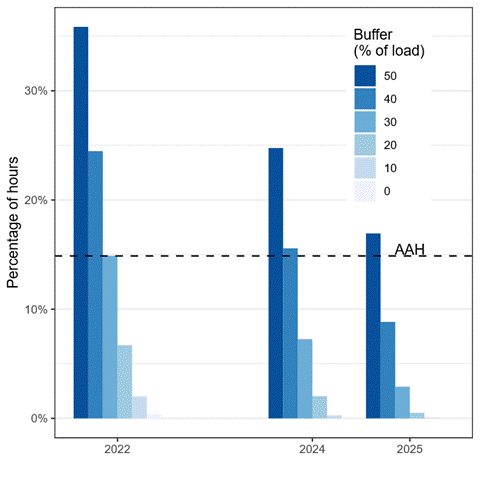
[1] Revised Straw Proposal at 28 and 30.
[2] The AAH are a range of hours that represent where the peak load hour is most likely to occur and are currently the binding assessment hours for RAAIM. System RA resources are subject to a five-hour range, while flex RA resources are subject up to a range of 16 hours. The AAH applies to all days except weekends and holidays, except for Category 1 and 2 flex RA which are assessed on all days. CAISO, Availability Assessment Hours, May 11, 2026 (2027 AAH Assessment) at 7. Available as “Final – 2027 Availability Assessment Hours” at: https://stakeholdercenter.caiso.com/RecurringStakeholderProcesses/Flexible-capacity-needs-assessment-2027.
[3] Revised Straw Proposal at 28.
[4] Revised Straw Proposal at 30
[5] CAISO proposes that the tier 2 assessment would trigger during EDAM RSE upward capacity failures. Given that EDAM launched in May, 2026, historical data for EDAM RSE outcomes is very limited, though the CAISO balancing authority area failed the similar Western Energy Imbalance Market RSE for just one 15-minute interval between 2024 and 2025. DMM, 2024 Annual Report on Market Issues & Performance, August 7, 2025 at 197. Available at: https://www.caiso.com/documents/2024-annual-report-on-market-issues-and-performance-aug-07-2025.pdf.
[6] RAAIM is assessed for system RA resources for 5 hours a day on weekdays and does not include holidays; 5 hours each 5 days a week for 52 weeks in a year is 1,300 hours. Flex RA resources are assessed more frequently, up to 16 hours a day on all days of the year (5,840 hours a year), depending on their flex category. 2027 AAH Assessment at 7.
[7] Comments of the Public Advocates Office on May 15 Stakeholder Discussion and Straw Proposal for Track 2, June 4, 2026 (Cal Advocates Straw Proposal Comments) at Section 2. Available at: https://stakeholdercenter.caiso.com/Comments/AllComments/0e34e687-e290-4afa-92a2-7dd9ebbeeb52#org-0b1b3f5e-fd41-456f-abbc-114f94f2a056.
[8] DMM previously commented:
DMM continues to emphasize that the availability mechanism should ensure capacity is operationally capable throughout the market, with incentive timing and price aligned with system needs and commensurate with RA requirements and prices. Accordingly, DMM recommends the ISO design a method to ensure RAAIM is assessed with sufficient frequency to approximate a commensurate RA price signal.
Comments of the Department of Market Monitoring on May 15 Stakeholder Discussion and Straw Proposal for Track 2, June 4, 2026 at Section 1. Available at: https://stakeholdercenter.caiso.com/Comments/AllComments/0e34e687-e290-4afa-92a2-7dd9ebbeeb52#org-f8221197-20c1-448d-9a1d-103a131dd2ae.
[9] Scheduling Coordinators are expected to make their RA capacity available to the CAISO, but the CAISO Tariff does not consider any specific penalty price for not doing so, other than a sanction for failure to report an outage. CAISO Tariff 37.2.4 and 37.4.1.
[10] Revised Straw Proposal at 7.
[11] CAISO, Resource Adequacy Working Group: Revised Discussion Paper & Final Recommendation Plan, July 26, 2024 at 20-21. Available as “Revised Discussion Paper and Final Recommendation Plan – Resource Adequacy Modeling and Program Design Working Group – Jul 26, 2024” at: https://stakeholdercenter.caiso.com/StakeholderInitiatives/Resource-adequacy-modeling-and-program-design.
[12] The tier 1 design provides advisory trigger conditions up to eight days before the trade date and may become binding three days before the trade date. Tier 2 would trigger and bind assessments following an EDAM RSE failure, which evaluates the next day of operations. Revised Straw Proposal at 28-30.
[13] The CAISO currently does not propose a specific definition for the uncertainty buffer, but previously proposed that it represent uncertainty including renewable production, outages, and load changes between the trade date and when the study is performed. CAISO, Resource Adequacy Modeling & Program Design RAAIM and Outage Substitution Straw Proposal, May 11 2026 (Straw Proposal) at 19. Available as “Straw Proposal – Resource Adequacy Modeling and Program Design – Track 2 – May 12, 2026” at: https://stakeholdercenter.caiso.com/StakeholderInitiatives/Resource-adequacy-modeling-and-program-design. See also Revised Straw Proposal at 28-29.
[14] Revised Straw Proposal at 28.
[15] This figure is calculated using data the CAISO provides for forecasts of hourly demand, reserves, and RA. 2023 was omitted from analysis as data for parts of 2023 appear to be incorrect. Figure 1 plots the cases where the following inequality is true for any of the forecasts 1-3 days before the operating day: resource adequacy capacity forecast + resource adequacy credits < day ahead demand forecast × (1 + buffer fraction) + reserve requirement forecast. Code is available on request. CAISO, 7-day resource adequacy capacity trend. Available at: https://www.caiso.com/todays-outlook. Past data is available using the following date scheme in the URL: https://www.caiso.com/outlook/history/{YYYYMMDD}/rtm_forecast_7day.csv.
[16] The Revised Straw Proposal does not discuss the specific form of the uncertainty buffer, whether it would be a percentage of load, a flat MW value, or something other calculation or unit.
[17] DMM also provided similar data on uncertainty buffer triggers described in the Straw Proposal. Comments of DMM on May 15 Stakeholder Discussion and Straw Proposal for Track 2, June 4, 2026 (DMM Straw Proposal Comments) at Section 1. Available at: https://stakeholdercenter.caiso.com/Comments/AllComments/0e34e687-e290-4afa-92a2-7dd9ebbeeb52#org-f8221197-20c1-448d-9a1d-103a131dd2ae.
4.
Please provide your organization’s overall feedback on the discussion regarding charges, payments, and bounded penalty exposure.
Cal Advocates provides no comments on this topic at this time.
5.
Please provide your organization’s overall feedback on the discussion regarding the bidding requirements.
In the Revised Straw Proposal, the CAISO discusses changes to bidding requirements – particularly for resources that are counted under an unforced capacity (UCAP) methodology or have partial capacity deliverability status – to accommodate changes to RAAIM and clarify treatment of the MOO.[1]
In the previous round of RAMPD comments, Cal Advocates recommended that the CAISO provide an option for LRAs to provide the MOO for the capacity shown in the LRAs’ RA program.[2] The Revised Straw Proposal, presentation slides, and the CAISO staff discussion did not mention this suggestion. Instead, the Revised Straw Proposal suggests use of the highest net qualifying capacity (NQC) to determine MOO when the NQC differs across LRAs. Under Cal Advocates’ proposal, the CAISO could still use the highest NQC submitted to set the maximum total showable RA for a resource.[3] However, using this NQC value will result in a MOO that is too low when the resource is split between an LRA using UCAP and one that does not use UCAP.
Consider a 100 megawatt (MW) Pmax, fully deliverable resource, which has an NQC of 80 MW in LRA X and 100 MW in LRA Y due to different accreditation approaches. The resource’s entire capacity is shown, with 75% of the capacity shown for compliance with LRA X and 25% shown with LRA Y – respectively, 60 MW (= 75% * 80 MW) and 25 MW (=25% * 100 MW) in the two programs. The MOO for this resource should be 100 MW, and that would be the MOO under the CAISO’s proposal if 100% of the resource’s capacity was shown by either LRA X or LRA Y.[4] However, because the resource’s capacity is used for RA by two different LRAs, the CAISO, as proposed, would use the higher NQC (100 MW) and calculate the MOO as only 85 MW (= (60 + 25 shown RA) × 100 Pmax / 100 NQC). This error will be corrected if the CAISO allows the LRAs the option of submitting an appropriate MOO. Here, LRA X could provide the CAISO with the appropriate MOO (75 MW for the portion used in LRA X’s compliance). Providing a MOO should not be obligatory; LRA Y can defer to the CAISO’s calculation (here, 25 MW = 25 MW × 100 Pmax / 100 NQC). The CAISO would then sum up the MOOs from the LRAs that provided them and those that the CAISO calculated with the default formula. Here, that result would be 100 MW = 75 MW + 25 MW, the appropriate total.
Additionally, the CAISO should describe how its proposal to cap the RAAIM penalty at the shown RA value interacts with variable energy RA resources. For example, it is common for solar facilities to have an NQC of only 0.1 MW in some months,[5] based on expected generation during the hour that determines NQC. If RAAIM is capped at NQC, would a 0.1 NQC MW solar plant’s RAAIM be capped to 0.1 MW?[6] This low value may not accurately capture the reliability implication of a mechanical outage at a large solar plant. The CAISO and stakeholders should investigate if there is an easy-to-implement metric that could be used in this context. Such a metric could be the basis of an RA performance benchmark, as the CAISO suggested in the previous Straw Proposal.[7]
[1] Revised Straw Proposal at 38-40.
[2] Cal Advocates Straw Proposal Comments at Section 3.
[3] Revised Straw Proposal at 40.
[4] CAISO proposes to use the formula: MOO MW = shown RA MW × Pmax MW / NQC MW. Revised Straw Proposal at 40.
[5] CPUC, 2026 Master Resource Database, July 2026. Available as: “2026 MRD Official (published July 2026)” at https://www.cpuc.ca.gov/industries-and-topics/electrical-energy/electric-power-procurement/resource-adequacy-homepage/resource-adequacy-compliance-materials.
[6] Revised Straw Proposal at 19.
[7] Straw Proposal at 27.
6.
Please provide your organization’s overall feedback on the discussion regarding substitution and outage definitions.
The CAISO added additional clarifications to its “shopping cart” concept of a substitution RA transaction platform.[1] Cal Advocates supports efforts to make substitution RA easier to transact. However, the proposed design still fails to address why the design would be superior to the existing substitution RA transaction platform (the Power Contracts Bulletin Board) that serves the same purpose but is not used by scheduling coordinators to buy or sell substitution RA. As Cal Advocates,[2] American Clean Power-California (ACP-CA),[3] DMM,[4] Middle River Power (MRP),[5] and Pacific Gas and Electric Company (PG&E)[6] recommended in previous comments, the CAISO should explain how this effort would result in new procurement efficiencies. The CAISO should particularly describe for what reasons the Power Contracts Bulletin Board is unused for substitution RA procurement, and how the replacement shopping cart platform would result in better substitution RA procurement usage and new procurement efficiencies. This additional information on the shopping cart platform would help to justify its creation and build support for the platform amongst potential users.
Additionally, the CAISO should consider relaxation of the POSO as a means to decrease capacity withholding and mitigate substitution procurement issues. Vistra Corp. (Vistra) recently identified that relaxation of POSO could help increase product liquidity,[7] while Cal Advocates has previously commented that rollback of POSO rules would substantially decrease procurement of substitution RA capacity,[8] and be consistent with this initiative’s problem statements.[9]
[1] Revised Straw Proposal at 43.
[2] “The CAISO should identify why the existing bullet board is disused and design its replacement in a manner that avoids those issues.” Cal Advocates Straw Proposal Comments at Section 4.
[3] Comments of ACP-CA on May 15 Stakeholder Discussion and Straw Proposal for Track 2, June 4, 2026 at Section 4. Available at: https://stakeholdercenter.caiso.com/Comments/AllComments/0e34e687-e290-4afa-92a2-7dd9ebbeeb52#org-d42d1d5b-6281-4c61-adce-c4310fbce31a:
We are also concerned that CAISO appears to be moving ahead with the proposed peer-to-peer "shopping cart" bulletin board despite the lack of stakeholder confidence that it will actually resolve the underlying issues that currently impact outage substitution.
[4] DMM Straw Proposal Comments at Section 1:
DMM requests the ISO further detail their recommended approach, and given it will take time and resources to develop, how it will be a useful improvement on the current bilateral outage substitution procedures.
[5] “MRP does not believe that CAISO’s proposed enhanced shopping cart would materially improve substitute capacity procurement relative to the current bilateral process.” Comments of MRP on May 15 Stakeholder Discussion and Straw Proposal for Track 2, June 4, 2026 at Section 4. Available at: https://stakeholdercenter.caiso.com/Comments/AllComments/0e34e687-e290-4afa-92a2-7dd9ebbeeb52#org-50de94a9-9ab8-4c9b-9bc4-8453fe47e0ca.
[6] Comments of PG&E on May 15 Stakeholder Discussion and Straw Proposal for Track 2, June 4, 2026 at Section 4. Available at: https://stakeholdercenter.caiso.com/Comments/AllComments/0e34e687-e290-4afa-92a2-7dd9ebbeeb52#org-9787d318-c34a-4b02-bdfb-337b9de29e93:
Implementing a voluntary, market-based approach to outage substitution must demonstrate sufficient efficiency and effectiveness compared with the current bilateral market before it is considered a viable solution, including for the contracting and procurement of these potential solutions.
[7] Comments of Vistra on May 15 Stakeholder Discussion and Straw Proposal for Track 2, June 8, 2026 at Section 4. Available at: https://stakeholdercenter.caiso.com/Comments/AllComments/0e34e687-e290-4afa-92a2-7dd9ebbeeb52#org-7d5dc1b8-2182-4440-a36f-5ecaba3dd598.
[8] Comments of the Public Advocates Office on April 29-30, 2024 Working Group Meeting, May 17, 2024 at Section 5. Available at: https://stakeholdercenter.caiso.com/Comments/AllComments/4726dcff-0976-4bbe-a424-6382c3a38012#org-154a4233-2a8c-43a6-b0d7-d74dc5f944ff:
The POSO rules require substitution for every planned outage. This substantially increases the need to procure substitute RA capacity. Prior to POSO, the CAISO would evaluate system reliability conditions and approve planned outages without substitution on a case-by-case basis. Thus, a rollback of the POSO rules could efficiently address the challenges related to procurement of substitute RA.
[9] Comments of the Public Advocates Office on March 13, 2024 Working Group, March 27, 2024 at Section 6. Available at: https://stakeholdercenter.caiso.com/Comments/AllComments/a79881e1-374a-4d13-aa17-cbbf7e631b3a#org-aae696bf-1f5d-4356-b1cd-f864e295bc13.
7.
Please provide your organization’s overall feedback on the WPTF presentation.
Cal Advocates provides no comments on this topic at this time.
8.
Please provide any additional feedback not already captured.
Cal Advocates provides no additional feedback at this time.
Calpine Corporation
Submitted 08/05/2026, 11:26 am
1.
Please provide your organization’s overall feedback on the Resource Adequacy Modeling and Program Design Track 2 Stakeholder Meeting on July 22, 2026 to discuss the Revised Straw Proposal.
While Calpine appreciates CAISO’s continued work on the proposal, Calpine maintains many of the same concerns about this version as the last one, largely because the revised proposal does not materially address several of the key issues raised by stakeholders in earlier comments. Calpine continues to have concerns regarding Tier 1 penalty design, bounded penalty exposure, and the treatment of Short Notice Opportunity Outages.
In addition, Calpine agrees with recommendations that the successful implementation of UCAP should remain the primary focus of Track 2. The interaction among UCAP accreditation, RA showings, must-offer requirements, outage treatment, substitution requirements, and availability incentives remains unresolved. CAISO should ensure these foundational elements are aligned before implementing significant changes to RAAIM.
2.
Please provide your organization’s overall feedback on the discussion regarding the revised RAAIM and resource type application.
Calpine supports the objective of aligning availability incentives with system reliability needs and generally agrees that any availability assessment framework should focus on resource performance during periods when capacity is most valuable to the system.
However, availability incentives should remain closely coordinated with the CPUC's UCAP framework and other market design initiatives to avoid creating overlapping or conflicting performance obligations. To the extent possible, CAISO should strive for consistency among UCAP accreditation, availability assessments, outage treatment, and must-offer requirements.
Calpine agrees with WPTF and other stakeholders that CAISO should clearly define how UCAP values will be translated through the broader RA framework, including monthly showings, must-offer obligations, outage substitution requirements, before considering changes to RAAIM.
3.
Please provide your organization’s overall feedback on the discussion regarding the tier assessment.
Calpine continues to believe that the Tier 1 penalties are not well justified, both with respect to triggers and penalty levels. If CAISO would like to assess availability in a relatively broad set of hours it is unclear why it should use a different set of hours than are the focus of its recently adopted UCAP proposal, i.e., at-risk hours on the top 10 net load days in each month. While there may be merit in the more targeted approach in the proposal, it seems unnecessarily complicated and introduces potential misalignment between RAAIM and UCAP. Creating separate performance measurement windows for UCAP, and Tier 1 RAAIM could increase administrative complexity while potentially sending inconsistent operational signals to suppliers.
Calpine also emphasizes that CAISO still has not provided a clear justification for using an energy price as a penalty for capacity availability. Day-ahead energy prices reflect the marginal value of energy, not the value of capacity availability, and do not have a strong conceptual basis as a capacity performance penalty.
Calpine has fewer concerns about CAISO’s Tier 2 proposal, which is appropriately focused on capacity scarcity periods. Calpine agrees with CAISO that the trigger should reflect capacity scarcity regardless of cause. While Calpine does not object to the use of RSE failures as a Tier 2 trigger, CAISO should evaluate whether operating reserve shortages, Energy Emergency Alert (EEA) conditions, system emergency declarations, or periods in which available supply margins fall below a defined threshold would provide a more direct measure of reliability stress. These conditions more clearly indicate that resource availability has become critical to maintaining reliability and may therefore provide a stronger conceptual basis for Tier 2 performance incentives and a closer connection to actual reliability outcomes than an RSE failure alone.
In addition, the proposed $2,000/MWh penalty price is high but also commensurate with similar penalties in other markets and estimates of the value of capacity. If adopted, however, CAISO should carefully consider a phased implementation to allow contracts to reflect the risk of this penalty exposure (to the extent that it is not bounded, as discussed below).
4.
Please provide your organization’s overall feedback on the discussion regarding charges, payments, and bounded penalty exposure.
Calpine notes that PJM caps Capacity Performance penalties at 1.5 times the relevant capacity clearing price on an annual basis. (ISO-NE has similar but more complicated monthly and annual limits.). In the absence of a clearing price capacity market in California, CAISO could attempt a similar approach based on estimates of bilateral RA prices or the CPM price. CAISO could maintain approximately the same maximum exposure to penalties as the status quo by setting the cap at the same value (60% of the CPM price) used to calculate current penalties, albeit with significantly greater potential concentration in Tier 2 hours. (Calpine notes that a $2000/MWh Tier 2 penalty price, the cap could be reached in approximately 2 hours.)
More broadly, bounded penalty exposure is critical to ensuring that RA suppliers can reasonably quantify and manage risk. Without an appropriately designed cap, suppliers will be forced to incorporate greater risk premiums into future RA contract prices, increasing costs to load-serving entities and ultimately ratepayers.
5.
Please provide your organization’s overall feedback on the discussion regarding the bidding requirements.
Calpine agrees that bidding requirements should be tied to Pmax/the installed (deliverable) capacity corresponding to the shown capacity, as in every other market with UCAP, because, in order to realize its UCAP, capacity must be available up to its ICAP when it is not forced out. This approach appropriately aligns accredited capacity with operational expectations.
6.
Please provide your organization’s overall feedback on the discussion regarding substitution and outage definitions.
Calpine continues to object to the proposal’s elimination of Short-Notice Opportunity Outages (SNOO). These outages have been allowed by CAISO because they present no reliability risk. Calpine believes they should be preserved, not require substitution, and not impact a resource’s UCAP accreditation value.
CAISO has historically reviewed and approved SNOO requests based on prevailing system conditions and expected reliability impacts. The existence of this category reflects an acknowledgment that not all outages have equivalent reliability consequences and that facilitating short-term planned maintenance can, under appropriate conditions, support long-term resource reliability and availability without creating operational reliability concerns.
The importance of preserving SNOOs is likely to increase as California continues to rely on an aging thermal fleet to maintain reliability. These resources require periodic inspection, repair, and maintenance to remain available during periods of system stress. Removing a practical mechanism for conducting maintenance may encourage resources to defer needed maintenance, potentially increasing forced outage rates and undermining the reliability objectives that the proposal is intended to achieve.
The current proposal to eliminate SNOOs as a category of outages effectively treats outages that have little or no reliability impact in the same manner as outages that occur during periods of system stress. This approach overstates reliability harm, creates unnecessary exposure to availability penalties and UCAP impacts, and ultimately increases RA procurement costs without providing corresponding reliability benefits.
Calpine notes that stakeholders have raised concerns regarding the elimination of SNOOs in multiple comment rounds. However, the revised proposal does not materially modify CAISO’s treatment of SNOOs or explain why the longstanding rationale for allowing these outages no longer applies. Nor has CAISO identified evidence that CAISO-approved SNOOs have created reliability concerns sufficient to justify eliminating the category.
Calpine recommends that CAISO preserve the functionality currently provided by SNOOs or demonstrate why SNOOs that historically presented no reliability concern should now be treated as reliability failures. CAISO should also clarify that approved SNOOs should not impact a resource’s UCAP accreditation value under other Local Regulatory Authorities accreditation approaches given CAISO’s determination that such outages do not present a reliability risk. The proposal should not allow resources to be penalized through UCAP degradation for outages that CAISO itself determined could be accommodated without adversely affecting system reliability.
7.
Please provide your organization’s overall feedback on the WPTF presentation.
Calpine generally agrees with WPTF's emphasis on ensuring that UCAP implementation is coordinated with other aspects of the CAISO RA framework, including must-offer obligations, outage definitions, substitution requirements, and availability incentives. A clear and internally consistent UCAP implementation framework should be established before CAISO finalizes significant changes to RAAIM.
As noted in response to Question 6 above, Calpine also agrees with WPTF's concerns regarding the elimination of Short-Notice Opportunity Outages and the need to preserve practical maintenance tools for resources that remain critical to California reliability. Calpine agrees that outage classifications and associated consequences should remain tied to actual reliability impacts rather than applying forced-outage treatment to outages that CAISO has historically determined present minimal reliability risk.
8.
Please provide any additional feedback not already captured.
As this initiative advances, Calpine encourages CAISO to focus on maintaining consistency across the various mechanisms intended to support resource availability, including accreditation, bidding obligations, outage management, substitution requirements, and availability incentives. The objective should be a framework in which resources receive clear and predictable operational signals, reliability outcomes are appropriately rewarded, and penalties remain closely tied to actual reliability needs.
Middle River Power, LLC
Submitted 08/05/2026, 03:49 pm
1.
Please provide your organization’s overall feedback on the Resource Adequacy Modeling and Program Design Track 2 Stakeholder Meeting on July 22, 2026 to discuss the Revised Straw Proposal.
Middle River Power LLC (“MRP”) appreciates the CAISO holding an in-person stakeholder meeting for RAMPD Track 2 and encourages the CAISO to continue using in-person or hybrid forums for complex RA design issues. The July 22 discussion covered several material changes to the Resource Adequacy Availability Incentive Mechanism (“RAAIM”), resource-type-specific application, tiered assessments, charges and payments, bidding requirements, outage substitution, and outage definitions. Given the breadth and significance of these topics, MRP believes the meeting did not provide sufficient time to discuss either the policy rationale for the proposal or the practical details necessary to evaluate implementation.
MRP opposes moving forward with the CAISO’s proposed RAAIM redesign and instead recommends targeted modifications to the existing RAAIM framework, including limited changes to current pricing, thresholds, outage treatment, and Nature of Work exemptions that would improve availability incentives without creating a new and more complex penalty structure. MRP also recommends that the CAISO allocate additional time in the next stakeholder meeting or hold targeted technical workshops focused on the most consequential design elements.
2.
Please provide your organization’s overall feedback on the discussion regarding the revised RAAIM and resource type application.
MRP recommends that the CAISO reconsider making significant structural changes to RAAIM at this time. MRP supports targeted reforms that improve availability and remove exemptions, including eliminating current categorical exemptions and eliminating or suspending Flexible RAAIM incentives and penalties. However, CAISO’s proposal would layer a materially different RAAIM framework on top of major concurrent changes to RA accreditation methodologies, UCAP implementation, outage definitions, outage-substitution rules, and potentially outage-submission timelines. Implementing these changes simultaneously could produce unintended consequences, increase compliance uncertainty, and create penalty exposure that is not well aligned with operational control or the RA capacity actually sold by a resource.
Rather than adopting a broad redesign of RAAIM immediately, MRP recommends that the CAISO first focus on targeted changes that directly improve availability and maintenance scheduling. The existing RAAIM framework can be modified to produce better incentives by adjusting pricing, thresholds, and Nature of Work treatment while preserving a more predictable compliance structure. A more incremental approach would allow the CAISO and stakeholders to observe how UCAP, revised outage rules, and EDAM implementation affect availability before adopting a new, more complex RAAIM design.
As part of the RAAIM modifications, MRP requests CAISO to consider the following:
First, MRP recommends that CAISO relax the requirement that all planned outages provide substitute capacity. This can be accomplished by moving both short-notice opportunity outages and off-peak opportunity outages into the planned outage framework, subject to CAISO review and approval based on forecasted system conditions. This would allow generators to perform short-duration maintenance when the grid is not expected to be stressed, rather than discouraging maintenance because substitute capacity is difficult or impractical to procure for brief outage windows. In many cases, allowing these outages to proceed during low-risk conditions would better support reliability than forcing resources to defer maintenance until equipment conditions deteriorate and the outage becomes forced. CAISO’s shopping-cart proposal itself underscores the practical difficulty of finding substitute capacity in the bilateral market, particularly for short-duration outages. If CAISO recognizes that substitute capacity may not be reasonably available for these outages, then such outages should be allowed to proceed as planned outages when system conditions permit and CAISO has reviewed and approved the request. These outages should not be categorized as forced outages because they are scheduled, subject to CAISO approval, and can be denied if CAISO determines they would create reliability concerns.
Second, MRP recommends that the CAISO revisit the Natures of Work that should be treated as outside of resource management control and therefore excluded from RAAIM penalties. For example, outages caused by fuel curtailments due to maintenance or operational restrictions on the gas distribution system are comparable to outages caused by maintenance on the electric transmission or distribution system. Generators do not control the scheduling, scope, or duration of gas utility work and often cannot reasonably plan around those restrictions. Penalizing resources for outages driven by third-party gas system conditions would not improve generator availability and would instead impose costs for circumstances outside the supplier’s control.
Third, MRP recommends that CAISO focus RAAIM availability calculations on outages that reflect actual plant equipment failures or other conditions that are reasonably within the resource owner’s control. Natures of Work associated with maintaining or improving plant availability should not be RAAIM-applicable where the outage reflects prudent utility practice rather than a failure to make RA capacity available. For example, a telemetry outage may result from circumstances outside the generator’s control, such as theft of copper lines, and may also be extended by CAISO processing requirements, including the 72-hour EDAS window before the outage can be ended. These types of events do not reflect a resource’s mechanical availability and should not trigger RAAIM exposure. RAAIM should apply only to outages that have a true and direct impact on a resource’s ability to provide RA capacity and that are appropriately attributable to resource management control.
MRP also requests that the CAISO provide specific resource type examples demonstrating how its revised RAAIM proposal would apply to thermal, storage, hydro, hybrid, and other resource types under different accreditation approaches. RAAIM should be designed to complement LRA accreditation methodologies, not create inconsistent availability obligations. If the underlying RA showing reflects UCAP, exceedance, ELCC, or another LRA-determined qualifying capacity methodology, the CAISO’s availability incentive should be calibrated to the obligation that was actually sold and shown, rather than creating a separate availability expectation that is misaligned with the applicable RA counting rules.
3.
Please provide your organization’s overall feedback on the discussion regarding the tier assessment.
MRP recommends that CAISO modify the existing RAAIM program’s price, threshold, and Nature of Work exemptions rather than adopting the proposed tier-assessment framework. The tiered approach appears to introduce additional complexity without clearly establishing that the new design will better identify the resources that are responsible for reliability risk or materially improve availability outcomes. Before adopting a tiered assessment, the CAISO should clearly define the specific problem the tier design is intended to solve, demonstrate that existing RAAIM modifications cannot address that problem, and provide numerical examples showing how charges and payments would be calculated under different grid conditions.
MRP does not support using the day-ahead LMP as the pricing mechanism for RAAIM because day-ahead energy prices do not reflect the cost or value of capacity. Availability penalties should be tied to the RA product and the capacity obligation being assessed. A day-ahead LMP-based penalty would expose resources to volatility driven by energy-market conditions that may be unrelated to the bilateral RA value of the capacity, the resource’s RA showing, or the actual incremental reliability impact of the outage. If the CAISO believes penalty prices should change, it should evaluate capacity-based benchmarks and explain how any revised price signal is calibrated to the RA market and to the reliability objective of the availability incentive.
MRP does not support Tier 2 at this time. Failure of an EDAM Resource Sufficiency Evaluation (“RSE”) is not necessarily tied directly to a specific generator’s failure to be available, and the relationship between an individual RA resource outage and an EDAM RSE failure may be attenuated by broader supply, demand, interchange, and balancing-area conditions. CAISO should not adopt a penalty mechanism that could materially increase resource exposure before EDAM has been implemented and before stakeholders have operational experience with how RSE outcomes relate to CAISO RA availability. At a minimum, CAISO should wait until EDAM RSE has been implemented for at least a full year and until related RA program changes have been evaluated before moving forward with any Tier 2 mechanism considerations.
If the CAISO continues to consider Tier 2, it should explain how causation would be established, how resource-specific obligations would be separated from system conditions, how penalties would be bounded, and how charges would avoid duplicating other exposure under RAAIM, UCAP, outage-substitution requirements, and market-performance obligations. Without that detail, stakeholders cannot reasonably evaluate whether Tier 2 would improve reliability or simply create uncertain penalty risk.
4.
Please provide your organization’s overall feedback on the discussion regarding charges, payments, and bounded penalty exposure.
MRP strongly recommends that CAISO modify the existing RAAIM framework rather than adopt a new charges-and-payments structure that may not align with how RA capacity is actually procured and shown. Any RAAIM charge should be calculated only against the RA capacity that the resource actually sold, showed, and was obligated to make available for the relevant month and hour.
MRP does not support the CAISO’s proposed revisions to the RAAIM charges-and-payments framework. The proposed Tier 1 and Tier 2 penalty structure could create substantial financial risk for suppliers that is not reasonably calibrated to the RA capacity obligation the resource actually assumed. The current RAAIM penalty price, being limited to 60% of the CPM soft offer cap is reasonable whereas the newly proposed RAAIM penalty prices do not seem reasonable as it could be significantly higher than the CPM soft offer cap. Penalties should be bounded, reasonable, predictable, and proportionate to the underlying RA transaction and any actual reliability impact. CAISO should retain a reasonable cap or other bounding mechanism that preserves availability incentives without imposing open-ended penalty exposure.
5.
Please provide your organization’s overall feedback on the discussion regarding the bidding requirements.
MRP agrees with WPTF that the must-offer obligation calculation should be capped at the resource’s current deliverable RA capacity. The bidding requirement should not obligate a resource to offer capacity that is not deliverable and that could not have been contracted as RA capacity. Under CAISO’s approach, generation capability that is currently not deliverable could be included in the must-offer obligation even though that portion of the resource could not be sold as RA and was not compensated through the RA transaction. Requiring a resource to bid non-deliverable capacity into the market would be inconsistent with the scope of the RA obligation and would effectively impose an uncompensated obligation on the resource.
MRP recommends that CAISO revise the bidding-requirement proposal so that, for resources subject to UCAP-based RA accreditation, the MOO is limited to the PMax associated with the resource’s deliverable RA capacity. This distinction is important because a resource’s UCAP value will generally be lower than its deliverable RA capacity, but the UCAP value should not cause CAISO to calculate the resource’s MOO using the full physical PMax of the plant where that PMax exceeds the resource’s deliverable RA capacity. If a UCAP resource is shown for only a partial amount of its accredited RA value, the MOO should be proportional to the PMax associated with the deliverable RA capacity that supports the shown UCAP quantity. In other words, the MOO should scale to the deliverable RA capability underlying the UCAP showing, not to the full PMax of the facility where the facility’s physical PMax is greater than its deliverable RA capacity. This approach would ensure that CAISO does not require offers from non-deliverable capability while maintaining consistency between UCAP accreditation, deliverability, and the resource’s market-offer obligation. If CAISO believes a different standard is needed, it should provide examples showing how the obligation would apply to UCAP resources with partial showings.
6.
Please provide your organization’s overall feedback on the discussion regarding substitution and outage definitions.
MRP requests that the CAISO clarify whether the timing of outage submissions used to distinguish forced, urgent, and planned outages will change as part of aligning outage definitions with RC West terminology. If the CAISO intends to change the timing rules, it should provide historical examples or data showing how outages previously categorized as planned would have been categorized under the revised definitions. This analysis is necessary because this classification could materially affect a resource’s UCAP calculation, RAAIM exposure, outage-substitution obligations, and the forced-outage assumptions used in LOLE studies, summer assessments, and other reliability analyses.
MRP recommends that the CAISO hold a dedicated workshop to develop the details of the proposed shopping-cart concept before including it in a final proposal. The workshop should address at least four design issues. First, the shopping cart should allow all buyers of capacity to submit offers. If a resource has sold capacity to multiple buyers, the Scheduling Coordinator for the resource should not be solely responsible for deciding how to offer capacity that has already been conveyed to separate RA buyers, particularly where those buyers may have different substitution needs or price expectations. Second, buyers seeking substitute capacity should be allowed to post bids so that sellers can identify demand and respond efficiently. Third, the CAISO should clarify whether an outage can remain in planned-outage status after an offer has been placed in the shopping cart if the parties are negotiating contract terms and execution extends into the forced-outage timeframe. Fourth, the CAISO should explain whether it would allow an outage to proceed if the resource has procured most, but not all, of the required substitute capacity.
These details are central to the shopping-cart design and must be resolved before stakeholders can determine whether the concept will reduce barriers to substitution or simply create another administrative step. The shopping-cart proposal does not address several issues that still require bilateral negotiation between parties, including confidentiality, credit, contracting risk, seller performance, substitution equivalency, partial substitution, and disputes between buyers and sellers. Without resolving these issues, MRP cannot determine whether the proposal would materially improve the ability of resources to schedule prudent maintenance while maintaining reliability.
7.
Please provide your organization’s overall feedback on the WPTF presentation.
MRP agrees with the WPTF presentation and has previously noted that the CAISO has not clearly defined the specific problem it is trying to solve through the proposed RAAIM redesign. The proposal appears to address several concerns at once, including outage substitution, availability incentives, UCAP implementation, bidding obligations, and EDAM-related reliability concerns. However, those issues raise different policy questions and may require different solutions. Before adopting a substantially revised RAAIM framework, the CAISO should identify the specific reliability or market-design deficiency it seeks to remedy, show the evidence supporting that deficiency, and explain why targeted modifications to the current RAAIM framework would be insufficient.
MRP also agrees that UCAP implementation and RAAIM reform should be coordinated carefully. UCAP already reflects historical outage performance in the accredited capacity value, and a revised RAAIM mechanism should not double-count the same outage risk through both a lower RA counting value and additional penalties that are not tied to incremental reliability harm. MRP encourages the CAISO to continue working with WPTF and other stakeholders to develop a framework that preserves reliability incentives while avoiding duplicative penalties, inconsistent obligations, and uncompensated must-offer requirements.
8.
Please provide any additional feedback not already captured.
As MRP has stated in these comments and in prior comments, MRP does not believe RAMPD Track 2 is ready for a CAISO Board decision in Q3 2026. A Q3 Board decision would leave insufficient time for stakeholders to evaluate several unresolved policy and implementation issues, including the scope of RAAIM reform, resource-type-specific application, Tier 1 and Tier 2 assessments, charges and payments, bounded penalty exposure, bidding obligations, outage substitution, shopping-cart functionality, and outage-definition changes. These issues go to the core design of the proposal and are too significant to be deferred to the implementation phase after Board approval.
If CAISO intends to continue pursuing a Q3 2026 Board decision, CAISO should hold additional workshops before presenting a final proposal to the Board. Those workshops should be used to develop and test the specific design details that stakeholders need to evaluate the proposal, including numerical examples, resource-type-specific applications, outage classification impacts, substitution mechanics, and how the proposal would interact with UCAP, Slice-of-Day RA, EDAM, and LRA-specific RA programs. CAISO should not rush these issues to the Board while leaving core design questions to be resolved during implementation before go-live. Doing so would limit stakeholder review of material policy choices, increase implementation risk, and could result in a Board-approved framework that requires substantial post-approval redesign before it can be implemented reliably.
NextEra Energy
Submitted 08/05/2026, 01:58 pm
1.
Please provide your organization’s overall feedback on the Resource Adequacy Modeling and Program Design Track 2 Stakeholder Meeting on July 22, 2026 to discuss the Revised Straw Proposal.
NextEra Energy Resources, LLC, (“NextEra Energy Resources”), appreciates the opportunity to provide comments on CAISO’s Revised Straw Proposal focusing on changes to the Resource Adequacy Availability Mechanism (RAAIM) and Outage Substitution. Overall, NextEra Energy Resources urges CAISO to push the RAAIM reform proposal into a future track and focus this track’s scope on Unforced Capacity (UCAP) implementation by the end of the year.
As discussed in further detail below, NextEra Energy Resources believes that the RAAIM reform proposal continues to fail to articulate its intended availability incentives and lacks significant detail for stakeholders to evaluate the effectiveness of the proposal. NextEra Energy Resources recommends that CAISO revisit the RAAIM proposal in 2027, once additional EDAM entities are onboarded, and additional EDAM Resource Sufficiency Evaluation data is available for stakeholder review.
2.
Please provide your organization’s overall feedback on the discussion regarding the revised RAAIM and resource type application.
NextEra Energy Resources continues to believe that the revised RAAIM proposal lacks justification, does not properly incentivize resource availability, and instead focuses on increasing penalties for resources without regard to event severity or generators’ ability to resolve the event. The Revised Straw Proposal describes general goals, such as reducing forced outages, improving availability during stressed conditions, and incentivizing timely return from outages. However, it doesn’t draw a clear link between the proposed penalty structure and the behavioral responses those penalties are meant to elicit. Further, there is no support that the current penalty value is not punitive enough. Without this foundation, it is difficult to evaluate whether the proposed Tier 1 and Tier 2 triggers will produce the intended reliability outcomes or simply impose increased costs on generators that have limited ability to respond within the relevant timeframes.
Tier 1 Trigger
This concern is acute for the Tier 1 trigger. The proposal activates Tier 1 based on a forecast-based operational margin test comparing forecasted demand plus reserves plus an uncertainty buffer against available RA.[1] CAISO acknowledges that this buffer is intended to account for forecast error, including renewable production uncertainty, outage status changes, and load fluctuations between the time the study is performed and the trade date. Once a Tier 1 advisory is confirmed at T-3, the assessment hours remain fixed for settlement purposes regardless of whether system conditions improve before the trade date. This means a generator can face a penalty for an event that did not actually materialize during the operating day, which would result in penalty assignment where no harm was caused. CAISO’s proposal should only penalize generators that are unavailable during actual scarcity events, not forecasted scarcity events that are resolved by the operating day.
While CAISO’s stated rationale is to encourage generators to return from outage and/or arrange substitute capacity prior to the operating day, these incentives would still exist even without locking in Tier 1 events at T-3 days. Specifically, suppose a generator receives advance notice of a potential Tier 1 event several days out but chooses to wait until the last possible moment to return from outage and/or procure substitute capacity (in case the event resolves itself on its own). The generator would face the risks of being unable to perfectly time its return from outage and that substitute capacity may be unavailable on short notice, both of which could result in being unavailable in real-time and exposure to Tier 1 penalties.
By extension, the proposal should be revised to assess generator availability based on real-time bids rather than day-ahead bids, consistent with the notion that generators should only be penalized for being unavailable during actual scarcity events. CAISO could consider penalizing Tier 1 unavailability at the greater of the applicable day-ahead and real-time LMPs to preserve the incentive for generators to take advance action in response to anticipated Tier 1 conditions.
In addition, the uncertainty buffer is undefined and is a critical component for stakeholder review.
Tier 2 Trigger
Tier 2 is triggered when the CAISO BAA fails the EDAM Resource Sufficiency Evaluation for insufficient upward capacity.[2] An EDAM RSE failure reflects a system-wide condition that can result from a combination of factors, such as including load forecast error, renewable output shortfalls, transmission constraints, and the bidding behavior of multiple market participants across the broader EDAM footprint. CAISO has not demonstrated that the average cost of operator actions to mitigate a typical RSE failure event is $2,000/MWh or that the penalty should not be otherwise scaled in proportion to event severity (e.g., by indexing to LMP). In addition, CAISO has not explained how its proposal would only trigger Tier 2 events that generators have a meaningful ability to address (e.g., as opposed to a major transmission outage that cannot be resolved with additional generation capacity regardless of price).
EDAM is a relatively new market construct and there is insufficient operational data to understand how frequently RSE failures are likely to occur, what conditions typically drive RSE failures, and most importantly, what share of those failures can be attributed to individual generator non-availability. Also, it is important to understand whether the Tier 2 trigger is a proxy for an event that by its nature makes generation less available and whether it is truly representative of an event that generators would be able to procure replacement generation for, or if it represents an event that would more appropriately managed through a planning reserve margin increase. That is, the Tier 2 trigger could represent the types of low probability events that the 1-in-10 loss-of-load-expectation is not meant to protect against. As a result, the Tier 2 event would penalize generators for an event that planners did not expect RA resources to be able to solve. CAISO's own proposal acknowledges that the $2,000/MWh fixed Tier 2 charge may be greater or less than what would result from allocating actual RSE failure costs among unavailable RA resources, depending on the circumstances of the event. This variability further illustrates that the Tier 2 charge is not reliably calibrated to the actual cost consequences of any individual generator's non-availability.
Importantly, bilateral RA contracts include penalties for non-performance as well. This has not been considered in the development of the penalty and when combined with a $2,000/MWh penalty, it can result in material total costs that are arguably disproportionate to any perceived harm a single generator could cause through unavailability. For example, consider a 100 MW resource that experiences a worst-case availability event and is completely unavailable for an entire month. Under the proposed framework, the resource could be subject to multiple layers of financial consequences arising from the same underlying outage. Specifically, the resource would: (1) forfeit its entire monthly capacity payment under its RA contract; (2) incur RA shortfall penalties of up to $20/kW-month, consistent with the penalty levels accepted in certain existing contracts, resulting in approximately $2 million in RA shortfall penalties for a 100 MW resource, which may exceed the monthly contract value; and (3) if the resource were unavailable during a single four-hour scarcity event, incur an additional Tier 2 availability charge of approximately $800,000 (100 MW × 4 hours × $2,000/MWh) under the proposed design. Having such stark penalties without a proper mechanism to identify generator-caused RSE failures is sub-optimal market design. If this proposal is implemented, it is very likely that bilateral contract RA prices will increase to account for the additional risks associated with the proposed penalty design, and existing contracts may need to be reopened.
Variable Energy Resources
NextEra Energy Resources continues to be concerned about the applicability of RAAIM for variable energy resources (VERs) that provide Generic (i.e., System and/or Local) RA. CAISO should be aware that RAAIM application to VERs will require an overhaul of all existing RA contracts to incorporate the resource applicability. While NextEra Energy Resources understands CAISO’s intent to treat all resource equally, it is unclear whether the additional reliability benefit is worth the complicated implementation, especially since wind and solar already have low accreditation values. If CAISO continues this route, it must provide examples of settlements. Further, it is unclear why subjecting VERs to RAAIM is a higher priority than reforming the Flex RA product at present.
Recommendation:
NextEra Energy Resources recommends that CAISO revisit the entire two-tiered RAAIM framework in 2027, once a meaningful body of EDAM operational data has been collected and analyzed, rather than finalizing a program redesign based on limited market experience. NextEra Energy Resources reiterates that the data presented by CAISO to date indicated that the current RAAIM deadband can allow resources to underperform during tight operating conditions and not be subject to RAAIM charges, which is not evidence that the current penalty value is not high enough. CAISO should conduct a more rigorous behavioral and attribution analysis. Specifically, CAISO should identify the actions that each tier is intended to deter or incentivize and explain how the penalty levels are calibrated to those specific behaviors. CAISO should also gather and analyze additional EDAM operational data before finalizing Tiers 1 and 2 trigger design, to ensure that the framework is grounded in actual market experience rather than hypothetical scenarios. Without this analysis, the revised RAAIM framework may not accomplish the stated goals and risks functioning as a cost-allocation mechanism rather than a meaningful reliability incentive.
In the near term, NextEra Energy Resources recommends that CAISO focus on UCAP implementation and consider targeted, incremental RAAIM enhancements rather than a full program redesign. As NextEra Energy Resources noted in previous comments, modifications such as removing the current 94.5%-98.5% deadband and assessing resources against 100% of their shown RA obligation would meaningfully strengthen availability incentives without the above concerns raised by the proposed tiered trigger framework.
[1] Revised Straw Proposal, pp. 28-29.
[2] Revised Straw Proposal, pp. 30-31.
3.
Please provide your organization’s overall feedback on the discussion regarding the tier assessment.
See above.
4.
Please provide your organization’s overall feedback on the discussion regarding charges, payments, and bounded penalty exposure.
Penalty Exposure
NextEra Energy Resources supports CAISO's proposal to consider a monthly cap on RAAIM penalty exposure and recommends that the cap be structured around the principle that an RA resource's aggregate RAAIM liability in any single month should not exceed its expected monthly RA capacity revenue. For example, a straightforward approach would set the cap at 60% of the CPM soft offer cap multiplied by the number of days in the month, consistent with the existing calibration basis used in the current RAAIM design.[1] The cap should reset each calendar month, so that penalties incurred in one month do not carry forward or count against the exposure limit in a subsequent month.
The underlying policy rationale for this cap structure flows directly from the UCAP framework and has been adopted by the CPUC.[2] UCAP reflects the reality that no resource can provide perfectly reliable capacity. A resource accredited RA value already accounts for an expected forced outage rate. A RAAIM framework that assumes perfect availability, or that presumes replacement capacity will always be available to avoid a penalty trigger, is inconsistent with that premise. It would be unfair for resources with UCAP-adjusted RA values to be subject to penalties premised on an expectation of zero forced outages. A monthly cap grounded in expected RA revenue preserves a meaningful availability incentive within any given month while avoiding the perverse outcome of penalty exposure so severe that it eliminates the economic rationale for contracting RA capacity altogether or creates incentives to withdraw from the RA market.
The case for a conservative and capped penalty structure is further supported by the layered nature of accountability already embedded in the CAISO RA construct. Unlike ISOs that operate centralized capacity markets, such as PJM and ISO-NE, where the capacity performance mechanism is the primary financial consequence for non-availability, CAISO's RA resources are subject to bilateral contracts that typically include their own contractual penalties for non-performance. RAAIM penalties will therefore not represent the full extent of the financial consequences a resource faces for unavailability during a stressed period. Stacking significant RAAIM penalty exposure on top of bilateral contract penalties could result in aggregate liability that is neither proportionate to the reliability harm caused by any single resource's unavailability nor conducive to a healthy RA procurement market.
Additionally, UCAP itself functions as a form of forward-looking penalty for non-availability: a resource with elevated forced outage rates will receive a lower accredited capacity value in the next compliance year, reducing its ability to show RA and earn RA revenue going forward. This forward accreditation consequence is a meaningful and durable incentive that operates independently of and in addition to RAAIM. The existence of this mechanism supports limiting RAAIM penalty levels, so that the combined effect of UCAP derates, bilateral contract penalties, and RAAIM assessments is proportionate and does not over-penalize resources for the type of unavailability that UCAP already acknowledges as inherent to the fleet.
NextEra Energy Resources recommends that CAISO adopt a monthly cap as part of the revised RAAIM framework and conduct a historical analysis of Tier event frequency and duration before finalizing penalty levels. That analysis should incorporate the cumulative exposure that could arise from the interaction of RAAIM assessments, bilateral contract terms, and UCAP derates, to ensure the combined framework provides strong but proportionate incentives without creating unintended consequences for RA market participation.
Payments:
NextEra Energy Resources recommends that CAISO revise the allocation of collected non-availability charges so that availability incentive payments flow only to RA resources that overperformed relative to their shown RA obligation during a Tier event, rather than to all available RA resources and load.
The revised straw proposal would allocate collected Tier 1 charges on a per-MW basis to all resources that met their must-offer obligation during the event, as well as to load.[3] CAISO has not explained why load should receive a share of collected penalty revenues. Similarly, capping the amount of penalty revenue a generator can receive at the generator’s shown RA amount removes the incentive for partially-shown generators to over-perform in real-time. A well-designed pay for performance framework should reward exceptional availability.
Allocating payments to load is particularly difficult to justify. Load has no availability obligation and cannot take operational actions to improve resource availability during a stressed period. In fact, load can inadvertently cause the tight operating conditions that led to the RAAIM event. Directing collected charges to load converts a portion of RAAIM into a rate reduction mechanism rather than an availability incentive, which is inconsistent with the reform's policy purpose.
[1] The RAAIM penalty value was set at 60% of the CPM soft offer cap based on an analysis of bilateral contract prices with the goal of reflecting a high average of RA prices. NextEra Energy Resources believes it is still reasonable to use as an estimate of monthly RA revenues to develop a monthly limit on penalties.
[2] California Public Utilities Commission. Decision 26-07-008, Order Instituting Rulemaking (R.) to Oversee the Resource Adequacy Program, Consider Program Reforms and Refinements, and Establish Forward Resource Adequacy Procurement Obligations, R. 25-10-003, July 2, 2026.
[3] Revised Straw Proposal, pp. 32-35.
5.
Please provide your organization’s overall feedback on the discussion regarding the bidding requirements.
NextEra Energy Resources continues to be supportive of assessing RAAIM performance based on shown RA value, even if it may differ from its must-offer obligation.
NextEra Energy Resources urges the CAISO to spend the remainder of this track in 2026 to address UCAP implementation. NextEra Energy Resources recognizes that the adoption of UCAP at the CPUC has raised numerous implementation questions and concerns to ensure the UCAP rules are properly reflected into CAISO’s tariff and Business Practice Manuals beyond bidding requirements. As proposed in the Western Power Trading Forum (WPTF)’s presentation, UCAP implementation requires separate capacity values such as Pmax RA/ACAP, LRA-specific QC, Maximum QC, and shown RA.[1] In addition, CAISO will need it change its local and flexible capacity studies to account for UCAP. CAISO should consider the entire umbrella of UCAP implementation needs in addition to bidding requirements.
[1] WPTF Presentation at CAISO’s July 22, 2026 Resource Adequacy Workshop. Available at: https://stakeholdercenter.caiso.com/InitiativeDocuments/WPTF-Presentation-UCAP-Implementation-and-RAAIM-Jul-22-2026.pdf
6.
Please provide your organization’s overall feedback on the discussion regarding substitution and outage definitions.
NextEra Energy Resources continues to recommend the CAISO to clearly lay out the RC west Operating rules and schedules into the outage definition and criteria. NextEra Energy Resources recommends that CAISO retain the Short Notice opportunity outages as it provides generators flexibility to perform maintenance during low reliability risk levels (e.g., overnight).
7.
Please provide your organization’s overall feedback on the WPTF presentation.
NextEra Energy Resources supports and wants CAISO to focus on UCAP implementation for the remainder of the year given the rise of contractual questions with UCAP. Given UCAP implementation for RA year 2028, finalizing implementation details by 2027 will give stakeholder enough time to incorporate UCAP into existing and new RA contracts.
8.
Please provide any additional feedback not already captured.
Pacific Gas & Electric
Submitted 08/06/2026, 12:31 pm
1.
Please provide your organization’s overall feedback on the Resource Adequacy Modeling and Program Design Track 2 Stakeholder Meeting on July 22, 2026 to discuss the Revised Straw Proposal.
PG&E appreciates CAISO's continued efforts to improve the Resource Adequacy framework and appreciates the additional detail provided in the Revised Straw Proposal. However, since the publication of the original Track 2 straw proposal, the policy landscape has changed. In Decision (D.) 26-07-008, the CPUC adopted a UCAP framework beginning with the 2028 Resource Adequacy compliance year. As a result, PG&E believes implementation of UCAP should become the primary near-term focus of Track 2.
Given the substantial implementation effort required to transition California's RA framework to UCAP, PG&E recommends that CAISO reprioritize UCAP-readiness:
- Ensure CAISO’s ability to translate shown UCAP values into ICAP equivalent values for any processes that implicitly use an ICAP value.
- Clarification of the Must Offer Obligation (MOO) under UCAP should be equal to the ICAP equivalent amount for any shown UCAP megawatts;
- Identify necessary tariff modifications associated with UCAP implementation and the transition from existing QC/NQC terminology;
- Provide more clarity on the outage definitions: forced outages, planned outages, and urgent outages (definition, timeline, substitution rules, RAAIM exposure).
PG&E believes these foundational issues should be resolved before CAISO implements a major redesign of RAAIM.
2.
Please provide your organization’s overall feedback on the discussion regarding the revised RAAIM and resource type application.
PG&E continues to support the principle that operational availability incentives can complement long-term accreditation incentives. However, with UCAP now adopted by the CPUC, CAISO should first focus on the implementation of the UCAP framework before implementing a fundamentally redesigned RAAIM.
At this time, PG&E recommends that CAISO pause implementation of the proposed scarcity-based RAAIM redesign for at least two years (or one year after the CPUC’s UCAP program begins) to provide clarity and certainty during the launch of the CPUC’s UCAP program.
3.
Please provide your organization’s overall feedback on the discussion regarding the tier assessment.
PG&E appreciates CAISO's efforts to improve predictability through the proposed advisory and binding assessment construct. And PG&E recognizes the inherent trade-off between providing cost certainty and the mechanism’s ability to reflect actual system scarcity.
Nevertheless, the proposed scarcity-triggered assessment framework remains significantly less predictable than the current structure from a contracting and procurement perspective. Because Tier 1 and Tier 2 exposure would depend on future system conditions, market participants may face difficulty forecasting and pricing potential RAAIM exposure.
PG&E understands that the goal of this mechanism is to more precisely target those who underperform during scarcity events. This should encourage better performance through improved outage practices, maintenance, or facility upgrades. These benefits will be hampered by the mechanism’s lack of predictability, which may increase risk premiums embedded in RA contracts and increase the difficulty of managing a portfolio of resources.
PG&E recommends deferring implementation of a scarcity-triggered assessment framework until UCAP implementation is complete and its impacts are better understood.
4.
Please provide your organization’s overall feedback on the discussion regarding charges, payments, and bounded penalty exposure.
PG&E appreciates CAISO's recognition that bounded exposure is necessary to address stakeholder concerns regarding potentially unlimited event-based penalties.
5.
Please provide your organization’s overall feedback on the discussion regarding the bidding requirements.
PG&E believes UCAP readiness is the highest priority in Track 2 and recommends
- The CAISO ensure they can translate shown UCAP quantities into equivalent ICAP values to ensure resources are treated equitably regardless of LRA.
- CAISO express the must-offer obligation in terms of ICAP or ICAP equivalent megawatts. A MOO based only on UCAP is very likely insufficient to meet the needs of the CAISO grid and an ICAP equivalent capacity amount (or Pmax RA equivalent) for UCAP programs is likely necessary to ensure effective, reliable systems operations (see PG&E’s comments – question 3 submitted in March 2026 - California ISO - All comments).
- The CAISO demonstrate the equitable application of the rules across UCAP an ICAP programs. Specifically CAISO should begin reviewing tariff terminology and definitions that implicitly rely on ICAP values (i.e., the current QC and NQC framework) to determine what revisions are necessary to equitably support a UCAP-based RA construct.
6.
Please provide your organization’s overall feedback on the discussion regarding substitution and outage definitions.
PG&E continues to believe that additional clarifications are needed on the proposed urgent outage type (e.g., timeline, NOW, UCAP and RAAIM exposure). PG&E does not see an enforceable way to consistently differentiate between a Forced Outage and an Urgent Outage. If a generator claims their unit’s outage is Urgent, how is CAISO to know whether it is being reported accurately or is truly a Forced (or vice versa)?
There needs to be a way to make this distinction for the new definitions to be effective.
PG&E requests additional detail and clarification regarding the proposed outage classifications, including the introduction of an “urgent” outage category. Specifically, PG&E seeks clarification on:
- Whether the new “urgent” outage type modifies or supersedes CAISO’s current forced outage definition, under which maintenance outages submitted seven days or less prior to the start date are treated as forced outages.
- The timing requirements and qualifying criteria associated with each outage type (i.e., urgent versus forced outage). PG&E is concerned that the current proposal leaves room for interpretation and may create implementation and incentive risks if criteria are not clearly defined.
- The approval process for outages, including how CAISO will evaluate, approve urgent outage submission.
- How urgent outages will be treated for UCAP purposes, including whether and how they will affect UCAP calculations and future accreditation.
- What will be the requirements in terms of RA substitution for the urgent outage type? How will urgent outages be exposed to RAAIM (or RAAIM replacement)?
PG&E emphasizes that clear, objective, and consistently applied outage definitions are critical to ensuring that availability incentives, accreditation outcomes, and operational expectations remain aligned.
7.
Please provide your organization’s overall feedback on the WPTF presentation.
PG&E appreciates the perspectives provided during the stakeholder discussion and agrees that implementation sequencing is an important consideration.
Given the adoption of UCAP, stakeholders should focus first on implementing core UCAP components, including accreditation, MOO requirements, outage treatment, and tariff updates before implementing additional operational incentive mechanisms.
8.
Please provide any additional feedback not already captured.
San Diego Gas & Electric
Submitted 08/05/2026, 04:26 pm
1.
Please provide your organization’s overall feedback on the Resource Adequacy Modeling and Program Design Track 2 Stakeholder Meeting on July 22, 2026 to discuss the Revised Straw Proposal.
SDG&E supports the transition to an event-based RAAIM framework, the refined two-tier assessment structure with advance notice and a binding T-3 confirmation, and the proposed penalty structure that aligns incentives with periods of elevated system risk included in the Revised Straw Proposal.
However, several elements in the proposal require additional refinement. CAISO should provide additional historical analysis, settlement examples, and implementation detail regarding resource-specific RAAIM treatment, hybrid and storage resources, penalty exposure, and the interaction between UCAP, ICAP, MOO requirements, outage substitution obligations, and RAAIM assessments. SDG&E also encourages continued coordination between CAISO and the CPUC to ensure consistent implementation of UCAP-related reforms and to minimize contracting and compliance challenges that could arise from differences between accreditation, showing, and operational requirements.
2.
Please provide your organization’s overall feedback on the discussion regarding the revised RAAIM and resource type application.
SDG&E appreciates the additional clarity provided in the revised proposal regarding the application of RAAIM across different resource types. SDG&E supports CAISO's clarification that storage resources should not incur RAAIM exposure due to modeled physical limitations such as nonlinearity and foldback and encourages CAISO to apply penalties consistently regardless of whether a modeled solution has been implemented, so resources are not penalized differently for the same underlying physical limitation.
For VERs, SDG&E views the distinction between plant outages and weather-driven variability or forecast uncertainty as a positive improvement over the earlier proposal. However, we would be interested in analysis that shows how VERs contribute to capacity shortfalls as to not create undue penalties whose costs are ultimately borne by customers. SDG&E also appreciates the clarification regarding hybrid and co-located resource treatment, but additional implementation detail is needed on how availability assessments and penalties would be applied when outages or limitations affect only a portion of a hybrid asset.
Further, to support stakeholder analysis, SDG&E encourages CAISO to provide implementation examples illustrating how availability is assessed under various combinations of bids, outages, derates, substitute capacity, and resource-specific limitations. A simple worksheet or matrix showing the availability target, assessed MW quantity, and resulting RAAIM exposure for representative resource types would greatly improve transparency and stakeholder understanding of the proposal.
3.
Please provide your organization’s overall feedback on the discussion regarding the tier assessment.
SDG&E supports the two-tier, event-based assessment framework as refined in the Revised Straw Proposal, including hourly, per-event assessment and the phased Tier 1 notice structure with a binding confirmation at T-3. The advisory window from T-8 through T-4, followed by a T-3 confirmation, resolves the forecast uncertainty concerns SDG&E and other stakeholders raised on the May proposal. SDG&E likewise does not oppose the Tier 1 persistence rule. However, there are some matters that require refinement and clarification.
Tier 1 Trigger Definitions:
The draft final proposal should define the Tier 1 trigger with greater precision. First, the uncertainty buffer. The proposal commits to continued refinement of the buffer, and the final draft proposal should include a precise definition, data sources, as well as a specified review cycle of the parameters so that calibration tracks evolving grid conditions. Second, the draft final proposal should detail how “available RA” will be assessed. At the T-3, the day ahead market for the trade date has not yet run and advance bid information is likely incomplete. Therefore, available RA cannot be derived from bids and must rest on other metrics such as RA showings, outage and derate status, and substitution records. The draft final proposal should identify the inputs used at each stage of the evaluation process. Third, because the proposed Tier 1 trigger relies on forecast demand, available RA, and an uncertainty buffer, the draft final proposal should provide additional detail regarding how the uncertainty buffer will be determined and whether it includes adjustments for load forecast uncertainty or other reliability considerations. The proposal should also state explicitly whether the binding Tier 1 confirmation relies on published forecast inputs and require transparency of any CAISO forecast adjustments or load bias assumptions that contribute to a binding Tier 1 declaration. Greater transparency regarding these inputs is necessary for stakeholders to evaluate the expected frequency of Tier 1 events and the resulting operational and financial impacts of the framework.
Double Penalization:
CAISO should codify that a single resource cannot be assessed Tier 1 and Tier 2 penalties for the same interval. The proposal provides that the tiers trigger independently and that Tier 2 requires no prior Tier 1 designation. Independence should not breed penalty duplication under the final draft proposal. If a Tier 1 hour is also an hour of a CAISO BAA RSE failure, the tariff should provide a single penalty assessment for that hour, with the Tier 2 penalty controlling.
The Need for a Retrospective Analysis:
SDG&E suggests that final calibration of the penalty structure and amounts should consider a look-back analysis of the historical frequency of simulated events under the proposed structure which should be published with the final proposal.
4.
Please provide your organization’s overall feedback on the discussion regarding charges, payments, and bounded penalty exposure.
Penalty Pricing:
SDG&E is generally supportive of using the day ahead hourly LMP as the Tier 1 penalty price and the fixed $2,000/MWh Tier 2 price, although we suggest CAISO provide supporting analysis to justify the use of these values. SDG&E does not support indexing either tier to bilateral RA price benchmarks, as the Department of Market Monitoring has urged, or to a short-term capacity product price such as Reliability Capacity Up, as WPTF proposed at the workshop. Bilateral RA prices are illiquid, opaque, reported with a lag, and unobservable at hourly granularity. Building settlement on them would also import price-discovery disputes into every event. A reliability capacity product price reflects the marginal cost of residual day-ahead capacity procurement, not the reliability value of shown RA that fails to appear in a stressed hour. If the historical analysis shows Tier 1 LMPs failing to exceed substitution costs in identified stressed hours, the correction is a Tier 1 price floor.
Bounded Exposure:
SDG&E supports a resource-level maximum monthly cap and opposes a minimum-hours construct. Customers ultimately pay RAAIM outcomes. Therefore, the structure should be meaningful, avoidable, and reasonably bounded. Conversely, a minimum-hours construct manufactures assessment where the trigger finds no stress; it adds administrative burden without incentive value, and the predictability it purports to supply is already delivered by the fixed T-3 assessment hours, the fixed Tier 2 price, and the proposed cap.
5.
Please provide your organization’s overall feedback on the discussion regarding the bidding requirements.
SDG&E is concerned that the proposed MOO framework may result in inconsistent bidding obligations for resources subject to different LRA accreditation methodologies. In a landscape with multiple accreditation approaches, including the UCAP framework, the resulting MOO requirements could vary based on the counting methodology applied rather than a resource's operational characteristics. Given that many resources are contracted by multiple LSEs across different jurisdictions, SDG&E believes the MOO framework should, to the extent practicable, remain neutral to differences in LRA accreditation methodologies and provide consistent operational expectations across resources.
At the same time, SDG&E supports CAISO's proposal to limit RAAIM exposure to the resource's shown RA value, even in situations where the MOO exceeds shown RA. Capping RAAIM penalties and substitution obligations at shown RA appropriately aligns penalty exposure with the capacity that has actually been accredited, contracted, and shown for RA compliance, while still allowing CAISO to maintain visibility into a resource's broader physical capability through the MOO framework.
6.
Please provide your organization’s overall feedback on the discussion regarding substitution and outage definitions.
While increased visibility into available substitute capacity may reduce transaction costs and improve transparency relative to the existing bilateral process, it remains unclear whether limited substitution activity is primarily driven by a lack of supply or by transaction frictions. To the extent the “shopping cart” proposal standardizes and anonymizes information such as MW quantity, price, duration, and terms while preserving participant control over transaction decisions, SDG&E is generally supportive of exploring the concept.
However, additional information is needed regarding confidentiality protections, particularly whether the platform could reveal commercially sensitive information regarding an LSE's excess capacity position or procurement strategy. SDG&E would also strongly oppose any future requirement that suppliers be obligated to offer all excess capacity through the platform. While the shopping cart approach could improve transaction efficiency in some cases, CAISO should consider whether it will materially increase substitute-capacity availability and liquidity during periods of tight supply and if the benefits outweigh the administrative complexity and commercial sensitivity concerns.
SDG&E supports the proposed “urgent outage” classification, particularly the flexibility to submit an outage either before or after the planned outage study window and the clarification that resources taking an urgent outage would not be required to provide substitute capacity. This approach should provide additional operational flexibility for scheduling coordinators while improving alignment between outage classifications and actual resource conditions. SDG&E appreciates CAISO's efforts to streamline outage management and supports the proposed enhancement.
7.
Please provide your organization’s overall feedback on the WPTF presentation.
SDG&E appreciates the WPTF presentation's treatment of UCAP implementation potential pitfalls and supports several of its transparency recommendations. However, SDG&E does not support the presentation's RAAIM recommendations, which would retain the current penalty level that the record discredits and defer the event-based reform in the straw proposal until an untenable evidentiary burden is met.
On UCAP framework development, WPTF’s presentation is constructive. Its central claim, that one post-UCAP number cannot serve every CAISO capacity function without double counting or lost capability, is correct. WPTF’s recommendations on this subject align with SDG&E's requests for a consolidated implementation timeline and for demonstrated translation between UCAP and ICAP denominations before the 2028 RA year. The draft final proposal should include a post-UCAP value map identifying the controlling value for each tariff function.
However, WPTF is incorrect in its contention that no failure of the current mechanism has been demonstrated. Forced outages were 97 to 98 percent of summer outages from 2021 through 2023; resources sat inside the deadband through September 2022 despite critical-hour unavailability; forced outages went essentially unsubstituted in the summer months of 2022 and 2023; and the charge sits below the cost of substitute capacity.
SDG&E further has concerns regarding several of WPTF’s RAAIM recommendations because they could reduce some of the benefits of the proposed framework. For example, an ex post Tier 1 assessment may diminish the value of advance notice by shifting compliance determinations to after-the-fact evaluations rather than encouraging actions before the trade date. Similarly, replacing the published day-ahead LMP with the Reliability Capacity Up price would introduce a settlement approach that has not yet been fully evaluated. SDG&E also notes that the proposed Tier 2 design already incorporates an availability-based attribution concept, as only the unavailable portion of shown RA in a deficient hour is subject to assessment. Finally, CAISO may wish to evaluate whether existing provisions directing Tier 2 collections toward EDAM RSE costs adequately address residual cost-causation concerns.
8.
Please provide any additional feedback not already captured.
No further comment.
Six Cities
Submitted 08/05/2026, 02:14 pm
Submitted on behalf of
Cities of Anaheim, Azusa, Banning, Colton, Pasadena, and Riverside, California
1.
Please provide your organization’s overall feedback on the Resource Adequacy Modeling and Program Design Track 2 Stakeholder Meeting on July 22, 2026 to discuss the Revised Straw Proposal.
As discussed in detail in reference to specific topics below, the Six Cities support a number of the CAISO’s recommendations in the July 17, 2026 Revised Straw Proposal (“Proposal”) but oppose other elements, particularly recommendations that would impose penalties for non-availability when system capacity is adequate, impose additional obligations on capacity not shown or contracted for resource adequacy (“RA”), or increase restrictions on resources’ ability to manage maintenance needs.
2.
Please provide your organization’s overall feedback on the discussion regarding the revised RAAIM and resource type application.
The Six Cities continue to support the approach of applying non-availability penalties to shown RA capacity that is not available to the market during critical hours. The Six Cities do not oppose the CAISO’s recommendations to limit broad or generalized exemptions from the RA Availability Incentive Mechanism (“RAAIM”). However, the Six Cities request further explanation regarding implementation of the proposed process for developing RAAIM exemptions on a resource-specific basis, including some illustrative examples.
3.
Please provide your organization’s overall feedback on the discussion regarding the tier assessment.
The Six Cities generally support the proposal for a tiered approach to defining critical hours when RAAIM penalties will apply. However, the Six Cities oppose the CAISO’s proposal to lock-in a declaration of a Tier 1 event at T-3 days before the relevant trading day and request further explanation regarding the determination of an uncertainty buffer for Tier 1 and the bases for both the trigger and the penalty price for a Tier 2 event.
The Six Cities support the proposed process for establishing advisory notifications of potential Tier 1 events beginning at T-8 but request further discussion and explanation regarding the CAISO’s intended approach for determining an uncertainty buffer included in the Tier 1 evaluation process. The Six Cities do not support making an anticipated Tier 1 event binding as of T-3. As the Six Cities understand the proposal, a binding Tier 1 confirmation at T-3 could result in application of Tier 1 RAAIM penalties to resources that were not available by the trading day identified in the T-3 confirmation even if system conditions had changed, and there was more than enough capacity available on the trading day to meet system needs. The imposition of RAAIM penalties in hours when there is no system capacity shortfall is unduly rigid and inconsistent with the objective of aligning the application of penalties with critical system conditions. Moreover, it does not seem likely that declaring a Tier 1 event on a binding basis three days before a trading day would significantly improve the incentive for resources to maximize the probability that they would be available as compared with simply continuing to notify the market of a potential capacity shortfall on an advisory basis. Persistent advisory notifications of potential capacity shortfalls will warn RA resources that they will be subject to RAAIM penalties if conditions develop as anticipated and they are not available. That identified risk of penalty exposure plus the expectation of higher prices and increased profits for inframarginal resources in scarcity conditions should be sufficient to encourage resources to take all possible steps to be available on days forecast to experience critical conditions. Imposing non-availability penalties on resources when there is no shortfall of capacity on the system is unreasonable, particularly in light of the challenges to procuring substitute capacity.
With respect to the CAISO’s proposal to trigger a Tier 2 event based on CAISO balancing authority area (“BAA”) failure of the Day-Ahead Resource Sufficiency Evaluation (“RSE”) test, the Six Cities note that factors other than non-availability of RA capacity can contribute to RSE failures. That being the case, the Six Cities request further explanation for why RSE failure is the best metric for defining a Tier 2 event.
4.
Please provide your organization’s overall feedback on the discussion regarding charges, payments, and bounded penalty exposure.
At this time, the Six Cities do not oppose establishing the Tier 1 penalty price as recommended in the Proposal. Basing the Tier 1 penalty on Day-Ahead LMPs allows gradation of Tier 1 penalties reflecting market conditions.
With respect to the proposed penalty price for Tier 2 events, the Six Cities request further explanation for why the $2,000/MWh maximum bid level for energy is the most appropriate basis for the Tier 2 penalty, as opposed to a penalty derived from capacity prices.
The Six Cities strongly support implementation of a stop-loss mechanism or cap on penalty exposure designed to appropriately balance the objective of enhancing incentives for RA availability during system critical hours while avoiding substantial increases in risk premiums in RA capacity prices. Such a cap on penalty exposure should be expressed as a per MW or per MWh amount over a stated time period, such that operation of the cap is proportional to the magnitude of capacity shortfalls subject to penalty. The Six Cities do not have a detailed recommendation for the design of such a stop-loss mechanism but would suggest consideration of a $/MW cap based on some percentage of the prevailing RA capacity price for the season in which the RAAIM event occurs, if a reasonably reliable estimate for such prices can be determined.
Regarding the distribution of revenues collected through application of RAAIM penalties, the Six Cities reiterate the observation included in their June 4, 2026 comments in this initiative that because load is paying RA resources to be available and suffers the consequences when resources fail to meet their obligations, it would be reasonable to allocate to load all funds payable by resources that incur non-availability penalties. At a minimum, revenues resulting from collection of Tier 2 penalties should be used first to offset Assistance Energy Transfer payments and/or RSE failure penalties incurred by the CAISO BAA.
5.
Please provide your organization’s overall feedback on the discussion regarding the bidding requirements.
The Six Cities appreciate and support the CAISO’s current proposals (i) that exposure to RAAIM penalties will be limited to shown RA value (Proposal at 18), and (ii) that a resource’s Must Offer Obligation (“MOO”) will not exceed its Pmax (Id. at 40). However, the Six Cities remain concerned with, and at this time opposed to, CAISO’s continuing proposal that a resource’s MOO may exceed its shown RA capacity value. As noted in the Six Cities’ 6/4/26 comments, if the payment for taking on RA obligations is premised on a stated capacity value, it does not seem appropriate to apply the MOO to capacity beyond the level for which the resource is being paid and the purchasing entity is receiving credit against RA requirements. Discussion during stakeholder conferences has suggested that the proposal to apply a MOO greater than stated RA value may reflect underpinnings of the UCAP approach to resource planning and procurement. As the CAISO is aware, however, the UCAP methodology has not been adopted by all Local Regulatory Authorities (“LRAs”) within the CAISO BAA, and it is not clear to the Six Cities why implementation of the UCAP methodology by the California Public Utilities Commission (“CPUC”) should drive determination of MOO for all resources within the CAISO BAA. Further, while the Six Cities support the CAISO’s recommendation in the Proposal that exposure to RAAIM penalties be based on shown RA, the consequence of not meeting a MOO set at a higher level is unclear. If, for example, the CAISO intends to insert bids, that would likewise impose obligations beyond the level for which the resource is being paid (absent a different agreement between the parties to the RA contract) and for which the purchasing entity is receiving credit for RA requirements. In addition, a MOO obligation that exceeds shown RA capacity would complicate implementation of the capacity substitution pool discussed in Section 6 below. If substitute capacity is transferred through the pool, is the magnitude of the MOO assumed by the buyer set at the capacity amount transferred, or is it something greater? How could the seller or the buyer of substitute capacity comply with a MOO associated with capacity beyond the amount to which it holds rights?
6.
Please provide your organization’s overall feedback on the discussion regarding substitution and outage definitions.
The Six Cities continue to support development of a substitute capacity pool and support the decentralized “shopping cart” approach described in the Proposal. The description at page 44 of the Proposal suggests that the duration of substitute capacity purchases through the pool will be flexible The Six Cities strongly support such flexibility and believe that it will enhance the value of the pool and maximize utilization of available capacity. Subsequent refinements to the shopping cart design may improve its utility, but the proposed framework appears both feasible and potentially useful for initial implementation.
The Six Cities reiterate their recommendation that the CAISO allow load serving entities (“LSEs”) to reflect on their RA showings varying levels of resource availability throughout the month. Permitting daily granularity for RA commitments by resources would increase the capacity available through the substitution pool and reduce incentives to hold back contracted RA capacity not needed to satisfy RA requirements in a given month. The CAISO continues to assert (Proposal at page 41) that the substitution process should not encourage scheduling coordinators to hold back capacity to substitute for their own needs nor create risks or uncompensated burdens for LSEs showing resources beyond those needed to meet their own requirements. Modification of the RA showing framework as recommended by the Six Cities could complement the proposed substitution pool and do more to address those objectives. Allowing daily variations in showings for resources as well as daily substitution opportunities would enhance the ability of both LSEs and resources to satisfy RA requirements and expand availability of RA eligible capacity.
The Six Cities oppose the changes to outage definitions described in the Proposal as unclear and apparently inconsistent with stated objectives for the initiative. The Proposal appears to indicate (at 45 n.16) that requests for planned outages must be submitted five business days before the RC West short-range study submission deadline, which could require a request for an outage beginning on a Friday to be submitted fourteen business days or nearly three calendar weeks in advance. It is unclear from the Proposal that a resource operator would have any option for submitting an outage request after that submission date that could avoid exposure to RAAIM penalties (other than an off-peak opportunity outage), even if substitute capacity could be obtained.
The Six Cities understand the CAISO’s desire to have as much notice as possible for planned outages, and it would be reasonable to provide incentives for resource operators to submit planned outage requests as early as possible. However, unnecessarily restrictive limitations on submission of planned outage requests are inconsistent with objectives of encouraging availability of capacity contracted for RA beyond levels needed to meet showing requirements and with expanding opportunities for RA substitution.
The proposed definition and treatment of “urgent outages” also appear to be counter-productive. The proposal to treat urgent outages the same as forced outages for purposes of non-availability penalties and UCAP-based QC value provide no incentive for resources to proactively address conditions that ultimately may lead to equipment failure before such failure actually occurs and at a time when there is less impact on system reliability. The Six Cities urge the CAISO to revise the treatment of urgent outages to exempt them from RAAIM penalties if substitute capacity is provided.
The Six Cities continue to strongly oppose elimination of Short Notice Opportunity Outages. As expressed in the Six Cities 6/4/26 comments, elimination of Short Notice Opportunity Outages will result in removal of a critical operational tool that certain resources rely on to address near-term maintenance needs. For example, the short notice outage card may be used to perform important weekend maintenance activities that are necessary to maintain turbine efficiency, emissions compliance, and safe operations. These outages cannot always be forecasted far—or even eight days—in advance, because they depend on ambient conditions and real time operational loading. Nonetheless, the maintenance activities may be required under prudent utility practice and to ensure optimal equipment operation. It is in the interests of all parties for the CAISO to enable this type of maintenance to be performed at times when doing so will pose little to no risk to grid reliability. If CAISO removes the Short Notice Opportunity Outage option, then resources may be forced to either (1) delay necessary maintenance or (2) take outages without an approved coordination mechanism. It also will continue to encourage LSEs to exclude from RA showings and the substitution pool capacity contracted for RA that exceeds showing requirements. All of these potential consequences increase reliability risk.
7.
Please provide your organization’s overall feedback on the WPTF presentation.
The Six Cities understand the desire of LSEs subject to the jurisdiction of the CPUC and the resources that contract with them to understand and manage the interactions between CAISO requirements and the CPUC’s resource planning and procurement policies. However, as the Proposal recognizes at 7, there are multiple LRAs with authority and responsibility for resource planning and procurement in the CAISO BAA, and efforts to align CAISO reliability provisions with CPUC planning and procurement policies may not override or pre-empt policies adopted by other LRAs.
8.
Please provide any additional feedback not already captured.
On further reflection, the Six Cities concur with the CAISO’s determination to address resource performance issues, defined in terms of compliance with bid commitments and dispatch instructions, in a separate initiative. (Proposal at 37). Without further analysis and discussion, it is not clear to the Six Cities whether performance expectations and consequences for non-performance should be different for RA resources versus non-RA resources that bid for and receive market awards.
Southern California Edison
Submitted 08/05/2026, 04:40 pm
1.
Please provide your organization’s overall feedback on the Resource Adequacy Modeling and Program Design Track 2 Stakeholder Meeting on July 22, 2026 to discuss the Revised Straw Proposal.
In considering the changes discussed in the recent Revised Straw Proposal and stakeholder meeting, the changes being considered need to be carefully assessed in light of certain issues that might not have been fully addressed:
- There is not one unified market for resource adequacy (RA) in California. Different Local Regulatory Authorities (LRA) establish different requirements for their jurisdictional entities. SCE, like the majority of the load-serving entities (LSEs) in California, is under the jurisdiction of the CPUC and must meet our Slice of Day (SOD) and soon Unforced Capacity (UCAP) RA requirements. SCE’s RA contracts with resources are likely not the same as those of other, non-CPUC jurisdictional LSEs. CAISO’s rules must account for the various LRA requirements and ensure that together they provide sufficient resources to guarantee the reliability of the CAISO grid. Focused consideration must be taken so that the CAISO RA rules work across all LRAs and treat all LSEs fairly.
- The changes contemplated in how resources are counted for RA, how their Must Offer Obligations (MOO) are determined, and what the base level availability is for any potential RAAIM or penalty calculation will impact not only future RA procurement but will potentially have an impact on existing RA contracts. CAISO must move cautiously when incorporating new requirements and consider and address how they may apply to existing contracts.
- A secondary consideration is the relationship between California RA and markets in the west. In the past, California was the only area with a formal RA program and that RA only directly impacted the CAISO market. Now, things are different. Other regions in the west have established RA programs (WRAP) or are exploring new RA programs and may more directly compete for RA resources. Additionally, the CAISO market no longer stands by itself. The CAISO market now operates as part of both EDAM and WEIM and the RA rules and obligations, such as the MOO, may not impact only the CAISO markets. Further, resources used to support the CAISO RA obligations may, in the future, no longer be treated similar to today (unspecified import RA from within EDAM or WEIM). These changes need to be considered when modifying the existing rules for RA.
To help stakeholders in analyzing the impacts of these potential changes, SCE requests that the CAISO provide data on how often it is expected that the CAISO markets would trigger Tier 1 and Tier 2. Additional information should be provided on how likely these conditions are to overlap, how likely it is that a Tier 2 event could occur absent a Tier 1 event having been declared, and how likely once a Tier 1 is called that the expected shortage conditions actually materialize, since the CAISO’s proposal would not allow a called Tier 1 to be rescinded.
2.
Please provide your organization’s overall feedback on the discussion regarding the revised RAAIM and resource type application.
SCE generally supports the proposed revised RAAIM resource-type framework but has concerns on its application to hydro resources. In particular, the proposed MOO framework could result in bidding obligations that exceed the capabilities of hydro resources constrained by hydrology, environmental requirements, or reservoir management. The proposed UCAP framework does not necessarily directly align hydro accreditation values with operational constraints.
Furthermore, biomass, biogas, and nuclear resources can be limited by their fuel availability. The proposed MOO framework may result in a MOO higher than the shown RA value because the ratio scales the bidding obligation in proportion with the RA showing. This may be result in operational issues for resource types that are limited by their fuel availability.
SCE recommends that CAISO further review the hydro resource treatment to ensure MOO obligations appropriately reflect unique operating characteristics of hydro resources (both dispatchable and run-of-river) and use limited resources.
3.
Please provide your organization’s overall feedback on the discussion regarding the tier assessment.
SCE generally supports the shift away from a monthly averages approach toward a scarcity-hour accountability framework as demonstrated through the proposed Tiered approach.
SCE does not support applying Tier 1 and Tier 2 assessments simultaneously because there may be risk of “double counting” for the same MW shortfall based on the currently proposed framework; it is currently unclear whether the same unavailable MW would be assessed both Tier 1 and Tier 2 charges during overlapping hours.
SCE also asks for clarifications on the counting of penalties for Tier 2. Are the penalties assessed on the day-ahead bids of the resource, or on the actual real-time participation of the resource? The RSE assessment is done based on the day-ahead bidding behavior of the resources but using that basis to assign the penalties provides no incentives for resources on outage to ensure they are back in service for the anticipated shortage hours.
Moreover, unless a day first has a Tier 1 event declared, Tier 2 penalties could happen without giving generation an opportunity to return online. Thus, as a precondition for applying Tier 2 penalties, the CAISO should be required to have first called a Tier 1 event on that corresponding day. This at least puts generation on notice, multiple days in advance, that they are at risk of $2000/MW penalties.
SCE believes that WPTF is correct that an RSE failure is not necessarily a generation failure, but that doesn’t have any implications for using the RSE failure to determine the Tier 2 period. Any RSE failure, whether caused by generation not being available, or by other causes, such as an extremely high load level, will obviously be a stressed period for the BAA and a period when it is important for all RA generation to be available. Also, the RA resource would only be subject to RAAIM penalties if they fail to meet their RA obligation. RAAIM penalties will only apply in a Tier 2 event to RA generation that is not available during this extreme period; the cause of the Tier 2 event is irrelevant.
4.
Please provide your organization’s overall feedback on the discussion regarding charges, payments, and bounded penalty exposure.
SCE encourages CAISO to carefully consider the possible reliability implications of potentially establishing a cap on revised RAAIM penalties, either an event-based limit or a monthly financial cap. While a penalty cap may improve the predictability of financial exposure, it may also weaken incentives for resources on an unexpected outage to return to service as quickly as possible during prolonged reliability events. Once a resource reaches its maximum exposure threshold, the incremental incentive to restore availability may be reduced because additional non-availability charges would no longer accrue.
As an alternative, SCE recommends that CAISO consider some form of continuing penalties, even if they are tempered after some threshold, while providing market participants with greater transparency regarding the expected frequency, duration, and historical occurrence of Tier 1 and Tier 2 events. CAISO’s independent publication of historical assessments and projections could help market participants better evaluate potential RAAIM exposure and incorporate those risks into contract negotiations. Improved visibility into the likelihood and magnitude of future RAAIM events may address concerns regarding unbounded financial exposure while preserving operational incentives that revised RAAIM is intended to create during periods of elevated reliability risk.
5.
Please provide your organization’s overall feedback on the discussion regarding the bidding requirements.
SCE generally supports the CAISO’s proposed MOO bidding approach but is concerned that the current proposal may not fully account for resources constrained by fuel availability and water management needs. The CPUC’s UCAP framework does not modify accreditation for hydro resources and as a result, the proposed MOO calculation could effectively increase the obligation assigned to these resources despite no associated change in their accredited capacity. Similarly, use limited resources may be obligated under the proposed MOO framework to represent more than what they are physically capable of providing due to their various use limitations. SCE recommends that CAISO evaluate this interaction and either exclude resource types not explicitly affected by UCAP or revisit the calculation methodology to ensure comparable treatment across resource technologies and mitigate unintended increases in obligations for hydro and use limited resources.
6.
Please provide your organization’s overall feedback on the discussion regarding substitution and outage definitions.
SCE does not support the full removal of the Short Notice Opportunity Outage (SNOO) category. SNOOs serve a unique reliability and asset-management function by allowing generators to take advantage of limited operational windows during non-peak/low demand periods approved by CAISO within a given month to perform maintenance activities or repairs that are necessary to maintain system or resource reliability and require immediate attention to prevent equipment damage or failure. These maintenance activities are neither planned sufficiently far in advance nor appropriately characterized as forced outages and are likely the result of continuous operation that have been supporting system reliability during high demand periods. The proposed transition to urgent outages does not appear to fully address these circumstances and may create an outage reporting gap for legitimate maintenance activities.
SCE recognizes the ISO's objective of simplifying outage classifications and improving outage data quality. However, rather than eliminating SNOOs entirely, SCE recommends evaluating targeted enhancements to the SNOO framework, such as narrowing eligible hours in which the SNOO may be taken or establishing clearer qualification criteria and language. These modifications could address potential concerns regarding consistency and outage accountability while preserving an important operational tool for resource owners and operators.
7.
Please provide your organization’s overall feedback on the WPTF presentation.
SCE supports efforts to address the uncertainty and contractual risk identified by WPTF. Rather than modifying the MOO framework, SCE recommends that CAISO publish historical and forecast information regarding Tier 1 and Tier 2 event frequency and duration of such events. Such transparency would allow market participants to better quantify risk and incorporate those considerations into bilateral contracting arrangements while preserving reliability objectives of the proposed framework.
8.
Please provide any additional feedback not already captured.
SCE supports the CAISO’s proposal to help accommodate substitution through a “shopping cart” structure. Because substitution needs are specific and not uniform, having the CAISO clear a market for substitute RA would force most of these substitutions to either procure more or less than they actually need and would thus not be efficient.
Terra-Gen
Submitted 08/05/2026, 04:08 pm
1.
Please provide your organization’s overall feedback on the Resource Adequacy Modeling and Program Design Track 2 Stakeholder Meeting on July 22, 2026 to discuss the Revised Straw Proposal.
Terra-Gen agrees with Western Power Trading Forum (WPTF) and the California Energy Storage Alliance (CESA) in asking that CAISO table the current RAAIM reform proposal and instead refocus its near-term efforts on needed improvements and clarifications in advance of UCAP impacting a significant portion of the RA fleet in 2028.
2.
Please provide your organization’s overall feedback on the discussion regarding the revised RAAIM and resource type application.
Terra-Gen supports CAISO's intention to examine the future of the Flex RA program alongside a needed coordination effort between CAISO's RA policy with UCAP implementation. In the interim, Terra-Gen supports maintaining the Flex RA showing requirements while suspending RA flex RAIM penalties. Examining the future of Flex RA should be done in concert with these needed coordination efforts especially as the CPUC has specifically scoped UCAP-Flex RA interactions into Track 2 of the current RA proceeding.
Terra-Gen is concerned about CAISO's proposed removal of RAAIM exemptions for hybrid resources. Despite the several pages that CAISO uses to delineate and describe how RAAIM exposure is applied to different resource types, there is very little information about hybrid resources, how RAAIM exposure is measured, and the justifications for removing the RAAIM exemption. CAISO places hybrids within the storage section, but only provides that "all underlaying components are represented to the ISO as a single resource ID. Therefore, exposure would be determined for the entire asset." This is an insufficient description and does not capture the full range of hybrid fuel combinations and how they may be assessed (i.e., VER and storage, thermal and storage). For example, Figure 9 shows VERs would be assessed RAAIM penalties based on documented outages against shown RA and that storage is assessed using applicable bids and outage status. Are hybrids only assessed based on their documented outages relative to RA? Or are they also assessed RAAIM exposure based on bids and outages? If hybrids are assessed like storage and is based on bids and outages, how will CAISO ensure that lack of fuel from an associated VER does not penalize the resource as that may show up as a lower bid amount? These are threshold implementation questions that CAISO must seriously contend with before moving forward with the removal of the hybrid RAAIM exemption.
Finally, CAISO is aware that the CPUC will establish a UCAP methodology applicable to hybrids in the next track of the RA proceeding. This will introduce new RA complexities for hybrids on what a MOO may look like given the various fuel configurations, how best to assess an EFORd given that some components may or may not be subject to UCAP, among others. As a result, Terra-Gen strongly encourages CAISO to keep the RAAIM exemption for hybrids until the CPUC has established what the applicable UCAP methodology is. At that point, CAISO may be better positioned to think through RAAIM's applicability to hybrid resources.
3.
Please provide your organization’s overall feedback on the discussion regarding the tier assessment.
See response to Question 1 above.
4.
Please provide your organization’s overall feedback on the discussion regarding charges, payments, and bounded penalty exposure.
See response to Question 1 above.
5.
Please provide your organization’s overall feedback on the discussion regarding the bidding requirements.
Terra-Gen does not support CAISO's proposal for a new outage type ("urgent outages") alongside the removal of the short-notice opportunity. There are several problems with CAISO's proposal.
At first glance, it is unclear what problem CAISO is intending to solve with the introduction of urgent outages. As defined, urgent outages "would apply when facility or equipment remains operable but carries an increased risk of a forced outage." From there, CAISO asserts that urgent outages are the equivalent to forced outages for a unit's UCAP based QC value. This is an inappropriate overreach into the CPUC's ability to determine what types of outages factor into a resource's UCAP value. From the CPUC's final decision on Track 1 of the RA proceeding, a forced outage is "an unplanned event that requires immediate, delayed, or postponed removal of a unit from service, derating, or another outage state due to equipment failure (or risk of imminent equipment failure) or due to factors that prevent a unit from operating at its full Pmax level." Furthermore, the CPUC's decision allows Energy Division to determine the specific nature of work (NOW) codes to be used in computing a unit's UCAP QC value. CAISO's definition of urgent outage explicitly notes that a facility is operable but carries an increased risk of a forced outage. An increased risk of a forced outage is not the same as a forced outage, and CAISO should not attempt to shoehorn "urgent outages" in as a sub-category of forced outages. Furthermore, it is unclear how CAISO will assess RAAIM penalties on "urgent" outages applicable to VERs where there is fuel unavailability. Stated differently, subjecting VERs to RAAIM penalties under an urgent outage may inappropriately penalize a resource operator during hours that they lack fuel and where a traditional forced outage may have zero impacts on system reliability (i.e., a solar plant taking a forced outage at HE2).
In addition to this new urgent outage category, CAISO is proposing to remove short-notice opportunity outages ostensibly out of concern that they dull incentives for resource owners to plan ahead for maintenance and to minimize forced outages. CAISO's proposal is a solution in search of a problem. The reason to move towards a UCAP accreditation framework is to specifically privatize the social costs of forced outages by reducing the RA value of resources. Stated differently, UCAP will force resource owners to strategically plan for maintenance and avoid taking forced outages as that would erode a resource's UCAP value. Meanwhile, the short-notice opportunity outage can be a helpful tool for completing urgent repairs and by CAISO's own BPM on outage management, it is "not likely to have a detrimental effect on reliable operation of the grid." It is therefore unclear what CAISO means in the straw proposal when it asserts that these outages "can undermine the purposes of the resource adequacy program."
6.
Please provide your organization’s overall feedback on the discussion regarding substitution and outage definitions.
See response to Question 1 above.
7.
Please provide your organization’s overall feedback on the WPTF presentation.
See response to Question 1 above.
8.
Please provide any additional feedback not already captured.
Vistra Corp.
Submitted 08/06/2026, 02:58 pm
1.
Please provide your organization’s overall feedback on the Resource Adequacy Modeling and Program Design Track 2 Stakeholder Meeting on July 22, 2026 to discuss the Revised Straw Proposal.
Vistra appreciates the California Independent System Operator’s continued engagement with stakeholders on Resource Adequacy Modeling and Program Design Track 2. Vistra supports CAISO’s objectives of clarifying ongoing Must-Offer Obligation rules, strengthening Resource Adequacy performance incentives, and improving operational visibility. However, the Revised Straw Proposal falls short because it applies performance incentives only to shown Resource Adequacy capacity and reduces the pool of performance-incentive funds by transferring a portion of charges to demand. Vistra requests that CAISO revise the proposal to focus first on UCAP implementation, targeted RAAIM clarifications, and improved outage substitution mechanisms.
In Track 2, CAISO should first clarify its MOO applied to shown RA in terms of system RA and local RA whether procured under an Integrated Resource Plan (IRP) contract, system RA contract, local RA contract to a Load Serving Entity (LSE) located within the California Public Utilities Commission’s (CPUC) Local Regulatory Agency (LRA) or another LRA within the CAISO Balancing Authority Area.
-
- Define deliverable PmaxRA as the common operational capacity value for CAISO compliance constructs.
- Consider two approaches either (1) adding a supply-plan contract terms field to distinguish UCAP MW from installed capacity (ICAP)/PmaxRA MW for purposing of calculating the MOO, CPM eligible MW, and RAAIM benchmark or (2) require all showings to be translated into a common deliverable ICAP/PmaxRA-equivalent basis before submitting the LSE RA plan or RA Supply Plan.
- Calculate MOO, Capacity Procurement Mechanism (CPM) eligibility, and RAAIM performance benchmark in terms of the resource’s PmaxRA-equivalent megawatts (MW) ensuring it does not apply MOO to any non-deliverable capacity.
Second, the CAISO should defer comprehensive Resource Adequacy Availability Assessment Mechanism (RAAIM) to a future effort. Vistra supports exploring near term RAAIM clarifications in Track 2 including adopting Vistra’s balancing-ratio adjustment to the deliverable PmaxRA-equivalent of shown RA (i.e., MOO) and establishing stronger RAAIM penalties in capacity terms by increasing the penalty from 60% of the Capacity Procurement Mechanism (CPM) soft-offer cap to a higher percentage. These narrow changes to RAAIM should immediately improve resource performance penalties increasing overperformance incentives and avoiding diluting the incentives by inappropriately gifting a share of resource penalties to LSEs.
Third, the CAISO should further explain its outage management proposal to align outage rules with Reliability Coordinator rules. The CAISO should clarify what elements of the Tariff or Business Practice Manuals it intends to change. Among these changes, the CAISO should decline to remove the Short-Notice Opportunity Outage coordination tool. Finally, Vistra supports the CAISO exploring whether it can take a more proactive approach to coordinate outage substitution especially when the RA eligible non-shown capacity is sufficient to cover outage needs even if that capacity is not willing to support RA substitution or alternatively relax 100% Planned Outage Substitution Obligation (POSO) to allow certain outages the system can support reliably without requiring substitution. The irony is that the POSO process prior to 100% POSO performed the assessment needed to identify whether the system could or could not prudently allow the outage to be taken, and instead now 100% POSO and the new Day-Ahead Market Enhancements (DAME) products increase incentives to rationally withhold non-shown RA capacity from providing substitution given POSO risks and opportunity costs of foregone revenues.
2.
Please provide your organization’s overall feedback on the discussion regarding the revised RAAIM and resource type application.
Vistra requests that CAISO revise the Revised Straw Proposal to adopt an incremental, capacity-based RAAIM reform. CAISO should not replace RAAIM with an event-based energy-price penalty construct. CAISO can strengthen incentives without creating a penalty design that is difficult to hedge, difficult to price, and likely to be reflected in higher RA contract costs. The central performance benchmark should be the balancing-ratio share of each resource’s deliverable PmaxRA-equivalent MOO. That benchmark gives CAISO a stronger and more defensible performance signal. It measures whether the resource performed to the portion of the system need it reasonably should bear. It does not impose exposure based on procurement shortfalls, forecast error, or inconsistent LRA showing conventions.
Vistra requests the following changes be made to CAISO’s Revised Straw Proposal for RAMPD Track 2:
- Replace unadjusted shown RA as the RAAIM benchmark with the balancing-ratio share of deliverable PmaxRA-equivalent MOO.
- Calculate MOO, CPM, and RAAIM on the same PmaxRA-equivalent basis.
- Add a supply-plan contract terms field so CAISO can distinguish UCAP MW from ICAP/PmaxRA MW and validate that resources have not sold more than 100 percent of their deliverable PmaxRA.
- Adjust PmaxRA-equivalent MOO by the balancing ratio to establish the applicable RAAIM and substitution target.
- Allocate collected penalties only to resources that perform above their balancing-ratio-adjusted MOO, and do not reduce that incentive pool by transferring RAAIM charges to load.
- Keep EDAM Resource Sufficiency Evaluation (RSE) failure surcharge allocation separate from RAAIM.
- Preserve outage coordination tools, including Short Notice Opportunity Outages (SNOO).
Vistra also requests that CAISO revise the resource-type application rules to avoid broad categorical exemptions for resources shown for RA, including Variable Energy Resources (VERs). CAISO should provide clear, resource-specific examples before implementation. A credible performance framework should apply to RA resources in a manner that reflects their operating characteristics. It should not rely on blanket exemptions or one-size-fits-all penalties. CAISO should not finalize resource-type application rules until those examples demonstrate that the assessment measures controllable physical availability. The examples should also show that the assessment does not penalize forecast variation, accreditation methodology differences, or market-model limitations.
3.
Please provide your organization’s overall feedback on the discussion regarding the tier assessment.
Vistra requests that CAISO revise the tier assessment design. Any enhanced RAAIM assessment should be tied to actual critical reliability conditions, not an administratively fixed forecast trigger nor to Resource Sufficiency Evaluation (RSE) failures. If CAISO retains tiers, Vistra’s preferred structure is a capacity-based Tier 1 tied to Energy Emergency Alert (EEA) Watch conditions and a capacity-based Tier 2 tied to EEA 1 or higher conditions. Vistra would not oppose a T-3 Tier 1 designation being locked as long as the RAAIM MW includes the balancing ratio adjustment capped at 100 percent described in more detail in Vistra’s previous comments. The balancing ratio provides a more durable solution because it scales each resource’s obligation to the system condition CAISO is trying to address.
Vistra requests that CAISO remove EDAM Resource Sufficiency Evaluation (RSE) failure as a RAAIM trigger or penalty basis. EDAM RSE failure is a Balancing Authority Area (BAA)-level sufficiency and cost-allocation issue. It is not, standing alone, evidence that an individual RA resource failed to meet an availability obligation. An RSE failure may result from procurement decisions, transfer constraints, load forecast changes, uncertainty requirements, bilateral market conditions, or other factors unrelated to the conduct of a particular RA resource. A penalty tied to EDAM RSE failure without a showing of resource-level causation risks converting RAAIM from an availability incentive into an unsupported surcharge mechanism. If CAISO believes EDAM RSE failure surcharge allocation should be revised, it should address that issue in the appropriate EDAM cost allocation forum rather than through RAAIM.
4.
Please provide your organization’s overall feedback on the discussion regarding charges, payments, and bounded penalty exposure.
Vistra requests that CAISO revise the charge design to keep RAAIM penalties in capacity terms. CAISO should remove day-ahead locational marginal price (LMP) pricing and the proposed fixed $2,000/MWh energy price and instead refresh the CPM soft offer cap through a new cost review and then increase the share of the CPM soft-offer cap that should set RAAIM penalties. An energy-price penalty is not reasonably tied to the capacity product sold. It may bear little relationship to cost causation and will be difficult to hedge or price in forward RA transactions. A capacity-based penalty, by contrast, is more transparent, more administrable, and better aligned with the product CAISO is seeking to incent.
Vistra’s preferred structure would apply increasingly stronger capacity penalties as reliability conditions worsen. For example, CAISO could use 90 percent of the refreshed CPM soft offer cap for Tier 1 and 100 percent of the refreshed CPM soft offer cap for Tier 2. Recall, Vistra does not support Tier 2 being defined as RSE failures but instead more extreme emergency conditions such as Emergency Energy Action 2 or 3.
Vistra does not support CAISO’s proposal to dilute resource performance incentives by gifting a portion of the penalties to loads. This obstructs the goal to incentivize the greatest performance out of the entire fleet above and beyond the capacity under a MOO. Vistra’s support for stronger penalties is conditioned on incorporating a balancing ratio adjustment to the deliverable Pmax-equivalent of shown RA and using the charges for the purposes of incentivizing resource performance. That is the purpose of an RA penalty and incentive structure: to increase resource availability when the system needs capacity most not to create another revenue stream for loads. Consequently, Vistra requests CAISO revise the payment allocation to preserve RAAIM as both an under-performance and over-performance construct. Collected penalties should be allocated to RA resources that perform above the balancing-ratio share of their deliverable PmaxRA-equivalent MOO and should not be redirected to load. Redirecting RAAIM penalties to load would dilute the final-megawatt performance incentive. It would also reduce the marginal value of over-performance and weaken the justification for the penalty itself.
Finally, Vistra supports bounded penalty exposure in principle, but a cap is only a backstop. The CAISO proposed concept ties the monthly cap to CPM costs in terms of capacity. Vistra notes the CAISO’s inclination to align the monthly cap to a value in terms of capacity conflicts with its penalty price proposals to shift to penalties in energy terms. Vistra supports maintaining alignment of penalties and any caps in capacity terms, and in fact think this conflict highlights that additional discussion is needed to ensure the penalty prices and any cap are both in terms of capacity not energy.
5.
Please provide your organization’s overall feedback on the discussion regarding the bidding requirements.
Vistra requests that CAISO revise the bidding requirements for shown RA to ensure that it accurately translates any MWs shown in UCAP terms to the deliverable Pmax (PmaxRA) equivalent to set the MOO. CAISO should revise its policy intent to state that its validation mechanism will ensure resources do not sell more than 100 percent of their deliverable PmaxRA across all shown load-serving entities (LSEs). CAISO should also state that it will not impose RA obligations on energy-only or non-deliverable MW that are ineligible to be contracted for RA compliance.
UCAP is a forward counting value that reflects expected forced-outage risk. It does not reduce the deliverable operating capability from the deliverable PmaxRA-equivalent that is contracted for in a transaction priced based on UCAP. At the same time, unconstrained Pmax may include energy-only or otherwise non-deliverable capability that should not support RA obligations.
The CAISO’s formula is directionally accurate albeit there may be simpler implementation approaches to achieve the same outcome, however it omits explanation of how CAISO would identify shown MW contract terms for the purpose of applying the MOO formula that scales and it inappropriately scales the MOO assuming UCAP MW showing to an amount including undeliverable capacity. Vistra’s workbook attachment to the previous set of comments provides an implementation path for translating showings expressed in different terms into the percentage of deliverable PmaxRA sold.
This change is narrow, implementable, and essential to avoid risks of resources showing more capacity than their full deliverable Pmax and avoid imposing obligations above the deliverable capacity.
6.
Please provide your organization’s overall feedback on the discussion regarding substitution and outage definitions.
Vistra requests that CAISO revise the outage substitution and outage-definition provisions to address the underlying liquidity problem rather than only the transaction workflow. Vistra is skeptical that the proposal will result in increased substitution liquidity given the meaningful incentives from 100% POSO and foregone DAME product revenues to withhold non-shown RA to meet future POSO needs or market opportunities. The CAISO has misunderstood the key driver of substitution liquidity – it is not transparency into substitution but the disincentives that can exist to desire to sell that product. The CAISO shopping cart proposal does not change the incentives for resources with excess RA-eligible capacity to hold that capacity in reserve rather than to sell for substitution.
In recognition that CAISO’s rules are a key driver to exacerbating substitution liquidity, CAISO should take action to either reduce incentives to withhold excess RA-eligible capacity or it should proactively manage outage substitution. One option is for the CAISO to relax the 100 percent POSO where an outage does not create a reliability issue. Alternatively, CAISO should commit to taking a more active role in allowing resources to take outages when sufficient deliverable capacity is available to support the outage without a reliability concern. The current proposal falls short of curing any outage substitution liquidity or coordination challenges scoped into Track 2.
Vistra requests more fulsome explanations and discussion of the CAISO’s outage management clarifications in its Revised Straw Proposal including around the requested changes below in our prior comments:
- Requested clarifying that any urgent outage category applies only to non-optional outages in the T-45 to T-8 window and does not overlap the forced outage timeline.
- Requested retaining SNOO as this outage coordination tool has been found to be useful to manage outages, and insufficient support has been provided to remove the tool. SNOO is an operational coordination tool that allows Scheduling Coordinators to perform necessary maintenance when CAISO determines system conditions can accommodate the outage without material reliability risk. Eliminating SNOO would reduce maintenance flexibility by removing an existing coordination tool between Generator Owners and CAISO. That result would be counterproductive. Vistra’s support for stronger RAAIM incentives is contingent on CAISO maintaining reasonable outage tools that allow resources to take outages when system can support the required work so that it may best ensure its availability when the system actually needs them.
In addition to our previous requests, Vistra also seeks a fuller explanation and discussion of what the CAISO’s proposal is to align its Tariff and BPM outage management rules with the Reliability Coordinator West outage rules. We do not understand sufficiently the CAISO’s proposal and as such the outage management proposals need to be further developed and discussed before finalizing.
7.
Please provide your organization’s overall feedback on the WPTF presentation.
None currently.
8.
Please provide any additional feedback not already captured.
There are several ways to implement in CAISO’s system CIRA any shown MW translation to deliverable Pmax-equivalent (PmaxRA-equivalent) for shown quantities expressed in terms of UCAP. Vistra suggests the CAISO hold a technical discussion and allow stakeholders to share their perspectives on what would allow greatest understanding and certainty once implemented. This technical workshop should inform the bidding requirements proposal.
Western Area Power Administration
Submitted 08/05/2026, 04:02 pm
1.
Please provide your organization’s overall feedback on the Resource Adequacy Modeling and Program Design Track 2 Stakeholder Meeting on July 22, 2026 to discuss the Revised Straw Proposal.
Western Area Power Administration (WAPA) is a federal agency responsible for marketing hydropower generated by the federal Central Valley Project (CVP) to meet its statutory responsibilities to serve project-use energy pumping requirements and market available hydropower generation under its Power Marketing Plan to preference power allottees. In Northern California, WAPA serves load in both the Balancing Authority of Northern California and the CAISO. WAPA delivers its generation from many large and small hydro facilities of the CVP to its loads. WAPA owns, operates and maintains an extensive high voltage transmission network extending to the load center of Northern California.
WAPA appreciates the opportunity to provide comments on the CAISO’s revised straw proposal on Resource Adequacy Modeling & Program Design Track 2 –RAAIM Reform. CVP generators plan to participate in the Extended Day-Ahead Market (EDAM) after Balancing Authority of Northern California (BANC) joins EDAM in October 2027. For CVP generators to support generic Resource Adequacy (RA) imports to its power customers in the CAISO Balancing Authority Area (BAA), according to the current EDAM GAP-tie design, RA obligations of Import Resources from BANC to CAISO must be reassigned to individual generators in BANC. However, RA is a capacity product that does not affect power flow. WAPA believes that it is not necessary to reassign RA obligations to individual CVP generators. WAPA encourages CAISO to explore more robust validation rules in CIRA to allow a portfolio of CVP generators to support the RA imports. More details will be provided in subsequent sections.
WAPA has significant amount of transmission ownership rights (TOR) that enable WAPA to import and wheel power from the Pacific Northwest to CAISO BAA. WAPA encourages CAISO to develop robust market rules to allow firm imports based on a chain of TORs to provide RA to CAISO BAA.
WAPA would like to ensure the Track 2 RAAIM Reform does not introduce design elements that would complicate WAPA’s implementation plan to join EDAM with BANC. Moreover, we look forward to working with CAISO in the coming stakeholder processes to enhance the proposal to enable CVP generation to more efficiently and effectively contribute to Resource Adequacy through EDAM participation.
2.
Please provide your organization’s overall feedback on the discussion regarding the revised RAAIM and resource type application.
WAPA noticed that CAISO changed the RAAIM Assessment basis from MOO to RA showing for hydro generation resources in the revised straw proposal. WAPA appreciated CAISO staff’s willingness and efforts in working with participants to devise workable solutions to address the challenges in Resource Adequacy. WAPA finds it reasonable to use RA showing as the basis for RAAIM assessment for hydro resources.
WAPA requests that CAISO describe how RA Import from a non-EDAM BAA is treated. Such import may not be backed by a specific generator. According to the current CAISO GAP-tie proposal, the import would be mapped to a default generation aggregation point (DGAP). How would MOO be calculated for the DGAP?
3.
Please provide your organization’s overall feedback on the discussion regarding the tier assessment.
WAPA agrees with the CAISO that a static AAH (5 consecutive clock hours on each weekday – hours determined for each season based on CAISO annual study) may not meet operational needs. WAPA finds Tier 1 reasonable to announce RAAIM assessment hours in advance of the trade date only when there is an anticipated capacity shortage. However, WAPA encourages the CAISO to consider all available capacity instead of just the RA showing in determining the true operational needs. Tier 1 should communicate CAISO’s true operational needs so that both the RA and non-RA resources can plan their capacity offering to ensure reliability. For example, CVP may be able to offer more capacity than its RA showing for a limited number of hours when CAISO truly needs it.
WAPA recommends postponing the discussion of the linkage between RA and RSE failure to a future stakeholder initiative when RSE failure cost causation is discussed. CAISO made this commitment in its compliance and tariff amendment filing for the Extended Day-Ahead Market (EDAM) and Day-Ahead Market Enhancements (DAME). Specifically, in Docket No. ER24-379-000, CAISO explained to the Federal Energy Regulatory Commission (FERC) that it could not immediately trace RSE failures to specific entities and would use metered demand as an interim allocation proxy, committing to continue working with stakeholders on a long-term cost causation design. Some of WAPA’s customers in CAISO BAA will receive firm import of Type_1 from BANC and Pacific Northwest to meet all their load or a significant part of their load based on daily load forecast regardless of RA showing based on monthly forecast. Since RA is shown by SCID and not by CAISO BAA, the current CAISO proposal for Tier 2 does not follow cost causation because it is based on overall CAISO RSE failure instead of SC RSE failure.
4.
Please provide your organization’s overall feedback on the discussion regarding charges, payments, and bounded penalty exposure.
Federal entities are exempt from penalties under the CAISO tariff due to principles of Federalism, Sovereign Immunity, and the Supremacy Clause of the Constitution. Additionally, the Anti-Deficiency Act prohibits the government from entering agreements where the government’s liability is indefinite or undetermined, and prohibits the commitment of obligations prior to a Congressional Appropriation. This reflected in the CAISO tariff, Section 22.9(a), which states that "No person or federal entity shall incur any liability by failing to comply with a CAISO Tariff provision that is inapplicable to it by reason of being inconsistent with any federal statutes, regulations, or orders lawfully promulgated thereunder..." WAPA as a federal entity, is exempt from penalties under the CAISO tariff, including those related to RAAIM. Accordingly, without a sufficient interest in the matter, WAPA respectfully declines to comment on the nature and character of CAISO’s penalty structure.
5.
Please provide your organization’s overall feedback on the discussion regarding the bidding requirements.
WAPA noticed that CAISO continues to propose the following MOO formula on page 40 of the Revised Straw Proposal:
MOO = shown_RA * Pmax/NQC
While WAPA strongly opposed this MOO formula in its previous comments on the Straw Proposal, WAPA also noticed that CAISO changed the RAAIM Assessment basis from MOO to RA showing for hydro generation resources in the revised straw proposal. It seems that if RAAIM is assessed based on shown_RA instead of MOO, the MOO formula only affects resources that are subject to CAISO’s automatic bid generation. WAPA now believes that this MOO formula does not affect Use-Limited Resources since they are exempt from automatic bid generation. WAPA requests that CAISO clarify explicitly what type of generation resources and how they are affected by this MOO formula.
6.
Please provide your organization’s overall feedback on the discussion regarding substitution and outage definitions.
The most efficient and reliable substitution process for resources and CAISO is eliminating the need for substitution for some resources. By allowing a portfolio of generators that are not subject to automatic MOO bid generation to provide the RA showing capacity, the substitution among these resources can be avoided. CVP has a system of reservoirs and generators that change their output frequently to maintain space in the regulating reservoirs. However, the total volume of water that needs to be moved may not change over the day. In other words, the total amount of energy (MWh) generated by all generators may not change even though the individual generator schedules may change hour by hour. The current proposed EDAM Gap-tie RA reassignment process requires each intertie resource showing RA to be reassigned to individual generation resources instead of a portfolio of generation resources. This requirement generates unnecessary outage submission and substitution busy work without real benefit to resources and CAISO. On the contrary, since substitution is not required by forced outage, CVP generation resources may not have sufficient time to show substitution after declaring outage, leading to shortage of RA capacity on paper due to CAISO RA accounting method and not because of real shortage of available capacity. WAPA respectfully requests that CAISO enables CVP as a portfolio of Use-Limited and Conditionally Available federal hydro resources to provide RA by the portfolio. This is a low hanging fruit that benefits both resources and CAISO.
Since CAISO is concerned with RA shortage, CAISO should remove process obstacles that prevent imports from providing RA. WAPA suggests that CAISO enable RA imports supported by a chain of ETC/TOR schedules with the last segment being registered for MIC. For example, the following imports originated from the Pacific Northwest should be allowed to provide RA:
Malin to BANC (TOR) > BANC to BANC (TOR wheel) > BANC to CAISO (MIC)
If a CVP generator that provides RA to load in the CAISO BAA is derated, WAPA should be allowed to use its transmission ownership rights to import power from the Pacific Northwest to BANC and wheel through BANC to deliver the power to CAISO via the registered MIC to substitute for the loss of CVP. WAPA’s understanding is that CAISO currently does not support such substitutions. In this scenario, by enhancing CAISO business processes and systems, CAISO systems will recognize the available RA capacity, and RA shortage can be addressed without increasing generation capacity and costs to the market.
7.
Please provide your organization’s overall feedback on the WPTF presentation.
WAPA currently does not have comments.
8.
Please provide any additional feedback not already captured.
WPTF
Submitted 08/06/2026, 10:57 am
Submitted on behalf of
Western Power Trading Forum
1.
Please provide your organization’s overall feedback on the Resource Adequacy Modeling and Program Design Track 2 Stakeholder Meeting on July 22, 2026 to discuss the Revised Straw Proposal.
The Western Power Trading Forum (WPTF) appreciates the opportunity to provide comments on the July 22, 2026 Resource Adequacy Modeling and Program Design Track 2 stakeholder meeting and Revised Straw Proposal. WPTF supports the objective of ensuring that Resource Adequacy (RA) capacity is operationally available when the system needs it. However, CAISO should not advance Track 2 for approval until it resolves two threshold issues that affect the foundation of the proposal: complete implementation of Unforced Capacity (UCAP) across the CAISO RA framework, and clarification of the proposed alignment between CAISO and Reliability Coordinator West outage definitions.
Threshold issue 1: Post-UCAP implementation. The California Public Utilities Commission (CPUC) has adopted a UCAP methodology for a substantial portion of the CAISO RA fleet beginning with the 2028 RA year. UCAP is a forward accreditation value that discounts expected forced-outage risk. CAISO therefore must explain how UCAP will be translated across the full RA architecture before it finalizes a new availability penalty.
As WPTF explained in its July 22 presentation, different capacity quantities will be needed for different functions. CAISO should separately maintain the resource’s physical Pmax, a deliverable or accredited PmaxRA value, the applicable LRA qualifying capacity value, the maximum CAISO NQC, and the quantity actually shown as RA. One number cannot perform all of these functions without either losing operational capability or double counting capacity. The implementation framework must address accreditation, monthly showings, must-offer obligations, RAAIM, substitution, deliverability, export RA, Resource Sufficiency Evaluation support, transitional-measures settlements, local and flexible RA, and CPM backstop procurement.
CAISO’s proposal correctly recognizes that a resource’s must-offer obligation may exceed its shown UCAP value. However, the proposed formula should use the resource’s deliverable PmaxRA value, not an unconstrained physical Pmax. If it does not fix this gap, energy-only capacity will be used in the CPUC LOLE studies and be counted as RA. There should also be additional discussion around whether CAISO should preserve the distinction between the bidding obligation and the capacity quantity used for RAAIM and substitution. One approach could be to continue measuring RAAIM and substitution against shown RA, because shown RA reflects the quantity procured, demonstrated, and relied upon for RA compliance.
Threshold issue 2: Outage-definition alignment. The Revised Straw Proposal states that CAISO will generally align CAISO outage definitions with the RC West outage-coordination framework. It is not clear whether CAISO intends only to harmonize terminology and timing, or whether it intends to substantively change what qualifies as a planned, urgent, or forced outage. This distinction is critical because outage classification will affect UCAP, RAAIM, substitution, and maintenance decisions. CAISO should clearly explain the intended changes and their consequences before advancing the proposal.
These threshold matters are not implementation details that can be deferred until tariff development. They define what product LSEs procure, what suppliers sell, what CAISO may rely upon, and what conduct creates financial liability. Finalizing RAAIM first would risk using an administrative penalty to address problems that should be resolved through accreditation, procurement, outage-management, or operational design.
Other Issues
WPTF also continues to question whether the record demonstrates a need for a fundamental redesign of RAAIM. The historical information presented by CAISO identifies questions for further analysis, but it does not establish that current RAAIM caused higher forced-outage rates, that a higher penalty would have prevented the outages, or that limited substitution resulted primarily from the existing penalty level rather than scarcity of replacement capacity and transaction friction. CAISO should use current data, distinguish correlation from causation, and identify the specific behavior it seeks to change before materially increasing supplier liability. RAAIM can be updated easily to accommodate UCAP by assessing resources based on their Shown RA value with no buffer.
WPTF also does not support removing the Short Notice Opportunity Outage as this is a key tool for resources to take needed maintenance without increasing grid costs or risking reliability.
WPTF recommends that CAISO issue another revised straw proposal and hold an additional stakeholder workshop before publishing a draft final proposal. The next proposal should maintain opportunity outages and include a complete post-UCAP implementation framework, clear outage definitions and consequences, historical back-testing of the proposed RAAIM design, and fully specified penalty caps and transition rules.
2.
Please provide your organization’s overall feedback on the discussion regarding the revised RAAIM and resource type application.
CAISO could consider measuring RAAIM exposure against shown RA rather than a potentially higher must-offer obligation. It is our understanding that this approach would align the assessment with the capacity quantity that the LSE procured and demonstrated and that CAISO relied upon for RA compliance. A resource should not incur a RAAIM charge for capacity above the shown RA quantity solely because its tariff bidding obligation extends to a higher operational value.
UCAP reduces the forward capacity value to reflect expected forced unavailability. Under the current RAAIM design, the 94.5 percent lower threshold recognizes that the planning reserve margin historically included an expectation that some installed-capacity MW would be unavailable. As CAISO implements UCAP, it could consider whether conceptual continuity should be preserved by assessing availability against shown UCAP and adjusting the existing availability buffer only to the extent needed to avoid recognizing the same expected forced-outage risk twice. UCAP implementation, standing alone, may not warrant replacing the current capacity-based price with a substantially larger event-based energy charge.
CAISO could thus consider if retaining a capacity-based RAAIM framework, applying the existing RAAIM capacity price to shown UCAP, and modifying the availability threshold only to the extent needed to avoid recognizing the same expected forced-outage risk twice is appropriate. CAISO should further evaluate whether the current price remains appropriate after the denominator changes from installed or qualifying capacity to UCAP.
Any revised assessment must remain an availability mechanism. It should determine whether the shown RA quantity was made available through the applicable bids, schedules, and outage status. It should not become a broad performance mechanism, a mechanism for recovering EDAM RSE charges, or a substitute for correcting LSE procurement deficiencies. Those issues involve different conduct, different parties, and different cost-causation principles.
Before changing the remedy, CAISO should identify the failure. If CAISO believes the existing price is too weak, it should show the relationship among resource availability, RAAIM exposure, fleet mix, seasons, maintenance decisions, and stressed conditions. If CAISO believes substitution is not preserving RA, it should analyze substitution requests, available offers, acceptance timing, transaction barriers, and whether planned work became forced because replacement capacity could not be obtained. If CAISO believes shown RA caused stressed-hour shortfalls, it should demonstrate event-level causation rather than infer generator non-performance from a system-level condition.
WPTF does not offer resource-type-specific positions in these comments. Across the fleet, WPTF encourages CAISO to clearly define the obligation being measured, consider limiting exposure to shown RA, and avoid assessing resources for conditions outside the obligation that was procured and relied upon.
3.
Please provide your organization’s overall feedback on the discussion regarding the tier assessment.
WPTF does not support the proposed two-tier structure as currently designed. The proposal changes the trigger, proof, and price of RAAIM at the same time, without first establishing that the current capacity-based framework has failed or that the proposed event triggers identify resource-caused reliability problems.
Tier 1. A forecast of possible system stress is not the same as an actual reliability need. CAISO proposes to fix the Tier 1 assessment hours at T-3 even if updated conditions show that the anticipated stress did not materialize. That design would penalize resources for forecast error rather than for contributing to an actual reliability problem. If CAISO retains Tier 1, the assessment should deactivate when the triggering condition no longer exists based on updated information.
WPTF strongly opposes using day-ahead LMP as the Tier 1 price. Day-ahead LMP is an energy price. It may reflect fuel costs, congestion, losses, commitment conditions, and energy scarcity, but it does not price the short-term availability of RA capacity. Tying a capacity availability obligation to LMP would create volatile and difficult-to-hedge exposure that is not calibrated to the RA product.
WPTF agrees with Calpine’s June 3, 2026 comments that, if CAISO retains an event-based Tier 1 construct, it should evaluate a short-term capacity construct based on Reliability Capacity Up (RCU), rather than LMP. WPTF recommends that CAISO evaluate both an RCU-based trigger and an RCU-based price. An RCU-based approach would be conceptually linked to the day-ahead need for upward reliability capacity and would preserve the capacity nature of the obligation.
Tier 2. A CAISO BAA failure of the upward EDAM Resource Sufficiency Evaluation is a system-level result, not a finding that a particular RA resource failed. The CAISO BAA could fail because the forward RA requirement was set too low, load or net load exceeded the forecast used for procurement, imports or transfers were unavailable, deliverability limited supply, non-RA capacity did not participate, LSEs did not show sufficient RA, or shown RA was unavailable. Only the last condition is a RAAIM availability failure.
Tier 2 therefore should not apply automatically whenever the CAISO BAA fails the RSE. At a minimum, CAISO would need to identify an attributable shortfall in shown RA during an actual stressed condition and demonstrate that the unavailable shown RA contributed to the insufficiency. The proposal should not shift load-side procurement, forecasting, import, or system risks to generators through RAAIM.
If CAISO retains tiers, it also must prevent duplicative charges when Tier 1 and Tier 2 overlap, explain whether the same MW can be charged under RAAIM and used to offset an EDAM RSE surcharge, and publish retrospective results showing how often each trigger would have occurred, how long events would have lasted, and what conditions caused each event. Tier 2 can remain a trigger under this structure, but the price should still be tied to capacity, not an arbitrary high energy price of $2,000/MWh.
4.
Please provide your organization’s overall feedback on the discussion regarding charges, payments, and bounded penalty exposure.
WPTF strongly opposes pricing RAAIM non-availability charges at day-ahead LMP or at a fixed $2,000/MWh energy price. RA is a capacity product and RAAIM is an availability mechanism. The price should remain capacity-based unless CAISO develops evidence showing that a different capacity price is needed to change a clearly identified and controllable behavior.
CAISO could consider applying the current RAAIM price, which is based on 60 percent of the CPM soft offer cap, to shown UCAP. If CAISO nevertheless adopts an event-based framework, it should evaluate an RCU-based capacity price as suggested by Calpine, not LMP. CAISO should not translate an RA obligation into an uncapped energy-price exposure simply because the assessment occurs in an hourly interval.
The proposed Tier 2 price is particularly disproportionate. A 100 MW shortfall during a five-hour Tier 2 event would produce a $1 million charge, equivalent to $10/kW-month from a single event. That exceeds the current full-month RAAIM price of approximately $4.40/kW-month by more than two times. This tail risk will not disappear because CAISO labels it an incentive. Suppliers, lenders, and investors will price it into RA contracts, financing requirements, outage decisions, and decisions about whether to sell RA at all.
WPTF appreciates the addition of a fixed and transparent per-event cap conceptually but believes this is not a replacement for a rational capacity penalty in the first place. At the very minimum, a single event should not eliminate the annual economic value of providing RA service. Any cap should be specified in the policy proposal and tested against historical events before the proposal advances.
WPTF supports preserving the self-funding availability incentive, but CAISO should not commingle RAAIM revenue allocation with EDAM RSE surcharge allocation unless it first establishes cost causation. RAAIM charges should support the availability incentive for RA capacity. They should not become a general mechanism for shifting BAA-level RSE costs to unavailable RA resources when those resources may not have caused the RSE failure.
5.
Please provide your organization’s overall feedback on the discussion regarding the bidding requirements.
WPTF supports CAISO’s recognition that UCAP requires a must-offer obligation that can differ from shown RA. A UCAP MW is a forward counting value that is already discounted for expected forced outages. It does not mean the resource’s physical capability has been reduced to the UCAP quantity. CAISO must preserve access to the operational capability associated with the RA showing.
WPTF supports the proportional structure of CAISO’s proposed formula with one important change: the numerator should be the resource’s deliverable PmaxRA value, not an unconstrained Pmax. The appropriate formulation is MOO = shown RA multiplied by PmaxRA divided by NQC. PmaxRA should reflect deliverability, interconnection, testing, and other physical limitations that determine the maximum capacity the resource can reliably provide as RA. Using Pmax could create a bidding obligation above the deliverable capability that supports the RA showing.
CAISO should maintain separate values for physical Pmax, PmaxRA or accredited capacity, LRA-specific QC, maximum CAISO NQC, and shown RA. The NQC field cannot carry every post-UCAP function. In particular, it cannot simultaneously serve as an LRA accreditation value, a deliverability ceiling, a showing cap, a must-offer denominator, an export-availability measure, and a CPM procurement denomination without creating inconsistencies.
The tariff should preserve the separation among MOO, RAAIM exposure, and substitution. CAISO could consider the following; MOO defines the quantity that must be made available through applicable bids and schedules. RAAIM and substitution could measure a shortfall below shown RA. Where a resource offers at least its shown RA but less than a higher MOO, CAISO could consider treating that circumstance as a tariff bidding issue without also imposing RAAIM or substitution liability above the RA capacity procured and shown.
Before finalizing the formula, CAISO should provide examples for partially shown resources, partial-capacity deliverability resources, resources shown under multiple LRA methodologies, resources subject to different contract denominations, export transactions, and CPM procurement. CAISO also should explain how UCAP will be reflected in local and flexible RA studies and in the NQC list. These examples should be part of the policy design, not deferred until implementation.
6.
Please provide your organization’s overall feedback on the discussion regarding substitution and outage definitions.
Outage-substitution platform. WPTF supports CAISO’s recognition that transaction efficiency is a material part of the outage-substitution problem. The proposed searchable shopping-cart concept is constructive and could improve visibility into available substitute capacity, needed dates, quantities, and prices. WPTF supports developing this concept into a more efficient, standardized CAISO-administered outage-substitution platform in a future initiative focused on transaction design and implementation.
A future initiative should examine how to improve transaction speed, standardization, price and availability transparency, and the ability to transact for daily and partial-month needs while preserving appropriate bilateral commercial control. WPTF agrees with Middle River Power that the current difficulty is not merely a lack of postings. Short-notice transactions can fail because parties must identify supply, confirm eligibility, negotiate terms, address credit, execute an agreement, and process the substitution in a compressed timeframe. A well-designed future platform could materially reduce that friction.
The current shopping-cart concept should be viewed as a useful building block, not as evidence that the substitution problem has already been solved. CAISO should not condition new penalties or the removal of existing maintenance tools on the assumption that substitute capacity will be readily available through the initial posting process.
Short-Notice Opportunity Outages must be retained. WPTF strongly opposes eliminating Short-Notice Opportunity Outages (SNOO). SNOO provides an important reliability tool that allows a Scheduling Coordinator to request short-duration maintenance when CAISO operators determine that system conditions can accommodate the outage without material reliability risk. It promotes coordination and enables necessary work to be performed at a time selected based on actual system conditions.
The proposed urgent-outage category is not an adequate substitute. Under the proposal, an urgent outage would be treated like a forced outage for UCAP and RAAIM purposes. That would impose forced-outage consequences on maintenance that CAISO has reviewed and determined can be accommodated. Off-Peak Opportunity Outages also are not an adequate replacement because their limited overnight and weekend windows may not align with the availability of contractors, replacement parts, specialized personnel, or the duration of the necessary work.
The need to preserve SNOO is becoming more important as California’s gas fleet ages. California and CAISO reliability planning continue to rely on substantial gas capacity through 2040 and do not identify a broad replacement pathway that would allow the existing fleet to retire in the near term. The state cannot rely on these resources for reliability while removing practical tools that allow owners to inspect, repair, and maintain them safely. Policy should encourage proactive maintenance when the system can accommodate it, not create an incentive to defer work until equipment fails and the outage becomes involuntary.
Eliminating SNOO therefore could increase, rather than reduce, forced outages. A resource owner that cannot obtain substitute capacity and faces UCAP and RAAIM consequences for a short, CAISO-approved maintenance window may defer the work. That result is directly contrary to the stated objective of improving availability. CAISO should retain SNOO as a separate category and preserve operator discretion to approve low-reliability-impact maintenance without forced-outage treatment.
Clarification of outage definitions. The proposal states that CAISO outage definitions will generally align with RC West definitions, but it is not clear whether the alignment will change the substantive definitions of planned and forced outages or only the associated terminology and coordination timelines. CAISO should clarify the intended changes and explain how each classification will affect UCAP, RAAIM, and substitution before the proposal advances.
7.
Please provide your organization’s overall feedback on the WPTF presentation.
We think it is great and the CAISO should move forward with its recommendations. But it was our presentation.
8.
Please provide any additional feedback not already captured.
WPTF recommends that CAISO continue policy development rather than move directly to a draft final proposal. The initiative now combines post-UCAP implementation, a new must-offer formula, event-based RAAIM, EDAM RSE interactions, new outage definitions, elimination of SNOO, and a new substitution process. These elements are interdependent and are not sufficiently defined for approval.
The next revised straw proposal should include the complete calculations and data needed to evaluate the design. This should include historical back-testing of Tier 1 and Tier 2, the frequency and duration of events, attribution of each historical condition, settlement outcomes, application of caps, and the effect on existing RA contracts and annual RA economics. CAISO should make the underlying data and formulas available so stakeholders can reproduce the analysis.
CAISO also should align the implementation schedule with the 2028 UCAP transition and provide adequate time after final tariff and implementation details are known for LSEs and suppliers to renegotiate contract terms and operational processes. A materially new liability should not become effective in the middle of existing contract periods.
WPTF supports targeted reforms that improve availability, facilitate maintenance, and make substitution easier. Those reforms will be durable only if they clearly define the RA product, preserve cost causation, maintain practical outage-management tools, and keep financial exposure predictable and contractable.