Appian Way Energy Partners
Submitted 10/14/2026, 04:20 pm
1.
Does your organization have a preferred proposal on auction efficiency at this time, or a preferred approach out of the “levers” discussed on slides 13-17? If so, please explain why you believe this proposal/approach is the best. Alternatively, if you have previous comments that address this question and are still accurate, please cite them.
Auction Efficiency
We continue to believe that the focus of the CRR Enhancements working group should be on improving the CRR product as an essential mechanism for market participants to manage congestion risk. First and foremost, the priority should be shoring up the financial integrity of the CRR product by addressing the sources of revenue inadequacy that CAISO has identified – loop flow, shift factor thresholds, incentivizing timely outage submission, and other modelling improvements. Appian Way notes that the comments from IOUs and LSE interests have focused on getting to the bottom of, and addressing, revenue inadequacy. We concur. In addition, the allocation of revenue adequacy according to the Track 1B process should be improved to follow cost causation principles, as we describe further in question 4 below.
From our comments July 2, regarding why large amounts of revenue inadequacy harms ratepayers:
“…we'd like to reiterate that when CRR financial integrity is compromised and highly uncertain, load/ratepayers are the entities that ultimately pay regardless of how revenue adequacy is collected via the Track 1B approach. Load pays because the allocated CRRs they retain for hedging or the additional CRRs they purchase in the auction are underfunded. And load futher pays when the allocated CRRs they want to sell in the auction are discounted below the fair value of the CRR price spread because of the buyers' expectation of underfunding; or because the excess transfer capacity that is released in the auction is discounted based on buyers' expectations of underfunding. Voluntary speculative participants in the market will surely discount their bids for CRRs, and require additional risk premia, when CRR financial integrity is so compromised, as it is uniquely in CAISO amongst all the ISOs.”
There appears to be significant consensus in the group that revised product definitions could better align the CRR product with hedging needs of wind and solar resources. Appian Way supports this although it is not a major business issue for us.
We also note significant interest in allowing storage resources to be eligible sinks and think this proposal should be expanded to add a discrete number of additional physical market locations to serve as eligible sinks, as described further below in question 9.
Finally, we believe that this group should consider a Balance-of-Period Monthly auction structure similar to several other ISOs. In this scenario, each monthly auction would include not only the prompt month, as occurs at present, but also the remaining months or seasons in the balance of the year.
2.
Please provide your organization’s feedback on the presentation by Doug Boccignone for the Bay Area Municipal Transmission Group (BAMx).
Auction Efficiency
The BAMx proposal restricts eligibility to participant in the CRR auction exclusively to participants that physically schedule power. This proposal to restrict competition would harm ratepayers and is inconsistent with FERC’s Order 888 requirement for open access and nondiscrimination. Ratepayers would be harmed because reduced competition in the CRR auctions could result in CRRs that are sold or released going for less than the competitive market price. In addition, non-physical trading entities that transact with LSEs and suppliers, and the banks, trading houses and other financial intermediaries that trade with said LSEs and suppliers, would be prevented from accessing congestion contracts to manage risk around their transactions. The result would be less competition to provide hedges to LSEs and suppliers in bilateral markets and higher risk premia required for serving load or contracting with physical generation resources to manage risk. This is fundamentally counter to FERC’s public policy objectives, competition, and the purpose of the CRR market.
From a practical standpoint, BAMx’s argument turns FERC’s Open Access requirement in Order 888 on its head. Open access means “open access,” not “open access only for certain classes of market participants with a physical position.” Given that this proposal, in our opinion, would be dead-on-arrival at FERC (and CAISO staffs’ own analysis of the relevant FERC precedents supports this conclusion in our opinion), and the significant opportunities for improvements in the CAISO CRR market associated with other proposals, it would be an extremely inefficient use of stakeholder resources to prioritize this particular initiative.
We note BAMx and municipal utilities have frequently proposed restricting access to the ISO markets, and FERC has consistently ruled against such proposals to restrict access. See, for instance, the Commission determination and discussion in the order approving MRTU at pages 242-245. (https://www.caiso.com/documents/september21_2006orderconditionallyaccepting2_9_06mrtufilingindocketnos_er06-615-000ander02-1656-027_etal.pdf )
3.
Please provide your organization’s feedback on the presentation by Roger Avalos from the ISO Department of Market Monitoring (DMM).
Auction Efficiency
Appian Way commented on the DMM proposal in our posted comments July 2, 2026 on the DRAFT Final Proposal and the June 25 Stakeholder meeting:
“DMM proposes a constraint-based minimum shadow price as opposed to a path-based minimum bid/clearing price. The problem is that CAISO models hundreds of constraints that might bind under certain conditions, but from a practical standpoint never do. Or if an unusual constraint does bind it is often a proxy for a related/similar constraint along a similar path. If all of the constraints were given minimum shadow prices, they would overlap and pancake to such an extent that virtually no FTRs would ever likely be able to trade. DMM’s proposal is therefore unworkable.”
Notably, DMM’s presentation September 30 was essentially identical to the proposal and paper it submitted to CAISO on June 16. During the Stakeholder meeting on September 30, it was apparent that CAISO’s CRR expert, Dr. Angelidis, had significant questions for DMM about how their proposal would work in practice. From the discussion, it did not appear that DMM staff engaged with CAISO staff on basic elements of their proposal nor with the basic issue we raised in our June comments.
Before market participants are asked to engage on the DMM proposal, DMM should present a practical example using the 2026 Annual Auction as a test case. This would mean proposing a principled approach for determining minimum shadow prices and then implementing this approach on every constraint in the 2026 CRR Annual Auction that took place in November 2025 for 2026 (there were approximately 2700 monitored elements and approximately 1800 contingencies in this auction, not to mention approximately 80 Nomograms). Most of these potential constraints do not bind in the auction or the Integrated Forward Market (IFM), but any of them could bind. Indeed, the crux of the DMM concern about the CRR auction is that there is no auction reservation price on constraints and according to DMM’s theory, some constraints are sold for very low prices (when evaluated ex-post) as a result and that this is the source of auction inefficiency.
To the extent that the DMM believes that some constraints should have minimum shadow prices and others are ignored, they should offer a rationale for these determinations. Most importantly, DMM should then analyze the point-to-point CRRs that in fact did clear in the 2026 auction and determine what the price spread hurdle would be for each CRR under the proposed minimum shadow price rule and their proposed thresholds, and determine which CRRs would still clear and which would no longer clear (CAISO staff did this for their phase 1 minimum price proposal). DMM should also assess allocated CRRs that were sold in the 2026 annual auction and which ones would no longer sell as a result of the proposal, and how auction prices, which are an important source of market transparency, would change. The analysis described above is possible and can be accomplished in a large spreadsheet or computer model.
In our view, it is not CAISO’s role to set shadow prices in the day-ahead market. The shadow price on a constraint is an output of the market’s competitive bids, not an input chosen by the ISO, and no one would propose that CAISO decree a minimum shadow price on Path 15 and withhold schedules until the market pays it. DMM says its reserve price works “the same way ISO implements penalty prices” (September 30 presentation, slide 5). It does not. A penalty price is a ceiling: it applies only when the market cannot honor a constraint, and it caps the shadow price so that an infeasible constraint does not price at infinity. DMM’s reserve price is a floor: it sets the limit to zero so that the administrative price becomes the shadow price on every reserve-priced constraint carrying any positive flow, in every auction, whether or not the constraint is scarce. That is not how the ISO implements penalty prices; it is the opposite. Taken to its logical conclusion, with CAISO pricing most auction constraints at or above what the market would pay, the proposal is exactly the willing-seller design in different clothes: The constraints would pancake the paths that in practice only participant-to-participant trades clear.
4.
Are there any ideas for improving auction efficiency or design that have not been discussed in the initiative yet that you believe should be included in Phase 2?
Auction Efficiency
Appian Way has proposed a simple reform to the Track 1B methodology for shortfall allocation that would bring this policy in line with cost causation principles. This was included in our comments submitted May 6, 2026 as feedback to the April 22 Stakeholder meeting. We would be happy to formally present this proposal to stakeholders at an upcoming meeting. As stated in our comments on 5/6/22:
“…addressing the unintended consequences of the Track 1B reforms is a high priority which will repair the financial integrity of the CRR product, improve the CRR market’s ability to serve its intended purpose, and increase the value of auctioned CRRs that are for the benefit of load-serving entities representing transmission ratepayers. Of course, we also support any and all efforts to reduce revenue inadequacy by addressing some of the root causes identified by CAISO – loop flows, the shift factor threshold cutoff, poor outage coordination, auction modelling that is misaligned with the actual market, etc. The proposal below explicitly addresses just shortfall allocation and can be carved out from other aspects of the stakeholder process.
As stated in Problem Statement 4: “Allocation of revenue shortfalls should be guided by cost causation principles.” In principle, this means that shortfalls that are caused by factors related to cost causation (such as transmission outages) can be specifically allocated on a constraint basis according to Track 1B, but shortfalls that are unrelated to cost causation, such as that associated with entities not paying for the congestion they cause (i.e. IFM shift factor cutoff, loop flows, EDAM CRA methodology, etc.), should be allocated broadly to the balancing account. Note that CAISO implicitly recognized the reasonableness of this approach in its June 2025 presentation to the EDAM policy initiative when it stated that CRR revenue inadequacy associated with constraints in external BAAs would be allocated to the balancing account. Note also the fundamental cost-allocation and FERC principle involved: assign costs specifically when specific beneficiaries can be identified and assign costs broadly when this is not possible.
To accomplish this, a cap can be placed on the amount of CRR shortfall allocation applied according to the track 1B methodology based on a simple calculated ratio, calculated hourly (just as CRR shortfalls are currently calculated hourly). The ratio numerator would be the actual physical line limit on a constraint in the IFM. The ratio denominator would be the CRR aggregate flow on the constraint from the CRR auction, summing up the flow on the constraint for all existing allocated and auctioned CRRs for the relevant hour.
Note that the Track 1B reform FERC filings implicated transmission outages and associated transfer capacity reductions in the IFM compared to the CRR market as the key driver of revenue inadequacy. The logic here would be to limit the shortfall allocation to no more than what is accounted for by the difference in transfer capability between the day-ahead market physical system capacity and what was modelled in the CRR auction. Such an approach would have the added benefit of ensuring that constraint-specific shortfall allocation to CRRs would never exceed the notional CRR expected value, regardless of the cause of the shortfall. The remaining shortfalls would be covered by the balancing account, following FERC cost allocation principles to assign costs specifically when specific beneficiaries can be identified and assign costs broadly when this is not possible.
Certainly, to the extent that other cost-causation-based reasons for shortfall can be specifically established by CAISO, it would be reasonable to allocate these amounts specifically to Track 1B. But to the extent that the shortfall cannot be specifically identified or is tied to non-cost-causation-based factors such as entities not paying for the congestion that they cause, then such shortfalls should be allocated broadly according to FERC precedent.”
Appian Way also provided analysis on the issue of revenue inadequacy allocation in our comments in February 2026 to the Stakeholder meeting from January:
“It is clear from the constraint-based allocation that the current approach does not follow cost causation. When CAISO presents revenue inadequacy in terms of overall percentages across the market, this masks how unprincipled the current allocation methodology is in practice and effect. The data demonstrates:
-
In 2024, 44 constraints were over 100% underfunded, with underfunding of $75 million compared with $54 million of notional revenue
-
In 2025 through 11/19/25, 31 constraints were over 100% underfunded, with underfunding of $9 million compared with $7 million of notional revenue
-
In 2024, 100 constraints were over 50% underfunded, with underfunding of $113 million compared with $112 million of notional revenue
-
In 2025 through 11/19/25, 80 constraints were over 50% underfunded, with underfunding of $90 million compared with $141 million of notional revenue
These extreme levels of underfunding present a stark picture of a broken financial instrument tainted by a flawed allocation process totally devoid of any cost causation-based justification. No one at CAISO staff, among CAISO stakeholders or FERC ever expected constraint-based shortfall allocation to exceed the notional value of the constraint and such clearly unreasonable outcomes should be a sign that the allocation process itself needs to be reformed to bring it in line with cost causation.”
5.
Please provide any other feedback from your organization on the auction efficiency and structure discussion covering slides 8-23
Auction Efficiency
As has been discussed previously in this process, the CAISO “auction efficiency” metric is a misnomer and does not relate to economic market efficiency. Moreover, it is misleading even in evaluating how much congestion rent in the market is returned to load. The metric measures the ratio of how much is paid by auctioned CRRs over how much in total is paid to auctioned CRRs. However, this metric does not contextualize that a large portion of auction buys are associated with voluntary sales of allocated CRRs and only some of this is associated with unused CRR auction capacity. Nor does it contextualize that allocated CRRs usually retain a majority of the economic value of congestion rent. It would be useful for CAISO to rethink the metric and come up with a new one.
Had CAISO presented page 11 in February 2026, the title would have read “CRR auction efficiency continues to rise in recent months, reaching roughly 180 percent in January.” CAISO’s slide attributes the August decline “mainly” to higher congestion rents but does not say why congestion rents were higher: August 2026 was the hottest August on record, nationally and in California. BAMx has already explained the four months above 100 percent (November 2025 through February 2026) as the product of “limited transmission congestion” (BAMx comments, July 2, 2026). Taken together, those two explanations concede the point: this metric tracks realized weather and congestion, not auction design. DMM itself has written that “in a well-functioning auction, there would be times when the payout transmission ratepayers make to CRRs would significantly exceed the auction revenues received,” offset by “risk premiums earned in other times” (DMM comments, September 22, 2025). The hottest August on record, preceded by four months of auction revenue exceeding payouts, is exactly that pattern.
Appian Way’s previous comments from February 2026 are relevant for context:
“Goal 1: CRRs in the auction should be priced at a reasonable approximation of their costs and the expected payout of congestion rent in the day-ahead market.”
The fundamental problem with the CAISO’s “auction efficiency” metric, is that it is measured based on ex-post market outcomes, not ex-ante market expectations that drive CRR prices in the auction. Electricity markets are notoriously volatile, which is precisely why market participants hedge and need CRRs to serve as a congestion hedge. The expected value of a volatile CRR contains a range of possible outcomes, and unpredictable events may drive CRR profits when actual realized spreads significantly exceed what was expected ex ante. The CAISO presented in February 2025 a case study of the January 2024 storm which concluded (slide 8): “Data from extreme cases shows that the expected value of CRRs bought and sold in the auction is not readily predictable to expect that CRR payouts align with auction revenues.”
As Appian Way noted in previous comments: each of the past several years have experienced fundamental factors that can explain, at least in part or significantly, why auction revenues determined in November have underpredicted the realized CRR values:
- 2021: unexpected economic recovery from COVID
- 2022: gas prices / war in Europe
- 2023: unexpected solar congestion
- 2024: winter storm/unexpected solar congestion
It is simply not possible to design a system where CRRs both serve a congestion hedging function and simultaneously the ex-post realized value of CRRs approximately matches what CRR participants paid for the CRRs. This is why goal 1 states that CRRs should be priced based on their “expected payout,” not at an approximation of how they settle in fact. If CRRs were always priced at auction close to their realized value, there would be no need for them as a hedge."
6.
If relevant, please provide your organization’s feedback on the current allocation process’s effectiveness at providing CRRs relevant to your congestion risk exposure. Are there specific features of the current allocation process that you see as barriers to receiving the CRRs most relevant to your congestion risk profile?
Allocation Process
Appian Way would like to call attention here to the issue of loop flow modelling and allocation of rights to flow on CAISO’s network, as discussed in our letter to the Board of Governors on 7 July, 2026 regarding the Phase 1 proposal which we supported. CAISO ratepayers pay for the CAISO network but external BAA transactions cause congestion on CAISO’s path-15 related constraints without paying for the congestion that they cause. The resulting loop flows have two consequences related to the allocation process’s effectiveness at providing CAISO LSEs with congestion hedges that they need to manage the risk associated with delivery of renewable contracted resources in the desert southwest to LSE DLAPs:
- Loop flows cause revenue inadequacy that has materially harmed the financial integrity of the CRR hedges that LSEs rely on for delivering power from contracted assets to load. Under the Track 1B reforms, underfunding on this path has been extreme, as presented by CAISO staff in their root cause analyses.
- The recent Phase 1 CRR enhancement will improve modelling of loop flows but may likely result in a reduction in the quantity of allocated CRRs available to CAISO LSEs on Path 15-related constraints.
There are two crucial questions that we believe it is important for CAISO staff to address relating to loop flows and their impact on CRR allocations and hedge effectiveness. They are:
- How much transfer capacity on internal CAISO congested paths, particularly along Path 15, is being consumed by external entities; and how does this compare with previous historical usage from different years?
- What is the fair allocation of usage of CAISO’s transmission network between CAISO ratepayers vs. EDAM and Market+ participants based on historical usage, common sense and good utility practice?
We believe it is incumbent on CAISO staff to analyze these questions for CAISO stakeholders as important input in both the CRR Enhancements and EDAM policy initiatives.
7.
Does your organization have any recommended changes to the allocation process?
Allocation Process
8.
Please provide any other feedback from your organization on the allocation process discussion covering slides 24-30.
Allocation Process
9.
Please provide your organization’s feedback on the product definition discussion covering slides 32-39.
Product Definition
As we stated in our comments February 10, 2026 on the Issue Paper and Straw Proposal on Product Definition and the Jan 23 stakeholder meeting:
“Appian Way supports allowing storage as sink nodes and we reiterate our belief that the allowable sink node set should be broadened to allow SOME (not all) additional generation, aggregate or transmission node locations. Adding additional FIXED nodes can offer important hedging opportunities for physical assets. For instance, renewable assets in Southern California (or those hedging on their behalf) may find more efficient hedging opportunities for their commercial needs from CRRs that sink at FIXED locations downsteam of Path 15 to manage the specific basis risk challenges associated with this chronic congestion, rather than having to sink at what may be imperfect hedges at load zones per se. In many cases, the most efficient hedging and CRR purchases for Gencos and other market participants would be paths that sink at fixed locations on the grid, not paths that sink at load zones. Paths that sink at fixed locations also have the advantage of representing the intended physical market flow of the CRR consistently between the auction and IFM models, whereas we believe paths that sink at load zones can distort market flows between the auction and IFM models, and represents a significant source of the very model divergence that CAISO is trying to minimize in this reform effort. As we have mentioned, PJM has an FTR settlement rule that addresses this problem, and consideration of the PJM approach here would be a worthwhile endeavor for the CRR Enhancements group.
To be clear, we believe that the aggressive Track 1A restrictions on sink nodes has exacerbated model divergence and underfunding by forcing CRRs to predominantly sink at locations whose shift factors change depending on the DA hourly load profile of the relevant load zone. Adding back a sufficient set of FIXED nodes (major gen buses, trading hubs, high kV transmission, or aggregates) as allowed CRR sinks may lessen this problem. We believe CAISO staff’s analysis has not yet sufficiently evaluated this potential source of model divergence/revenue inadequacy.”
10.
What areas or proposals related to revenue adequacy are your organization’s highest priority going into Phase 2? Why do you see these as the highest priority?
Revenue Adequacy
Appian Way prioritizes:
- Addressing root causes of revenue adequacy – loop flows, shift factor thresholds, incentivizing timely outage submission, and other modelling improvements. In particular, we believe it is essential for CAISO to provide the analysis of loop flows described above at section 6.
- Changing allocation of revenue adequacy to align with cost causation principles as described in answer to question 4 above
11.
Please provide your organization’s feedback on the potential modeling enhancements discussed on slides 45-50.
Revenue Adequacy
Appian Way supports better model alignment and consideration of the enhancements discussed in the presentation.
We support the concept of modeling the most up-to-date outage information in the CRR auction, but feel it should be paired with a compliance enforcement mechanism that incentivizes timely outage reporting. To the extent the “new information” is a planned outage that a Participating TO failed to submit within the tariff deadlines (Sections 9.3.6 and 36.4.3), the implication is to strengthen the submittal requirements, not to redesign the auction process around the expectation that TOs will not meet them.
However, we oppose adding the breakeven calculation as proposed. The breakeven calculation is a statistical haircut: it sets a constraint’s limit at the level that would have been revenue neutral over a two-to-three-year historical window, as a proxy for unscheduled outages and derates that cannot be modeled explicitly a year ahead. That logic is much weaker in the monthly timeframe, where scheduled outages should be known 30 days out and the model already carries the global derate factor. Layering a historical breakeven on top of actual outage modeling and the GDF counts the same risk twice and simply withdraws capacity from the auction. Reducing capacity will always “improve” revenue adequacy; it does so by shrinking the hedging market rather than closing the divergence between the CRR model and the day-ahead market that CAISO’s own root cause analysis identified.
12.
Please provide any other feedback from your organization on the revenue adequacy discussion covering slides 40-51.
Revenue Adequacy
13.
Please provide any comments your organization has on the timeline and coordination discussion covering slides 51-52.
Timeline and Process Coordination
Appian Way prioritizes advancing four areas: (1) continued model alignment and loop flow improvements, including evaluation of the shift factor threshold, and evaluation of the use of CAISO’s network by external BAAs via loop flow; (2) changes to the allocation of underfunding to better align with cost causation; (3) updated product definitions; and (4) storage and other discrete locations as an eligible sink location. Structural auction reforms should be deferred until these changes have been implemented and the CAISO and stakeholders have had time to observe their effects, including with more experience under EDAM.
14.
Are there any topics that your organization would like to request “deep dive” explanatory presentations on in future Phase 2 meetings?
Timeline and Process Coordination
15.
Please provide any other comments or feedback your organization has on the September 30 Phase 2 kickoff meeting.
Catch-all
Bay Area Municipal Transmission Group (BAMx)
Submitted 10/14/2026, 04:17 pm
Submitted on behalf of
City of Santa Clara dba Silicon Valley Power and City of Palo Alto Utilities
1.
Does your organization have a preferred proposal on auction efficiency at this time, or a preferred approach out of the “levers” discussed on slides 13-17? If so, please explain why you believe this proposal/approach is the best. Alternatively, if you have previous comments that address this question and are still accurate, please cite them.
Auction Efficiency
The Bay Area Municipal Transmission group[1] (BAMx) thanks the CAISO for the opportunity to comment on the September 30 Congestion Revenue Rights (CRR) Enhancements stakeholder meeting. BAMx believes that the CAISO CRR auction process should be modified to better prioritize the needs of entities with exposure to actual congestion on CAISO’s transmission system. In its current form, the CRR auction allows entities with no apparent exposure to transmission congestion to acquire CRRs with zero or negative bids which then have yielded systematic gains for those entities, and corresponding losses of value for the funders of the CAISO transmission system. This results in persistent annual transfers of value from CAISO transmission ratepayers to entities that are not actually using CAISO transmission and thus have no CAISO congestion exposure or no need for access to CAISO congestion hedging products.
BAMx believes that the current CRR auction design allows for more auction CRRs to be distributed to buyers than can be reasonably supported by the transmission system during congested periods. Our analysis, presented at the May 12, 2025 CRR Enhancements stakeholder meeting[2], showed that in 2024 over 80% of auction CRRs were held by entities representing less than 2% of the physical use of the CAISO transmission system. These CRRs also created more than 70% of the auction shortfall for the year. Limiting access to CAISO auction CRRs to those entities with exposure to transmission congestion is consistent with FERC principles and would improve the hedging value of all congestion revenue rights in the CAISO market.
[1] BAMx consists of the City of Santa Clara dba Silicon Valley Power and City of Palo Alto Utilities
[2] Bay Area Municipal Transmission Group (BAMx), “Analysis of CRR Auction Participation,” May 12, 2025. https://stakeholdercenter.caiso.com/InitiativeDocuments/Presentation-BAMX-Congestion-Revenue-Rights-Enhancements-May-12-2025.pdf
2.
Please provide your organization’s feedback on the presentation by Doug Boccignone for the Bay Area Municipal Transmission Group (BAMx).
Auction Efficiency
BAMx thanks the CAISO for the invitation to present at the September 30 meeting, and we are grateful to stakeholders for their thoughtful questions and engagement during and after the presentation. In response to these questions and comments, we offer the following clarifications to our non-discriminatory use-based limitations proposal, indicated in bold below. Some formatting is not preserved by the CAISO commenting tool. For the original, formatted version, please see the attached comments.
Seasonal Auctions
|
Seasonal Allocation
|
Proposed Seasonal Auction
|
|
1. Load Metric = 99.5% of most recent full calendar year load by time-of-use period
|
Usage Metric = X% of most recent full calendar year aggregate Usage* by time-of-use period
|
|
2. Adjusted Load Metric = Load Metric – TOR – ETC
|
Adjusted Usage Metric = Usage Metric – TOR – ETC
|
|
3. Seasonal Eligible Quantity = Adjusted Load Metric x 0.75
+/- Load Migration – LT CRR
|
Seasonal Eligible Auction Quantity = Adjusted Usage Metric x 0.75 +/- Load Migration – LT CRR
|
Usage* Metric: Given concerns that a usage metric based on 99.5% of recent aggregate usage could be used to create artificially high usage values based on a handful of intervals, we propose setting the usage metric below the 99.5% threshold used in the allocation. Simulations may need to be performed to determine an appropriate threshold.
*Seasonal Usage is defined at the interval level as the lesser of the hourly scheduled injections/documented buys at Trading Hubs/Load Aggregation Points (LAPs)/Scheduling Points and withdrawals/documented sells at Trading Hubs/LAPs/Scheduling Points. At least one side of the transaction must be scheduled with the CAISO.
Seasonal Usagei=minHourly Scheduled Injectionsij,Withdrawlsij
Where i = interval in each Seasonal TOU period and j = Trading Hub/LAP/Scheduling Point
Monthly Auctions:
|
Monthly Allocation
|
Proposed Monthly Auction
|
|
1. Load Metric = 99.5% of forecast monthly load by time-of-use period
|
Usage Metric = X% of forecast usage* by time-of-use period
|
|
2. Adjusted Load Metric = Load Metric– TOR – ETC – LT CRR
|
Adjusted Usage Metric = Usage Metric – TOR – ETC
|
|
3. Monthly Eligible Quantity = Adjusted Load Metric x 1.00 +/- Load Migration – LT CRR – Seasonal CRR
|
Monthly Eligible Auction Quantity = Adjusted Usage Metric x 1.00 +/- Load Migration – LT CRR – Seasonal CRR
|
Usage Metric: The usage metric for monthly auctions should also be modified similarly to the usage metric for seasonal auctions.
*Monthly Usage is defined at the interval level as the greater of (a) the lesser of the hourly scheduled injections/documented buys at Trading Hubs/Load Aggregation Points (LAPs)/Scheduling Points and withdrawals/documented sells at Trading Hubs/LAPs/Scheduling Points, and (b) contracted usage of the CAISO transmission system. At least one side of the transaction must be scheduled with the CAISO.
Usagei=max?(minHourly Scheduled Injectionsij,Withdrawlsij,CAISO Contracted Transmission)
Where i = interval in each Monthly TOU period and j = Trading Hub/LAP/Scheduling Point
3.
Please provide your organization’s feedback on the presentation by Roger Avalos from the ISO Department of Market Monitoring (DMM).
Auction Efficiency
BAMx shares the DMM’s opinion that the $0 offer price for ratepayer-backed CRRs is a flaw in the current auction design.[1] The DMM’s reserve pricing proposal improves upon the initial bid-and-price floor proposal considered during Phase 1 of this process. A reserve pricing mechanism should reduce the number of CRRs in the auction and potentially reduce the mismatch between actual transmission capability in congested periods and the number of CRRs available at auction. We are, however, concerned about the complexity of the constraint-specific reserve pricing proposal, including its effect on the simultaneous feasibility test and the difficulty of establishing appropriate reserve prices, particularly for constraints with limited binding history. While we are generally supportive of measures that address the distortions created by offering ratepayer-backed CRRs for $0 offer prices to entities regardless of their exposure to physical transmission limits, we believe pursuing the BAMx usage-based approach, including the willing seller features for non-CAISO backed CRRs, would be a better path.
[1] “Adding reserve prices to CRR auction,” Presentation by CAISO Department of Market Monitoring at September 30 stakeholder meeting, page 2
4.
Are there any ideas for improving auction efficiency or design that have not been discussed in the initiative yet that you believe should be included in Phase 2?
Auction Efficiency
No additional comments.
5.
Please provide any other feedback from your organization on the auction efficiency and structure discussion covering slides 8-23
Auction Efficiency
No additional comments.
6.
If relevant, please provide your organization’s feedback on the current allocation process’s effectiveness at providing CRRs relevant to your congestion risk exposure. Are there specific features of the current allocation process that you see as barriers to receiving the CRRs most relevant to your congestion risk profile?
Allocation Process
No additional comments.
7.
Does your organization have any recommended changes to the allocation process?
Allocation Process
No additional comments.
8.
Please provide any other feedback from your organization on the allocation process discussion covering slides 24-30.
Allocation Process
No additional comments.
9.
Please provide your organization’s feedback on the product definition discussion covering slides 32-39.
Product Definition
No additional comments.
10.
What areas or proposals related to revenue adequacy are your organization’s highest priority going into Phase 2? Why do you see these as the highest priority?
Revenue Adequacy
No additional comments.
11.
Please provide your organization’s feedback on the potential modeling enhancements discussed on slides 45-50.
Revenue Adequacy
No additional comments.
12.
Please provide any other feedback from your organization on the revenue adequacy discussion covering slides 40-51.
Revenue Adequacy
No additional comments.
13.
Please provide any comments your organization has on the timeline and coordination discussion covering slides 51-52.
Timeline and Process Coordination
No additional comments.
14.
Are there any topics that your organization would like to request “deep dive” explanatory presentations on in future Phase 2 meetings?
Timeline and Process Coordination
No additional comments.
15.
Please provide any other comments or feedback your organization has on the September 30 Phase 2 kickoff meeting.
Catch-all
No additional comments.
California Community Choice Association
Submitted 10/14/2026, 11:55 am
1.
Does your organization have a preferred proposal on auction efficiency at this time, or a preferred approach out of the “levers” discussed on slides 13-17? If so, please explain why you believe this proposal/approach is the best. Alternatively, if you have previous comments that address this question and are still accurate, please cite them.
Auction Efficiency
The California Community Choice Association (CalCCA) appreciates the opportunity to comment on the September 30, 2026, stakeholder meeting on the California Independent System Operator’s (CAISO) Congestion Revenue Rights (CRR) Enhancements initiative. Before determining which proposal is “preferred,” community choice aggregators require the CAISO to simulate each proposal using the 2026 allocation and auction process and present what the results would have been if these proposals were in place.
This analysis is necessary to assess which auction transactions would continue to clear and which would not under each proposal. This will allow load serving entities (LSE) to evaluate how each proposal would allow them to align their CRR allocations, purchases, and sales with their portfolios.[1] This analysis would also allow CAISO to compare the simulated auction results with actual congestion in 2026 to determine whether the proposals achieve the efficient pricing outcomes the CAISO is seeking.
CalCCA explained how this analysis could be done in its March 26, 2025, Comments, and this analysis is a prerequisite for CalCCA taking a position on its preferred proposal.[2]
[1] CalCCA recognizes that this simulation will not be a perfect representation of the proposal impacts because market participants may change their bidding behavior, but it will still be informative.
[2] CalCCA Comments on February 27th and March 12th - Working Group Session 3 - Root Cause Analysis (Mar. 26, 2025), https://stakeholdercenter.caiso.com/Comments/AllComments/bbb949f8-adea-47aa-893d-e55bcdf67c9f#org-d7a46234-99b7-4f98-8bba-86d0230ba82e. While these comments are specific to the willing buyer-willing seller proposal, the same approach could be used for other proposals to fully assess their impact.
2.
Please provide your organization’s feedback on the presentation by Doug Boccignone for the Bay Area Municipal Transmission Group (BAMx).
Auction Efficiency
CalCCA has no comments at this time.
3.
Please provide your organization’s feedback on the presentation by Roger Avalos from the ISO Department of Market Monitoring (DMM).
Auction Efficiency
CalCCA has no comments at this time.
4.
Are there any ideas for improving auction efficiency or design that have not been discussed in the initiative yet that you believe should be included in Phase 2?
Auction Efficiency
CalCCA has no comments at this time.
5.
Please provide any other feedback from your organization on the auction efficiency and structure discussion covering slides 8-23
Auction Efficiency
CalCCA has no comments at this time.
6.
If relevant, please provide your organization’s feedback on the current allocation process’s effectiveness at providing CRRs relevant to your congestion risk exposure. Are there specific features of the current allocation process that you see as barriers to receiving the CRRs most relevant to your congestion risk profile?
Allocation Process
CalCCA has no comments at this time.
7.
Does your organization have any recommended changes to the allocation process?
Allocation Process
CalCCA has no comments at this time.
8.
Please provide any other feedback from your organization on the allocation process discussion covering slides 24-30.
Allocation Process
CalCCA has no comments at this time.
9.
Please provide your organization’s feedback on the product definition discussion covering slides 32-39.
Product Definition
The CAISO should explore its CRR product definitions within this initiative to ensure they support LSEs’ ability to hedge congestion risks. First, the CAISO should evaluate its time-of-use periods. As renewables on the system have increased, the CAISO’s load shape and generation patterns have changed, affecting energy flows and congestion patterns on the system. This initiative should evaluate how to change the definitions, either by redefining the hours of peak and off-peak or adding additional products (e.g., a new super-peak product or additional products). The CAISO should perform an analysis before defining new products and/or hours by mapping energy flows by hour to identify logical ways to refine the product definitions and their time periods.
Second, CalCCA reiterates its May 6, 2026, Comments, regarding the ability to use standalone storage as a sink in the auction and allocation process. The CAISO should allow CRRs to sink at all storage, regardless of technology, in the allocation process in addition to the auction process.[1] This will correct the current discrimination occurring by allowing only a subset of LSEs and storage resources of a particular type to obtain CRRs in the allocation process.
[1] CalCCA Comments on Apr 22, 2026, Session 9, Stakeholder Meeting (May 6, 2026), https://stakeholdercenter.caiso.com/Comments/AllComments/836119df-cf33-404e-9d16-ac11df5106be#org-76e6c372-e0d5-4c92-bd9f-875ddadb59fc.
10.
What areas or proposals related to revenue adequacy are your organization’s highest priority going into Phase 2? Why do you see these as the highest priority?
Revenue Adequacy
CalCCA has no comments at this time.
11.
Please provide your organization’s feedback on the potential modeling enhancements discussed on slides 45-50.
Revenue Adequacy
CalCCA has no comments at this time.
12.
Please provide any other feedback from your organization on the revenue adequacy discussion covering slides 40-51.
Revenue Adequacy
CalCCA has no comments at this time.
13.
Please provide any comments your organization has on the timeline and coordination discussion covering slides 51-52.
Timeline and Process Coordination
As stated in CalCCA’s May 6, 2026, comments, the CAISO should move forward expeditiously with refinements to time-of-use (TOU) periods and storage as a sink, given the likely lengthy timeframe needed for evaluation and implementation of options to address revenue sufficiency and auction efficiency. Delaying important changes like the TOU, which can better reflect current grid congestion, and storage as a sink, for which the process is presently discriminatory, should not be delayed by reforms to the allocation structure and auction process.[1]
While implementation of all reforms in a timely manner is preferred, it is apparent that the revenue sufficiency and auction efficiency topics are far more controversial with more options for resolution than the TOU and storage as a sink items. In addition, the TOU and storage as a sink items are largely independent of the revenue sufficiency and auction efficiency topics. Any future changes to these latter two items will impact all CRRs including any changes made to the TOU and storage as a sink elements.
[1] Ibid.
14.
Are there any topics that your organization would like to request “deep dive” explanatory presentations on in future Phase 2 meetings?
Timeline and Process Coordination
CalCCA has no comments at this time.
15.
Please provide any other comments or feedback your organization has on the September 30 Phase 2 kickoff meeting.
Catch-all
CalCCA has no comments at this time.
California ISO - Department of Market Monitoring
Submitted 10/14/2026, 04:42 pm
1.
Does your organization have a preferred proposal on auction efficiency at this time, or a preferred approach out of the “levers” discussed on slides 13-17? If so, please explain why you believe this proposal/approach is the best. Alternatively, if you have previous comments that address this question and are still accurate, please cite them.
Auction Efficiency
Comments on Congestion Revenue Rights Enhancements
September 30 Meeting
Department of Market Monitoring
October 14, 2026
Summary
The Department of Market Monitoring (DMM) appreciates the opportunity to comment on the Congestion Revenue Rights Enhancements September 30th Meeting.[1] In these comments, we focus mainly on providing further details and examples of the approach based on constraint specific reserve prices that was presented by DMM and discussed with stakeholders at the September 30 meeting. As described in the first section of these comments, DMM views this approach as one of several viable approaches that can address flaws in the existing auction design, while also addressing the concerns about the willing seller approach that have been identified in this initiative.
Background
DMM continues to support development of a congestion revenue rights (CRR) auction design based on willing sellers as a top priority for the current CRR enhancements initiative. However, after years of discussion and despite significant support from load serving entities, the ISO has not undertaken any analysis that would be needed to address stakeholder questions about this approach and move forward with consideration of this option. Therefore, DMM has also begun suggesting other options that could improve the CRR auction while addressing specific concerns about the willing seller approach raised by the ISO and some stakeholders.
In recent stakeholder comments, DMM has outlined two options for addressing the main concerns with the willing seller approach that have been expressed by the ISO and some stakeholders in this initiative:
- Willing seller auction with backstop mechanism. This approach would address concerns expressed by the ISO and some stakeholders about the willing seller approach by providing opportunities for entities to obtain CRRs to hedge energy transactions if they do not receive them in the allocation or auction.[2] This backstop approach would be made available to a targeted set of entities hedging physical transactions in the ISO’s energy markets, as suggested by the Bay Area Municipal Transmission Group (BAMx).
- Constraint specific reserve prices. DMM has suggested this approach as an effective alternative to the ISO’s proposal for placing uniform reserve bid or clearing price limits directly on CRRs (source-to-sink pairs).[3] This approach has also been suggested by members of the ISO’s Market Surveillance Committee (MSC). This approach could also be made available to the set of entities hedging physical transactions in the ISO’s energy markets in addition to a willing seller auction, as suggested by BAMx.
In addition, the Bay Area Municipal Transmission Group has outlined potential ways the ISO could seek to provide liquidity using the current CRR auction in a targeted manner, aimed at parties that actually use the transmission system and can utilize CRR as hedges.[4]
DMM believes all three of these options merit more detailed development and consideration by the ISO and stakeholders. DMM does not believe the ISO should expend additional resources developing and analyzing the uniform minimum bid/price approach.
In prior comments, DMM has also outlined two other measures that could be taken in addition to any of the three options for changing the auction.[5] These include:
- Improving the CRR allocation process. This involves modifying the CRR allocation process and increasing CRRs allocated to load serving entities, so that these entities do not need to rely on the auction to hedge their energy procurement.
- Increasing market information prior to auction. The ISO could create a voluntary mechanism to collect and disseminate information to all participants prior to the auction about CRRs that parties have indicated they are interested in buying or selling. This approach would address concerns about liquidity by helping offers to buy and sell CRRs to coalesce on a more limited set of specific CRR source-to-sink pairs.
DMM believes that that these two measures deserve further discussion and consideration as additional measures that could be taken, rather than as a substitute for any of the three options for changing the auction listed above.
In the remainder of these comments, DMM focuses on providing further details and examples of the approach based on constraint specific reserve prices that was presented by DMM and discussed with stakeholders at the September 30 meeting. The comments are designed to specifically address questions and concerns about this approach made at the September 30 meeting.
Constraint specific reserve prices
Examples of adding constraint specific reserve prices
Below are simple examples meant to illustrate how adding reserve prices to an SFT CRR auction could be modeled. Excel files are posted to the initiative comments webpage with the examples (Excel’s solver needs to be enabled to run the files).
For the first example, consider a simple two-node, one-constraint network. This is modeled by setting the constraint limit to zero and adding a relaxation variable that acts to release contracts up to the constraint limit if the reserve price is met.
maxMW,R1MWi*Pi+R1*rpK1
Subject to:
iSFiK1*MWi-R1≤0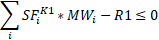
MWi:cleared CRR bids for bidder i
Pi:bid price for MWi
R1:cleared relaxtion variable for constraint K1
rpK1:reserve price for constraint K1
Figure 1 shows the example of this one-constraint model from the September meeting where there is both trade between CRR bidders and sales from the ISO relaxation variable. Note the change in sign convention from the meeting where the reserve price is now added to the objective function and it being a cost to the objective function is accounted for in the sign of the reserve price (as the Excel file calculates bid surplus with a sum product). As shown in the September 30 stakeholder meeting, this model illustrates that constraint specific reserve prices can allow auction participants to buy from the ISO if the reserve price is met, and still trade with each other even if their bids would not meet the reserve price if implemented as a bid floor/cap.
The relaxation variable R1 has a reserve price of -$2.50 meaning it will only release contracts if someone is willing to bid at least $2.50. That is, if clearing the participant bid increases (or at least does not decrease) the bid surplus net of the cost of the $2.50 reserve price cost to the bid surplus. Bid 1 is willing to pay $3.00 so clears contracts up to the limit of 30 MW. Bid 1 bids to buy up to 100 MW which is more than the 30 MW limit. Bid 2 is willing to sell contracts for $2.75 which is less than Bid 1’s willingness to pay, so an additional 70 MW of contracts is traded between Bid 1 and Bid 2. The shadow price on the constraint is $2.75 which sets the price for the contracts traded.
Figure 1. Two-node, one-constraint example 1

Now consider that a transmission line is really two constraints (i.e., one constraint for each of the two possible directions of flow on the line). Adding constraint K1C, which is the constraint on flows in the opposite direction of constraint K1, would mean also adding a relaxation variable and reserve price for constraint K1C as its limit is also set to 0. Just like all flows from CRRs on K1 are by definition counterflows on K1C, the model needs to account for the R1 counterflows on K1 being flows on K1C (and vice versa).
The formulation for this two-constraint model is:
maxMW,R1,R1CMWi*Pi+R1*rpK1+R1C*rpK1C
Subject to:
iSFiK1*MWi-R1+R1C≤0
iSFiK1C*MWi+R1-R1C≤0
Figure 2 and 3 below provide two examples of this two-node two-constraint model.[6] In these examples, the expected shadow price on constraint K1 is $3 and the reserve prices are set with 5 percent premiums on this expected shadow price. This implies a reserve price in the flow direction (R1) of $3.15 and a reserve price in the counterflow direction (R1C) of $2.85.
- Example 1 in Figure 2 shows that, again, auction participants can trade with each other or with the ISO through the relaxation variables. Bid 1 clears 8 MW. Bid 2 provides 3 MW because it is willing to sell at $2.80 which is less than Bid 1’s willingness to pay of $3.20. R1, the ISO relaxation variable, provides the additional 5 MW as $3.20 is greater than the reserve price. The price is set at $3.20 for all contracts.
- Example 2 in Figure 3 shows an example of only a bid clearing counter to the direction of prevailing flow. This is meant to highlight that setting reserve prices based on expected value means lowering the reserve price when the default $0 reserve price is above the expected value. Here, Bid 2 is willing to pay -$2.80 for 3 MW which is greater than the -$2.85 reserve price of the relaxation variable R1C (which enters the bid surplus as +$2.85). The ISO sells 3 MW to Bid 2 for a price of -$2.85.
Figure 2. Two-node, two-constraint example 1

Figure 3. Two-node, two-constraint example 2

Examples of calculating average shadow prices
To address some of the questions raised in the September 30 stakeholder meeting, below are some examples of how the reserve prices can be derived from a time series of hourly congestion data. Because no premiums or adjustments are applied to congestion data in these examples, the resulting reserve prices equal the value of having a CRR that flowed over the constraints over the period in the data. Note that the examples assume the same shift factors in the auction as in the data.
First, consider the case shown in Figure 4, where there are three lines in series modeled over 4 hours. When there is congestion, one of the three constraints binds with a shadow price of $1 per MWh. Constraint A binds for the first two hours. Constraint B binds in the third hour, and constraint C binds in the last hour. Summing up the shadow prices over the 4 hours on the constraints individually results in a $2 reserve price for constraint A, and $1 reserve prices for both constraints B and C. Summing over all the three constraints results in $4 (or $1 per MWh when dividing by 4 hours), which is what a CRR would be paid over the period. A reserve price of $4 could be put on any one of the three constraints, or $4 split into reserve prices over the three constraints as it is in the data, and the cost to the objective function would still equal the value of the CRR coming from the data.
Figure 4 Three lines in series, 4 hours

Now consider the case shown in Figure 5 where there are three lines in parallel. When there is congestion, one of the three constraints binds with a shadow price of $1 per MWh. Summing up the shadow prices over the 4 hours on the constraints individually results in a $2 reserve value for constraint A and $1 each for constraints B and C. Summing over all the constraints results in a total of $4 (or $1 per MWh). Applying the equal shift factors of 0.33, this results in an MCC of $1.33 (or $0.33 per MWh), which is equal to what CRR would be paid over the period. A reserve price of $4 could be put on any one of the constraints, or $4 split into reserve prices over the three constraints as it is in the data, and the cost to the objective function would still equal the value of the CRR coming from using the data as is.
Figure 5 Three parallel lines, 4 hours

Intervening to provide liquidity in a targeted and limited way
BAMx proposal
The Bay Area Municipal Transmission Group (BAMx) outlined potential ways the ISO could seek to provide liquidity in the CRR market in a targeted manner, aimed at parties that use the transmission system and can utilize CRR as hedges. This is consistent with the principle that if the ISO is going to intervene in markets, the intervention should be targeted and limited to achieving the purpose of the intervention.
Under the BAMx proposal, there are several ways the ISO could provide liquidity in addition to a willing seller auction to this targeted group:
- Running the current simultaneous feasibility test (SFT) auction design for the target group before a Willing Seller market.
- Providing source-to-sink path-based contracts, with reserve prices on these contracts, before or after a Willing Seller market to the target group.
- Running an SFT auction design for the target group with constraint specific reserve prices.
The ISO could also consider running an SFT auction with constraint specific reserve prices that is not targeted at entities that actually use the transmission system. Because this would not be targeted and limited, and because it would still have many of the problems caused by an SFT-based auction, this option may require additional measures such as the deficit offsets or other measures to mitigate opportunistic behavior.
[1] Congestion Revenue Rights Enhancements Phase 2, California ISO, September 30, 2026: https://stakeholdercenter.caiso.com/StakeholderInitiatives/Congestion-revenue-rights-enhancements
[2] Comments on Congestion Revenue Rights Enhancements Stakeholder Meeting Session #9, Department of Market Monitoring, May 6, 2026, pp 3-5: https://www.caiso.com/documents/dmm-comments-on-congestion-revenue-rights-enhancements-stakeholder-meeting-session-9-may-06-2026.pdf
[3] Comments on Congestion Revenue Rights Enhancements Phase 1 Draft Final Proposal, Department of Market Monitoring, July 2, 2026, pp 3-5: https://www.caiso.com/documents/dmm-comments-on-congestion-revenue-rights-enhancements-phase-1-draft-final-proposal-on-auction-efficiency-and-revenue-adequacy-jul-02-2026.pdf
Adding reserve prices to the CRR auction, Department of Market Monitoring, Congestion Revenue Rights Working Group, September 30, 2026: https://stakeholdercenter.caiso.com/InitiativeDocuments/Presentation-Department-of-Market-Monitoring-Congestion-Revenue-Rights-Enhancements-Sep-30-2026.pdf
[4] Usage-Based Limitations for Auction CRRs, Bay Area Municipal Transmission Group (BAMx), September 30, 2026: https://stakeholdercenter.caiso.com/InitiativeDocuments/Presentation-Flynn-Resources-Consultants-Congestion-Revenue-Rights-Enhancements-Sep-30-2026.pdf
[5] Memo to ISO Board of Governors and Western Energy Markets Governing Body, re: congestion revenue rights enhancements, July 8, 2026: https://www.caiso.com/documents/department-of-market-monitoring-update-congestion-revenue-rights-enhancements-jul-2026.pdf
[6] An Excel model for this example is also posted to the initiative comments.
2.
Please provide your organization’s feedback on the presentation by Doug Boccignone for the Bay Area Municipal Transmission Group (BAMx).
Auction Efficiency
Please see the PDF attached below the final question for DMM's fully formatted complete set of comments. For the reader's convenience, the complete text of the comments is pasted in response to #1, but there may be some formatting errors.
3.
Please provide your organization’s feedback on the presentation by Roger Avalos from the ISO Department of Market Monitoring (DMM).
Auction Efficiency
Please see the PDF attached below the final question for DMM's fully formatted complete set of comments. For the reader's convenience, the complete text of the comments is pasted in response to #1, but there may be some formatting errors.
4.
Are there any ideas for improving auction efficiency or design that have not been discussed in the initiative yet that you believe should be included in Phase 2?
Auction Efficiency
Please see the PDF attached below the final question for DMM's fully formatted complete set of comments. For the reader's convenience, the complete text of the comments is pasted in response to #1, but there may be some formatting errors.
5.
Please provide any other feedback from your organization on the auction efficiency and structure discussion covering slides 8-23
Auction Efficiency
Please see the PDF attached below the final question for DMM's fully formatted complete set of comments. For the reader's convenience, the complete text of the comments is pasted in response to #1, but there may be some formatting errors.
6.
If relevant, please provide your organization’s feedback on the current allocation process’s effectiveness at providing CRRs relevant to your congestion risk exposure. Are there specific features of the current allocation process that you see as barriers to receiving the CRRs most relevant to your congestion risk profile?
Allocation Process
Please see the PDF attached below the final question for DMM's fully formatted complete set of comments. For the reader's convenience, the complete text of the comments is pasted in response to #1, but there may be some formatting errors.
7.
Does your organization have any recommended changes to the allocation process?
Allocation Process
Please see the PDF attached below the final question for DMM's fully formatted complete set of comments. For the reader's convenience, the complete text of the comments is pasted in response to #1, but there may be some formatting errors.
8.
Please provide any other feedback from your organization on the allocation process discussion covering slides 24-30.
Allocation Process
Please see the PDF attached below the final question for DMM's fully formatted complete set of comments. For the reader's convenience, the complete text of the comments is pasted in response to #1, but there may be some formatting errors.
9.
Please provide your organization’s feedback on the product definition discussion covering slides 32-39.
Product Definition
Please see the PDF attached below the final question for DMM's fully formatted complete set of comments. For the reader's convenience, the complete text of the comments is pasted in response to #1, but there may be some formatting errors.
10.
What areas or proposals related to revenue adequacy are your organization’s highest priority going into Phase 2? Why do you see these as the highest priority?
Revenue Adequacy
Please see the PDF attached below the final question for DMM's fully formatted complete set of comments. For the reader's convenience, the complete text of the comments is pasted in response to #1, but there may be some formatting errors.
11.
Please provide your organization’s feedback on the potential modeling enhancements discussed on slides 45-50.
Revenue Adequacy
Please see the PDF attached below the final question for DMM's fully formatted complete set of comments. For the reader's convenience, the complete text of the comments is pasted in response to #1, but there may be some formatting errors.
12.
Please provide any other feedback from your organization on the revenue adequacy discussion covering slides 40-51.
Revenue Adequacy
Please see the PDF attached below the final question for DMM's fully formatted complete set of comments. For the reader's convenience, the complete text of the comments is pasted in response to #1, but there may be some formatting errors.
13.
Please provide any comments your organization has on the timeline and coordination discussion covering slides 51-52.
Timeline and Process Coordination
Please see the PDF attached below the final question for DMM's fully formatted complete set of comments. For the reader's convenience, the complete text of the comments is pasted in response to #1, but there may be some formatting errors.
14.
Are there any topics that your organization would like to request “deep dive” explanatory presentations on in future Phase 2 meetings?
Timeline and Process Coordination
Please see the PDF attached below the final question for DMM's fully formatted complete set of comments. For the reader's convenience, the complete text of the comments is pasted in response to #1, but there may be some formatting errors.
15.
Please provide any other comments or feedback your organization has on the September 30 Phase 2 kickoff meeting.
Catch-all
Please see the PDF attached below the final question for DMM's fully formatted complete set of comments. For the reader's convenience, the complete text of the comments is pasted in response to #1, but there may be some formatting errors.
Constellation
Submitted 10/16/2026, 12:57 pm
1.
Does your organization have a preferred proposal on auction efficiency at this time, or a preferred approach out of the “levers” discussed on slides 13-17? If so, please explain why you believe this proposal/approach is the best. Alternatively, if you have previous comments that address this question and are still accurate, please cite them.
Auction Efficiency
Organizational Transition and Prior Comments
Following Constellation’s acquisition of Calpine, Constellation is participating in this initiative as a single organization representing the combined business and reflecting the interests and market perspectives previously represented by Calpine.
Accordingly, Constellation stands behind Calpine’s prior comments and stakeholder feedback in this initiative unless expressly modified or superseded in subsequent comments.
This organizational transition does not change the substantive concerns and recommendations Calpine previously raised regarding the CRR market. Those positions include the importance of broad participation and liquidity, effective congestion hedging, improved price discovery, greater auction frequency, improved alignment between the CRR and Day-Ahead models, and reforms that improve CRR funding reliability before CAISO considers significant restrictions on auction participation. These themes are reflected consistently in Calpine’s prior CRR comments.
Constellation therefore encourages CAISO to consider the prior Calpine comments together with these comments as a continuous stakeholder record in this initiative.
Overview and Recommendation for Approach to Restarting CRR Initiative and Addressing Auction Efficiency
Constellation recommends that CAISO focus first on establishing a more liquid, competitive, and reliable CRR market before considering new participation limits, usage requirements, reserve prices, or other new restrictions. The first step should be to improve the underlying market structure and increase participation, liquidity, and price discovery. CAISO can then evaluate actual market outcomes and determine whether targeted changes remain necessary.
This sequencing is important. More frequent auctions, improved CRR products, greater participation, better model alignment, and more reliable funding should improve price formation and allow competition to reduce persistent pricing disparities. Calpine’s prior comments consistently emphasized that broad participation and liquidity allow profitable opportunities and excessive risk premiums to be competed away, while restrictions on participation can weaken price discovery and hedging effectiveness.
CAISO should avoid trying to improve the market structure while simultaneously imposing new restrictions on that market. Doing both at once could reduce participation before the benefits of the structural improvements can be observed and make it difficult to determine what is actually driving auction outcomes.
Constellation recommends a straightforward sequence:
- Fix the foundational structure by improving auction frequency, products, model alignment, funding reliability, and opportunities for participation.
- Allow increased liquidity and competition to improve price discovery and compete away persistent profits or mispricing where possible.
- Evaluate the resulting market and identify the specific paths or constraints that continue to contribute materially to underfunding.
- Only then consider targeted measures directed at demonstrated residual problems.
This approach does not foreclose later changes. It gives CAISO better information for designing them. If material underfunding remains concentrated on particular paths or constraints after the market improvements are implemented, CAISO can address those problems directly rather than applying broad restrictions that could unnecessarily reduce participation and liquidity across the market.
Consistent with this approach, Constellation does not recommend advancing the BAMx proposal or DMM reserve-price concepts at this stage. Other stakeholders including WPTF similarly recommend addressing modeling, underfunding allocation, product definitions, and storage sink eligibility before significant structural auction reforms. The immediate priority should be to improve how the CRR market functions, expand participation and liquidity, and then use the resulting market experience to determine whether additional, more surgical reforms are warranted.
2.
Please provide your organization’s feedback on the presentation by Doug Boccignone for the Bay Area Municipal Transmission Group (BAMx).
Auction Efficiency
Constellation does not necessarily oppose some aspects of BAMx’s proposal, however we do not support advancing the BAMx proposal at this stage.
The proposal would impose eligibility and quantity restrictions before CAISO has tested whether foundational market improvements can increase participation, deepen liquidity, improve price discovery, and reduce apparent auction inefficiencies. Restrictions tied to physical positions, Inter-SC Trades, or other usage measures could exclude participants that provide liquidity, counterflow, and risk-management services even when those participants do not hold the underlying physical exposure.
The BAMx proposal also risks treating financial participation as the cause of underfunding without first separating the effects of model divergence, loop flows, outage representation, the shift factor threshold, payout uncertainty, and the current shortfall allocation method. Prior Calpine comments explained that financial participants can provide the counterparty needed by physical hedgers, supply counterflow, increase feasible hedge availability, and improve price formation.
CAISO should first establish a market structure that encourages broader participation. Increased competition should reduce persistent profits on underpriced paths as additional participants identify and compete for those positions. Once the market becomes deeper and produces better price signals, CAISO will be better positioned to identify any specific paths or constraints that continue to cause material underfunding.
If targeted problems remain, CAISO can then consider narrow measures directed at those problems. This would be more effective than applying a blunt participation restriction across the auction.
3.
Please provide your organization’s feedback on the presentation by Roger Avalos from the ISO Department of Market Monitoring (DMM).
Auction Efficiency
Constellation does not support proposals to introduce constraint-specific reserve prices at this stage. A constraint-specific approach may be narrower than a universal price floor, but it would still introduce an administrative pricing constraint before CAISO has completed the foundational work needed to improve market participation and price formation. The immediate priority should remain liquidity, auction frequency, model alignment, product improvements, and greater confidence in CRR payouts.
Reserve prices could prevent economically useful transactions, reduce counterflow, and limit the number of simultaneously feasible CRRs awarded. The current record does not establish how those effects would influence participation, clearing volumes, hedge availability, or underfunding.
CAISO should revisit this concept only after it has improved the underlying market structure and assessed the resulting outcomes. If specific constraints continue to produce material underfunding, CAISO could then evaluate a targeted mechanism based on transparent analysis. Any proposal should provide analysis of its effects on participation, counterflow, clearing quantities, auction prices, and CRR funding.
4.
Are there any ideas for improving auction efficiency or design that have not been discussed in the initiative yet that you believe should be included in Phase 2?
Auction Efficiency
Constellation requests that CAISO focus Phase 2 on the reforms needed to create a well-functioning CRR market:
- More frequent auctions, including Balance of Planning Period opportunities.
- Updated product definitions that better reflect current system conditions.
- Stand-alone storage eligibility as a CRR sink.
- Improved alignment between the CRR and Day-Ahead models.
- Better treatment of loop flows, outages, unscheduled flows, and the shift factor threshold.
- Reform of constraint-by-constraint shortfall allocation to improve hedge reliability and reduce path-specific payout volatility.
- Transparent reporting that identifies the paths and constraints responsible for material underfunding.
These reforms address separate but related barriers to participation. More frequent auctions allow participants to rebalance as system information changes. Better products make CRRs more useful as hedges. Improved model alignment and shortfall allocation reduce payout uncertainty. Together, these changes should attract participation, improve price discovery, and make CRRs more reliable.
5.
Please provide any other feedback from your organization on the auction efficiency and structure discussion covering slides 8-23
Auction Efficiency
CAISO should not treat the auction efficiency metric as a complete measure of market performance or assume that profitable auction positions establish a defect in the auction structure.
The relevant criterion is whether the market provides useful congestion hedges and competitive forward price signals at a reasonable total cost. Constellation and Calpine have direct experience that well-functioning CRR and FTR markets can reduce risk premiums in bilateral and retail contracts, facilitate longer-term procurement, and allow participants to rebalance changing portfolios. Those benefits are not captured by a comparison of auction revenues and realized CRR payouts.
A liquid market should cause persistent profits to attract additional participation. Competition should bid up undervalued paths and reduce abnormal returns. Restricting participation would work in the opposite direction. It could preserve mispricing by reducing the number of participants evaluating and competing for available CRRs.
CAISO should therefore first expand participation and improve market design. It should then use the resulting data to isolate paths or constraints that continue to contribute disproportionately to underfunding. Any remaining intervention should be surgical and directed at the demonstrated sources of problems.
6.
If relevant, please provide your organization’s feedback on the current allocation process’s effectiveness at providing CRRs relevant to your congestion risk exposure. Are there specific features of the current allocation process that you see as barriers to receiving the CRRs most relevant to your congestion risk profile?
Allocation Process
The allocation process alone cannot provide all participants with CRRs that match their changing congestion exposure. Load, supply arrangements, customer portfolios, and resource positions change over time. The auction provides the mechanism needed to acquire, sell, and rebalance CRRs when allocated rights do not correspond to actual exposure.
CAISO should therefore evaluate allocation changes together with the need for a liquid reconfiguration market. Allocation reform should not substitute for broad auction access or restrict the ability of participants to obtain the hedges that correspond to their actual portfolios.
7.
Does your organization have any recommended changes to the allocation process?
Allocation Process
Constellation supports moving forward with updated time-of-use products and allowing stand-alone storage to qualify as an eligible sink.
CAISO should also continue developing more frequent and longer-tenor products. These changes would improve the usefulness of CRRs, provide more current price signals, and allow participants to adjust positions as grid conditions change.
Product improvements should proceed before CAISO considers restrictions that could reduce the participant base. Better products and more frequent auctions are direct means of attracting participation and improving price discovery.
8.
Please provide any other feedback from your organization on the allocation process discussion covering slides 24-30.
Allocation Process
No comment at this time.
9.
Please provide your organization’s feedback on the product definition discussion covering slides 32-39.
Product Definition
No comment at this time.
10.
What areas or proposals related to revenue adequacy are your organization’s highest priority going into Phase 2? Why do you see these as the highest priority?
Revenue Adequacy
Constellation recommends that CAISO should prioritize the identified causes of revenue inadequacy rather than treating auction participation as the default cause.
The existing record identifies model differences, loop flows, outage representation, and the shift factor threshold as material issues. CAISO should quantify the contribution of each driver, improve model convergence, and reconsider whether constraint-by-constraint shortfall allocation places risk on the parties best able to manage it.
CAISO should also provide path-level and constraint-level information identifying where underfunding remains concentrated. That information will allow CAISO and stakeholders to distinguish broad structural problems from discrete issues that may warrant targeted treatment.
11.
Please provide your organization’s feedback on the potential modeling enhancements discussed on slides 45-50.
Revenue Adequacy
No comment at this time.
12.
Please provide any other feedback from your organization on the revenue adequacy discussion covering slides 40-51.
Revenue Adequacy
No comment at this time.
13.
Please provide any comments your organization has on the timeline and coordination discussion covering slides 51-52.
Timeline and Process Coordination
Constellation supports a phased process, but the sequence matters. CAISO should first implement changes that enhance liquidity, participation, price discovery, product usefulness, model alignment, and hedge reliability. It should then evaluate performance over a reasonable operating period and determine whether material problems remain.
CAISO should not attempt to improve market structure and restrict participation at the same time. Doing both would make it difficult to determine which change caused the resulting outcomes and could prevent the improved structure from attracting the participation needed to work effectively.
CAISO will have additional opportunities to consider refinements. It should use those opportunities after the foundational reforms produce sufficient information to support targeted reforms. The near-term priority should be to fix the structure first, evaluate the market response, and make narrow adjustments later.
14.
Are there any topics that your organization would like to request “deep dive” explanatory presentations on in future Phase 2 meetings?
Timeline and Process Coordination
No comment at this time.
15.
Please provide any other comments or feedback your organization has on the September 30 Phase 2 kickoff meeting.
Catch-all
No comment at this time.
CPUC
Submitted 10/13/2026, 10:30 am
1.
Does your organization have a preferred proposal on auction efficiency at this time, or a preferred approach out of the “levers” discussed on slides 13-17? If so, please explain why you believe this proposal/approach is the best. Alternatively, if you have previous comments that address this question and are still accurate, please cite them.
Auction Efficiency
Energy Division staff (ED staff or staff) of the California Public Utilities Commission (CPUC) develops and administers energy policy and programs to serve the public interest, advises the CPUC, and ensures compliance with CPUC decisions and statutory mandates. ED staff provides objective and expert analyses that promote reliable, safe, and environmentally sound energy services at just and reasonable rates for the people of California.
ED staff appreciates the opportunity to submit comments on the Congestion Revenue Rights (CRR) Phase 2 kickoff meeting. The CRR market as currently designed has led to over $1 billion in ratepayer losses since its formation in 2012. ED staff highlights that this initiative was launched in the Fall of 2024 to examine and pursue improvements to the CRR market. This initiative has now met a total of 12 times over two years without any major reforms being adopted. The problem with the current CRR auction design has been clear throughout the stakeholder initiative; the current design of the CRR auction allows participants with no hedging need to purchase CRRs at $0 or low prices.
In this initiative, market participants purchasing CRRs at or near $0 have argued that they provide liquidity for forward contract price discovery commensurate with the level of congestion revenue that their CRR positions capture. While these participants claim that liquidity benefits ratepayers with improved price discovery, they have not provided any concrete evidence to support this contention. CAISO’s Market Surveillance Committee chair, Dr. James Bushnell stated a similar point during the June 11th MSC meeting focused on CAISO’s Phase 1 CRR proposal:
I am not aware of empirical evidence on how much CRRs [excluding long-term CRRs] (or equivalents) improve investment efficiency or other outcomes, and how much value is there in the ability to nominate or purchase a sequence of seasonal or monthly CRRs for financing new investment?[1]
Market participation from financial entities solely for the purposes of speculative auction participation negatively impacts affordability for CAISO ratepayers since the speculative financial positions capture congestion revenues that cannot be allocated to load pro-rata to reduce their transmission access charge (TAC) burden. Given that congestion revenues could reduce ratepayers’ TAC burden if that revenue is not diverted to non-load entities, those financial entities who want ongoing access to congestion revenue should have to pay at least something reasonable in order to gain access to congestion revenues. ED staff supports the idea that CAISO should not be selling CRRs at $0 to entities (or, at the extreme, paying entities to take them) that do not pay for the cost of the transmission grid.
CAISO’s recent analysis presented at the September 30th CRR meeting and at the September 28th EDAM Market Performance meeting highlights a concerning trend.[2] If one removes the abnormality of January 2024 Martin Luther King weekend, August 2026 appears to have the lowest auction efficiency over the last two years. The auctions are supposed to be a price discovery mechanism for day-ahead market (DAM) congestion. If the auction was effectively acting as a price discovery mechanism, auction revenues should be close to the levels of congestion seen. This mechanism is never going to perfectly predict DAM congestion, but it should be fairly close. However, while this data is limited to the last two years, it does not appear to be working effectively. By contrast, if one is engaging in CRR auction speculation, an entity is effectively paying 30 cents for an entitlement to a $1 CRR payout. The less an entity pays for the CRR, the larger the spread between the payment for the CRR and the return on investment with the CRR payout. Due to the Track 1B deficit offset changes, an entity’s payout is reduced down to only what is collected, so an entity might only receive 80 cents instead of a $1. However, as revenue adequacy levels continue to improve, the size of a CRR holders’ exposure to the Track 1B deficit offset declines, because the size of payout reductions are reduced if more revenue is collected.
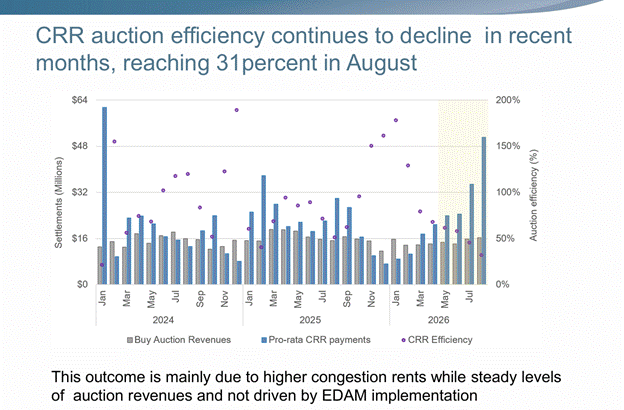
Building off this history and context, ED staff appreciates CAISO directly addressing auction efficiency at the kickoff of Phase 2 of CRRE with a series of different proposals. Stakeholders will disagree on possible improvements, but the broader objective of improving the ability of the CRR auctions to serve as a price discovery mechanism of DAM congestion should not be controversial.
During the September 30th workshop, CAISO presented three different groupings of possible auction efficiency improvement measures: Price Measures, Participation Measures, and Availability Measures. ED staff continues to support wholesale CRR auction reform as the cleanest and most direct mechanism for providing hedging opportunities and reducing ratepayer risk. Measures such as the Department of Market Monitoring’s (DMM) Willing Buyer-Willing Seller (WBWS) proposal would accomplish those goals. However, WBWS has continually received significant opposition from outside the load serving entity (LSE) community — leaving stakeholders with less ideal solutions.
Broadly speaking, ED staff believes price and availability measures are likely to include more viable solutions that will receive less opposition than participation measures. ED staff is supportive of participation measures, but these types of measures introduce more extensive questions. ED staff does think some sort of participation mechanism will be needed if the CRR process is expanded to storage resources, however that is beyond the scope of this question.
CAISO is required by a series of FERC orders to provide hedging opportunities for market participants, but CAISO is not required to provide access to hedging opportunities at a discount or low prices. Further, CAISO is required to provide hedging opportunities, but it is not required to provide unlimited opportunities. These two well-established premises provide more than sufficient basis for adoption of price and/or availability measures to improve auction efficiency and improve the quality of hedges emerging from the CRR process. ED staff encourages CAISO to continue to explore and develop further price and availability measures. Stakeholders have raised concerns about CAISO’s ability to accurately set reserve or minimum prices, but the expectation should not be that CAISO nor any other entity will get this right on the first try. CAISO should focus this next phase of this initiative on developing a reserve pricing proposal, with the ability to fine tune and adjust the reserve prices via Business Practice Manual (BPM) changes. Ultimately, even an imperfect price is better than very small, $0, or negative clearing prices. ED staff will expand on this in response to Question 4, below.
[1] Slide 4 Congestion Revenue Rights: Initial Thoughts on the Current Proposals
[2] Presentation-Congestion-Reveune-Rights-Enhancements-Sep30-2026 (1).pdf
2.
Please provide your organization’s feedback on the presentation by Doug Boccignone for the Bay Area Municipal Transmission Group (BAMx).
Auction Efficiency
ED staff appreciates the presentation by Doug Boccignone on behalf of the Bay Area Municipal Transmission Group (BAMx). ED staff is supportive of this proposal should there be sufficient stakeholder support. ED staff thanks BAMx for highlighting the FERC precedent for auction limits:
FERC Order 681 does not require an unrestricted auction as a condition of open access and establishes priority to financial transmission rights based on load-serving obligations, transmission use, and transmission investment.[1]
ED staff appreciate BAMx developing this proposal, because it allows those with true hedging needs to access CAISO-backed CRRs. ED staff sees value in a version of this proposal being used to incorporate storage as a sink in the auction process. ED staff is concerned that allowing storage into the CRR auctions with no restrictions could effectively undo a critical part of the Track 1A reforms that eliminated gen-gen CRRs. ED staff conditions any expansion of storage in the CRR process to be conditional on storage paying the TAC. If a standalone storage resource is dependent on the grid for charging, then the resource using the grid should pay the TAC. When storage is in a charging state, that resource is effectively acting as load; thus, it follows that if load pays the TAC, storage should also. If standalone storage is truly charging from the grid and paying the TAC, then there is a rationale for needing to hedge congestion that the resource might experience when charging. However, ED staff is concerned that entities without true hedging needs could identify work arounds to circumvent qualification metrics in order to gain access to the CRR auction process.
[1] Slide 3 Presentation-Flynn-Resources-Consultants-Congestion-Revenue-Rights-Enhancements-Sep-30-2026 (1).pdf
3.
Please provide your organization’s feedback on the presentation by Roger Avalos from the ISO Department of Market Monitoring (DMM).
Auction Efficiency
ED staff are very supportive of DMM’s constraint-based reserve pricing proposal. ED staff, along with many other stakeholders, has for years been concerned about CAISO making unallocated grid capacity available at low, zero, or even negative prices on behalf of California ratepayers. Ratepayers fund the upkeep and maintenance of the grid via the TAC, but have never explicitly agreed to make this unallocated grid capacity available or allow the release of these excess funds. Establishing constraint-based reserve prices based on consultation with ratepayer representatives would reduce ED staff’s concerns stemming from the auction.
4.
Are there any ideas for improving auction efficiency or design that have not been discussed in the initiative yet that you believe should be included in Phase 2?
Auction Efficiency
ED staff is supportive of DMM’s constraint-based reserve pricing proposal. However, if DMM’s proposal proves too difficult to implement on every constraint across the grid, ED staff would encourage CAISO to identify a subset of constraints to establish constraint specific reserve prices for. For example, CAISO could establish reserve prices for a subset of constraints (e.g., the top 20 highest valued constraints or top 20% percentage of constraints based on value, etc.) and apply a universal minimum to the rest of the grid. ED staff will reiterate establishing perfect reserve prices is not the expectation.
5.
Please provide any other feedback from your organization on the auction efficiency and structure discussion covering slides 8-23
Auction Efficiency
ED staff would be open to considering a tiered approach to CRR payouts (see slide 16 settlement measures).[1] A tiered approach was briefly discussed during Phase 1 but not considered further. There are a number of questions that arise with this approach, that stakeholders and CAISO would need to consider:
- Should CRRs allocated to TAC paying entities be entitled to full CRR payouts based on notional, not realized value?
- If CRR revenue is not sufficient to fully fund CRR payouts for TAC paying entities, should a revenue netting mechanism be implemented or should uplift be charged to measured demand (load)?
- Are there cost shifting concerns with an uplift-based mechanism to ensure full funding for TAC paying entities (e.g. load from one LSE could be funding full CRR payouts to another LSE)?
- Could different market participants pay a charge set at a percentage of the TAC rate in order to be guaranteed a commensurate level of CRR payouts? Should this percentage be fixed or variable? Should it differ by season, monthly, or annual process?
- If CRR revenue is not sufficient to fully fund partial CRR payout entitlements, what should occur?
- Does a bifurcated settlement measure based tier approach really improve the quality or reduce uncertainty of hedges from procurement in the CRR auction?
More importantly, the current state of the CRR market, CAISO’s own slide deck, and the last five questions show there is extensive work to be done in terms of improving auction efficiency. Therefore, ED staff continues to encourage CAISO to explicitly focus on improving auction efficiency before implementing new time-of-use periods or adding new sink locations in the auctions. ED staff agrees that improved revenue adequacy could reduce the size of risk premiums entities are including in their CRR auction bids, but cautions that risk premiums alone are not likely the sole cause of high levels of auction inefficiency. In addition, there is no transparent mechanism to understand the offer curves that entities use to determine their risk premiums, so ED staff is skeptical how much improved revenue adequacy would actually improve auction efficiency. ED staff does not necessarily oppose new modeling enhancements that could improve revenue adequacy, but strongly believes these are a second order priority.
[1] Presentation-Congestion-Reveune-Rights-Enhancements-Sep30-2026 (1).pdf
6.
If relevant, please provide your organization’s feedback on the current allocation process’s effectiveness at providing CRRs relevant to your congestion risk exposure. Are there specific features of the current allocation process that you see as barriers to receiving the CRRs most relevant to your congestion risk profile?
Allocation Process
ED staff does not directly participate in the CRR market, but the CPUC has regulatory oversight jurisdiction over IOU CRR market participation in the allocation and auction process via each IOU’s bundled procurement plan (BPP). An update and review of each IOU’s BPP is currently in scope of Rulemaking (R.) 25-06-019, however ED staff is not aware of any modifications being needed or proposed to the allocation process that has been raised in this initiative or in the BPP proceeding by stakeholders more broadly. While IOU CRR auction participation restrictions are under consideration in R.25-06-019, this is a separate issue outside of the scope of this question and of this initiative.
ED staff will note that non-IOU LSE stakeholders have mentioned concerns with the CRR allocation process during the June 11th MSC meeting. CRRs are allocated based on historical usage, and a new LSE does not have historical usage to be allocated. ED staff does not regulate non-IOU LSEs, so ED staff is not familiar with the details of their allocations. ED staff requests and would welcome a deep-dive presentation by non-IOU LSEs to understand in detail what issues non-IOU LSEs are experiencing in the CRR allocation process. ED staff believes further information on this issue to the extent there are issues would be helpful for all stakeholders. If non-IOU LSEs do not identify any needed modifications to the CRR allocation process, then ED staff recommends removing this topic from the scope of this initiative.
7.
Does your organization have any recommended changes to the allocation process?
Allocation Process
ED staff would encourage CAISO to explore allocating CRRs to independent generators and energy marketers in exchange for paying the TAC. Currently, the only way energy marketers or independent generators can get access to CRRs they need for hedging is through the auction process. This seems less efficient than simply just allocating them the hedges to begin with, and reconfiguring portfolio misalignment in the downstream auctions.
ED staff does not support the addition of any new products, time-of-use periods, or sink locations to the auction process at this time. If storage is added as a sink in the auction, it should only be adopted if added as a sink in the allocation process as well. The MSC in their July board memo noted that limited sink availability in the allocation process could be introducing other issues, “The allocation mechanism raises its own efficiency and equity concerns: some LSEs may gain far more value from their allocations than others, and limited sink options can lead to herding on high-value paths.”[1] In addition, for standalone storage to be eligible for hedges, they should be required to pay the TAC. Standalone storage is exposed to congestion when charging from the grid acting as load, so should contribute to the cost of the grid. ED staff understands the majority of storage contracts are RA-only, but to the extent there are tolling contracts in place now or signed in the future, LSEs should be able to hedge their congestion exposure.
[1] Pg.3, market-surveillance-committee-update-jul-2026.pdf
8.
Please provide any other feedback from your organization on the allocation process discussion covering slides 24-30.
Allocation Process
ED staff does not have additional feedback at this time. However, ED staff requests analysis or aggregated auction data detailing how many low priced CRRs are from LSE sales or from CAISO selling the unallocated grid capacity. ED staff does not believe this to be the case but is curious to what extent are LSEs possibly intentionally nominating CRRs to just to then sell them in the auction process.
9.
Please provide your organization’s feedback on the product definition discussion covering slides 32-39.
Product Definition
ED staff is not opposed to adding new time-of-use periods, because ED staff agrees that grid conditions have changed with the addition of large amounts of solar and storage, so hedging needs are evolving. However, ED staff does not view new TOU periods as a priority. ED staff is concerned about introducing more variables to the CRR process, when the CRR process is already experiencing high levels of revenue inadequacy and auction inefficiency. It is true product misalignment could be contributing to these issues, but ED staff does not believe product misalignment is a key contributor.
ED staff is hesitant about adding storage as sink location in the auction process at this time. In Track 1A of the 2018-2019 CRR Initiative, the ability to acquire gen-to-gen CRRs was eliminated, which has helped improve the hedging quality of CRRs. The addition of storage as a sink could easily reverse this improvement, as it would effectively undo the gen-to-gen CRR restrictions. Unless a storage facility has a procurement contract with a specified resource, it remains unclear to ED staff what actually would be the source location for these proposed gen-to-storage CRRs because most storage assets are not paired with specific resources. The majority of storage resources are just absorbing cheap abundant excess solar energy produced during the day regardless of its actual source location and sinking it in their batteries. It remains unclear how an entity could determine that they would need to hedge a congestion risk if they do not even know what the source is themselves, let alone be able to identify this source location to purchase a CRR in the auction. In essence, ED staff is unclear how an entity would determine a source for proposed gen-to-storage CRRs. ED staff supposes one could source at a DLAP and sink at their storage location, but this is effectively an imprecise hedge rather than a precise hedging instrument.[1] ED staff does not disagree that storage resources could be exposed to congestion while charging, but would appreciate more insight regarding how to determine the source in order to determine the congestion hedge needed.
Co-located or hybrid resources should be restricted entirely. There is no congestion to hedge when the source and sink are at the same location. To the extent the onsite generation at times does not produce sufficient capacity to charge the onsite storage assets, that is a design issue rather than justification for a congestion hedge.
[1] See slide 5 – an entity could use a DLAP, sub-LAP, intertie point, etc. to create an imperfect hedge. Presentation-Vistra-Congestion-Revenue-Rights-Enhancements-Jan-28-2025 (3).pdf
10.
What areas or proposals related to revenue adequacy are your organization’s highest priority going into Phase 2? Why do you see these as the highest priority?
Revenue Adequacy
ED staff requests more detailed information and analysis on the two proposed enhancements, before providing further comment. ED staff is particularly interested in understanding further the implications of using different models in the annual and monthly processes. Using the most up-to-date grid conditions seems wise.
11.
Please provide your organization’s feedback on the potential modeling enhancements discussed on slides 45-50.
Revenue Adequacy
See question 10.
12.
Please provide any other feedback from your organization on the revenue adequacy discussion covering slides 40-51.
Revenue Adequacy
ED staff appreciates CAISO expanding their loop flow modeling, but it is too early to know if this expanded modeling will improve revenue adequacy. ED staff in previous comments has questioned the impact this change will have. In addition, conversations surrounding modifying the global derate factor (GDF) could be warranted depending on the impact of these modeling changes and the expansion of the GDF to contingency constraints. However, modeling loop flow is different than collecting revenue for congestion caused by loop flows. ED staff has consistently argued that external entities should not be able to freely use capacity on the transmission grid without paying for the congestion that they cause. However, this is a conversation for the EDAM Congestion Revenue Allocation (CRA) initiative.
Regarding reducing the divergence between the shift factors thresholds used in the integrated forward market (IFM) and CRR models, ED staff currently does not support keeping this item in scope. ED staff understands and agrees with the stakeholder interest in this reform because it is likely to have the largest bang-for-your-buck impact in terms of improving revenue adequacy. However, there have been no material changes in facts regarding the complexity and risks of implementing such a change. Reducing this divergence of shift factor thresholds requires modifications to the IFM which would implicate the entire EDAM footprint, not just the CAISO BAA CRR process. Pursuing reforms to the IFM for a relatively small amount of additional congestion revenue pales in comparison to the computational and reliability impacts reducing the shift factor thresholds could have on the IFM. ED staff is interested in hearing from other stakeholders whether they have identified any other mechanisms to reduce this divergence that does not implicate the market model that runs the electricity grid for the entire EDAM footprint.
13.
Please provide any comments your organization has on the timeline and coordination discussion covering slides 51-52.
Timeline and Process Coordination
ED staff understands that there are modeling improvements that could result in increasing revenue adequacy and are likely simpler to design than mechanisms to improve auction efficiency. However, one goal should not move before the other as currently floated by CAISO on slide 53 “Additional modeling enhancements in line with today’s discussion could be ready for a Board decision in Q1 if there is sufficient stakeholder support.”[1] Improving revenue adequacy and auction efficiency are two overarching goals of this initiative, so ED staff supports CAISO moving forward with a grand package as proposed for Q3 2027.
ED staff continues to be concerned about the development of a long-term EDAM Congestion Revenue Allocation mechanism in Phase 2 as the underfunding of CRRs caused by loop-flows will become further entrenched with an unconstrained EDAM-wide simultaneous feasibility test (SFT). In addition, the proposed usage of the weighted-least squares methodology in EDAM CRA is a concern for ED staff as this methodology could further degrade the quality of CRRs, because constraints with higher shift factors are curtailed first before constraints farther away with lower shift factors.
[1] Presentation-Congestion-Reveune-Rights-Enhancements-Sep30-2026 (1).pdf
14.
Are there any topics that your organization would like to request “deep dive” explanatory presentations on in future Phase 2 meetings?
Timeline and Process Coordination
Please see question 6 and 9. ED staff would welcome a refreshed presentation by Vistra or other storage operators and how one determines a source for these hedges, since it has been almost two years since Vistra first presented this topic. In addition, ED staff requests a presentation by non-IOU LSEs regarding the challenges these entities face in the allocation process.
15.
Please provide any other comments or feedback your organization has on the September 30 Phase 2 kickoff meeting.
Catch-all
No further comments at this time. ED staff looks forward to further engagement and discussion in this initiative.
DC Energy California, LLC
Submitted 10/15/2026, 04:19 am
1.
Does your organization have a preferred proposal on auction efficiency at this time, or a preferred approach out of the “levers” discussed on slides 13-17? If so, please explain why you believe this proposal/approach is the best. Alternatively, if you have previous comments that address this question and are still accurate, please cite them.
Auction Efficiency
Yes, the CAISO can and should improve Auction Efficiency through practical enhancements to the existing market design that improve the reliability and utility of CRRs , increasing auction participant confidence and ultimately auction revenue, as discussed on Slide 17. (See DC Energy’s proposed “Package Four – Incremental enhancements to the current CRR market design” in response to Question 2 in comments submitted on May 6, 2026 for a more complete answer.)
In the CAISO, high and uncertain congestion revenue inadequacy reduces CRR Auction Efficiency. The CAISO should address the three root causes of congestion revenue underfunding: (1) unscheduled parallel flows; (2) misalignment between the day-ahead and CRR models; and (3) the shift factor threshold cutoff discrepancy. Reducing CRR underfunding by both reducing congestion revenue inadequacy, as well as reforming its allocation, would make CRRs a more reliable and therefore more valuable congestion hedging instrument, ultimately improving Auction Efficiency.
The CAISO’s proposal to focus on further enhancements to CRR modeling in Phase 2A should help mitigate the first two causes of congestion revenue inadequacy, i.e., unscheduled parallel flows and misalignment between day-ahead and CRR models. In addition, increasing ed transparency regarding future system conditions, including more accurate outage information postings, would reduce congestion revenue inadequacy and also would allow CRR auction participants to bid with more confidence in CRR auctions, further improving Auction Efficiency.
Next, the CAISO should return to the proposal to add a Time of Use (TOU) for CRRs that better represents solar peak hours. A Peak-Solar TOU period would allow market participants to bid on CRRs with greater confidence, because a narrower, more targeted set of hours reduces variability in (1) the power flows and congestion patterns that determine hedge value, and (2) the volumes, and for batteries the direction, that determine hedge quantity. . In addition, solar resources in the Southwest account for a substantial portion of unscheduled parallel flow in the CAISO. Accurate loop flow modeling requires differentiating between Peak-Solar hours and the other hours in the current On-Peak definition.
Each of the other four categories of changes or “levers” discussed on Slide 17 represents a significant limitation on a key aspect of the CRR market and a deterioration of the original market design. The participation measures limit participation in auctions, and the availability measures limit the availability of CRRs, violating open access principles and limiting market liquidity. The price measures limit the prices at which CRRs can be bid and/or clear, excluding or failing to clear transactions, ultimately limiting price formation and market liquidity. The settlement measures limit the availability of firm settlement rights, creating two classes of rights: one that remains the financial equivalent of firm transmission service and another that would be far less certain and, therefore, far less useful. (See DC Energy’s comments on “Package Three” in response to Question 2 in comments submitted on May 6, 2026 for a more complete answer regarding the proposal to split the CRR market into different settlement classes.)
2.
Please provide your organization’s feedback on the presentation by Doug Boccignone for the Bay Area Municipal Transmission Group (BAMx).
Auction Efficiency
The BAMx proposal is unduly discriminatory, violates the principles of open access, will drastically reduce liquidity, and will ultimately fail to improve Auction Efficiency.
Under BAMx’s proposal, there would be far less competition in the CRR market. Facing less competition, the remaining auction participants would have less incentive to bid up to their respective expectations of future congestion on certain paths, let alone pay more in the auction. Also, there would be far less counterflow, and,as a result, some auction participants seeking to hedge physical transactions would be unable to acquire an adequate CRR portfolio. Furthermore, there would be far fewer market participants willing or able to purchase CRR capacity and take on its attendant risk from CRR allocation recipients attempting to sell their allocations at auction.
With less liquidity, the auction would fail to maximize the full potential of networked capacity. A thinly traded, illiquid market would provide less robust price discovery and less efficient distribution of settlement risk. Less auction revenue would be collected as a result of the proposed bidding restrictions and more congestion revenue would be allocated on an inefficient load ratio basis rather than on the basis of CRR portfolios calibrated to the congestion risk various physical market participants actually face.
BAMx’s proposal would limit auctions to physical hedgers, decreasing competition and shrinking the market, which would further deteriorate rather than enhance the hedge value of CRRs. Instead, load serving entities should participate more fully in CRR auctions, thus increasing competition, which would improve the price discovery function of the CRR market and ultimately the hedging value of CRRs. Additional competition would be better for the CAISO market and the long-term interests of all market participants.
3.
Please provide your organization’s feedback on the presentation by Roger Avalos from the ISO Department of Market Monitoring (DMM).
Auction Efficiency
DC Energy shares many of the concerns with this proposal that were raised during the meeting.
The DMM’s reservation proposal would only be workable if certain reasonable measures were built into its methodology. For instance, as discussed at the September 30th meeting, reservation prices on the individual constraints that make up a CRR path should not pancake. If they did pancake, many paths would have prohibitively high reservation prices that would prevent them (and perhaps the whole market) from clearing.
Furthermore, constraint reservation prices should not be based on modeling future congestion. Any inaccuracy in these forecasts would lead to market inefficiency. For example, if a CRR was worth less than the CAISO’s reservation price, then the CRR capacity would be effectively held back from the auction, garnering no auction revenue even when market participants were willing to pay some amount for the capacity. Valuing future congestion takes considerable effort to do properly and establishing a reservation price for all CRRs would be an inefficient use of scarce CAISO resources.
Constraint reservation prices based on historical lookback could create the same inefficiencies, for instance, on a constraint that previously experienced significant congestion but now presents a lower risk of congestion in the future. A high reservation price based on historical congestion would effectively hold this capacity back from the market.
Furthermore, a historical reservation price based on the mean expectation would not be workable. Congestion on individual constraints is relatively infrequent and the value across a month can be driven by a handful of hours. It is unreasonable to expect the market to perfectly price these rare outcomes, and any estimate of the expected value will be correspondingly unreliable. Instead, historical lookback prices could be set at a percentile of the historical distribution of prices on a constraint across all hours. A reasonable percentile could be set as high as the 50th percentile (i.e., the median). Even then, many constraints bind far less than 50% of the time, so the median price would be $0. Even if reservation prices apply on shift factor basis, it would not be appropriate to assign a reservation price above $0 to every constraint.
It would also be essential to adopt a reasonable methodology for assigning values to constraints that are highly correlated and cannot bind together, for example, different contingencies on the same monitored element. In this instance, using the non-coincident median value of each constraint would result in an unreasonably high reservation price. Capacity sought with competitive bids at reasonable prices would fail to clear; compounded over every contingency in the network, the entire auction might fail to clear. Instead, the CAISO would need to base reservation prices at highly correlated constraints on coincident values.
Reservation prices would take a considerable effort to implement and process in each auction optimization, and there is no evidence of persistently congested constraints clearing for persistently low prices. The analysis the CAISO presented to the CRREWG in February 2025 showed that individual CRR paths do not experience chronic Auction Inefficiency that persists across multiple auctions. CRR auction prices reflect the market’s collective expectation of the value of future congestion, minus risk premiums for CRR underfunding and general uncertainty about future system conditions. It would be a better use of the CAISO’s limited resources to reduce CRR underfunding by addressing the root causes of congestion revenue inadequacy and otherwise work to improve market participant confidence in the accuracy of the CRR auction model and available data regarding outages and other system conditions that affect congestion.
4.
Are there any ideas for improving auction efficiency or design that have not been discussed in the initiative yet that you believe should be included in Phase 2?
Auction Efficiency
Reforming the allocation of congestion revenue inadequacy among CAISO market participants has been raised in this initiative but was not included in the Phase 2 discussion. The current, overly-specific allocation of all congestion revenue inadequacy to CRR holders on an individual constraint basis each hour results in volatile, difficult to predict CRR underfunding with disparate outcomes among CRR paths. The resulting uncertainty further depresses CRR auction prices below what would be expected from aggregate levels of systemwide congestion revenue inadequacy.
In order to improve the predictability of CRR underfunding, the CAISO should net congestion revenue surplus and inadequacy over time and then spread the allocation among all CRR holders on a volumetric per MWh portfolio basis. In addition, cost causation principals do not support allocating all congestion revenue inadequacy to CRR holders.
5.
Please provide any other feedback from your organization on the auction efficiency and structure discussion covering slides 8-23
Auction Efficiency
See above
6.
If relevant, please provide your organization’s feedback on the current allocation process’s effectiveness at providing CRRs relevant to your congestion risk exposure. Are there specific features of the current allocation process that you see as barriers to receiving the CRRs most relevant to your congestion risk profile?
Allocation Process
Not applicable.
7.
Does your organization have any recommended changes to the allocation process?
Allocation Process
Not at this time.
8.
Please provide any other feedback from your organization on the allocation process discussion covering slides 24-30.
Allocation Process
Not at this time.
9.
Please provide your organization’s feedback on the product definition discussion covering slides 32-39.
Product Definition
Product definition enhancements should be a top priority for the CAISO. The proposals to add a Peak Solar TOU and to allow CRRs to sink at battery locations would make CRRs a more useful hedging product, allowing for better risk management and ultimately lowering costs in the CAISO.
Adding a Peak Solar TOU would allow market participants to better align their CRR portfolios with congestion risk in the day-ahead market, which is often shaped heavily by solar generation over the course of the day. The current On-Peak and Off-Peak TOUs were established prior to the integration of substantial solar resources and the commercial viability of current storage technologies. As a result, a market participant seeking to hedge congestion associated with peak demand must purchase CRR capacity in hours when it does not anticipate peak demand. A market participant seeking to balance the cost of over-hedging for a number of hours generally bids at volumes below its maximum expected need, leaving the market participant over-hedged for a number of hours and under-hedged in the few hours when congestion costs are greatest. This misalignment in product definition and congestion risk is particularly pronounced on those constraints where congestion may bind in the opposite direction during peak solar hours than in the other hours in the current On-Peak definition.
The misalignment between flows and the currently available TOUs applies to unscheduled parallel flows (i.e. loop flows) as well. Solar resources in the Southwest flowing North during peak solar hours are a significant source of loop flow on the CAISO’s system during peak solar hours. During other hours in the current On-Peak definition, however, loop flow (along with other binding congestion) may flow North to South. The CAISO’s efforts to model loop flow cannot be accurate unless and until the CRR model distinguishes between peak solar and other on-peak hours. Instead, the CAISO must model with some combination of under-accounting for loop flow in the hours where it is most likely to be significant and over-accounting for loop flow in other hours. This inaccuracy is particularly problematic because the CAISO allocates all congestion revenue inadequacy to CRR holders on a constraint-by-constraint basis each hour with no netting of shortfalls and congestion revenue surpluses over time or among constraints. Therefore, a Peak Solar TOU should be implemented as soon as practicable.
A Peak-Solar TOU should be implemented simultaneously with the addition of CRR sink locations for battery and other storage locations. Batteries and other storage technologies face different congestion patterns and opportunities in solar peak hours than in other On-Peak hours. For instance, a common pattern among battery resources is to absorb excess generation during solar peak hours and then release it later in the day when solar output wanes but demand remains at or close to peak. Therefore, an ability to hedge congestion risk associated with sinking power at a storage resource that is limited to the entire, current On-Peak TOU definition would not match the congestion risk of a storage resource.
The CAISO should take a data driven approach to the specific TOU definitions it adopts. For instance, data demonstrates that similar solar-driven congestion patterns occur on weekends and holidays as on other days, so a solar hours TOU also should apply to these days as well. Similarly, data regarding congestion patterns should determine the hours defined as peak solar hours. Also, if the data shows that some constraints flow in opposite directions in the non-solar peak morning hours than in non-solar peak afternoon hours, then separate TOUs should be available to allow CRR portfolios to reflect these differences. Otherwise, there is no need to differentiate between the mornings and afternoons.
Implementation impediments are surmountable by the CAISO. The annual model and allocation process for the 2028 CRR settlement year could mark the beginning of TOUs better tailored to the congestion risks in the CAISO. Secondary market products that clear on Nodal Exchange and ICE could be updated to reflect the changed product definition on this timeline. Furthermore, additional TOUs would increase rather than decrease liquidity because they would allow market participants to acquire CRR portfolios that better match their expectations of future congestion risk, increasing the utility and value of the product.
The existence of previously allocated long-term CRRs with a 10-year settlement period should not be viewed as an impediment to the CAISO’s implementation. Outstanding long-term CRRs could be decomposed into more granular TOUs. For example, if the current On-Peak TOU is separated into a Solar Peak and a separate Non-Solar Peak period, then an outstanding allocation could be similarly separated with equivalent capacity in each period. Allocation recipients would then have both annual and monthly auctions to reconfigure their earlier allocations prior to settlement.
Regarding the ability to sink CRRs at battery and other storage locations, the CAISO has heard from Vistra and other storage owners and operators that adding this capability should be a priority. Any related policy issues should be worked through by the CAISO and stakeholders in the spirit of enhancing the utility and reliability of the CRR product. For instance, in regards to CRR allocations for power sinking at storage locations, there appears to be no need for any class of storage resource to receive an allocation. Instead, storage resources should be biddable sink points at auction. This would allow storage resources to be hedged at the discretion of the market participant, while also ensuring that capacity that might otherwise be allocated to load serving entities is not consumed by the storage resources and that all storage resources owners and operators are treated equitably.
10.
What areas or proposals related to revenue adequacy are your organization’s highest priority going into Phase 2? Why do you see these as the highest priority?
Revenue Adequacy
DC Energy supports the CAISO’s current plan to prioritize modeling enhancements in Phase 2A. There are additional improvements that could be made without further Tariff changes. It is the best use of the CAISO’s limited resources to focus its effort in this area now before implementing additional, complementary reforms such as the product definition enhancements discussed above. The focus on further modeling enhancements in 2A should include two of the three root causes of congestion revenue inadequacy in the CAISO, namely, loop flow and misalignments between the day-ahead market and the CRR model.
Loop Flow
Regarding loop flow modeling, the CAISO should continue with its current efforts and further refine and expand its modeling enhancements. The CAISO should endeavor to model unscheduled parallel flows from all sources and on all constraints as accurately as possible based on flows and shift factors throughout its system. The more accurately the CAISO models loop flows and other system conditions, the more it can relax the Global Derate Factor (GDF). The goal should be accuracy, not necessarily further limits on the capacity allocated and auctioned.
For instance, when determining how to adjust capacity limits when accounting for loop flows in the CRR model, the CAISO should take into account constraints where congestion revenue is over-collected, not just the extent to which congestion revenue is under-collected. Post-GDF monitored limits should be raised on constraints with persistent over-collection of congestion revenue. In other words, the CAISO should raise limits where it can in addition to lowering them where it should.
In August, the CAISO indicated that it was only working on modeling loop flows in the annual CRR process and was still considering how to approach the monthly process. Limiting only the capacity in the annual CRR allocation and auction process to account for loop flows will have no practical effect on congestion revenue inadequacy, however, if similar limitations are not included in the monthly process, because the monthly process determines the amount of capacity that is ultimately allocated and auctioned prior to the settlement period.
The CAISO must iterate to improve modeling accuracy both within a given year as it transitions from the annual process to the monthly process, as well as, across years. Specifically, the CAISO should conduct year-over-year analyses of loop flows across all constraints in the IFM as part of its new and ongoing modeling processes. Loop flow patterns change over time, and this analysis will help update models accordingly.
Ultimately, no matter how accurate the CAISO’s models become, unscheduled parallel flows are not only a modeling issue. The CAISO should pursue seams agreements with neighboring balancing areas, both in and out of EDAM, that secure payment for the use of transmission capacity in the CAISO and limit unscheduled flows.
Improving alignment between CRR models and the Day-Ahead Market
The CAISO should continue with its efforts to better align CRR models with the day-ahead market. The proposal to continue iterating on CRR models after initial allocation and prior to auctions would help with this goal. As the CAISO staff has suggested, the CAISO should update the CRR model after initial publication to ensure that it includes up-to-date expectations regarding system configuration. Adopting a more dynamic approach would allow the CAISO to reflect outages reported closer to auction closing times in auction models, which would better align the CRR model with the day-ahead market.
Also, applying a breakeven calculation process in the monthly CRR process similar to the annual process would further help align CRR models with the day-ahead market. Expanding this approach to the monthly process, in addition to loop flow modeling, offers a path forward to modeling system conditions accurately enough to reduce or eliminate the GDF
Because the monthly process determines the amount of capacity that is ultimately allocated and auctioned prior to CRR settlement, reducing (or eliminating) the monthly GDF will improve the amount of capacity available to the CAISO’s market participants. The annual GDF holds back capacity that can then be allocated and auctioned in the monthly process when models are more accurate because more is known about planned outages and system configuration during the settlement period. The GDF in the annual process could be reduced but it should remain higher than the GDF applied in the monthly process to allow more capacity to be released when models are more accurate and market participants are more confident that they can forecast system conditions in the settlement period.
Also, because applying a breakeven calculation process in the monthly CRR process would more accurately determine available capacity, holding more capacity back from the annual allocation and auction process for release in the monthly process would be a reasonable approach. Releasing less capacity in the annual and more in the monthly process would help increase Auction Efficiency and reduce congestion revenue inadequacy because a greater portion of CRR capacity would be awarded in the monthly process when more is known about grid conditions in the settlement period and action participants tend to bid with more confidence.
Improving alignment is more than a modeling issue. There are additional, related enhancements that the CAISO should make, some without the need for further amendments to the CAISO’s Tariff. For example, enforcing existing scheduled outage reporting deadlines, and publishing information regarding all scheduled outages reported up until auction close, would ensure that all CRR action participants are bidding with information more closely aligned to day-ahead market system conditions during the settlement period.
To this end, the CAISO should end its practice of not updating its daily scheduled outages posting within a certain number of days (typically 20 days) before a CRR auction (the “freeze period”).[1] Instead, once an outage is reported, the scheduled outage data should be published for all market participants. Currently, the lack of reliable and up-to-date outage information adds to the risk of the unknown for each CRR auction participant, which is ultimately reflected in a higher risk premium (i.e., discount) on the amount they are willing to bid.
The CAISO should continue its efforts to ensure more accurate and timely transmission outage reporting by incentivizing transmission owners to report planned outages consistently prior to CRR auction closing periods and revising and clarifying reporting requirements where appropriate. The CAISO should consider how to incentivize accurate and timely outage reporting, e.g., by making auction revenue and surplus congestion revenue allocation contingent on compliance with outage reporting requirements.
Shift Factor Cutoff Threshold Discrepancy
The current, high shift factor cutoff threshold on many constraints is the other root cause of congestion revenue inadequacy, because the shift factor cutoff prevents the CAISO from collecting congestion revenue from constraint contributions below the threshold. In addition, the current discrepancy between the shift factor cutoff thresholds on different types of constraints is the chief contributing factor to congestion revenue settlement reversals that transform a CRR from an asset to a liability, an unacceptable outcome, particularly as CRRs are supposed to provide a hedge. Addressing the shift factor cut off threshold discrepancy should follow the above-discussed efforts to address the other two root causes of congestion revenue inadequacy because it appears to be a more difficult implementation for the CAISO.
Difficult implementation, however, is not an acceptable reason to allow a systematic source of congestion revenue inadequacy to continue indefinitely. The CAISO has made changes to the shift factor cutoff threshold in the past and it can do so again. DC Energy supports the suggestion Appian Way made at the September 30th Meeting that the CAISO study what level of incremental reduction in the current shift factor cutoff threshold would yield significant improvement.
Also, the current “decisional classification” of the CRREWG initiative, which designates the CAISO Board of Governors as the decisional authority for any necessary Tariff amendments resulting from the current effort, should not be a barrier to amending the current shift factor cutoff threshold. If amending the shift factor cutoff threshold requires changes to Tariff provisions governing the real-time and day-ahead markets, which fall under the decisional authority of the Western Energy Markets Governing Boad (“WEM GB”), then the CAISO should take whatever procedural steps are necessary to either carve out the issue of shift factor cutoff reform for WEM GB approval or include them in the approval process for a proposed package of Tariff reforms. d
[1] See the CAISO Transmission Outages webpage, listing roughly 20-day cut off periods for inclusion of scheduled outages in the model of upcoming CRR auctions, at: https://www.caiso.com/market-operations/outages (certificate required for access); see also, https://www.caiso.com/documents/outagemanagementsystemtransmissionoutagereport-faq.pdf The freeze period was devised to prevent auction participants from targeting lines that would be underfunded due to unmodeled outages back when CRRs were guaranteed to be fully funded. CRRs are no longer fully funded and there is no longer any incentive to target constraints that may be underfunded due to recently reported outages.
11.
Please provide your organization’s feedback on the potential modeling enhancements discussed on slides 45-50.
Revenue Adequacy
DC Energy supports both (1) allowing model changes between the allocation and auction, and (2) applying the breakeven calculation in the monthly CRR process in addition to the annual process. The CRR model should reflect the most accurate available information on the most likely system configuration during the settlement period, subject only to preserving auction feasibility. As practicable, the CRR model also should be updated as that information improves throughout the CRR allocation and auction process. No one is prejudiced by the publication of incremental improvements in the CRR model as new information becomes available. The CAISO can post notice of model updates available to all potential CRR auction participants and those participants that received CRRs earlier via an allocation or participation in an earlier auction can reconfigure their portfolios in the next applicable auction.
Applying a breakeven calculation to the monthly process, similar to the annual process, will help align the CRR model with the day-ahead market, as discussed above in response to Question 10. DC Energy’s only reservation is that this methodology should not be used in addition to the current GDF in the monthly process. If a breakeven calculation is employed and loop flow is modeled in the monthly process, then the GDF can and should be relaxed or eliminated in the monthly process.
12.
Please provide any other feedback from your organization on the revenue adequacy discussion covering slides 40-51.
Revenue Adequacy
See above.
13.
Please provide any comments your organization has on the timeline and coordination discussion covering slides 51-52.
Timeline and Process Coordination
Regarding the timeline, DC Energy supports the CAISO’s current focus on modeling enhancements, including the prioritization of further modeling enhancements in Phase 2A. There are improvements that the CAISO can and should make in this regard without the need for further Tariff amendments along with other related, complementary enhancements such as improvements to outage data transparency and reporting requirements. See Question 10 for a more complete response. After modeling improvements, the CAISO should return its focus to product definition enhancements, namely the adoption of a Peak-Solar TOU and the addition of CRR sink locations for storage resources. In addition, the CAISO should take any necessary preliminary steps to address the ongoing shift factor cutoff threshold issue.
Regarding coordination with other stakeholder initiatives, it is important to coordinate this initiative with the ongoing EDAM Congestion Revenue Allocation discussion. Better funding and more useful CRRs would help with EDAM stakeholder acceptance and implementation of the common simultaneous feasibility test (SFT) based allocation process currently under consideration (i.e., Design Concept 3). CRR modeling enhancements made in anticipation of a common SFT should include modeled constraints at interties between EDAM BAAs in order to ensure that rights are allocated to the transmission customers that paid for each BAA rather than being allocated to unscheduled parallel flows among EDAM BAAs.
Also, reducing and standardizing the shift factor cutoff threshold is particularly important for EDAM. Within the CAISO BAA, the current shift factor cutoff thresholds prevent collection of nearly all congestion revenue associated with unscheduled parallel flows originating in other EDAM BAAs. This allows transmission customers in those BAAs to continue to consume the CAISO’s transmission capacity at no cost, perpetuating a root cause of congestion revenue inadequacy in the CAISO. The CAISO and stakeholders are considering enhancements to congestion revenue allocation under EDAM, but one cannot change the allocation of congestion revenue that is not collected.
14.
Are there any topics that your organization would like to request “deep dive” explanatory presentations on in future Phase 2 meetings?
Timeline and Process Coordination
DC Energy supports deep dive meetings focused on practical, incremental enhancements to the reliability and utility of CRRs.
First, DC Energy supports a deep dive meeting or series of shorter meetings focused on modeling enhancements and related data collection and transparency topics, such as outage reporting. Half-day or shorter meetings on practical enhancements would allow both CAISO and stakeholder subject matter experts to engage in more substantive discussions. The goal of these discussions should be to provide the CAISO with the guidance and information necessary to further enhance CRR models both in the near-term and in further iterations going forward.
Second, the CAISO should hold a deep dive meeting or a series of shorter meetings focused on any remaining practical hurdles to CRR product definition enhancements (i.e., TOU reform and sink locations for energy storage resources).
If given the concentrated attention these issues deserve, the CAISO should receive the guidance and information it needs to move forward with practical, incremental enhancements to CRRs that will reduce congestion revenue inadequacy, make CRRs a more reliable and useful product, and, ultimately, improve Auction Efficiency.
After these meetings, the CAISO should hold a deep dive meeting or a series of shorter meetings dedicated to the shift factor cutoff threshold issue. In the meantime, the CAISO should pursue the related analysis and decisional classification preliminary steps discussed above in response to Question 10.
15.
Please provide any other comments or feedback your organization has on the September 30 Phase 2 kickoff meeting.
Catch-all
The September 30th meeting was long and covered many complex topics, which is understandable for a meeting to kick-off Phase 2 of this initiative. It would be helpful, however, if future meetings could cover fewer and more focused topics. It would also help the quality and depth of discussion if stakeholders could review meeting materials, including the results of any related studies or other analysis, in advance.
Five Dimensions Energy
Submitted 10/02/2026, 11:55 am
1.
Does your organization have a preferred proposal on auction efficiency at this time, or a preferred approach out of the “levers” discussed on slides 13-17? If so, please explain why you believe this proposal/approach is the best. Alternatively, if you have previous comments that address this question and are still accurate, please cite them.
Auction Efficiency
Five Dimensions Energy LLC does not support the Universal Floor, Flowgate-Specific Floor, or other administratively imposed bid or price floor proposals. Our preferred direction is for CAISO to prioritize the root-cause solutions for Revenue Adequacy identified in Phase 2 rather than introduce additional Auction Efficiency price, participation, or availability restrictions.
CRR/FTR products were developed as a financial counterpart to LMP-based congestion. Their core purpose is to allow market participants to hedge locational congestion risk by transferring and pricing that risk in a forward financial market. FTRs are the financial equivalent of firm transmission service, but they are financial rights rather than physical transmission schedules. A competitive auction therefore does more than allocate hedges: it brings together different expectations of future congestion, creates counterparties for risk transfer, provides counterflow, supports portfolio rebalancing, and produces forward price discovery for transmission congestion.
Administrative Auction Efficiency interventions can create significant negative effects when they substitute administrative parameters for competitive price formation. Depending on the design, they can reduce participation and liquidity, weaken counterflow and portfolio-rebalancing opportunities, increase market concentration, raise hedging costs, and create additional regulatory and model risk. They can also weaken forward price discovery if clearing outcomes depend increasingly on administratively selected parameters rather than the range of market participants' forward congestion expectations.
CAISO has identified three root causes of revenue inadequacy: missing power-flow contributions from small shift factors, loop flow, and model differences between the CRR and Day-Ahead markets. We believe Phase 2 should focus first on these root causes, particularly narrowing the model differences between the CRR and Day-Ahead markets. CAISO’s own Auction Efficiency presentation recognizes that price measures can set a minimum price for cleared CRRs but do not guarantee higher auction revenue, clearing volume, or auction efficiency.
On the auction-design side, we support continued consideration of Balance-of-Planning-Period (BOPP) auctions and a multi-year CRR auction product. These approaches expand hedging and rebalancing opportunities without administratively determining what a competitive CRR price should be.
References: FERC, Western Energy Markets Explainer (https://www.ferc.gov/OPP/western-markets-explainer); PJM, Financial Transmission Rights Market Review (2020) (https://www.pjm.com/-/media/DotCom/library/reports-notices/special-reports/2020/ftr-market-review-whitepaper.ashx).
2.
Please provide your organization’s feedback on the presentation by Doug Boccignone for the Bay Area Municipal Transmission Group (BAMx).
Auction Efficiency
Five Dimensions Energy LLC strongly disagrees with the BAMx proposal as presented.
The BAMx proposal would limit access to CAISO-backed auction CRRs based on an entity’s demonstrated physical or contracted transmission usage. In our view, this fundamentally misunderstands the role of a competitive CRR/FTR auction. CRRs are financial congestion-right products. Their value is not limited to the entity that physically schedules energy across the transmission system; they are also used to transfer congestion risk, provide counterflow, rebalance portfolios, and create competitive forward price discovery.
BAMx is a stakeholder group submitting comments on behalf of the City of Santa Clara dba Silicon Valley Power and the City of Palo Alto Utilities, both municipal load-serving entities. That LSE perspective is legitimate, but it is materially different from the perspective of firms whose principal activity is competitive CRR auction participation and congestion-risk trading. This distinction matters because the BAMx proposal would impose the greatest restrictions on the class of financial CRR participants that BAMx does not principally represent. In effect, the proposal would redesign the CRR Auction around the physical-use profile of LSEs and transmission customers and make other legitimate market functions secondary.
We do not believe physical transmission usage should determine whether a financially qualified CRR Market Participant may compete for residual auction capacity. FTR/CRR products were intentionally developed as financial instruments. Other ISOs such as PJM recognize that financial participants contribute competitive forces that improve the valuation of available transmission capability and increase liquidity. ISO New England even maintains an FTR-only membership category for entities that only buy or trade FTRs. These market structures recognize that financial participation is not incidental to the product; it is part of a functioning congestion-risk market.
The BAMx presentation also does not demonstrate that its proposed usage-based restriction has been successfully implemented in another major competitive U.S. FTR market. Before fundamentally restricting an established class of market participants, there should be compelling market evidence that the restriction improves customer outcomes. The presentation provides no such demonstrated operating-market evidence.
If CAISO moved in the BAMx direction, we would expect serious adverse consequences: fewer financial participants, less competition for residual transmission capability, less counterflow, lower liquidity, greater concentration of CRR positions among a smaller number of physical entities, more difficult portfolio rebalancing, weaker forward price discovery, and potentially lower auction revenue because fewer participants would be competing to value transmission capability. It could also increase hedging costs for generators, load-serving entities, marketers, and other participants that rely on a liquid secondary risk-transfer market.
For these reasons, Five Dimensions Energy LLC does not support advancing the BAMx usage-based limitation proposal in Phase 2. In our view, the proposal would fundamentally change the role of the CRR Auction and would reduce, rather than strengthen, the competitive financial market functions that support congestion-risk transfer and price discovery.
References: CAISO Stakeholder Comments - BAMx submissions on behalf of City of Santa Clara dba Silicon Valley Power and City of Palo Alto Utilities (https://stakeholdercenter.caiso.com/Comments/AllComments/836119df-cf33-404e-9d16-ac11df5106be); PJM, Financial Transmission Rights Market Review (2020) (https://www.pjm.com/-/media/DotCom/library/reports-notices/special-reports/2020/ftr-market-review-whitepaper.ashx); ISO New England, Membership FAQs - FTR-only membership (https://www.iso-ne.com/participate/support/faq/membership).
3.
Please provide your organization’s feedback on the presentation by Roger Avalos from the ISO Department of Market Monitoring (DMM).
Auction Efficiency
Five Dimensions Energy LLC does not support adding constraint-specific reserve prices to the CRR Auction.
We understand that the DMM proposal is different from a universal bidding floor because the reserve price would apply to CAISO-backed constraint capacity rather than directly impose a minimum bid on every CRR transaction. We also recognize that, under the proposal, participant-to-participant trades supported by counterflow could still clear below the reserve price. Our concern is therefore not that the mechanism would prevent low-valued bids from using CAISO-backed capacity - that is the stated purpose of the proposal. Our concern is that the auction outcome would become dependent on CAISO's administrative estimate of the forward value of each constraint.
That estimate introduces a new source of model risk into the Auction Efficiency framework. If a reserve price materially overestimates the future value of a constraint, economically meaningful bids based on an accurate view of expected Day-Ahead congestion could be displaced from CAISO-backed capacity. If the reserve price materially underestimates the future value, the mechanism would not address the concern it is intended to solve. The result would depend on methodology choices such as the historical lookback period, averaging or percentile assumptions, contingency treatment, forward-price adjustments, and any risk premium. Market participants would therefore need to forecast not only future Day-Ahead congestion, but also CAISO's reserve-price methodology. In our view, this can distort forward price discovery and add regulatory and model risk without improving the physical accuracy of the CRR model.
Most importantly, a constraint-specific reserve price does not solve the Revenue Adequacy root causes identified by CAISO. If the CRR model differs from the Day-Ahead market because of outages, loop flow, small-shift-factor omissions, topology differences, or other modeling issues, assigning an administrative value to the modeled capacity does not correct that mismatch. Five Dimensions Energy LLC therefore believes CAISO should prioritize the root-cause solutions for Revenue Adequacy - particularly CRR/Day-Ahead model convergence, outage modeling, loop-flow representation, and small-shift-factor treatment - rather than rely on a reserve-price mechanism to address the consequences of those underlying differences.
4.
Are there any ideas for improving auction efficiency or design that have not been discussed in the initiative yet that you believe should be included in Phase 2?
Auction Efficiency
CAISO should prioritize the Revenue Adequacy root-cause solutions over additional Auction Efficiency restrictions. Improving CRR/Day-Ahead model convergence, outage modeling, loop-flow representation, and small-shift-factor treatment directly addresses the causes of underfunding identified by CAISO. Greater transparency around these model inputs and changes would also help market participants understand and price the improved physical model.
For auction design, Five Dimensions Energy LLC supports BOPP auctions and a multi-year CRR auction product, potentially extending approximately three years forward. More frequent rebalancing opportunities and longer-dated products can bring more hedgers, liquidity, and capital into the CRR market and provide better forward congestion price discovery.
5.
Please provide any other feedback from your organization on the auction efficiency and structure discussion covering slides 8-23
Auction Efficiency
Auction Efficiency and Revenue Adequacy are related but distinct issues. Administrative Auction Efficiency measures can change clearing prices, awards, or participation, but they do not correct the Revenue Adequacy root causes identified by CAISO. In particular, differences between the CRR and Day-Ahead models, outage assumptions, loop-flow conditions, small-shift-factor treatment, and constraint capabilities can create underfunding even if the auction clearing mechanism itself is functioning competitively.
For this reason, Five Dimensions Energy LLC believes CAISO should prioritize the Revenue Adequacy root-cause work first and allow the competitive CRR Auction to price a more accurate physical model. Bidding floors, reserve prices, and participation limits may change auction outcomes, but they can also reduce competition, liquidity, counterflow, and the diversity of forward congestion expectations represented in the market without correcting the underlying CRR/Day-Ahead mismatch.
6.
If relevant, please provide your organization’s feedback on the current allocation process’s effectiveness at providing CRRs relevant to your congestion risk exposure. Are there specific features of the current allocation process that you see as barriers to receiving the CRRs most relevant to your congestion risk profile?
Allocation Process
Five Dimensions Energy LLC primarily participates in the CRR Auction rather than the CRR Allocation process, so we do not have significant direct experience regarding whether the allocation process provides LSEs with CRRs that match their congestion-risk profiles.
However, any allocation reform should be evaluated for its downstream effects on the CRR Auction, including residual SFT capacity, LSE resale volumes, liquidity, and market concentration. Allocation reform should not become an indirect mechanism for restricting competitive auction participation.
7.
Does your organization have any recommended changes to the allocation process?
Allocation Process
We do not recommend major allocation-process changes at this time. CAISO should preserve a clear distinction between priority rights available to entities that qualify for allocation and open competitive participation in the residual CRR Auction.
Providing priority treatment to eligible LSEs in the allocation process does not require restricting financial participation in the subsequent auction.
8.
Please provide any other feedback from your organization on the allocation process discussion covering slides 24-30.
Allocation Process
If CAISO modifies the allocation process, it should quantify and disclose the resulting impacts on residual auction capacity, LSE resale supply, bid competition, and market liquidity. These downstream auction impacts are particularly relevant to non-LSE CRR Market Participants.
9.
Please provide your organization’s feedback on the product definition discussion covering slides 32-39.
Product Definition
Time-of-Use: Five Dimensions Energy LLC does not oppose continued consideration of CAISO’s proposed TOU changes. We recommend that the final design be supported by historical congestion analysis and avoid unnecessary fragmentation of liquidity. We also recommend that Saturday be treated as Off-Peak for CRR purposes.
Bid-matrix flexibility: In addition to allowing storage to participate as an eligible sink, we encourage CAISO to remove unnecessary restrictions from the CRR bidding matrix and make eligible source/sink combinations as flexible as technically and settlement-feasible. Generator-to-generator CRR paths should be allowed, but our recommendation is broader than generator-to-generator paths: market participants should be able to construct any economically meaningful source/sink combination that can be represented in the network model, settled correctly, and pass the SFT.
Greater flexibility would allow participants to construct more precise congestion hedges, create more useful counterflow and rebalancing opportunities, increase the number of economically meaningful paths, and attract additional liquidity and capital to the CRR market.
10.
What areas or proposals related to revenue adequacy are your organization’s highest priority going into Phase 2? Why do you see these as the highest priority?
Revenue Adequacy
Revenue Adequacy should be the highest priority in Phase 2. Five Dimensions Energy LLC supports CAISO’s work on all three root causes identified in the kickoff presentation, and we believe the highest priority should be narrowing the model differences between the CRR and Day-Ahead markets.
Model accuracy is important not only for Revenue Adequacy but also for the basic hedging function of CRRs. A participant may build a forward model that accurately anticipates Day-Ahead topology, outages, transfer capability, and congestion and may bid for a CRR specifically to hedge a generator, load, transmission exposure, or other congestion risk. If the CAISO CRR model is materially less accurate than the expected Day-Ahead model, the SFT can reject or under-award the intended hedge even when the participant's expectation of Day-Ahead conditions is correct. The participant can then remain exposed to Day-Ahead congestion despite having correctly identified the risk and attempted to hedge it. The opposite mismatch can also occur: if the CRR model makes capacity available that is not ultimately available in the Day-Ahead market, the auction can release CRR exposure that contributes to Revenue Adequacy problems.
This problem can be especially damaging for participants hedging generation or transmission-related exposures because the failure is not caused by an incorrect market view; it is caused by a mismatch between the auction model and the model that later drives Day-Ahead congestion. Improving CRR/Day-Ahead model convergence therefore supports both Revenue Adequacy and the core purpose for which CRR/FTR products were developed.
Other ISOs like PJM have also linked FTR Revenue Adequacy to alignment between the FTR model and the Day-Ahead market. Other ISOs like MISO derive the ARR/FTR network model from an EMS model used for State Estimator and Contingency Analysis, while ERCOT requires its CRR Network Model, to the extent practicable, to reflect the topology, contingencies, operating procedures, and material outages expected in its Network Operations Model. These practices support prioritizing model convergence and outage accuracy as root-cause Revenue Adequacy solutions.
References: PJM, Financial Transmission Rights Market Review (https://www.pjm.com/-/media/DotCom/library/reports-notices/special-reports/2020/ftr-market-review-whitepaper.ashx); MISO, ARR/FTR Modeling Practices Procedure (https://cdn.misoenergy.org/ARR%20FTR%20Modeling%20Practices%20Procedure104856.pdf); ERCOT, Current Nodal Protocols (https://www.ercot.com/mktrules/nprotocols/current).
11.
Please provide your organization’s feedback on the potential modeling enhancements discussed on slides 45-50.
Revenue Adequacy
1) Allowing CRR model changes between the allocation and auction: Five Dimensions Energy LLC strongly supports this enhancement. If materially better transmission information becomes available after allocation, the CRR Auction should not be required to use a model that CAISO already knows is outdated. CAISO should republish the updated auction model, provide a clear change log, identify changed outages and constraint limits, and allow sufficient time for participants to rerun SFT and shift-factor analysis before the bid deadline.
We also believe CAISO should change the current treatment of long-term transmission outage information during the monthly CRR process. CAISO currently stops updating the long-term outage report during a defined portion of the monthly CRR process. In our view, long-term outage information should continue to be updated throughout the process, and material outage changes should be reflected in the CRR Auction model up to a clearly defined model-update cutoff. Freezing long-term outage information early in the process increases the risk that the auction model will diverge from expected Day-Ahead conditions.
Other ISOs like PJM maintain explicit outage-submittal timing and late-outage rules. PJM’s Annual ARR/FTR outage-modeling process begins with a transmission-outage list submitted by Transmission Owners and posted on OASIS, and that list changes as updated information becomes available. PJM Manual 03 also provides that late transmission outages may be denied, canceled, or rescheduled if they create reliability or congestion concerns, and in specified circumstances a Transmission Owner may elect to bear identifiable off-cost operations associated with a late outage to avoid cancellation or rescheduling. This type of discipline reinforces the importance of timely and continuously maintained outage information.
2) Breakeven calculation and loop flow: We understand that reducing available CRR capacity is the intended mechanism through which a breakeven calculation can reduce over-allocation. Our concern is not the capacity reduction itself, but the risk that breakeven adjustments become a broad proxy for Revenue Adequacy problems that should instead be traced to specific root causes. Breakeven adjustments do not by themselves correct CRR/Day-Ahead model differences, loop flow, missing power-flow contributions, or outage-modeling differences. CAISO should therefore show how any monthly breakeven adjustment is tied to identified causes of underfunding and how it interacts with GDF, outage derates, and loop-flow modeling so that the same underlying risk is not reflected through duplicative capacity reductions.
As EDAM expands, CAISO should also study whether EDAM transfer paths, external constraints, or other EDAM-related settlement/modeling constructs can be incorporated into the CRR framework to better capture external and loop-flow impacts.
References: CAISO, Outages page (https://www.caiso.com/market-operations/outages); PJM, Annual ARR Allocation and Annual FTR Auction Transmission Outage Modeling (https://www.pjm.com/-/media/DotCom/markets-ops/ftr/annual-arr-allocation/2025-2026/2025-2026-annual-outage-modeling.pdf); PJM Manual 03, Transmission Operations, Section 4.2.9.1 (https://www.pjm.com/-/media/DotCom/documents/manuals/m03).
12.
Please provide any other feedback from your organization on the revenue adequacy discussion covering slides 40-51.
Revenue Adequacy
Five Dimensions Energy LLC strongly supports greater transparency into the network conditions that drive CRR Revenue Adequacy.
CAISO should provide CRR Market Participants with more information on model topology, relevant transmission outages, constraint limits, model changes, and differences between CRR and Day-Ahead network assumptions. Where security concerns exist, CAISO could consider delayed, sanitized, or secure-access information rather than withholding useful modeling information entirely.
Other ISOs like MISO provide a useful reference because the ARR/FTR network model is derived from the EMS model used for State Estimator and Contingency Analysis. Other ISOs like ERCOT require close alignment between the CRR Network Model and the Network Operations Model, including material expected outages. CAISO should evaluate whether additional model snapshots, State Estimator-related information, or secure model access could help CRR participants understand and price the conditions that ultimately drive Day-Ahead congestion.
Greater transparency would help market participants understand why CRR and Day-Ahead outcomes diverge and would allow CAISO and stakeholders to better distinguish underfunding caused by physical system conditions from underfunding caused by modeling or settlement differences.
References: MISO, ARR/FTR Modeling Practices Procedure (https://cdn.misoenergy.org/ARR%20FTR%20Modeling%20Practices%20Procedure104856.pdf); ERCOT, Current Nodal Protocols (https://www.ercot.com/mktrules/nprotocols/current).
13.
Please provide any comments your organization has on the timeline and coordination discussion covering slides 51-52.
Timeline and Process Coordination
The proposed Phase 2 timeline is generally reasonable for Five Dimensions Energy LLC. However, within that timeline we recommend that CAISO prioritize the root-cause Revenue Adequacy work, particularly CRR/Day-Ahead model convergence, outage modeling, loop-flow representation, and small-shift-factor issues, before advancing new Auction Efficiency restrictions such as bidding floors, reserve prices, or participation limits.
14.
Are there any topics that your organization would like to request “deep dive” explanatory presentations on in future Phase 2 meetings?
Timeline and Process Coordination
Five Dimensions Energy LLC requests future deep-dive presentations focused primarily on the Revenue Adequacy root causes and model-convergence work:
1. A constraint-level decomposition of CRR revenue inadequacy into model differences, transmission outages, loop flow, small-shift-factor effects, settlement effects, and other drivers.
2. A detailed comparison of the CRR model and Day-Ahead model, including model-update timing, outage incorporation, topology changes, and constraint-limit differences.
3. A comparison of CAISO outage/modeling practices with other ISOs like PJM, MISO, and ERCOT, especially how updated outage information is incorporated into FTR/CRR models.
4. Loop-flow modeling and potential EDAM-related approaches to external congestion exposure.
5. The monthly breakeven methodology and how it interacts with GDF, outage derates, and loop-flow modeling to avoid duplicative capacity reductions.
6. BOPP and multi-year CRR auction design alternatives.
15.
Please provide any other comments or feedback your organization has on the September 30 Phase 2 kickoff meeting.
Catch-all
Five Dimensions Energy LLC supports CAISO’s objective of improving CRR Revenue Adequacy and believes the root-cause work should be the central focus of Phase 2.
We strongly oppose attempts to address underfunding primarily through administrative Auction Efficiency mechanisms that restrict prices, ISO-backed capacity, or market participation. This includes bidding floors, constraint-specific reserve prices, and the BAMx usage-based participation proposal. Depending on their design, these interventions can distort forward price discovery, reduce participation and liquidity, weaken counterflow and portfolio-rebalancing opportunities, increase market concentration and hedging costs, and introduce additional regulatory and model risk without correcting the underlying CRR/Day-Ahead mismatch.
At the same time, we support CAISO’s work on CRR/Day-Ahead model convergence, loop-flow representation, small-shift-factor issues, more accurate and continuously updated outage information, and greater transparency. These measures address the root causes of underfunding while preserving the core hedging and risk-transfer functions of the CRR market.
Our preferred direction for Phase 2 is therefore to prioritize Revenue Adequacy root-cause solutions, improve model accuracy and transparency, preserve broad financial participation, expand useful auction products such as BOPP and multi-year products, and avoid administrative Auction Efficiency restrictions that may damage liquidity and price discovery without solving the underlying problem.
NCPA
Submitted 10/14/2026, 03:34 pm
Submitted on behalf of
Northern California Power Agency
1.
Does your organization have a preferred proposal on auction efficiency at this time, or a preferred approach out of the “levers” discussed on slides 13-17? If so, please explain why you believe this proposal/approach is the best. Alternatively, if you have previous comments that address this question and are still accurate, please cite them.
Auction Efficiency
NCPA’s June 16, 2026 comments (answers 2 and 4) continue to reflect NCPA’s preferred approach: a minimum price paired with a minimum bid of $1.00/MWh on-peak and $0.25/MWh off-peak. NCPA is also open to evaluating a flowgate-specific floor and DMM’s constraint-specific reserve-price proposal, provided CAISO demonstrates how such prices would be established and evaluates their effect on the value received by sellers of allocated CRRs.
2.
Please provide your organization’s feedback on the presentation by Doug Boccignone for the Bay Area Municipal Transmission Group (BAMx).
Auction Efficiency
NCPA supports further consideration of tying access to CAISO-backed CRRs more closely to grid use. At the same time, LSEs should retain the ability to sell allocated CRRs they no longer need. CAISO should explain how one SFT would distinguish CAISO-backed CRRs from CRRs offered by willing sellers and whether supply delivered through interties, bilateral transactions, and aggregated scheduling arrangements would count toward usage.
3.
Please provide your organization’s feedback on the presentation by Roger Avalos from the ISO Department of Market Monitoring (DMM).
Auction Efficiency
NCPA agrees that selling CAISO-backed CRRs at a $0 offer price warrants reform and supports further evaluation of DMM’s constraint-specific reserve-price concept (slides 2 and 4). CAISO should explain how each reserve price would be established, including how historical prices would be used following EDAM’s May 1, 2026 implementation (slide 9). CAISO should rerun past auctions using those prices and the willing-seller backstop (slide 10) to show what sellers of allocated CRRs would have received.
4.
Are there any ideas for improving auction efficiency or design that have not been discussed in the initiative yet that you believe should be included in Phase 2?
Auction Efficiency
NCPA does not propose another design option at this time. Instead, CAISO should evaluate the options already identified using consistent measures and historical periods.
The comparison should include auction revenue relative to CRR payout, prices received by sellers of allocated CRRs, results by TOU product and participant type (slide 9), and how much of an LSE’s congestion exposure remains hedged after resale. Where possible, CAISO should also compare results before and after EDAM implementation.
5.
Please provide any other feedback from your organization on the auction efficiency and structure discussion covering slides 8-23
Auction Efficiency
The September 30 presentation indicates that August’s decline in auction efficiency was mainly driven by higher congestion rents not EDAM. Please post enough path- and constraint-level data for stakeholders to evaluate that result.
CAISO should also add an example showing what an LSE receives when selling an allocated CRR and clarify the Bidder 5 example on slide 19.
6.
If relevant, please provide your organization’s feedback on the current allocation process’s effectiveness at providing CRRs relevant to your congestion risk exposure. Are there specific features of the current allocation process that you see as barriers to receiving the CRRs most relevant to your congestion risk profile?
Allocation Process
7.
Does your organization have any recommended changes to the allocation process?
Allocation Process
Allocation remains the main way LSEs receive CRRs to hedge congestion associated with serving load. NCPA does not support changes that unnecessarily reduce LSE allocations or restrict the ability to sell CRRs that are no longer needed.
8.
Please provide any other feedback from your organization on the allocation process discussion covering slides 24-30.
Allocation Process
Allocation and auction changes should be considered together. An LSE’s ability to recover value from allocated CRRs it no longer needs depends in part on the auction price.
Before using the MSC’s relative-value concept for allocation changes, CAISO should provide the metric, supporting data and examples of how it would affect different LSEs.
9.
Please provide your organization’s feedback on the product definition discussion covering slides 32-39.
Product Definition
NCPA supports continued work on TOU products but would like to see the analysis supporting the proposed grouping of HE 7-9 with HE 18-22 rather than HE 10-17. Existing allocated and long-term CRRs should transition without unnecessary loss of MW or value.
NCPA also supports allowing standalone storage as an auction sink. CAISO should define standalone storage, explain the storage-to-storage limitation, and evaluate the effect on LSE allocations before considering charging energy for allocation eligibility.
10.
What areas or proposals related to revenue adequacy are your organization’s highest priority going into Phase 2? Why do you see these as the highest priority?
Revenue Adequacy
NCPA’s priority is loop flow. CAISO should evaluate whether the Phase 1 changes improve CRR revenue adequacy using actual results from the 2027 annual process and post-EDAM data.
The shift-factor threshold should also be evaluated because it can contribute to differences between CRR feasibility and day-ahead market results.
NCPA also continues to support evaluating shortfall allocation based on cost causation.
11.
Please provide your organization’s feedback on the potential modeling enhancements discussed on slides 45-50.
Revenue Adequacy
NCPA supports further evaluation of both modeling enhancements.
CAISO should also provide current outage-reporting information and publish the method, inputs and results used for the proposed monthly breakeven calculation (slide 48).
12.
Please provide any other feedback from your organization on the revenue adequacy discussion covering slides 40-51.
Revenue Adequacy
CAISO should compare CRR settlements and revenue adequacy before and after EDAM implementation and identify the main drivers of any changes, including modeling differences, loop flow and the shift-factor threshold.
CAISO should also provide enough constraint-level and hourly settlement information for CRR holders to evaluate CRR1B shortfall allocations.
13.
Please provide any comments your organization has on the timeline and coordination discussion covering slides 51-52.
Timeline and Process Coordination
NCPA supports the end-of-Q3 2027 Board target if CAISO establishes clear interim dates for the major Phase 2 workstreams.
CAISO should also clarify whether the proposed schedule could allow changes to be incorporated into the 2028 annual CRR process and show how the CRA joint SFT could affect CRR capacity.
14.
Are there any topics that your organization would like to request “deep dive” explanatory presentations on in future Phase 2 meetings?
Timeline and Process Coordination
NCPA recommends future deep dives with numerical examples on:
- Constraint-specific reserve prices and the willing-seller approach.
- Usage-based limits within one SFT, with LSE, marketer and willing-seller examples.
- Shift-factor threshold alternatives and their effect on revenue adequacy and CRR availability.
- CRR classes and BOPP auctions, including how each would perform in a shortfall month.
15.
Please provide any other comments or feedback your organization has on the September 30 Phase 2 kickoff meeting.
Catch-all
NCPA’s primary objective is to preserve effective congestion hedging for its members and the CCAs it serves. Phase 2 reforms should therefore maintain access to allocated CRRs that appropriately reflect LSE congestion exposure while preserving their hedging and economic value.
Pacific Gas & Electric
Submitted 10/14/2026, 04:52 pm
1.
Does your organization have a preferred proposal on auction efficiency at this time, or a preferred approach out of the “levers” discussed on slides 13-17? If so, please explain why you believe this proposal/approach is the best. Alternatively, if you have previous comments that address this question and are still accurate, please cite them.
Auction Efficiency
Pacific Gas & Electric (PG&E) appreciates the opportunity to comment on the California Independent System Operator’s (CAISO) Congestion Revenue Rights Enhancements (CRRE) stakeholder meeting on September 30, 2026. PG&E would like to thank the CAISO for its efforts exploring comprehensive, structural changes in Phase 2b.
Don’t Let Phase 2a slow down Phase 2b
As stated in previous comments, PG&E believes that the auction is a main driver of revenue inadequacy, and stakeholders' time is best served by focusing first on solutions to solve this auction-caused revenue inadequacy.
CAISO’s next step should be to develop a straw proposal that includes:
-
the CAISO Department of Market Monitoring’s (DMM) Willing Seller auction design with or without DMM's Constraint-Specific Reserve Pricing design as a backstop,
-
the Constraint-Specific Reserve Pricing design as a standalone, or
-
both
Prioritize the auction in Phase 2b
Addressing other changes (e.g., product definition) of the CRR design, while important and potentially valuable, could exacerbate CRR revenue inadequacy if the auction’s role in underfunding is not addressed first.
2.
Please provide your organization’s feedback on the presentation by Doug Boccignone for the Bay Area Municipal Transmission Group (BAMx).
Auction Efficiency
PG&E would like to thank BAMx for its Usage-Based Limitations for Auction CRRs presentation. It was clear and very insightful, and we believe their proposal could potentially work in conjunction with DMM’s Willing Seller auction design as a backstop mechanism.
3.
Please provide your organization’s feedback on the presentation by Roger Avalos from the ISO Department of Market Monitoring (DMM).
Auction Efficiency
PG&E would like to thank DMM for its Constraint-Specific Reserve Prices for the CRR Auction presentation. It was highly informative, and we look forward to further discussion and development of the concept. PG&E believes both DMM’s Willing Seller auction design and Constraint-Specific Reserve Pricing for the CRR auction are viable solutions to address auction-caused revenue inadequacy. DMM’s Constraint-Specific Reserve Pricing design will likely reduce underfunding in the CRR auction by putting a reserve price on capacity made available by a transmission constraint that reflects an appropriate cost to CRRs that impact this constraint.
The CAISO should not let Phase 2a slow down the progress of Phase 2b. The CAISO’s next step should be to develop a straw proposal that includes:
-
the CAISO Department of Market Monitoring’s (DMM) Willing Seller auction design with or without the Constraint-Specific Reserve Pricing design as a backstop,
-
the Constraint-Specific Reserve Pricing design as a standalone, or
-
both
4.
Are there any ideas for improving auction efficiency or design that have not been discussed in the initiative yet that you believe should be included in Phase 2?
Auction Efficiency
PG&E would like to reiterate that our priority is the auction’s role in creating underfunding. While this might also help improve auction efficiency, it is not our goal. We would once again request that the CAISO consider changing its wording and phrasing to be more precise to this difference. The goal of the auction reforms is primarily to address revenue inadequacy.
The CAISO’s next step should be to develop a straw proposal that includes:
-
the CAISO Department of Market Monitoring’s (DMM) Willing Seller auction design with or without DMM's Constraint-Specific Reserve Pricing design as a backstop,
-
the Constraint-Specific Reserve Pricing design as a standalone, or
-
both
5.
Please provide any other feedback from your organization on the auction efficiency and structure discussion covering slides 8-23
Auction Efficiency
PG&E would like to reiterate that our priority is the auction’s role in creating underfunding. While this might also help improve auction efficiency, it is not our goal. We would once again request that the CAISO consider changing its wording and phrasing to be more precise to this difference. The goal of the auction reforms is primarily to address revenue inadequacy.
The CAISO’s next step should be to develop a straw proposal that includes:
-
the CAISO Department of Market Monitoring’s (DMM) Willing Seller auction design with or without DMM's Constraint-Specific Reserve Pricing design as a backstop,
-
the Constraint-Specific Reserve Pricing design as a standalone, or
-
both
6.
If relevant, please provide your organization’s feedback on the current allocation process’s effectiveness at providing CRRs relevant to your congestion risk exposure. Are there specific features of the current allocation process that you see as barriers to receiving the CRRs most relevant to your congestion risk profile?
Allocation Process
PG&E finds the current allocation process effective at providing CRRs relevant to its congestion risk exposure and does not recommend any changes at this time.
7.
Does your organization have any recommended changes to the allocation process?
Allocation Process
PG&E finds the current allocation process effective at providing CRRs relevant to our congestion risk exposure and does not recommend any changes at this time.
8.
Please provide any other feedback from your organization on the allocation process discussion covering slides 24-30.
Allocation Process
No feedback at this time.
9.
Please provide your organization’s feedback on the product definition discussion covering slides 32-39.
Product Definition
PG&E believes that the auction is a primary driver of revenue inadequacy, and stakeholders' time is best served by focusing initially on solutions to solve this auction-caused revenue inadequacy. Addressing other changes of the CRR design such as product definition, while important and potentially valuable, could exacerbate CRR revenue inadequacy if the auction’s role in underfunding is not addressed first.
10.
What areas or proposals related to revenue adequacy are your organization’s highest priority going into Phase 2? Why do you see these as the highest priority?
Revenue Adequacy
PG&E believes that the auction is a primary driver of revenue inadequacy, and stakeholders' time is best served by focusing on solutions to solve this auction-caused revenue inadequacy. Both DMM’s Willing Seller auction design and Constraint-Specific Reserve Pricing design for the CRR auction are viable solutions to address auction-caused revenue inadequacy. The constraint-specific reserve pricing will likely reduce underfunding in the CRR auction by putting a reserve price on capacity made available by a transmission constraint that reflects an appropriate cost of CRRs that impact this constraint.
11.
Please provide your organization’s feedback on the potential modeling enhancements discussed on slides 45-50.
Revenue Adequacy
PG&E believes that the auction is a primary driver of revenue inadequacy, and stakeholders' time is best served by focusing on solutions to solve this auction-caused revenue inadequacy. Addressing other changes of the CRR design such as modeling enhancements, while important and potentially valuable, could exacerbate CRR revenue inadequacy if the auction’s role in underfunding is not addressed first.
12.
Please provide any other feedback from your organization on the revenue adequacy discussion covering slides 40-51.
Revenue Adequacy
PG&E notes that these root causes are the same root causes discussed since the beginning of the initiative. The CAISO still has not looked into the auction’s role in causing underfunding.
13.
Please provide any comments your organization has on the timeline and coordination discussion covering slides 51-52.
Timeline and Process Coordination
PG&E supports the scoping of Phase 2a but we should not let it slow down Phase 2b
PG&E believes that the auction is a primary driver of revenue inadequacy, and stakeholders' time is best served by focusing on solutions to solve this auction-caused revenue inadequacy. Addressing other changes of the CRR design such as modeling enhancements, while important and potentially valuable, could exacerbate CRR revenue inadequacy if the auction’s role in underfunding is not addressed first.
14.
Are there any topics that your organization would like to request “deep dive” explanatory presentations on in future Phase 2 meetings?
Timeline and Process Coordination
None
15.
Please provide any other comments or feedback your organization has on the September 30 Phase 2 kickoff meeting.
Catch-all
PG&E believes the CAISO needs to provide greater transparency and stakeholder engagement on the implemented 2026 modeling enhancements. We respectfully request that the CAISO for further details on the application of the global derate factor to contingency constraints implemented in March 2026 and the loop flow modeling used in the 2027 annual process. This should include a fully documented explanation of the changes (with examples) and analysis of the modifications’ impacts.
San Diego Gas & Electric
Submitted 10/14/2026, 01:42 pm
1.
Does your organization have a preferred proposal on auction efficiency at this time, or a preferred approach out of the “levers” discussed on slides 13-17? If so, please explain why you believe this proposal/approach is the best. Alternatively, if you have previous comments that address this question and are still accurate, please cite them.
Auction Efficiency
At this time, SDG&E is most interested in exploring flowgate-specific price floors as the most promising solution to improve auction efficiency. Before fully supporting a specific design, SDG&E would like to see illustrative modeled impacts of this change using historical data, which would allow stakeholders to better understand the full impacts of the proposals and how much additional revenue would be generated. Additionally, it is important to ensure that hedging opportunities are available to all resources in the portfolio. SDG&E requests further examples of the revenue impacts of flowgate specific reserve prices using actual market conditions if CAISO continues to explore that option.
2.
Please provide your organization’s feedback on the presentation by Doug Boccignone for the Bay Area Municipal Transmission Group (BAMx).
Auction Efficiency
No comment.
3.
Please provide your organization’s feedback on the presentation by Roger Avalos from the ISO Department of Market Monitoring (DMM).
Auction Efficiency
SDG&E appreciates the alternative proposal on reserve prices presented by DMM and supports CAISO exploring this concept further. If flowgate specific reserve prices are developed, SDG&E is particularly interested to better understand the impact this would have on the revenue in the CRR market. Specifically, would revenue collected as a result of these reserve prices directly fund the CRR payouts, or would this be allocated differently once collected? For flowgate specific reserve prices as well as other proposals that move forward, SDG&E requests that CAISO provide an illustrative bid to bill example(s) in upcoming presentations.
4.
Are there any ideas for improving auction efficiency or design that have not been discussed in the initiative yet that you believe should be included in Phase 2?
Auction Efficiency
No comment.
5.
Please provide any other feedback from your organization on the auction efficiency and structure discussion covering slides 8-23
Auction Efficiency
SDG&E supports a more targeted workshop and/or analysis of the auction efficiency trends presented on slide 11, including whether certain CRR paths or other characteristics consistently drive lower auction efficiency or contribute to month-to-month volatility. This analysis would help stakeholders better understand the drivers of auction performance and evaluate the potential effectiveness of the proposed auction reforms.
SDG&E appreciates the examples on slides 18 and 19. SDG&E suggests building on these going forward to illustrate how the proposed changes would apply and utilizing the same examples under the current structure and proposed structure to more clearly illustrate the impacts of the proposed changes.
6.
If relevant, please provide your organization’s feedback on the current allocation process’s effectiveness at providing CRRs relevant to your congestion risk exposure. Are there specific features of the current allocation process that you see as barriers to receiving the CRRs most relevant to your congestion risk profile?
Allocation Process
At this time, SDG&E believes its current CRR allocation appropriately reflects its congestion risk profile for load and has not identified specific barriers that materially limit its ability to obtain relevant CRRs. SDG&E’s current position reflects, in part, high levels of departed load and corresponding congestion risk exposure. As described in SDG&E’s Bundled Procurement Plan, the allocation process is the primary mechanism through which SDG&E acquires CRRs, with nomination limits tied to load. Together, the current allocation process and SDG&E’s load profile have provided sufficient CRRs to address SDG&E’s current congestion risk exposure for load.
7.
Does your organization have any recommended changes to the allocation process?
Allocation Process
Although SDG&E is appropriately hedged under the current allocation process, this position reflects, in part, its substantial amount of departed load and corresponding congestion risk exposure. SDG&E does not recommend specific changes to the allocation process at this time, but is open to further evaluation of potential changes that could improve hedging protections for LSEs that are not receiving CRRs sufficient to address their congestion risk.
8.
Please provide any other feedback from your organization on the allocation process discussion covering slides 24-30.
Allocation Process
No comment.
9.
Please provide your organization’s feedback on the product definition discussion covering slides 32-39.
Product Definition
SDG&E does not support prioritization of changes to TOU periods at this time. SDG&E supports further exploration of allowing standalone storage resources to serve as auction sinks. As storage represents an increasing portion of SDG&E's resource portfolio, SDG&E supports consideration of CRR product definitions that appropriately reflect the congestion exposure associated with storage charging.
10.
What areas or proposals related to revenue adequacy are your organization’s highest priority going into Phase 2? Why do you see these as the highest priority?
Revenue Adequacy
SDG&E highest priority is ensuring that ratepayers are not systematically overfunding the auction or consistently absorbing risk at a greater magnitude or frequency relative to other CRR market participants.
11.
Please provide your organization’s feedback on the potential modeling enhancements discussed on slides 45-50.
Revenue Adequacy
SDG&E supports continued refinement of the modeling methodology and is interested in further exploring alignment with day ahead market and exploring the impacts of EDAM on revenue adequacy and auction efficiency. However, with the recent modeling improvements adopted in this initiative, additional modeling enhancements are a lower priority than improving auction efficiency.
12.
Please provide any other feedback from your organization on the revenue adequacy discussion covering slides 40-51.
Revenue Adequacy
SDG&E supports the continued evaluation of modeling enhancements but does not have a position on the specific modeling elements discussed at this time. As stated above, additional modeling enhancements are a lower priority than improving auction efficiency.
13.
Please provide any comments your organization has on the timeline and coordination discussion covering slides 51-52.
Timeline and Process Coordination
No comment.
14.
Are there any topics that your organization would like to request “deep dive” explanatory presentations on in future Phase 2 meetings?
Timeline and Process Coordination
SDG&E would be interested in a more focused workshop that explores the current source of CRR auction revenue shortfalls as well as explores trends in CRR auction revenue adequacy. SDG&E appreciates the previous analysis put together by DMM but believes at this point in the initiative it would be helpful to see an update of trends in Revenue Adequacy and Auction Efficiency in the form of a shorter, more focused workshop to align stakeholders on the problems the proposed solutions are attempting to address. As part of this process, it would be useful to see previous auction results recalculated under illustrative values for some of the current proposals to get a sense of the impact, if possible. For example, to look at bids on a particular path as they actually occurred and the revenue generated with those same bids assuming the given path had a reserve price as described by DMM’s proposal.
Additionally, SDG&E would like to see examples of the types of congestion risk that could be hedged by allowing standalone storage resources to act as a sink. For example, how many additional paths this is expected to add, the various circumstances where this congestion risk would occur, and if this would create complications in bidding that arise from a single resource being a source or sink on paths where congestion can flow in multiple directions.
15.
Please provide any other comments or feedback your organization has on the September 30 Phase 2 kickoff meeting.
Catch-all
No comment.
SB Energy
Submitted 10/14/2026, 01:35 am
1.
Does your organization have a preferred proposal on auction efficiency at this time, or a preferred approach out of the “levers” discussed on slides 13-17? If so, please explain why you believe this proposal/approach is the best. Alternatively, if you have previous comments that address this question and are still accurate, please cite them.
Auction Efficiency
2.
Please provide your organization’s feedback on the presentation by Doug Boccignone for the Bay Area Municipal Transmission Group (BAMx).
Auction Efficiency
3.
Please provide your organization’s feedback on the presentation by Roger Avalos from the ISO Department of Market Monitoring (DMM).
Auction Efficiency
4.
Are there any ideas for improving auction efficiency or design that have not been discussed in the initiative yet that you believe should be included in Phase 2?
Auction Efficiency
5.
Please provide any other feedback from your organization on the auction efficiency and structure discussion covering slides 8-23
Auction Efficiency
6.
If relevant, please provide your organization’s feedback on the current allocation process’s effectiveness at providing CRRs relevant to your congestion risk exposure. Are there specific features of the current allocation process that you see as barriers to receiving the CRRs most relevant to your congestion risk profile?
Allocation Process
7.
Does your organization have any recommended changes to the allocation process?
Allocation Process
8.
Please provide any other feedback from your organization on the allocation process discussion covering slides 24-30.
Allocation Process
9.
Please provide your organization’s feedback on the product definition discussion covering slides 32-39.
Product Definition
10.
What areas or proposals related to revenue adequacy are your organization’s highest priority going into Phase 2? Why do you see these as the highest priority?
Revenue Adequacy
SB Energy's highest priority for Phase 2 is addressing CRR revenue inadequacy caused by differences between the transmission network models used for CRR allocations and auctions and the network conditions subsequently reflected in the day-ahead market (DAM).
A significant source of these differences is the early cutoff for incorporating transmission outages into the CRR network model.
There are numerous instances in which Participating Transmission Owners (PTOs) extend previously scheduled transmission outages or submit new outages well after the initial CRR model cutoff. These changes can arise from evolving equipment conditions, unexpected maintenance requirements, or other operational circumstances genuinely beyond the PTOs' control.
When such outages are excluded from the CRR network model, the corresponding changes in transmission topology, available transmission capacity, and contingency constraints may also be omitted from the CRR simultaneous feasibility test (SFT). Consequently, the CRR process may fail to recognize constraints that subsequently become binding in DAM, potentially resulting in CRR awards that exceed the congestion revenues available to support them.
Of particular concern are outages associated with reliability-related operating nomograms or other market constraints that do not necessarily involve removing transmission lines or transformers from service.
For example, an outage may initially be scheduled to end before the applicable CRR delivery period and therefore may not result in the associated nomogram being included in the CRR model. If that outage is subsequently extended into the delivery period after the CRR model cutoff, the corresponding nomogram may be entirely absent from the CRR simultaneous feasibility test, even though it is enforced in DAM.
Such nomograms can create severe congestion and materially affect locational marginal prices. Their omission from the CRR feasibility analysis can contribute to significant revenue inadequacy.
This highlights why the CRR model cutoff must accommodate late outage extensions and why the required updates must extend beyond physical transmission topology to include outage-related operating nomograms and market constraints.
SB Energy requests that CAISO revise the applicable tariff and Business Practice Manual (BPM) provisions governing the CRR network model cutoff to require incorporation of the latest available qualified transmission outages and associated constraints up to the last technically feasible point before CRR awards are finalized.
This recommendation is separate from the existing 30-day advance outage reporting requirement for PTOs, which SB Energy is not proposing to change. The CRR process must recognize that transmission outage schedules are inherently dynamic and accommodate material changes that become known after the initial model cutoff.
Addressing this issue would mitigate an avoidable source of CRR revenue inadequacy and funding shortfalls.
11.
Please provide your organization’s feedback on the potential modeling enhancements discussed on slides 45-50.
Revenue Adequacy
SB Energy recommends that Phase 2 modeling enhancements include a mandatory process for incorporating material transmission outage changes into the CRR network model after its initial preparation and before the applicable CRR awards are finalized.
Incorporating additional outages must include the corresponding network and constraint updates, not merely revisions to the outage list.
Specifically, CAISO should:
-
Incorporate newly scheduled qualified outages, extensions of existing outages, material schedule changes, and equipment derates that become known before the final model cutoff.
-
Update the transmission network topology and facility availability to reflect those changes.
-
Perform the necessary contingency analyses to identify and incorporate affected monitored elements, contingency combinations, transmission limits, and other relevant constraints.
-
Explicitly review and incorporate applicable reliability-related market constraints, including operating nomograms, even when an outage does not involve removing a transmission line or transformer from service.
-
Rerun the applicable simultaneous feasibility test (SFT) using the updated network model and associated constraints before finalizing CRR awards.
These steps are necessary because an outage can change transmission flows or trigger reliability-related operating constraints that were not identified or enforced in the original CRR model.
The final CRR simultaneous feasibility analysis should account for outage-related operating nomograms, monitored constraints, operating limits, and relevant contingency definitions, including appropriate treatment of constraints that cannot be directly represented in the CRR model.
The objective should be to ensure that the CRR SFT evaluates the most current technically feasible representation of the transmission system and the constraints that could materially affect DAM congestion and CRR revenue adequacy.
12.
Please provide any other feedback from your organization on the revenue adequacy discussion covering slides 40-51.
Revenue Adequacy
13.
Please provide any comments your organization has on the timeline and coordination discussion covering slides 51-52.
Timeline and Process Coordination
1. CRR Network Model Cutoff and Finalization Timeline
SB Energy recommends that CAISO revise the monthly CRR allocation and auction timelines to move the final network model cutoff as close to the respective allocation and auction execution dates as technically feasible.
The revised process should allow material outage updates to be incorporated after the initial network model preparation, while preserving sufficient time for network validation, contingency analysis, simultaneous feasibility testing, and reliable market execution.
CAISO should establish a clearly defined final model cutoff based on the minimum time required to complete these activities, rather than maintaining an unnecessarily early cutoff that excludes significant outage information available before CRR awards are finalized.
Where necessary, CAISO should consider adjustments to the sequencing and timing of monthly CRR allocation and auction activities to accommodate these updates.
SB Energy requests that these requirements be implemented through revisions to the applicable tariff and BPM provisions, establishing a mandatory process for incorporating qualified late outage changes and their associated constraints.
SB Energy also recommends that CAISO consider corresponding improvements to the annual CRR allocation and auction process, recognizing the greater uncertainty associated with longer-term outage schedules.
2. Publication Timing of the 1,000-Day Transmission Outage Report at CRR Blackout Boundaries
SB Energy requests that CAISO align the publication of its 1,000-day transmission outage report with the officially established start and end times of the CRR outage-reporting blackout periods.
CAISO's published schedule identifies the dates and times when publication of the 1,000-day transmission outage report stops and resumes, generally at 5:00 PM. However, the report is ordinarily published only once daily at approximately 8:00 AM, resulting in a mismatch between the announced blackout boundaries and the actual availability of updated outage information.
For example, CAISO's published schedule indicates that reporting resumes on September 22, 2026, at 5:00 PM and stops again on October 1, 2026, at 5:00 PM.
Under the current daily publication schedule:
-
The first report following the September 22, 5:00 PM blackout expiration is not published until September 23 at approximately 8:00 AM, creating a 15-hour delay.
-
The final report before the October 1, 5:00 PM blackout begins is published at approximately 8:00 AM that morning, leaving a nine-hour gap during which additional outage information may become available but is not reflected in the final published report.
These publication timing gaps prevent market participants from receiving the most current transmission outage information at the officially established blackout boundaries, effectively extending the information gap beyond the announced reporting suspension period at one end and leaving the final pre-blackout report outdated at the other.
SB Energy recommends that CAISO publish an additional, updated 1,000-day transmission outage report at each 5:00 PM blackout boundary:
-
At the end of the blackout: Publish an updated report at 5:00 PM when reporting resumes, reflecting the latest available outage information.
-
At the beginning of the blackout: Publish a final updated report at or immediately before 5:00 PM, reflecting the latest available outage information before reporting is suspended.
These additional reports should supplement the existing 8:00 AM daily publication schedule.
SB Energy supports maintaining the existing CRR outage-reporting blackout periods and is not requesting any change to their duration or established start and end times.
The requested change is limited to ensuring that market participants receive the most current available outage information at the actual blackout boundaries, rather than relying on reports published several hours earlier or waiting until the following morning.
This improvement would enhance transparency, provide more equitable access to outage information, and ensure that the effective information blackout aligns with CAISO's officially published schedule.
14.
Are there any topics that your organization would like to request “deep dive” explanatory presentations on in future Phase 2 meetings?
Timeline and Process Coordination
15.
Please provide any other comments or feedback your organization has on the September 30 Phase 2 kickoff meeting.
Catch-all
Shell Energy North America
Submitted 10/14/2026, 04:53 pm
1.
Does your organization have a preferred proposal on auction efficiency at this time, or a preferred approach out of the “levers” discussed on slides 13-17? If so, please explain why you believe this proposal/approach is the best. Alternatively, if you have previous comments that address this question and are still accurate, please cite them.
Auction Efficiency
Shell Energy does not have a preferred proposal at this stage and supports continued evaluation of the available price, participation, availability, and structural levers as a coordinated package. Any redesign should target known drivers of CRR underperformance while preserving broad participation, voluntary participant-to-participant transactions, and the ability of LSEs, generators, and other physical market participants to obtain and reconfigure effective congestion hedges.
Among the concepts presented, Shell Energy sees merit in further developing DMM’s constraint-specific reserve-price proposal. A constraint-specific approach appears better suited than a universal floor to recognize that congestion value and risk vary materially across constraints, while potentially allowing willing buyers and sellers to continue transacting below the CAISO reserve when no incremental CAISO-backed capacity is required. By contrast, a single floor may be too low on high risk constraints and conversely, too high for lower value rights, potentially suppressing counterflow, liquidity, and legitimate hedging without ensuring a better overall market outcome.
Shell Energy also cautions against treating the auction revenue-to-payout ratio as the principal measure of market health or designing solely to move it toward 1.0. The metric is a useful diagnostic, but it does not capture forecast risk, the time value of money, collateral costs, partial-funding risk, liquidity, price discovery, or the broader value of hedging. Policies that improve the ratio primarily by withholding capacity, narrowing eligible products, or excluding participants could impair efficient market outcomes and increase all-in procurement costs.
Before selecting a preferred design, CAISO should make best efforts to back cast the principal proposals over representative historical and stress periods. The analysis could test auction revenue, nominal and funded payouts, cleared MW, liquidity, hedge availability, concentration, collateral impacts, and net outcomes for transmission customers and physical hedgers. Shell Energy believes that back casting is necessary both to test the robustness of each approach and to confirm that it advances the intended outcome without merely improving a single ratio.
2.
Please provide your organization’s feedback on the presentation by Doug Boccignone for the Bay Area Municipal Transmission Group (BAMx).
Auction Efficiency
Shell Energy appreciates BAMx’s effort to distinguish unmatched CAISO-backed CRRs from voluntary resale and matched participant-to-participant transactions. Applying a usage-based limit only to incremental CAISO-backed supply could better align access with demonstrated transmission use while preserving portfolio rebalancing. However, the proposal requires further analysis of its effects on liquidity and price formation. Associating participation eligibility based on historical usage may not capture legitimate forward hedging needs arising from new load, changing procurement portfolios, long-term contracts, storage, or generation, and boxing out certain entities could reduce the number of bidders, resale demand, and useful counterflow.
It will be important to assess the implications this approach will have on total auction proceeds as it may result in reduced bid competition, reduced resale demand, weaker counterflow, and higher bilateral hedging costs. If there is sufficient support for this approach, the CAISO should test the proposal by rerunning historical auctions across representative and stress periods using BAMx eligibility limits, and compare participation levels, clearing prices, auction revenue, resale activity, and outcomes by participant type etc. against actual results.
3.
Please provide your organization’s feedback on the presentation by Roger Avalos from the ISO Department of Market Monitoring (DMM).
Auction Efficiency
Shell Energy sees merit in further developing DMM’s constraint-specific reserve-price proposal. Relative to a universal minimum floor, the approach is more dynamic and better positioned to reflect the heterogeneous value and risk of transmission capacity. Because each CRR path has shift-factor exposure to one or more applicable constraints, the constraint reserve prices would contribute a fractional, shift factor weighted reserve value to the associated path. This should produce a more representative reservation value than applying the same minimum price across materially different paths and constraints, while preserving participant-to-participant trades that do not require incremental CAISO-backed capacity.
The methodology may also be tunable by constraint, season, and time of use product, allowing reserve values to better reflect expected congestion patterns across peak, midday-peak, and off-peak periods. Further discussion is necessary, however, to establish which constraints would receive reserves and how values would be calculated, updated, normalized, and disclosed. CAISO should evaluate historical and forward-looking inputs, multi constraint path interactions, counterflow treatment, topology and outage changes etc. and the effects on liquidity, hedging access, and auction revenue.
4.
Are there any ideas for improving auction efficiency or design that have not been discussed in the initiative yet that you believe should be included in Phase 2?
Auction Efficiency
5.
Please provide any other feedback from your organization on the auction efficiency and structure discussion covering slides 8-23
Auction Efficiency
6.
If relevant, please provide your organization’s feedback on the current allocation process’s effectiveness at providing CRRs relevant to your congestion risk exposure. Are there specific features of the current allocation process that you see as barriers to receiving the CRRs most relevant to your congestion risk profile?
Allocation Process
7.
Does your organization have any recommended changes to the allocation process?
Allocation Process
8.
Please provide any other feedback from your organization on the allocation process discussion covering slides 24-30.
Allocation Process
9.
Please provide your organization’s feedback on the product definition discussion covering slides 32-39.
Product Definition
Shell Energy supports continued development of more granular time-of-use products, including separate peak and midday-peak periods, where the resulting products better align with physical congestion exposure and commonly traded financial and bilateral power products. The CAISO should work to actively avoid definitions that create unnecessary basis risk between CRRs and the underlying energy markets.
Shell Energy also supports retaining a meaningful off-peak product however, the inclusion of weekends and holidays within peak or midday-peak definitions could disconnect CRR coverage from established physical and financial market conventions. CAISO should therefore evaluate whether Saturdays should remain on-peak while Sundays and holidays remain off-peak, and whether a midday block of HE 9 - 16 or HE 10 - 17 provides the better market alignment. Shifting established hourly conventions may add complexity without a commensurate hedging benefit. The objective should be a limited set of intuitive products that improves hedge alignment without unnecessarily fragmenting liquidity or increasing operational burden.
10.
What areas or proposals related to revenue adequacy are your organization’s highest priority going into Phase 2? Why do you see these as the highest priority?
Revenue Adequacy
Shell Energy’s highest priority for Phase 2 is reducing divergence between the CRR model and the day-ahead market with the thinking that improved physical and financial alignment will address the underlying causes of revenue inadequacy and ultimately strengthen the funded value of CRRs as hedges. The CAISO should prioritize using material, updated outage and transmission information between allocation and auction.
Additional priorities should include evaluating the shift-factor asymmetry between the CRR and day-ahead models and developing risk-based outage representation that reflects outage probability, duration, and materiality without suppressing CRR availability. If the CAISO can provide as much analysis and back casting as possible to support policy development, that would be greatly appreciated.
Shell Energy supports effective implementation of the constraint-specific loop-flow modeling approved in Phase 1 and ongoing monitoring of its performance relative to the global derate factor. The CAISO should evaluate whether targeted constraint ratings or derates can replace or reduce reliance on broad systemwide reductions for constraints with demonstrated recurring loop-flow or other inadequacy risk.
Finally, CAISO should align this work with the EDAM Congestion Revenue Allocation initiative, and any joint simultaneous feasibility framework may alter both the funding base and modeled capability supporting CAISO CRRs.
11.
Please provide your organization’s feedback on the potential modeling enhancements discussed on slides 45-50.
Revenue Adequacy
12.
Please provide any other feedback from your organization on the revenue adequacy discussion covering slides 40-51.
Revenue Adequacy
13.
Please provide any comments your organization has on the timeline and coordination discussion covering slides 51-52.
Timeline and Process Coordination
14.
Are there any topics that your organization would like to request “deep dive” explanatory presentations on in future Phase 2 meetings?
Timeline and Process Coordination
15.
Please provide any other comments or feedback your organization has on the September 30 Phase 2 kickoff meeting.
Catch-all
Six Cities
Submitted 10/14/2026, 03:30 pm
Submitted on behalf of
Cities of Anaheim, Azusa, Banning, Colton, Pasadena, and Riverside, California
1.
Does your organization have a preferred proposal on auction efficiency at this time, or a preferred approach out of the “levers” discussed on slides 13-17? If so, please explain why you believe this proposal/approach is the best. Alternatively, if you have previous comments that address this question and are still accurate, please cite them.
Auction Efficiency
The Phase 2 Congestion Revenue Rights Enhancements (“CRRE”) efforts should prioritize CRR design changes most likely to improve the performance of CAISO CRRs in achieving the two core objectives of (1) allowing users of the transmission system to hedge against congestion costs, and (2) returning congestion revenue to transmission users that pay the costs for the transmission system. At this time, it appears that reformation of the CRR auction design as proposed by BAMx is most consistent with progress toward meeting the two objectives and capable of implementation within a reasonable lead time. In addition, the Six Cities support further evaluation of the DMM’s recommendation to establish constraint-specific reserve prices for CAISO-backed CRRs included in the auction (i.e., CRRs not offered into the auction for resale by a willing seller). The Six Cities recommend that CRRE Phase 2 focus first on these two design concepts.
2.
Please provide your organization’s feedback on the presentation by Doug Boccignone for the Bay Area Municipal Transmission Group (BAMx).
Auction Efficiency
As noted in response to Question 1 above, the Six Cities support further development of the BAMx proposal as described at the September 30, 2026 meeting. The proposal to tie participation in the auction for CAISO-backed CRRs to aggregate physical use of the transmission system is entirely consistent with the purpose of CRRs to allow transmission users to hedge against congestion costs and would provide symmetric, usage-based eligibility criteria to holders of both auctioned and allocated CRRs. In addition, it should improve alignment between auction revenues and payouts to auctioned CRR holders. The Six Cities support BAMx’s proposal to retain the ability of CRR holders to rebalance their CRR portfolios by applying the usage-based limitation only to auction CRRs backed by the CAISO, as described at Slide 5 of the BAMx presentation.
3.
Please provide your organization’s feedback on the presentation by Roger Avalos from the ISO Department of Market Monitoring (DMM).
Auction Efficiency
The Six Cities also support further evaluation of the concept of constraint-specific reserve prices as described in the DMM presentation for the September 30th meeting. Constraint-specific reserve prices could be implemented in parallel with usage-based participation limits recommended by BAMx. Consistent with preserving the ability of CRR holders to rebalance their CRR portfolios, implementation of reserve prices for CAISO-backed CRRs should not preclude resales of CRRs by a willing seller to a willing buyer at a price less than the reserve price.
4.
Are there any ideas for improving auction efficiency or design that have not been discussed in the initiative yet that you believe should be included in Phase 2?
Auction Efficiency
The Six Cities have not identified potential CRR design concepts that have not been discussed previously in this initiative.
5.
Please provide any other feedback from your organization on the auction efficiency and structure discussion covering slides 8-23
Auction Efficiency
In previous comments in this initiative the Six Cities have supported development of the DMM’s recommendation for a willing seller/willing buyer auction design. At this time, the usage-based participation criteria proposed by BAMx and the concept of constraint-specific reservation prices discussed in the DMM presentation appear likely to address the most significant flaws in the current CRR design while involving fewer implementation hurdles than a willing seller/willing buyer structure. However, the Six Cities would support further consideration of elements of a willing seller/willing buyer framework that may be compatible with usage-based participation criteria and constraint-specific reserve prices. The Six Cities would strongly oppose reversal of the CRRE Phase 1a and 1b design reforms currently in effect.
6.
If relevant, please provide your organization’s feedback on the current allocation process’s effectiveness at providing CRRs relevant to your congestion risk exposure. Are there specific features of the current allocation process that you see as barriers to receiving the CRRs most relevant to your congestion risk profile?
Allocation Process
The Six Cities are in the process of evaluating the desirability of modifications to the CRR allocation process but do not have any recommendations on that topic at this time.
7.
Does your organization have any recommended changes to the allocation process?
Allocation Process
See the response to Question 6 above.
8.
Please provide any other feedback from your organization on the allocation process discussion covering slides 24-30.
Allocation Process
Throughout these comments, the Six Cities emphasize their view that reform of the CRR auction design should be the highest priority for this phase of the CRRE initiative. While the Six Cities do not oppose analysis and potential consideration of design modifications that may enhance the effectiveness of the CRR allocation process, opening up this new topic should not derail completion and implementation of auction design reforms as expeditiously as possible.
9.
Please provide your organization’s feedback on the product definition discussion covering slides 32-39.
Product Definition
As noted in previous comments in this initiative, the Six Cities support or do not oppose consideration of modifying CRR product definitions to align more closely with hedging needs. Consideration of such changes, however, should not delay or take priority over the more urgent objective of aligning auction design and participation criteria more closely with actual hedging needs.
10.
What areas or proposals related to revenue adequacy are your organization’s highest priority going into Phase 2? Why do you see these as the highest priority?
Revenue Adequacy
Efforts to identify further enhancements to CRR modeling should not delay or prolong development and implementation of auction design reforms. Subject to clear prioritization of reforms to auction design, the Six Cities support or do not oppose consideration of further refinements to CRR modeling that may improve revenue adequacy by better aligning the models used in the CRR processes with the models used in IFM optimization.
11.
Please provide your organization’s feedback on the potential modeling enhancements discussed on slides 45-50.
Revenue Adequacy
See the response to Question 10.
12.
Please provide any other feedback from your organization on the revenue adequacy discussion covering slides 40-51.
Revenue Adequacy
The Six Cities continue to support analyzing levels of underfunding by market participant type or, alternatively, distinguishing between CRRs used for hedging of physical deliveries versus CRRs not used for hedges of physical transactions. Efforts to identify measures to reduce underfunding explored in this initiative should focus on addressing underfunding for CRRs actually used for hedging. In addition, the CAISO should reject any suggestion that underfunding of CRRs not used for hedging of physical deliveries should be charged to load. Such an approach would be patently inconsistent with both of the recognized core purposes of CRRs, which are providing an opportunity for hedging of physical deliveries and returning congestion revenues to load.
13.
Please provide any comments your organization has on the timeline and coordination discussion covering slides 51-52.
Timeline and Process Coordination
As emphasized in response to previous questions, the Six Cities urge the CAISO to attach highest priority to development and implementation of auction design reforms and request that the CAISO adopt a timeline that would enable implementation of a reformed auction structure in time for the annual process for 2028 CRRs.
14.
Are there any topics that your organization would like to request “deep dive” explanatory presentations on in future Phase 2 meetings?
Timeline and Process Coordination
The Six Cities do not have suggestions for additional topics at this time.
15.
Please provide any other comments or feedback your organization has on the September 30 Phase 2 kickoff meeting.
Catch-all
The Six Cities have no additional comments at this time.
Southern California Edison
Submitted 10/16/2026, 04:45 pm
1.
Does your organization have a preferred proposal on auction efficiency at this time, or a preferred approach out of the “levers” discussed on slides 13-17? If so, please explain why you believe this proposal/approach is the best. Alternatively, if you have previous comments that address this question and are still accurate, please cite them.
Auction Efficiency
SCE supports a reform hierarchy that begins with a willing-seller auction paired with an appropriately designed hedging backstop. This arrangement keeps the market structure with minimum constraints on the market that would impinge on its efficiency. The other options rely on constraining the participants, available supply, or the market optimization, all of which may impact the economic efficiency of the market. Usage-based limits on CAISO-backed CRRs, as proposed by BAMx, would be the next preferred option because, again, the impact on the efficiency of the market is expected to be small – the constraint on market participation is simply closing a market externality which allows some entities to exploit a market flaw, and those with a confirmed need for the CRRs are allowed to participate. Constraint-specific reserve prices could also be evaluated as a supplemental protection, but would likely be difficult to implement. A universal bid or price floor should be considered only as a fallback after the more structural options are tested as the possibilities for distortions in the market or unintended consequences caused by a universal bid floor on demand seem very large.
2.
Please provide your organization’s feedback on the presentation by Doug Boccignone for the Bay Area Municipal Transmission Group (BAMx).
Auction Efficiency
SCE supports the central concept of the BAMx proposal. Entities with demonstrated congestion exposure should retain access to CAISO-backed CRRs, while entities without such exposure should remain able to transact with willing counterparties rather than receive unrestricted access to ratepayer-backed CRRs. CAISO should work with stakeholders to refine the eligibility metric and guard against circumvention. SCE believes that such a restriction on participation in the CRR auction is similar to the existing restriction in the CRR allocation process, and the requirement in OATT based systems that those procuring transmission rights pay for the transmission system. Ensuring that entities participating in the CRR auction are using the transmission system is simply a mechanism to ensure that those holding the transmission rights are contributing to the cost of the transmission.
3.
Please provide your organization’s feedback on the presentation by Roger Avalos from the ISO Department of Market Monitoring (DMM).
Auction Efficiency
SCE supports further analysis of DMM's constraint-specific reserve price proposal, including how reserve prices would be established and updated and how the design would perform under historical auction conditions. SCE suspects that the devil will appear in the details when the CAISO and stakeholders try to determine a functional method to determine the constraint specific bid floors. It seems to us that the implementation of either the willing seller method or the BAMx proposal would be easier with a much smaller potential for mistakes and/or unintended consequences. This concept may address some shortcomings of a universal price floor, but it should be compared with the willing-seller and usage-based approaches before CAISO selects a preferred design.
4.
Are there any ideas for improving auction efficiency or design that have not been discussed in the initiative yet that you believe should be included in Phase 2?
Auction Efficiency
CAISO should examine whether participation limits can be combined with a willing-seller framework and whether eligibility should be tied to demonstrated physical congestion exposure. Any design should preserve CRR portfolio rebalancing for market participants while limiting the amount of CAISO-backed transmission capacity made available without a demonstrated hedging need.
5.
Please provide any other feedback from your organization on the auction efficiency and structure discussion covering slides 8-23
Auction Efficiency
SCE recommends that CAISO evaluate the alternatives using common historical scenarios and report impacts on allocation quantities, auction revenue, CRR payouts, revenue adequacy, and the distribution of congestion revenues by participant category. Modeling improvements should remain the near-term priority while the more structural auction reforms are developed.
6.
If relevant, please provide your organization’s feedback on the current allocation process’s effectiveness at providing CRRs relevant to your congestion risk exposure. Are there specific features of the current allocation process that you see as barriers to receiving the CRRs most relevant to your congestion risk profile?
Allocation Process
SCE appreciates CAISO’s review of the allocation process. The process should provide LSEs with CRRs that reasonably reflect their underlying congestion exposure and support effective hedging of the costs associated with serving load. To the extent allocation constraints limit an LSE’s ability to obtain CRRs aligned with that exposure, customers may remain exposed to congestion costs. SCE looks forward to working with CAISO and stakeholders in Phase 2 to evaluate opportunities to improve the effectiveness of the allocation process.
7.
Does your organization have any recommended changes to the allocation process?
Allocation Process
LSEs must retain priority access to CRRs because they serve load and fund the transmission system. Other market participants retain the option of acquiring CRRs by building transmission and turning it over to the CAISO in exchange for CRRs. CAISO should improve the allocation process, provide LSEs a practical means to rebalance allocated portfolios, and ensure that the auction has lower priority and does not reduce or impair allocations.
8.
Please provide any other feedback from your organization on the allocation process discussion covering slides 24-30.
Allocation Process
The allocation review should be completed in coordination with auction reform. A willing-seller design or other auction change should not be implemented without first ensuring that LSEs can obtain effective hedges through the allocation process and possibly the CRR auction and can rebalance positions when procurement needs change.
9.
Please provide your organization’s feedback on the product definition discussion covering slides 32-39.
Product Definition
SCE supports continued development of CRR time-of-use products that better reflect evolving congestion patterns. In its comments submitted in February SCE provided an extensive analysis and recommendations concerning the time of use product definition. SCE is not prepared to support storage as a CRR sink without substantially more analysis and carefully developed rules for how storage would be treated as a sink. Given the amount of storage already operating and under development and the difficulty of defining and verifying charging-related congestion exposure. SCE agrees with the concerns others have expressed about the need to ensure adding storage as a sink will not create new opportunities for speculative positions and undo other improvements contemplated in this initiative.
10.
What areas or proposals related to revenue adequacy are your organization’s highest priority going into Phase 2? Why do you see these as the highest priority?
Revenue Adequacy
SCE's highest priorities are reducing divergence between the CRR and day-ahead models, improving constraint-specific treatment of loop flows and outages, and evaluating smaller shift-factor thresholds. CAISO should also evaluate targeted model updates between allocation and auction and test use of the breakeven calculation in the monthly process. These modeling improvements should receive priority over auction changes because they directly affect the effectiveness of CRRs as congestion hedges.
It is also important for any potential changes considered in this initiative to be coordinated and considered in light of changes considered in the EDAM Congestion Revenue Allocation initiative. In that initiative the preferred path forward seems to be Simultaneous Feasibility Test (SFT) to help limit loop flow congestion across the EDAM footprint. The discussions there indicate that the proposal would consider CAISO allocation CRRs in that process but does not contemplate including the auction CRRs in that process. It doesn’t seem feasible to SCE to decide on changes impacting the allocation and auction CRR processes without also considering the potential implications from changes in the EDAM CRA initiative on them, or the implications of the changes in the CRR allocation and auction process considered here on the potential solutions considered in the CRA initiative.
11.
Please provide your organization’s feedback on the potential modeling enhancements discussed on slides 45-50.
Revenue Adequacy
SCE supports considering model updates between allocation and auction when material new transmission information becomes available, provided the changes are transparent, timely, and do not retroactively impair allocated CRRs. However, SCE suggests that the CAISO provide information on how often this would be effective. The allocation and auction processes are not run that far apart in time and are both run before the auction year so it is not clear how likely it is that changes in the model would arise, or how large an impact they would have. The CAISO should provide information on how often and how large the potential impacts could be so that stakeholders can determine if the extra effort of re-analyzing the market before the auction process is worth it. SCE supports testing the monthly breakeven calculation before adoption and evaluating whether it would unnecessarily reduce useful CRR capacity.
As explained in the prior answer, SCE requests that the CAISO explicitly consider how the improved loop flow modeling contemplated in the EDAM CRA initiative might be utilized to improve the CRR allocation and auction processes.
12.
Please provide any other feedback from your organization on the revenue adequacy discussion covering slides 40-51.
Revenue Adequacy
CAISO should avoid relying on blunt derates that reduce useful LSE allocations. The CAISO should provide analysis demonstrating the appropriateness of the current Global Derate Factors and whether changes in them should be considered after modeling changes. Modeling changes should be targeted, transparent, and evaluated separately for their effects on allocated and auctioned CRRs.
13.
Please provide any comments your organization has on the timeline and coordination discussion covering slides 51-52.
Timeline and Process Coordination
SCE supports the Phase 2 schedule but encourages CAISO to prioritize modeling improvements while allowing sufficient time to develop and test structural auction reforms. CAISO should carefully explain how the initiative schedule and contemplated Board approval will interact with the annual and monthly CRR allocation and auction process. Stakeholders need to clearly understand, at least several months in advance, what the proposed changes will be and when they will become effective.
As explained in other answers, coordination with the EDAM Congestion Revenue Allocation initiative is essential, particularly for any joint SFT or treatment of external OATT rights.
Coordination must also occur with CAISO’s Intertie Scheduling Modeling initiative. That initiative is contemplating changes to the pricing points at the interties, which might have impacts on CRRs. CAISO needs to consider, analyze, and explain to stakeholders how those changes may impact the availability of allocation and auction CRRs.
14.
Are there any topics that your organization would like to request “deep dive” explanatory presentations on in future Phase 2 meetings?
Timeline and Process Coordination
SCE requests deep dives on: (1) historical testing of the willing-seller, BAMx, and constraint-specific reserve price approaches; (2) eligibility and anti-circumvention rules for usage-based limits; (3) the effect of model changes and monthly breakeven calculations on LSE allocations; (4) the interaction among CRRs, external OATT rights, and a potential joint SFT under EDAM; (5) the interaction of the Intertie Scheduling Modeling initiative and CRR allocations, auctions and payments as detailed in the previous answer; and (6) explanations of how CRRs and OATT transmission rights in other BAAs can be used to provide hedging across the EDAM footprint.
15.
Please provide any other comments or feedback your organization has on the September 30 Phase 2 kickoff meeting.
Catch-all
CRR reforms should preserve priority for CAISO LSEs and should not subordinate their allocation rights to external OATT rights, create additional uplift for California load, or require allocated CRRs to absorb disproportionate derates. CAISO should quantify these effects before advancing any coordinated CRR and EDAM design.
TransAlta
Submitted 10/14/2026, 03:52 pm
1.
Does your organization have a preferred proposal on auction efficiency at this time, or a preferred approach out of the “levers” discussed on slides 13-17? If so, please explain why you believe this proposal/approach is the best. Alternatively, if you have previous comments that address this question and are still accurate, please cite them.
Auction Efficiency
TransAlta Energy Marketing U.S. (TEMUS) thanks the CAISO for this opportunity to submit comments and for the CAISO’s commitment to improving CRR outcomes.
TEMUS strongly recommends that the CAISO should quantify the effects of the Phase 1 changes (i.e. FERC docket ER25-2637) for at least one annual cycle before adopting additional major auction design reforms. The Phase 1 changes are specifically intended to address the impact of loop flows, which is one of the three root causes of revenue inadequacy that CAISO previously identified, and the actual magnitude of that improvement is still unknown.
In addition, TEMUS is concerned that the CRR Enhancements Initiative is evolving as if in isolation from parallel EDAM market design changes. The changes discussed in the Intertie Scheduling Modeling Enhancements Initiative – namely GAP-tie pricing and the phase-out of intertie bidding – will change the underlying congestion patterns and price formation that CRRs are intended to hedge. These changes could be more impactful than any change proposed in Phase 2 and should be analyzed before other reforms are explored.
There are further changes that could significantly impact CRR outcomes, namely the Simultaneous Feasibility Test (SFT) proposed in the EDAM Congestion Revenue Allocation Phase 2 Initiative. The impact of this change should be analyzed before changes to the CRR framework are explored.
Finally, solutions to the other two root causes that the CAISO identified in its analysis - namely shift-factor threshold differences and CRR/day-ahead model divergence - should be investigated before moving to other auction reforms that could have unintended market outcomes such participation exclusions and pricing restrictions.
2.
Please provide your organization’s feedback on the presentation by Doug Boccignone for the Bay Area Municipal Transmission Group (BAMx).
Auction Efficiency
The BAMx proposal focuses primarily on ownership and participant eligibility rather than the underlying reasons for revenue inadequacy identified in the CAISO’s root cause analysis.
By limiting auction participation to California-based Load Serving Entities (LSEs) and large transmission owners and relegating other entities currently participating in the auction today to the secondary market, BAMx’s proposal fails to recognize that other auction participants have “legitimate” hedging needs resulting from physical energy schedules and bilateral contracting creating “real” congestion risk.
BAMx is proposing a substantive change in the auction framework could have significant negative impacts on liquidity, price discovery, and hedging costs, as well as creating market power issues since only LSEs and large physical market participants would receive and control access to CRRs. If implemented together with the Concept #3 proposed in the EDAM Congestion Revenue Allocation Initiative (i.e., SFT), BAMx’s proposal could dramatically lower the number of CRRs allocated and therefore also drastically reduce the number available for auction or the secondary market.
BAMx has still not shared evidence that auction underfunding is caused by financial entities participation or that the underfunding would disappear under their proposal. In fact, their analysis recognized that “some marketing entities have physical EQR market participation aligned with or higher than their financial CRR participation.” In their comments, the DMM also affirmed that the issues facing the CRR auction will not be solved by placing broad restrictions on market activity. BAMx’s assumption that oversupply is the primary driver of revenue inadequacy is not supported by the CAISO’s root cause analysis, which instead points to structural issues such as loop flows, missing small-shift-factor flows, differences between CRR and Day-Ahead market models, transmission outages and network changes, and feasibility assumptions that differ from actual operations.
3.
Please provide your organization’s feedback on the presentation by Roger Avalos from the ISO Department of Market Monitoring (DMM).
Auction Efficiency
TEMUS’s understanding of the DMM’s proposal is that a CRR would not be awarded unless bids exceed the estimated congestion value of the constrained transmission capacity being used. The assumption underlying the DMM’s proposal is that reserve prices would reduce “over-supply” of CRRs and therefore improve the underfunding issue.
However, the DMM’s proposal implicitly assumes that CAISO can reasonably estimate the economic value of a transmission constraint, while the CAISO’s root cause analysis suggests that modeling improvements are needed before the DMM’s proposal could can be contemplated.. In addition, there is a structural break in the historical data informing the modeling with the launch of EDAM, the joining of new entrants, and, looking forward, ongoing impactful EDAM market design changes such as the phase-out of intertie bidding.
Assuming that the underlying model is correct, the DMM’s proposal should be tested for potentially negative market impacts, such as a significant reduction in CRR volumes (i.e. market depth) that would limit ability of participants to hedge their “legitimate” transactions and the significant risk of “pancaking" since most transactions depend on transmission paths with multiple constraints.
Implementation of this proposal would need to address how it would protect against reserve price pancaking, monitor impacts on auction liquidity and availability, validate against actual congestion outcomes, provide price transparency, and assess impacts on intertie hedging.
4.
Are there any ideas for improving auction efficiency or design that have not been discussed in the initiative yet that you believe should be included in Phase 2?
Auction Efficiency
Before considering major structural changes to the CRR market, the CAISO should:
- Measure the impact of Phase 1 reforms on revenue adequacy;
- Quantify the impact of GAP-Tie pricing on congestion patterns and CRR performance;
- Analyze how the elimination of intertie bidding will alter congestion rents and CRR hedge effectiveness;
- Assess impacts of potential common-SFT Congestion Revenue Allocation (CRA) proposals on CRR availability and auction liquidity.
- Publish a comprehensive assessment of residual revenue inadequacy and impact on the CAISO’s identified root causes after these initiatives take effect.
This sequencing would allow stakeholders to determine whether additional auction reforms are necessary and ensure that any future reforms target actual residual issues.
5.
Please provide any other feedback from your organization on the auction efficiency and structure discussion covering slides 8-23
Auction Efficiency
The results of the CAISO’s root cause analysis do not support the thesis that the solution to CRR underfunding is limiting auction participation and/or reducing the number of CRRs.
6.
If relevant, please provide your organization’s feedback on the current allocation process’s effectiveness at providing CRRs relevant to your congestion risk exposure. Are there specific features of the current allocation process that you see as barriers to receiving the CRRs most relevant to your congestion risk profile?
Allocation Process
The current allocation process primarily favors load-serving entities, not recognizing that non-LSE entities also have physical transactions (such as bilateral contracting) and hedging needs.
Any future review of the allocation process should recognize that congestion risk extends beyond LSEs and includes market participants that facilitate imports, exports, liquidity, and efficient risk transfer.
7.
Does your organization have any recommended changes to the allocation process?
Allocation Process
See Question #6.
8.
Please provide any other feedback from your organization on the allocation process discussion covering slides 24-30.
Allocation Process
CAISO should carefully assess whether improving allocation precision for LSEs would materially reduce auction participation and liquidity. A more targeted allocation process may lessen LSE reliance on auctions, but it could also reduce opportunities for other participants to acquire congestion hedges and contribute to price discovery.
9.
Please provide your organization’s feedback on the product definition discussion covering slides 32-39.
Product Definition
As a general principle, TEMUS supports the periodic evaluation of existing and new auction products as the market design evolves and as congestion flows change for hedge effectiveness and liquidity. However, this enhancement would be more meaningful after the impact of other changes to market design (CRR Enhancements Phase I, GAP-tie pricing, phase-out of intertie bidding, impact of new EDAM entities) are evaluated.
These initiatives will change how congestion forms across internal and external interfaces and may alter the hours during which congestion occurs. As a result, historical congestion patterns may become less representative of future market outcomes.
10.
What areas or proposals related to revenue adequacy are your organization’s highest priority going into Phase 2? Why do you see these as the highest priority?
Revenue Adequacy
TEMUS's highest priority remains addressing the underlying root causes of CRR underfunding identified in the CAISO’s analysis, including:
- CRR and Day-Ahead model convergence;
- Loop-flow representation;
- Improved outage modeling;
- Transparency regarding congestion revenue impacts associated with EDAM and external flows; and
- Evaluation of common-SFT impacts on CRR funding and feasibility.
11.
Please provide your organization’s feedback on the potential modeling enhancements discussed on slides 45-50.
Revenue Adequacy
TEMUS supports continued evaluation of potential modeling enhancements that will address the root causes identified in the CAISO’s previous analysis, including intra-cycle model updates, improved outage representation, and enhanced CRR/day-ahead convergence.
However, before proceeding, the CAISO should first quantify the effectiveness of recently implemented Phase 1 reforms before introducing further reforms.
12.
Please provide any other feedback from your organization on the revenue adequacy discussion covering slides 40-51.
Revenue Adequacy
Revenue adequacy should be evaluated holistically and with quantitative analysis before implementing major structural changes to CRR auctions.
13.
Please provide any comments your organization has on the timeline and coordination discussion covering slides 51-52.
Timeline and Process Coordination
TEMUS strongly supports coordination between the CRR Enhancements Initiative and other active initiatives that will create significant market design changes such as the EDAM Congestion Revenue Allocation and Intertie Schedule Modeling Enhancements Initiatives, as well as any future transmission-rights initiatives.
These efforts address overlapping issues and should not proceed in isolation. The CAISO should clearly demonstrate the effects of each initiative before adopting subsequent reforms.
14.
Are there any topics that your organization would like to request “deep dive” explanatory presentations on in future Phase 2 meetings?
Timeline and Process Coordination
TEMUS requests future presentations on the following topics and how they will address the CAISO’s root cause analysis:
- Impact of common SFT proposals on CRR availability and liquidity;
- Interaction between EDAM congestion revenue allocation and CRR funding;
- Impacts of GAP-Tie pricing on CRR source/sink valuation;
- Effects of eliminating intertie bidding on congestion patterns and hedge effectiveness;
- Quantitative assessment of Phase 1 revenue adequacy improvements; and
- Comparative analysis of BAMx and DMM proposals under future EDAM conditions.
CAISO is redesigning congestion formation through the launch of EDAM, proposed GAP-Tie pricing and the phase-out of intertie bidding, and significant changes to EDAM congestion revenue allocation at the same time it is redesigning CRR products, and these efforts should be evaluated together.
15.
Please provide any other comments or feedback your organization has on the September 30 Phase 2 kickoff meeting.
Catch-all
TEMUS encourages CAISO to establish clear success metrics for the Congestion Revenue Rights Enhancements Initiative that are directly tied to the root causes identified in CAISO's February 2025 root cause analysis.
CAISO's analysis identified three primary drivers of revenue inadequacy: (1) missing power-flow contributions from locations with small shift factors, (2) loop flows that consume transmission capability and reduce congestion rent collections, and (3) differences between CRR and day-ahead market models.
Before adopting additional market design changes to CRRs CAISO should establish objective measures to evaluate whether approved and pending reforms are successfully addressing these identified causes. TEMUS recommends that CAISO publish baseline metrics and measure changes over time, including:
- System-wide and constraint-level revenue adequacy;
- The contribution of loop flows to revenue inadequacy;
- The contribution of CRR/Day-Ahead model divergence to revenue inadequacy;
- The frequency and magnitude of settlement reversals;
- The extent of CRR and Day-Ahead flow convergence;
- Auction efficiency metrics;
- CRR liquidity and auction participation metrics; and
- Changes in CRR hedge effectiveness for intertie, import, and export transactions.
TEMUS further recommends that CAISO evaluate the effects of recently approved and pending reforms, including Phase 1 loop-flow enhancements, CRR-Day-Ahead model convergence efforts, GAP-Tie implementation, EDAM congestion revenue allocation changes, common-SFT proposals, and intertie bidding reforms, against these metrics before determining whether additional auction-design changes are necessary.
Establishing measurable success criteria at the outset will help ensure that future reforms are assessed based on their effectiveness in addressing the root causes identified by CAISO.
Given the number of concurrent market-design initiatives that affect congestion formation and CRR valuation, TEMUS believes CAISO should periodically publish a "CRR Enhancements Scorecard" that tracks progress against these metrics and identifies the remaining portion of revenue inadequacy attributable to each root cause category.
White & Case LLP for Financial Marketers Coalition
Submitted 10/14/2026, 04:14 pm
1.
Does your organization have a preferred proposal on auction efficiency at this time, or a preferred approach out of the “levers” discussed on slides 13-17? If so, please explain why you believe this proposal/approach is the best. Alternatively, if you have previous comments that address this question and are still accurate, please cite them.
Auction Efficiency
At this early stage of Phase 2, we do not have a preferred proposal but we do have significant concerns that some of the proposals may cause significant harm to the CAISO CRR market, and the CAISO markets more broadly. We note that a number of market participants, including Appian Way and DC Energy, have given very substantial feedback with which we agree.
As we noted in prior comments, the concept of either a Universal Floor or a Flowgate-Specific Floor requires greater study and analytics. Overall we question whether implementing a bid and price floor will have any positive impacts on underfunding. At the same time, this proposal might distort pricing and reduce liquidity. In balancing the equities we would like to see far more evidence of positive benefits to overcome the potential harms. As we noted in our June 16, 2026 comments, if a floor is to be adopted, we believe an incremental approach makes sense. Once CAISO has six months to a year of data, CAISO and its stakeholders could revisit the issue to see how the floor has impacted the markets. CAISO acknowledged that the auction floor could be introduced as an incremental change that is adjusted over time.
As noted in prior comments, we do not support the High Minimum Price proposal, regardless of the hedging-need exemption as this does not address the identified causes of underfunding. With that said, implementing a minimum bid price for counterflow CRRs could help in certain cases, so we do not oppose this specific enhancement.
2.
Please provide your organization’s feedback on the presentation by Doug Boccignone for the Bay Area Municipal Transmission Group (BAMx).
Auction Efficiency
We oppose this proposal. Most significantly, this proposal denies open access to the transmission system via CRRs to CAISO market participants who do not inject or withdraw energy on the transmission grid, and limits open access to those who do inject and withdraw to a percentage of their activity. Restricting financial participants would reduce competition, liquidity, and price discovery without necessarily addressing the underlying causes of revenue inadequacy. As we have explained in prior comments, CRR and convergence bidding market participants bring significant liquidity and competition to the market and their exclusion would bring negative impacts to the market. As CAISO staff noted, limited participation in the CRR market limits the ability of entities to find buyers for the CRRs they wish to sell. BAMx’s proposal is very similar to the CAISO DMM’s willing seller model, albeit in a slightly different shape.
Further, releasing CRRs based on historical load metrics could be problematic in a period of substantial future load growth. Along with the rest of the US electricity market, CAISO is experiencing significant load growth. The California Energy Commission has estimated that CAISO’s load will increase by 1.8 GW by 2030 and 4.9 GW by 2040. Using a historical metric in periods of unprecedented growth could be extremely limiting.
3.
Please provide your organization’s feedback on the presentation by Roger Avalos from the ISO Department of Market Monitoring (DMM).
Auction Efficiency
We found the DMM’s proposal as presented to be complex and difficult to follow. More significantly, its implications are not clear. In the first place, the DMM has not demonstrated why reserve prices are necessary and how this proposal differs from the previously-presented floor price proposals. If the DMM’s reserve price is comparable to the floor price proposal, then our concerns on that proposal in response to Question 1 apply equally here.
If future discussions continue on this reserve price proposal, DMM should provide specific easier-to-understand analysis of how this proposal would impact a past auction: would a constraint-specific reserve price have a beneficial effect on any of the metrics? Could the use of a reserve price distort auction clearing prices in an unintended or non-obvious way? How reserve prices will be implemented at the constraint level is unclear, but if it were to occur, such implementation should be transparent, economically justified, and designed to avoid artificially restricting efficient trading opportunities
4.
Are there any ideas for improving auction efficiency or design that have not been discussed in the initiative yet that you believe should be included in Phase 2?
Auction Efficiency
We do not have any additional ideas at this time but may bring some forward in the future.
5.
Please provide any other feedback from your organization on the auction efficiency and structure discussion covering slides 8-23
Auction Efficiency
No comments at this time.
6.
If relevant, please provide your organization’s feedback on the current allocation process’s effectiveness at providing CRRs relevant to your congestion risk exposure. Are there specific features of the current allocation process that you see as barriers to receiving the CRRs most relevant to your congestion risk profile?
Allocation Process
No comments at this time.
7.
Does your organization have any recommended changes to the allocation process?
Allocation Process
No comments at this time.
8.
Please provide any other feedback from your organization on the allocation process discussion covering slides 24-30.
Allocation Process
No comments at this time.
9.
Please provide your organization’s feedback on the product definition discussion covering slides 32-39.
Product Definition
As noted in prior comments, we generally support the proposals related to time of use periods, hedging of storage loads and potentially revisiting the auction schedule.
10.
What areas or proposals related to revenue adequacy are your organization’s highest priority going into Phase 2? Why do you see these as the highest priority?
Revenue Adequacy
Our top priority going into Phase 2 is to ensure that the CAISO CRR market remains vibrant and liquid. A number of proposals, including those by BAMx and the CAISO DMM, could gut the CAISO CRR market, an outcome we think would be disastrous for the CAISO markets overall. CAISO needs to address the underfunding issues that have plagued the CRR market. It has taken significant steps in that direction in Phase 1, including through modeling enhancements and the loop flow modeling proposal recently approved by FERC. CAISO should continue enhancing the CRR market with improvements directly related to the causes of underfunding rather than considering proposals that may cause more harm than good.
11.
Please provide your organization’s feedback on the potential modeling enhancements discussed on slides 45-50.
Revenue Adequacy
Enhancement 1, CRR model changes: this proposal is interesting and merits further discussion. The practical commercial implications on bidding strategy do need to be considered. CAISO could develop a cutoff period whereby it will not use new information received more than a certain timeframe before the auction, so that market participants have sufficient notice of which model CAISO is using. Overall, we support this proposal provided that updated models are published with sufficient advance notice for participants to properly assess their bids. Last-minute changes without adequate transparency would introduce unnecessary uncertainty and disadvantage participants relying on detailed network simulations.
Enhancement 2, breakeven calculation: our concern with the breakeven calculation is that this is a historical metric that does not take future changes into account. This is particularly relevant now, as CAISO implements changes that may reduce underfunding and increase efficiency. For example if a certain constraint is historically underfunded because a utility often performs transmission outages that were not included in the auction model, but then their behavior changes in the future, capping the constraint limit based on what happened in the past would be unnecessary and possibly reduce hedging opportunities for participants. That said, we would be willing to support this proposal if it improves revenue adequacy, provided the methodology is transparent and avoids unnecessarily restricting auction capacity.
12.
Please provide any other feedback from your organization on the revenue adequacy discussion covering slides 40-51.
Revenue Adequacy
CAISO has identified fundamental drivers of underfunding in the CAISO market, as identified in slide 41:
1. Missing power flow contributions from locations with small shift factors that fall below the existing threshold;
2. Power flow contributions from loop flows that consume capacity from transmission constraints; and
3. Model differences between the CRR and DA markets.
Phase 2 must consider the remaining drivers which remain unaddressed. While CAISO has been reticent to address the small shift factor issue, market participants have repeatedly asked CAISO to do so. The Coalition again asks CAISO to please address the small shift factor issue. Similarly, CAISO must address the issue of model differences between the CRR and DA markets, including determining the level of model differences that remain once the Global Derate Factor issue has been resolved. Both of these are low hanging fruit to improve CAISO CRR underfunding.
13.
Please provide any comments your organization has on the timeline and coordination discussion covering slides 51-52.
Timeline and Process Coordination
CAISO’s timeline is very aggressive and does not allow time for analysis of either measures put in place to date on loop flow modeling and modeling enhancements, or analysis of the impacts of the proposals being put forth. Rather than rushing through this process, CAISO should take time to fully vet and analyze changes and proposals, giving enough time for the changes made to date to actually impact the CRR market.
14.
Are there any topics that your organization would like to request “deep dive” explanatory presentations on in future Phase 2 meetings?
Timeline and Process Coordination
We believe that CAISO needs to do a deep dive into the impacts of the changes that it recently made, including on loop flow modeling and modeling enhancements.
15.
Please provide any other comments or feedback your organization has on the September 30 Phase 2 kickoff meeting.
Catch-all
We do not have any additional comments at this time.
WPTF
Submitted 10/15/2026, 09:11 am
Submitted on behalf of
Western Power Trading Forum
1.
Does your organization have a preferred proposal on auction efficiency at this time, or a preferred approach out of the “levers” discussed on slides 13-17? If so, please explain why you believe this proposal/approach is the best. Alternatively, if you have previous comments that address this question and are still accurate, please cite them.
Auction Efficiency
As reflected in our prior comments, we continue to believe the CAISO should first focus on changes that directly address the identified drivers of revenue inadequacy and improve the value of CRRs as hedging instruments before materially restricting auction participation or restructuring the auction. This includes continuing loop flow and other modeling improvements, evaluating opportunities to lower the shift factor threshold, revisiting the allocation of underfunding so that it better aligns with cost causation principles, advancing revised product definitions, and allowing storage to participate as an eligible sink location.
WPTF recommends that discussions regarding structural auction changes be deferred until these more targeted enhancements have been implemented and stakeholders have had an opportunity to observe their effects, including with additional experience under EDAM. To the extent the CAISO continues evaluating auction-specific levers in the meantime, WPTF supports developing sufficient quantitative analysis and practical examples before continuing those discussions. We remain concerned with participation restrictions and willing-buyer/willing-seller constructs that could reduce liquidity and access to congestion hedges. Price-based approaches require further analysis and should be evaluated through simulations that show the impacts on clearing volumes, prices, liquidity, and ratepayer outcomes. Additionally, we support balance-of-period (BoP) auctions to also continue being part of the discussions.
2.
Please provide your organization’s feedback on the presentation by Doug Boccignone for the Bay Area Municipal Transmission Group (BAMx).
Auction Efficiency
WPTF appreciates the time and effort of BAMx to discuss their proposal. However, we remain concerned that the proposal could unduly restrict access to auction CRRs and goes against open access. For entities without direct load or generation usage, the proposal appears to make eligibility dependent on demonstrating usage through mechanisms such as Inter-SC Trades or contracted transmission usage. Because Inter-SC Trade functionality is optional, WPTF does not believe use of that functionality should become a practical prerequisite for accessing the CRR auction. Continuing to spend time discussing changes that go against open access does not seem to be the best use of stakeholder resources.
More broadly, WPTF continues to believe the CAISO should first advance the less disruptive enhancements that already have substantial stakeholder support and more directly address the issues identified through this initiative. Those priorities are continued modeling improvements, revisiting the allocation of underfunding, updated product definitions, and storage as an eligible sink location.
3.
Please provide your organization’s feedback on the presentation by Roger Avalos from the ISO Department of Market Monitoring (DMM).
Auction Efficiency
WPTF appreciates DMM developing a more targeted alternative to a universal minimum bid or price floor. A constraint-specific reserve price appears to address some of the concerns with the prior universal bid and price floor concept because it would allow different reserve values by constraint. However, we believe further analysis and additional examples are needed. It is not clear to us at this moment if this is just a variant of the willing-buyer and willing-seller model and thus would have the same issues. More importantly, WPTF believes the CAISO should first complete the higher-priority work on modeling improvements, the allocation of underfunding, product definitions, and storage sink eligibility, and then gain additional experience with EDAM before considering significant changes to the auction structure.
One important question is how reserve prices would effectively combine, or “pancake,” when a CRR path has material shift factors on multiple constraints. The examples presented on Sept 30 are helpful for illustrating the mechanics on a single constraint, but do not show what hurdle a CRR would face when it affects many constraints. For example, if ten constraints each had a $1/MW reserve price and all materially impacted the same sink location, would a CRR using that sink effectively need to clear at $10/MW or more, assuming no offsetting impacts at the source, or would the effective reserve be some fraction of that amount based on the applicable shift factors? Additionally, DMM noted during the presentation that this proposal would still allow CRRs to clear under the reserve price if an entity is willing to sell at a lower price. We would like to see simulations done that show when and how that can occur under this proposal.
WPTF recommends that DMM and the CAISO provide multi-constraint examples before stakeholders are asked to assess the proposal further. The CAISO should also run simulations showing how many CRRs would clear and how clearing prices and volumes would change under alternative reserve-price assumptions.
The methodology used to set the reserve prices would also be critical. To the extent historical congestion is used, WPTF believes the calculation should reflect reasonable expected congestion and avoid allowing unusual or extreme historical events that are unlikely to recur to drive the reserve price. Finally, if CRR holders continue to bear underfunding risk on a constraint-by-constraint basis, the reserve price should appropriately reflect that risk rather than being based on an expected congestion value that assumes full funding.
4.
Are there any ideas for improving auction efficiency or design that have not been discussed in the initiative yet that you believe should be included in Phase 2?
Auction Efficiency
Rather than add another structural auction lever, WPTF believes Phase 2 should focus on the changes that can improve auction outcomes by addressing the underlying drivers first. As the CAISO's root cause analysis shows, the primary contributors to revenue inadequacy are missing power flow contributions associated with the shift factor threshold, loop flows, and differences between the CRR and day-ahead models. These are largely modeling issues that CRR holders cannot control through their behavior. Accordingly, WPTF believes modeling improvements and a reexamination of the allocation of underfunding should be prioritized alongside the product definition and storage sink changes, with structural auction reform deferred until the impacts of those changes and additional EDAM experience can be evaluated.
For that reason, WPTF continues to believe the CAISO should revisit whether allocating underfunding to CRR holders on a constraint-by-constraint basis is consistent with cost causation. A participant should generally bear a cost when its actions cause or can reasonably reduce that cost exposure. CRR holders cannot change their behavior to eliminate loop flows, model divergence, or the impacts of the shift factor threshold. Reducing the uncertainty associated with underfunding would also reduce the risk discount reflected in auction bids and could therefore improve the commonly cited auction efficiency metric without imposing more fundamental restrictions on auction participation. WPTF also continues to support considering broader netting of congestion surpluses and shortfalls, including on a monthly basis, to better align settlement outcomes with the monthly nature of the CRR product.
5.
Please provide any other feedback from your organization on the auction efficiency and structure discussion covering slides 8-23
Auction Efficiency
WPTF continues to caution against treating the auction efficiency metric as a stand-alone measure of whether the CRR auction is functioning efficiently. The Sept 30 presentation shows the metric declining to 31 percent in August, but the CAISO also explains that the decline was primarily driven by higher realized congestion rents. More importantly, what was not shown was the revenue adequacy metric for the same time period, which has been well over 100 percent since March. These results reinforce WPTF's view that the CAISO should focus first on the underlying modeling, underfunding allocation, product definition, and storage sink issues rather than using the auction efficiency metric as a basis for near-term structural auction changes.
WPTF also disagrees with comments suggesting that the auction itself is the source of CRR revenue inadequacy. The analysis sometimes cited for that conclusion first compares congestion revenue to only the CRRs released through the allocation process and observes that the available congestion revenue would be sufficient to fund those allocated CRRs. It then adds the auctioned CRRs to the allocated CRRs, compares the combined obligation to congestion revenue, and attributes any resulting shortfall to the auctioned CRRs. That does not establish causation. At most, the comparison shows that the total quantity of CRRs released through the allocation and auction processes is greater than the amount that can be fully funded by realized congestion revenue. If the CRR model overstates the transmission capability that will ultimately be available in the day-ahead market because of loop flows, the shift factor threshold, or other model differences, the resulting underfunding is a modeling and quantity issue; simply labeling the increment released in the auction as the cause does not address the underlying reason the combined CRR obligations cannot be fully funded. This is another reason WPTF believes the CAISO should address the identified root causes and allocation of underfunding before pursuing structural auction reforms.
6.
If relevant, please provide your organization’s feedback on the current allocation process’s effectiveness at providing CRRs relevant to your congestion risk exposure. Are there specific features of the current allocation process that you see as barriers to receiving the CRRs most relevant to your congestion risk profile?
Allocation Process
7.
Does your organization have any recommended changes to the allocation process?
Allocation Process
8.
Please provide any other feedback from your organization on the allocation process discussion covering slides 24-30.
Allocation Process
WPTF is not opposed to reviewing the allocation process, but recommends keeping the review focused and data driven so that it does not delay the more immediate Phase 2 priorities. In other words, this additional scope item should not further delay the changes that are nearing consensus – specifically product definitions and storage as an eligible sink location.
9.
Please provide your organization’s feedback on the product definition discussion covering slides 32-39.
Product Definition
WPTF continues to believe the product definition work should move forward on a more immediate track and should not be delayed until the broader auction efficiency discussions are complete. The Sept 30 presentation confirms broad stakeholder support for continued consideration of both updated TOU definitions and allowing stand-alone storage to participate as an auction sink. These are practical changes that can improve the usefulness of CRRs as hedging instruments and may also improve auction and revenue adequacy outcomes by better aligning the products with current system conditions.
Regarding the TOU definitions, WPTF suggests the CAISO consider an approach similar to the RAAIM hours, where the specific hours are maintained in the BPM to the extent permitted by the tariff framework. This could provide a more practical process for making modest adjustments over time if future analysis shows that the Peak or Midday-Peak hours should shift as system conditions evolve. Any such changes should continue to be supported by data and stakeholder feedback. WPTF also continues to support evaluating whether the definitions should vary seasonally and how Sundays and holidays should be treated.
WPTF also supports moving forward with stand-alone storage as an eligible sink location. While there may be some additional details to work out, we believe these are not significant hurdles and can be addressed relatively quickly. For example, the CAISO could consider allowing stand-alone only in the allocation and auction process as a starting point.
10.
What areas or proposals related to revenue adequacy are your organization’s highest priority going into Phase 2? Why do you see these as the highest priority?
Revenue Adequacy
WPTF's highest priorities continue to be changes that directly address the root causes the CAISO has identified. Revenue adequacy has improved materially since March, which coincides with the CAISO beginning to apply the Global Derate Factor to contingency constraints in the CRR model. This result reinforces the value of better alignment between the CRR model and expected day-ahead conditions and supports continuing the loop flow and other model-convergence work. These types of targeted improvements should be exhausted before the CAISO concludes that structural changes to the auction are needed. Additionally, the new TOU definitions and storage as an eligible sink location could also help improve revenue adequacy.
WPTF also strongly encourages the CAISO to reconsider the shift factor threshold. The Sept 30 presentation again identifies missing power flow contributions from locations below the threshold as one of the three primary root causes of revenue inadequacy, yet this issue was not addressed in Phase 1. WPTF recognizes that eliminating the threshold entirely may not be computationally practical, but the CAISO should evaluate whether an intermediate threshold could provide a meaningful improvement while remaining feasible.
In parallel, WPTF believes the CAISO should revisit the allocation of underfunding. If the residual shortfalls are primarily driven by modeling differences, loop flows, and the shift factor threshold, continuing to assign those shortfalls to CRR holders on a constraint-by-constraint basis does not appear to align with cost causation. This issue can be addressed independently of more fundamental auction reform and should not be deferred until the end of Phase 2. Together with product definition and storage sink eligibility, these changes should form the near-term focus of Phase 2.
11.
Please provide your organization’s feedback on the potential modeling enhancements discussed on slides 45-50.
Revenue Adequacy
WPTF supports further consideration of both modeling enhancements discussed on Sept 30 and believes continued model convergence should be one of the CAISO's highest Phase 2 priorities. Allowing model changes between the allocation and auction could improve convergence with the day-ahead market when new transmission information becomes available. At the same time, the CAISO appropriately noted that the current approach provides participants with consistency between the model used to develop nominations and bids and the model used to run the auction. WPTF believes the potential revenue adequacy benefit should therefore be weighed against the practical impact on participants that rely on the posted model to develop their participation. It would be useful to hear directly from those market participants on their thoughts about whether model releases would disrupt their practices or help improve overall participation.
12.
Please provide any other feedback from your organization on the revenue adequacy discussion covering slides 40-51.
Revenue Adequacy
WPTF believes additional explanation of the recent revenue adequacy results would be helpful. Since March, the overall revenue adequacy metric has been above 100% each month, but that does not necessarily mean individual CRRs have been fully funded under the current constraint-by-constraint shortfall allocation methodology. A deeper discussion of how those two outcomes can occur at the same time would help stakeholders evaluate whether the current allocation of underfunding remains appropriate.
Specifically, WPTF recommends that the CAISO show how congestion surpluses and deficits are distributed across constraints and days, how much CRR underfunding is still being allocated to holders during months with overall revenue adequacy above 100%, and how much of that underfunding is associated with the root causes identified in the CAISO's analysis. This information would also help inform whether broader netting of surplus congestion revenue against deficits, including on a monthly basis, would provide a more reasonable outcome. The focus should remain on identifying and correcting the causes of underfunding and improving its allocation rather than assuming that auctioned CRRs are the causal problem.
13.
Please provide any comments your organization has on the timeline and coordination discussion covering slides 51-52.
Timeline and Process Coordination
WPTF supports a phased approach so not all items need to wait for a single decision.
WPTF recommends advancing four areas: (1) continued model alignment and loop flow improvements, including evaluation of the shift factor threshold; (2) changes to the allocation of underfunding to better align with cost causation; (3) updated product definitions; and (4) storage as an eligible sink location. Structural auction reforms should be deferred until these changes have been implemented and the CAISO and stakeholders have had time to observe their effects, including with more experience under EDAM.
WPTF also supports close coordination with the EDAM Congestion Revenue Allocation initiative. The EDAM CRA discussion of a joint SFT incorporating both CRRs and OATT rights could affect the amount of capacity available to CRRs and CRR revenue adequacy. Those interactions should be brought into the CRR Enhancements discussion early enough that Phase 2 design decisions are not made using assumptions that may change as the CRA proposal develops.
14.
Are there any topics that your organization would like to request “deep dive” explanatory presentations on in future Phase 2 meetings?
Timeline and Process Coordination
15.
Please provide any other comments or feedback your organization has on the September 30 Phase 2 kickoff meeting.
Catch-all
