1.
Please provide your organization’s comments on Reliability-driven Projects Recommended for Approval.
The Public Advocates Office at the California Public Utilities Commission (Cal Advocates) provides these comments on the California Independent System Operator’s (CAISO) 2025-2026 Transmission Planning Process (TPP) – Draft Transmission Plan (Draft Plan), and April 15, 2026 stakeholder meeting. Cal Advocates is an independent ratepayer advocate with a statutory mandate to obtain the lowest possible rates for utility services, consistent with reliable and safe service levels and the state’s environmental goals.[1]
- CAISO’s Proposed Project Approvals and Concurrences Should Consider California’s Skyrocketing Electric Rates.
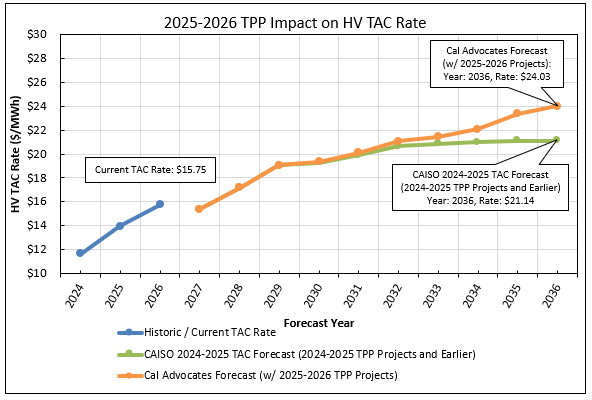
California is in a rates crisis, with the second highest electricity rates in the country.[2] The Draft Plan recommends approval of $7.0 billion in new transmission capital expenditures (e.g., transmission network upgrades and local network upgrades).[3] Additionally, CAISO concurs with PG&E as to $1.9 billion in local network upgrades to interconnect 11 data centers.[4] These upgrades amount to an additional $8.9 billion in total project costs. Previous TPPs approved costs of $7.3 billion,[5] $6.1 billion,[6] and $4.8 billion[7] between 2023 and 2025, respectively, totaling $27.1 billion in TPP approved costs in the last 4 years. The four most recent TPPs average more than 9 times the yearly average of the previous 22 years.[8] This staggering financial commitment to transmission infrastructure is unsustainable and could result in an increase of the High-Voltage Transmission Access Charge (HV TAC) from its current rate of $15.75/MWh to $24.03/MWh by 2036.[9]
Accordingly, Cal Advocates recommends that CAISO continue to (1) re-evaluate previously approved projects for necessity, (2) ensure that approved projects are the most cost-effective, and (3) consider low-cost grid enhancing technologies (GETs), where feasible. Cal Advocates is encouraged by CAISO’s cancelling or placing on hold three previously approved projects due to extreme cost increases.[10] For example, CAISO canceled the Del Amo - Mesa - Serrano 500 kV project, the cost of which increased from $1.125 billion to $5.0 billion. The CAISO should complete thorough reviews and analysis to ensure the most cost-effective alternative is selected, while re-evaluating and, where appropriate, eliminating costly and unnecessary projects.
- Utilities Treat Concurrence the Same as CAISO Approval and the Costs of Concurrence Projects should be Reflected in the Draft Plan Totals.
The Draft Plan recommends approval for $7.0 billion in new transmission capital expenditures[11] and concurs with $1.9 billion in data center network upgrades,[12], [13] for a total $8.9 billion in project costs. The utilities often treat CAISO project concurrences the same as a CAISO approval. For example, in a recent hearing considering a new large-load interconnection tariff (Rule 30 proceeding) at the California Public Utilities Commission (CPUC), Pacific Gas and Electric Company (PG&E) stated that “CAISO concurrence allows us to proceed forward.”[14] For improved transparency on the impacts to ratepayers, the Draft Plan should reflect that it is approving $8.9 billion in transmission network upgrades and concurred local network upgrades, rather than the $7.0 billion described in the plan.
- To Protect Ratepayers, CAISO Should Require Signed Interconnection Agreements as a Condition for CAISO Concurrence of Data Center Interconnection Projects.
In the Draft Plan, CAISO concurs with PG&E proposed upgrades to interconnect numerous data centers, totaling $1.9 billion.[15] This constitutes an outsized addition to an already costly transmission plan, further impacting the TAC. However, PG&E has yet to demonstrate that these customers have fully committed to interconnecting with Signed Agreements.
PG&E submits applications to CAISO after customers sign off on an Engineering Study. The Engineering Study is a step in PG&E’s interconnection process to get to the final Signed Agreement for Electric Service.[16] Unlike when an applicant cancels a data center project after a Signed Agreement, applicants can withdraw their application after the Engineering Study or after its application is submitted to CAISO, without penalty.[17] On the other hand, customers with Signed Agreements have agreed to a payment schedule and are financially obligated to pay their initial advance.[18] Thus, customers with a Signed Agreement, compared to an Engineering Study, demonstrate a higher commitment to bring load to the system and use the facilities CAISO approves or concurs with.
PG&E failed to demonstrate that the customers it proposed to CAISO have Signed Agreements. However, with CAISO’s concurrence, PG&E would have the go ahead to build transmission projects, regardless of whether the customer’s load comes online.[19] CAISO should provide its concurrence for any required transmission projects only after PG&E demonstrates a customer’s commitment to interconnect through a Signed Agreement.
- CAISO and PG&E Should Explain the $68 Million Increase for the Concurred Project to Interconnect LC24-3.
At the September 25, 2025 Stakeholder meeting, PG&E presented the scope for projects studied in PG&E’s 2024 Cluster Study. In the Draft Plan, the scope of an unnamed project increased by $68 million without explanation. CAISO should explain why this project has changed scope and what the details of the project change include to justify the $68 million cost increase.
At the September meeting, the project to support the interconnection of LC24-3 included the following scope items.
- Interconnection:
- Build new 115 kV switching station, Charcot, near Trimble 115 kV and associated service lines.
- Build (2) 0.8-mile 115 kV transmission line to connect Charcot to Trimble 115 kV.
- Capacity Upgrade:
- Trimble 230 kV/115 kV Substation expansion looping onto NRS-San Jose B 230 kV Line.[20]
In the Draft Plan, the scope now includes an additional item under Capacity Upgrades, without any discussion of the change: Trimble-Montague 115 kV line upgrade.[21] This change increases the cost from $242 million - $484 million to $276 million - $552 million. Further, this project now references five other large loads to be supported by this project, even though these large loads are already supported by other projects in the Cluster Study. Cal Advocates recommends that CAISO and PG&E clarify why this item was added to the scope, explain which data centers rely on the project, provide the details of the project change, and justify the $34 million - $68 million increase in cost.
- CAISO Should Include the Draft Plan Impacts on the High-Voltage Transmission Access Charge (HV TAC) for Transparency and Due Process.
CAISO’s Draft Plan does not include analysis of cost impacts of the Draft Plan to HV TAC rates.[22] This has been a recurring problem in the last four TPP cycles.[23] CAISO’s HV TAC analysis provides critical cost information necessary to fully evaluate the impact of the Draft Plan on transmission rates. Failing to include the HV TAC analysis reduces transparency and denies stakeholders the ability to analyze and vet the cost impacts of CAISO’s proposed plan. Given California’s ongoing electric rates crisis, it is critical that stakeholders have the opportunity to provide feedback on this analysis. To improve transparency and to provide due process, CAISO should expeditiously post its 2025-2026 HV TAC forecasts and include HV TAC estimates in all future draft TPP plans.
Cal Advocates analyzed CAISO’s 2024-2025 HV TAC model, and added the capital expenditures proposed in the Draft Plan to estimate the potential HV TAC impact in lieu of an analysis in the Draft Plan. The model forecasts that the HV TAC rate will rise to $24.03/MWh by 2036, compared to the current HV TAC rate of $15.75/MWh.[24], [25] This change amounts to a 53% increase in the HV TAC over 10 years. Further, $2.89/MWh, or 35% of the HV TAC increase, is attributed to projects recommended for approval in this year’s Draft Plan alone. This increase will further exacerbate the current electric rates crisis. Notably, this analysis excludes the $1.9 billion in CAISO concurred data center interconnection projects, which will additionally impact transmission rates.
- CAISO and the Participating Transmission Owners Should Provide Details on the Costs to Integrate New Data Center Loads.
CAISO and the Participating Transmission Owners (PTOs) do not provide the cost impacts for the different drivers of new transmission investments in the TPP. As a result, the cost impacts associated with accommodating new data center demand are undistinguishable from other loads. CAISO should identify all projects that are primarily driven by the data center loads in the Draft Plan. Only one project recommended for approval in the $9 Billion Draft Plan references data center load as a driver,[26] although it is likely that many other projects that cite load growth in the Greater Bay Area share this project driver. To increase transparency, Cal Advocates recommends that CAISO and its PTOs identify the data center-driven transmission costs in the 2025-2026 TPP. This will enable stakeholders to properly evaluate the impact of integrating data center loads. Demands to integrate these new types of data centers started increasing in 2022, and state and federal policies to respond to the impact of these new types of data centers on grid reliability and potential cost shifts are still being formulated.[27], [28], [29] New California and federal policies may require new data centers to pay their share of new transmission investments -- making it imperative that CAISO identify data center driven transmission costs.
Cal Advocates also recommends that the CAISO 2025-2026 TPP identify any new transmission investments that would be unnecessary if not for new data center load. This will enable stakeholders to understand the impacts of data center loads on the transmission system and points to specific projects that could be canceled, reduced, or modified if the data center load does not materialize.
- CAISO and its PTOs Should Provide Itemized Project Cost Estimates and the Length of Proposed New and Reconductored Lines for All Proposed Projects.
In the Draft Plan, CAISO does not provide information on the cost for individual project components or consistently provide the length of new and reconductored lines. These deficiencies obscure the cost of individual project scope items. Without this information, it is difficult for stakeholders to compare the proposed project descriptions to PTO cost benchmarks to confirm whether the project costs estimates are reasonable.
For example, projects with similar scopes may have very different costs. The Monta Vista 230/115 kV Transformer Bank Addition and San Jose B 230/115 kV Transformer Bank Addition projects both install one 230/115 kV transformer bank and have cost ranges of $52 million - $104 million and $35 million - $70 million, respectively.[30] This cost difference cannot be discerned from the Draft Plan and PTO Per Unit Cost Guides. Further, projects that do not include line lengths cannot be checked using the PTO Per Unit Cost Guides. Neither the Lincoln – Pleasant Grove Line Reconductoring Project nor the TL623C Reconductor project includes line lengths in the transmission plan.
Federal Energy Regulatory Commission (FERC) Order No. 890 and the proceeding transmission planning Order No. 1000-A require that transmission providers provide sufficient details in their regional transmission planning process to allow one to replicate the results of the planning study.[31], [32]
To comply with the FERC Orders No. 890 and 1000-A’s openness and transparency transmission planning principles, Cal Advocates recommends that CAISO include the costs for each component and the approximate length of new transmission lines or reconducted lines for every proposed project in the Draft Plan.
- Southern California Edison (SCE) Should Include Reconductoring Cost Estimates in the Per Unit Cost Guide.
SCE’s Per Unit Cost Guide does not include a cost estimate for reconductoring, which makes it difficult to determine whether the cost of the Mesa - Laguna Bell 230 kV #2 Upgrade (Advanced Reconductoring) is reasonable. Cal Advocates recommends that SCE’s costs for reconductoring be included in the Draft Plan, as well as be updated in SCE’s Per Unit Cost Guide.
[1] Cal. Pub. Util. Code § 309.5.
[2] Californians pay second highest electricity rates in the country, according to a new report, Megan Myscofski, January 9, 2025, available at https://www.capradio.org/articles/2025/01/09/californians-pay-second-highest-electricity-rates-in-the-country-according-to-a-new-report/.
[3] CAISO Draft 2025-2026 Transmission Plan at 5.
[4] CAISO Draft 2025-2026 Transmission Plan at 92-94.
[5] CAISO 2022-2023 Transmission Plan at 3.
[6] CAISO 2023-2024 Transmission Plan at 3.
[7] CAISO 2024-2025 Transmission Plan at 7.
[8] Cal Advocates Transmission Data Dashboard at 3, available at https://www.publicadvocates.cpuc.ca.gov/press-room/reports-and-analyses/transmission-data-dashboard-2025.
[9] See section 5 for analysis.
[10] Southern California Edison (SCE) informed CAISO that the cost of the Coolwater 115 kV Line Looping into Tortilla 115 kV Substation project has increased from $37 million to $105 million. Further, the load in the area has decreased. This project is now on hold. CAISO Draft 2025-2026 Transmission Plan at 90.
SCE informed CAISO that the cost of the Julian Hind-Mirage 230 kV Line Upgrade Project has increased from $76 million to $178 million. Further, the amount of Department of Energy (DOE) subsidization is still being evaluated. This project is now on hold. CAISO Draft 2025-2026 Transmission Plan at 89.
SCE informed CAISO that the cost of the Del Amo - Mesa - Serrano 500 kV project has increased from $1.125 billion to $5.0 billion. This project is now canceled. CAISO Draft 2025-2026 Transmission Plan at 109.
[11] CAISO Draft 2025-2026 Transmission Plan at 5.
[12] CAISO Draft 2025-2026 Transmission Plan at 92-94.
[13] To address a new large load interconnection request that comes in after development of the demand forecast and CPUC resource portfolios, Participating TOs may submit proposals into the ISO’s Transmission Planning Process for the ISO’s concurrence in the Transmission Plan. Large Load Considerations Issue Paper, CAISO, January 30, 2026 at 9.
[14] Reporter’s Transcript, Evidentiary Hearing, A.24-11-007, April 15, 2026 at 523, lines 9-10.
[15] CAISO Draft 2025-2026 Transmission Plan at 92-94.
[16] Comments on the December 17, 2025 California Energy Commission (CEC) Integrated Energy Policy Report (IEPR) Commissioner Workshop on Energy Demand Forecast Results, Cal Advocates, December 31, 2026, available at https://www.energy.ca.gov/event/workshop/2025-12/iepr-commissioner-workshop-energy-demand-forecast-results.
[17] Data center applicants can cancel or withdraw its data center project without penalty prior to signing binding interconnection agreements with the utility. An Engineering Study is not the same thing as a binding interconnection agreement. An Engineering Study is part of the process that leads up to the signing of binding interconnection agreement(s). Comments on the December 17, 2025 California Energy Commission (CEC) Integrated Energy Policy Report (IEPR) Commissioner Workshop on Energy Demand Forecast Results, Cal Advocates, December 31, 2026, available at https://www.energy.ca.gov/event/workshop/2025-12/iepr-commissioner-workshop-energy-demand-forecast-results.
[18] Comments on the December 17, 2025 California Energy Commission (CEC) Integrated Energy Policy Report (IEPR) Commissioner Workshop on Energy Demand Forecast Results, Cal Advocates, December 31, 2026, available at https://www.energy.ca.gov/event/workshop/2025-12/iepr-commissioner-workshop-energy-demand-forecast-results.
[19] Reporter’s Transcript, Evidentiary Hearing, A.24-11-007, April 15, 2026, at 523, lines 9-10. (PG&E witness describing that “the CAISO concurrence allows us to proceed forward.”)
[20] CAISO 2025-2026 Transmission Planning Process, September 25, 2025, PG&E Presentation at 63.
[21] CAISO Draft 2025-2026 Transmission Plan at 93.
[22] CAISO Draft 2025-2026 Transmission Plan at 173.
[23] Only the previous four draft transmission plans were checked. See CAISO Draft 2024-2025 Transmission Plan at 194; CAISO Draft 2023-2024 Transmission Plan at 161; CAISO Draft 2022-2023 Transmission Plan at 170; CAISO Draft 2021-2022 Transmission Plan at 382.
[24] High Voltage Access Charge Rates Effective Jan 30, 2026 (Revised Apr 8, 2026), CAISO, April 10, 2026, available at high-voltage-access-charge-rates-effective-jan-30-2026-revised-apr-08-2026.pdf.
[25] The starting point was not updated in CAISO’s 2024-2025 HV TAC model to the current HV TAC ($15.75/MWh). The actual TAC rate in 2036 may be higher.
[26] San Jose B 230/115 kV Transformer Bank Addition project refers to data center load specifically. CAISO Draft 2025-2026 Transmission Plan at 61.
[27] Department of Energy (DOE) Advanced Notice of Proposed Rulemaking (ANOPR), Interconnection of Large Loads to the Interstate Transmission System (FERC Docket No. RM26-4-000), October 23, 2025.
[28] Ratepayer Protection Pledge, March 4, 2026, available at https://www.whitehouse.gov/releases/2026/03/ratepayer-protection-pledge/.
[29] PG&E Rule 30 Application (CPUC Application Number: A.24-11-007), November 21, 2024.
[30] CAISO Draft 2025-2026 Transmission Plan at 56 and 61.
[31] Order No. 890, FERC Stats. & Regs. ¶ 31, 241 item 471 at 269-270.
[32] Order No. 1000-A, FERC Stats. & Regs. ¶ 61,132, item 281 at 211.