ACP-California
Submitted 09/03/2026, 10:44 am
Submitted on behalf of
ACP-California
1.
Please provide your organization's overall feedback regarding the EDAM Congestion Revenue Allocation – Design Concept #3 discussions held on August 13, 2026 and August 20, 2026.
While ACP-California appreciates CAISO’s work in this initiative so far – and generally agrees with the proposed long-term direction – we have serious concerns that the initiative is moving at a pace too fast to be conductive to gathering input from all key stakeholders, including EDAM Entities and their transmission customers. Thus, we ask that – as a next step, and rather than proceeding with additional discussion on design details – CAISO make concentrated efforts to coordinate with impacted parties in the west and bring their perspective into the discussion. There is clearly a need for additional education on how OATT rights function and how parallel flows from CAISO impact Open Access Transmission Tariff (OATT) right sales, in addition to the recognition and discussion on how OATT rights impact CAISO Congestion Revenue Rights (CRRs). It would also be helpful to understand how other markets (e.g., in the Eastern Interconnection) have addressed flows from other markets on their systems through Firm Flow Entitlements, etc.
ACP-California appreciates CAISO’s continued work to develop a durable approach to congestion revenue allocation that treats transmission and congestion revenue rights across the EDAM footprint equitably and reduces incentives for market participants to self-schedule rather than submit economic offers. ACP-California believes Design Concept #3, which would use a common simultaneous feasibility test (SFT) to establish congestion revenue entitlements for CAISO CRRs and eligible OATT rights, merits continued consideration as a potential long-term framework.
At the same time, ACP-California encourages CAISO to proceed deliberately before continuing stakeholder work that may be seen as settling or significantly guiding key design and implementation questions associated with Design Concept #3. The proposed framework would represent a meaningful change in the way OATT transmission rights would work in the West and could require changes to EDAM Entity tariffs, business practices, settlement processes, and information technology systems. Yet, as the stakeholder discussions have continued, participation from EDAM Entities and other western stakeholders that operate under and rely upon OATT transmission service has been relatively limited and, sometimes, non-existent. Those parties need to be actively engaged in the discussions and able to provide insights to CAISO participants on how, under today’s framework, OATT transmission rights are made available, sold and administered. These entities also are a necessary part of the conversation to help evaluate what changes Design Concept #3 would require, and the practical timelines associated with implementing those changes.
ACP-California therefore encourages CAISO to focus the next stage of this initiative on building a common understanding among CAISO, EDAM Entities, CRR holders, OATT customers, generators, and other affected stakeholders before moving too quickly into continued discussion on design decisions for the SFT. In particular, CAISO should engage directly with current and prospective EDAM Entities to understand the impacts of Design Concept #3 on their tariffs and practices, the treatment of their transmission customers, and the implementation work and sequencing that would be required to implement this approach. CAISO should then facilitate a process to bring that information back into the broader stakeholder process.
Taking additional time at this stage does not require abandoning Design Concept #3 or indefinitely delaying Phase 2. Rather, ACP-California believes additional coordination now will increase the likelihood that the ultimate framework is durable, workable, and viewed as equitable across EDAM’s regional footprint. This is particularly important as EDAM continues to expand and as the West transitions toward independent regional governance. The objective for the coming months should be to align affected parties around the underlying framework and its consequences before decisions are made, or directions are set, that may be difficult to unwind later.
2.
Please provide your organization’s feedback regarding the use of a common simultaneous feasibility test (incorporating CRRs and EDAM entity OATT rights) to establish congestion revenue entitlements.
ACP-California supports continued evaluation of a common SFT as a potential long-term means of establishing congestion revenue entitlements for CRRs and eligible OATT rights. Conceptually, an SFT could provide a more consistent framework for recognizing transmission rights while separating congestion hedging from market scheduling decisions, thereby reducing the incentive created by the Phase 1 framework to self-schedule in order to preserve a congestion hedge.
However, support for continued evaluation of the SFT should not be interpreted as support for all of the implementation choices discussed to date. Eligibility, the treatment of different types of transmission rights, outage assumptions, parallel flows, underfunding, and the relative treatment of CRRs and OATT rights could all materially affect the ultimate distribution of congestion revenues. ACP-California encourages CAISO to develop those elements only after EDAM Entities and other affected regional stakeholders have had sufficient opportunity to understand and meaningfully participate in the design and assess the impacts to OATT constructs from the high-level SFT concept.
3.
Please provide your organization’s feedback regarding the inputs into the common simultaneous feasibility test as discussed in the presentation. Should there be any extraneous constraints considered in the test that are not represented in the market constraints? If so, please describe them, their intended effects, and the rationale.
ACP-California does not have a specific recommendation regarding additional constraints at this time. Before determining whether additional constraints should be incorporated, ACP-California encourages CAISO to engage EDAM Entities and stakeholders familiar with OATT transmission planning and operations.
4.
Please provide your organization’s feedback regarding incorporation of CRR nominations (as part of the CRR allocation process) for the CAISO balancing area within the common simultaneous feasibility test as part of Design Concept #3. Should there be additional considerations or inputs taken into account in representing the CAISO balancing area in the common simultaneous feasibility test? Please indicate these and the associated rationale.
ACP-California does not have a specific recommendation regarding the mechanics for representing CAISO CRR nominations at this time.
More broadly, before finalizing the relative treatment of CRRs and OATT rights within the common SFT, stakeholders would benefit from a better understanding of how the quantity of firm OATT transmission service is limited in the West today. CAISO should facilitate discussion with EDAM Entities and other transmission providers regarding limitations on firm transmission sales and other OATT functionality. That information would provide an important factual foundation for evaluating concerns regarding the interaction between OATT rights and CRR allocations and whether additional safeguards are necessary
5.
Please provide your organization’s feedback regarding the eligible firm OATT rights to be considered within the simultaneous feasibility test as part of Design Concept #3. Aside from long-term firm point-to-point and network integration transmission service rights, should other types of OATT rights be considered? If so, please describe the rationale for inclusion of these.
Yes. ACP-California believes CAISO should allow monthly firm point-to-point transmission service to be eligible for a congestion revenue entitlement, provided the underlying right can be identified in sufficient time to be incorporated into the applicable monthly SFT.
ACP-California does not see a sufficient basis at this stage for categorically excluding monthly firm service merely because its duration is shorter than long-term firm service. Customers purchasing monthly firm transmission are also supporting the funding of the transmission system on which they are purchasing rights. Short-term rights are also a necessary use case in the West as, in many circumstances, long-term firm service is not available for purchase. Excluding monthly transmission rights from eligibility for the SFT could create a disincentive for purchasing these longer-term rights and push customers to purchase shorter-term transmission rights (e.g., weekly, daily or hourly) instead, which would have a negative impact on transmission cost recovery for OATT service providers.
6.
Please provide your organization’s feedback regarding the structure of the annual simultaneous feasibility test and representation of CRRs and eligible firm OATT transmission rights across the identified three tiers. Should these inputs (CRRs, OATT rights) be represented differently across the three tiers? If so, please describe the rationale.
ACP-California does not have a specific recommendation regarding the proposed three-tier structure at this time.
ACP-California believes it is premature to be discussing this level of design specifics given the lack of regional voices that have been meaningfully engaged in the conversation to date.
7.
Please provide your organization’s feedback regarding the representation of 65% of the transmission system within the annual simultaneous feasibility test (also known as the global derate factor) to recognize uncertainty with system topology, outages, and loop flows from outside the market footprint. Should this amount be different, recognizing that modeling of the EDAM footprint will allow for accounting of parallel flows between EDAM balancing areas within the feasibility test itself, or for other reasons? If so, please describe the rationale.
ACP-California does not have a specific recommendation regarding the proposed three-tier structure at this time.
ACP-California believes it is premature to be discussing this level of design specifics given the lack of regional voices that have been meaningfully engaged in the conversation to date.
8.
Please provide your organization’s feedback regarding the structure of the monthly simultaneous feasibility test and representation of CRRs and eligible firm OATT transmission rights across the identified two tiers. Should these inputs (CRRs, OATT rights) be represented differently across the two tiers? If so, please describe the rationale.
ACP-California does not have a specific recommendation regarding the proposed two-tier structure at this time.
ACP-California believes it is premature to be discussing this level of design specifics given the lack of regional voices that have been meaningfully engaged in the conversation to date.
9.
Please provide your organization’s feedback regarding the representation of 82.5% of the transmission system within the monthly simultaneous feasibility test (also known as the global derate factor) to recognize uncertainty with system topology, outages, and loop flows from outside the market footprint. Should this amount be different, recognizing that modeling of the EDAM footprint will allow for accounting of parallel flows between EDAM balancing areas within the feasibility test itself, or for other reasons? If so, please describe the rationale.
ACP-California does not have a specific recommendation at this time and believes it is premature to be discussing this level of design specifics given the lack of regional voices that have been meaningfully engaged in the conversation to date.
10.
Please provide your organization’s feedback regarding the utilization of the weighted least squares methodology, as described in the presentation, to reduce or haircut the transmission rights input into the simultaneous feasibility test when necessary to achieve feasibility (and resulting congestion revenue entitlements). Should a different methodology be utilized? If so, please describe the methodology and rationale.
ACP-California does not have a specific recommendation at this time and believes it is premature to be discussing this level of design specifics given the lack of regional voices that have been meaningfully engaged in the conversation to date.
11.
Please provide your organization’s feedback regarding the described approach for managing congestion underfunding, which would pay out the collected congestion revenues.
The allocation of revenue shortfalls could have significant distributional consequences among CAISO CRR holders, EDAM Entities, transmission customers, and ultimately customers throughout the EDAM footprint. As noted above, ACP-California believes that it is premature to be discussing these details and suggests that the conversation should be brought back up to a higher level and with better western stakeholder engagement before making any recommendations on key elements of the SFT design. That said, ACP-California believes any approach to congestion revenue underfunding should provide equitable and transparent treatment of CRRs and OATT congestion revenue entitlements created through the common SFT.
12.
Please provide your organization’s feedback regarding the potential incentives that may be created by different aspects of Design Concept #3. Please provide the associated rationale for these incentives and potential ways to mitigate undesirable incentives.
One of the primary potential benefits of Concept #3 is that it could eliminate or materially reduce the incentive created by the Phase 1 framework for transmission customers to self-schedule in order to preserve the financial value associated with their firm transmission rights. ACP-California supports development of a framework that allows resources to submit economic offers and participate efficiently in EDAM without unnecessarily sacrificing an otherwise appropriate congestion hedge. But the implementation on Design Concept #3 is likely to have major impacts on how EDAM Entities administer the sale of OATT rights and on their underlying value. It is important to consider those impacts, ensure EDAM entities are aware of the implications, and have further opportunities to weigh in before moving into any additional discussions that could entrench parties on the design details for the SFT.
13.
Please provide your organization’s feedback regarding any additional information, data, or analysis – beyond the data analysis that the CAISO has already committed to undertaking as described in the slides – that may be helpful in evaluating Design Concept #3.
While additional data analysis will be beneficial, ACP-California sees the primary need at this time as not a data/analysis-driven need, but rather a need to ensure common understandings of OATT rights impacts through facilitated conversation on how the implementation of an SFT (at a high level) would impact EDAM entity sale of transmission rights and their practices and procedures. It would also be helpful to bring in experts from the eastern markets to discuss how they have addressed flows across their systems from other markets/transmission planning regions, including the use of firm flow entitlements. We therefore urge CAISO to focus its efforts not on data and analysis but on coordination and education and ensuring the current stakeholder process and timeline is feasible for Western stakeholders to engage with.
14.
Please provide any additional feedback not already captured.
ACP-California encourages CAISO to use the next phase of this initiative to bring the relevant parties together and build greater alignment. As expressed above, we’re concerned that continuing at the current pace could serve to entrench parties on positions without the full picture of potential impacts and considerations across EDAM entities. Early coordination with current and prospective EDAM Entities should identify the tariff, policy, business-process, data, and information-technology changes that Design Concept #3 would require and establish a realistic implementation timeline.
This additional work is particularly warranted given that EDAM remains relatively new and the magnitude and distribution of congestion revenues under the Phase 1 framework are still developing. In fact, the July EDAM Market Report includes revised values for congestion revenue allocation transfers to PacifiCorp, with starkly lower dollar values, including two months where the transfer was from PacifiCorp to CAISO (i.e., a negative dollar settlement). This change in settlement outcomes not only shows the issue is not as large as previously thought but also illustrates the risk of drawing policy conclusions too quickly from the earliest months of market results.
ACP-California supports continuing to develop a durable Phase 2 solution. But durability requires much more than selecting a technically workable methodology. It requires confidence among participants throughout the EDAM footprint that the framework appropriately recognizes both CRRs and OATT transmission rights and that all affected parties had a meaningful role in shaping the outcome and understanding how it will impact their processes and businesses. Taking the time over the next steps in this initiative to get EDAM Entities, transmission customers, generators, CRR holders, and other stakeholders engaged and aligned will ultimately support a stronger and more sustainable regional market design.
Appian Way Energy Partners
Submitted 09/03/2026, 02:25 pm
1.
Please provide your organization's overall feedback regarding the EDAM Congestion Revenue Allocation – Design Concept #3 discussions held on August 13, 2026 and August 20, 2026.
Appian Way appreciates CAISO staff’s continued effort to engage stakeholders and develop market design solutions regarding implementation of the Extended Day-Ahead Market (EDAM) and the ongoing congestion revenue allocation (CRA) dialogue. Appian Way wholeheartedly supports the promise of a broader regional market through EDAM, which, if implemented properly, will bring greater reliability, market efficiency and cost savings for consumers and market participants throughout the West.
Many aspects of Design Concept 3 are extremely promising, including the use of the SFT process to determine rights allocations and the process’s equal/comparable treatment of CRRs and OATT rights with respect to congestion rights allocation (through the SFT) and with respect to allocation of revenue inadequacy. Appian Way remains concerned, however, that DS3 may result in unfair outcomes for CAISO LSEs and ratepayers in terms of their receiving a fair share of the transmission network that they pay for. Appian Way expressed these concerns in our submitted comments in this EDAM proceeding on May 22 and August 10 and we elaborate further below.
The process CAISO has outlined does not, in our opinion, treat CAISO financial rights on an equal footing with physical OATT rights. Our concern is that EDAM entities may be able to "optimize" their NITS and point-to-point (PTP) rights to capture the most commercially valuable congestion, diverting CRA away from the CAISO market. We believe that for the small subset of constraints that limit flow from south to north (the constraints related to Path 15, which CAISO’s analysis has identified), a business solution involving use of Firm Flow Entitlements (FFEs) may be necessary to ensure efficient and fair apportioning of congestion rights among the various entities. Such a system – and its value – has been described by the MSC previously and was also a main recommendation from the presentation by Richard Doying at the initial market-wide Seams workshop on July 31, 2026.
Why do we believe the process CAISO has proposed will incentivize physical rights holders to capture congestion away from the CAISO entities? The fundamental issue is that when CAISO rights are allocated, CAISO does so accounting completely for the physical limits on the CAISO network. It does not matter that CAISO LSEs have flexibility in choosing their paths during the allocation. The commercially valuable paths (in this case, Path 15-related constraints) will be fully subscribed one way or the other. When OATT rights are allocated as PTP or network, we do not believe the neighboring TSPs are or will be fully accounting for the relevant Path 15 related constraints.
- For OATT PTP, there may be a process for some consideration of ATC on neighboring (Path 15) flowgates, but we are skeptical that this is sufficiently robust, as modeling of the external market is never as detailed as the modeling of their own network. For instance, if the base case for the TSP calculations is a summer peak case, then the OATT calculations will show plenty of ATC on Path 15 flowgates that are fully subscribed in winter and spring on-peak, which is where the commercial value is for hedging.
- For network customers (NITS), the proposed CAISO market design is inviting material incentives for gaming, which the eastern markets experienced in their early stages of allocating rights. We continue to believe that under EDAM/LMP, with transmission access no longer tied to physical transmission, OATT customers over time will release OATT rights when market prices do not justify the investment and may lean into OATT rights to the maximum extent possible where there is commercial value. For instance, sticking with the Path 15 example, it is not hard to imagine creative LSEs (and their creative marketer counterparties) doing transactions for the sole purpose of designating network resources in the desert SW, upstream of commercially valuable constraints. In PJM in the early aughts, there was a cottage industry of phantom capacity contracts (until the rules were modified) for the sole purpose of capturing valuable congestion rights. CAISO should want to avoid this. Or more simply, CAISO may find that the EDAM BAAs’ network resources in spring are quite different from summer with respect to NITS for the allocation process. Stepping back on the balcony, we do not believe that there would be any Path 15-related limitation preventing an LSE from optimizing its NITS resources to capture as much valuable congestion on CAISO’s network as possible.
The potential upshot would be that OATT rights (that do not fully account for their impact on Path 15, but which may flow 40% on Path 15-related flowgates) may be able to bring more and more leverage on Path 15 into the SFT process, while CAISO rights are what they are and are limited by the relevant constraints. That is, CAISO entity rights to use their own system are determined based on the physical grid limits, while OATT rights’ usage of CAISO’s system is determined primarily by OATT entities’ profit-maximizing choices of what locations to tag in their OATT physical rights definitions. This is what we mean by creating an unfair system that allows non-CAISO entities to capture CRA on the CAISO network away from the CAISO LSEs and ratepayers that pay for the CAISO network.
Reconciling the FFE and SFT Approaches
It would not be difficult to incorporate the FFE concept into the SFT optimization. This could involve adding a constraint that limits CAISO entities to x% of the relevant flowgates and non-CAISO entities to no more than y%. This is where some analysis of the historical usage over time would be helpful in determining the right shares, and we suggest this additional analysis in answer to question 13 below. Such a process would minimize the potential for gaming. Note that such an approach would not impact allocation efficiency. We expect both CAISO and non-CAISO entities to fully subscribe the commercially valuable paths within their own designated fair shares.
A flow-entitlement construct would also provide a consistent foundation for both the market-to-market congestion coordination that will eventually be required with Markets+. The important distinction here is not one common market optimization in EDAM vs. two distinct market operators independently optimizing different footprints (CAISO and Markets+), but rather how to fairly handle allocation when there are financial rights in CAISO vs. physical rights in non-CAISO EDAM and Markets+.
We believe it would be entirely appropriate to handle the Path 15-related constraints specifically. We learned from CAISO’s presentations that CAISO transactions do not flow on the neighboring BAAs’ networks and the neighboring BAAs do not flow much into CAISO – except for the specific Path 15-related congestion that is commercially valuable. Ensuring fair usage of the relevant constraints where there is this CRA problem and loop flow is exactly what this EDAM CRA policy initiative should be designed to address.
2.
Please provide your organization’s feedback regarding the use of a common simultaneous feasibility test (incorporating CRRs and EDAM entity OATT rights) to establish congestion revenue entitlements.
The common SFT approach is insufficient as described above and needs to be combined with a business solution that apportions the right to flow on Path 15-related flowgates amongst CAISO, non-CAISO EDAM, and ideally Markets+ entities. When OATT rights are allocated by a TSP, the process for considering external networks is quite imperfect, especially in the context of using planning models that will invariably diverge from actual system conditions and market incentives. This has the unfortunate consequence of incenting entities to target valuable OATT rights that derive their value from flowing on CAISO’s network, resulting in a potential erosion of CAISO rights over time.
3.
Please provide your organization’s feedback regarding the inputs into the common simultaneous feasibility test as discussed in the presentation. Should there be any extraneous constraints considered in the test that are not represented in the market constraints? If so, please describe them, their intended effects, and the rationale.
For the constraints CAISO has identified where EDAM transactions can flow materially on CAISO Path 15-related flowgates, we believe an input into the SFT should be a predetermined set of FFEs for those flowgates.
4.
Please provide your organization’s feedback regarding incorporation of CRR nominations (as part of the CRR allocation process) for the CAISO balancing area within the common simultaneous feasibility test as part of Design Concept #3. Should there be additional considerations or inputs taken into account in representing the CAISO balancing area in the common simultaneous feasibility test? Please indicate these and the associated rationale.
no comments at this time.
5.
Please provide your organization’s feedback regarding the eligible firm OATT rights to be considered within the simultaneous feasibility test as part of Design Concept #3. Aside from long-term firm point-to-point and network integration transmission service rights, should other types of OATT rights be considered? If so, please describe the rationale for inclusion of these.
This is a great question, and a question that illustrates the problem inherent in CAISO’s proposed approach (as opposed to a business solution that explicitly assigns rights that everyone agrees are fair at the outset).
Under the currently proposed process, introduction of additional OATT rights, such as allowing monthly firm PTP rights to have similar treatment, would further erode CAISO entities’ share of usage of their network. If Path 15-related flowgates were allocated based on FFEs, it would not matter to CAISO entities whether monthly firm PTP rights holders were included in the allocation. However, OATT long-term rights holders would potentially be competing with this new customer class and have their annual rights diluted. Of course, this all entirely depends on CAISO’s continued commitment to not overselling the system through use of a simultaneous feasibility test (SFT). The integrity of the SFT is an essential part of good market design and CAISO is to be commended for maintaining this as part of the process.
However, this question 5 – should additional OATT rights be allowed? – precisely highlights the issue of fairness in the allocation and why explicitly assigning FFEs is the superior and fairer approach. Under the current proposal, adding more OATT rights would dilute CAISO CRRs, so of course EDAM entities outside of CAISO will likely favor this approach. Would these entities support including monthly OATT rights if the FFEs were fixed through a different process and the additional rights came at the expense of longer-term OATT rights instead of at the expense of CAISO ARRs? This answer is not so obvious. And the implication from this thought experiment is: design a business solution that explicitly assigns the rights at the outset (such as FFEs).
6.
Please provide your organization’s feedback regarding the structure of the annual simultaneous feasibility test and representation of CRRs and eligible firm OATT transmission rights across the identified three tiers. Should these inputs (CRRs, OATT rights) be represented differently across the three tiers? If so, please describe the rationale.
no comments at this time.
7.
Please provide your organization’s feedback regarding the representation of 65% of the transmission system within the annual simultaneous feasibility test (also known as the global derate factor) to recognize uncertainty with system topology, outages, and loop flows from outside the market footprint. Should this amount be different, recognizing that modeling of the EDAM footprint will allow for accounting of parallel flows between EDAM balancing areas within the feasibility test itself, or for other reasons? If so, please describe the rationale.
Given that the GDF is meant, at least in part, to recognize loop flow from EDAM entities on CAISO’s system, it makes sense to increase the GDF from 65% to a higher number assuming EDAM entity OATT transactions are included in the SFT. In essence the GDF of 65% can be thought of as recognizing external BAAs’ rights to flow on CAISO’s system (analogous to their having firm flow entitlement rights).
Further study of the GDF is very much warranted, but we do not have sufficient information or analysis at this time to suggest by how much to alter the GDF. This may be a topic for further analysis and study. The north star should be to allocate and/or auction as many rights as possible but leave some margin to ensure that the system is not oversold. In theory the SFT is designed to not oversell the system, but the GDF is an important safeguard in case model assumptions in the SFT process do not conform to what actually transpires.
8.
Please provide your organization’s feedback regarding the structure of the monthly simultaneous feasibility test and representation of CRRs and eligible firm OATT transmission rights across the identified two tiers. Should these inputs (CRRs, OATT rights) be represented differently across the two tiers? If so, please describe the rationale.
no comments at this time.
9.
Please provide your organization’s feedback regarding the representation of 82.5% of the transmission system within the monthly simultaneous feasibility test (also known as the global derate factor) to recognize uncertainty with system topology, outages, and loop flows from outside the market footprint. Should this amount be different, recognizing that modeling of the EDAM footprint will allow for accounting of parallel flows between EDAM balancing areas within the feasibility test itself, or for other reasons? If so, please describe the rationale.
Given that the GDF is meant, at least in part, to recognize loop flow from EDAM entities on CAISO’s system, it makes sense to increase the GDF from 65% to a higher number assuming EDAM entity OATT transactions are included in the SFT. In essence the GDF of 65% can be thought of as recognizing external BAAs’ rights to flow on CAISO’s system (analogous to their having firm flow entitlement rights).
Further study of the GDF is very much warranted, but we do not have sufficient information or analysis at this time to suggest by how much to alter the GDF. This may be a topic for further analysis and study. The north star should be to allocate and/or auction as many rights as possible but leave some margin to ensure that the system is not oversold. In theory the SFT is designed to not oversell the system, but the GDF is an important safeguard in case model assumptions in the SFT process do not conform to what actually transpires.
10.
Please provide your organization’s feedback regarding the utilization of the weighted least squares methodology, as described in the presentation, to reduce or haircut the transmission rights input into the simultaneous feasibility test when necessary to achieve feasibility (and resulting congestion revenue entitlements). Should a different methodology be utilized? If so, please describe the methodology and rationale.
no comments at this time.
11.
Please provide your organization’s feedback regarding the described approach for managing congestion underfunding, which would pay out the collected congestion revenues.
CAISO’s proposal to treat congestion revenue shortfalls comparably between CRR and OATT entitlements is the only just and reasonable approach.
Separately, the Track 1B shortfall allocation methodology used by CAISO is flawed because while it purports to follow cost-causation principles, it does not do so in practice. This issue is the subject of the separate CRR Enhancements policy initiative.
12.
Please provide your organization’s feedback regarding the potential incentives that may be created by different aspects of Design Concept #3. Please provide the associated rationale for these incentives and potential ways to mitigate undesirable incentives.
We discuss above several examples of how DS3 may incentivize physical rights holders to "optimize" their NITS and PTP rights to capture the most commercially valuable congestion, diverting CRA away from the CAISO market. As a general matter, when faced with an allocation of rights, entities will follow incentives to maximize their rights. The key is to establish a fair system and process that results in outcomes that key stakeholder entities deem to be fair. The process CAISO has outlined does not do this in our opinion. Rather it establishes a system where there is incentive for market participants to seek out and acquire purely fictional contract path rights for the sole purpose of garnering an ever-increasing share of the right to flow congestion-free on their neighbors’ system.
The MSC and Richard Doying both have recommended using Flow Entitlement Limits as a basis for determining a fair allocation of transmission rights. We believe CAISO should move in this direction.
13.
Please provide your organization’s feedback regarding any additional information, data, or analysis – beyond the data analysis that the CAISO has already committed to undertaking as described in the slides – that may be helpful in evaluating Design Concept #3.
CAISO has provided excellent analysis of the constraints in CAISO and EDAM and CAISO’s impact on external EDAM BAA constraints and external EDAM transactions’ impact on CAISO constraints.
See for instance: https://stakeholdercenter.caiso.com/InitiativeDocuments/Presentation-Congestion-cost-analysis-Jul-28-2026.pdf
This analysis clearly highlights that the parallel flow issue is concentrated in a small set of CAISO constraints. Where the congested direction is south to north, sourcing from the desert southwest and southern California, we have been referring to these as "Path 15-related" constraints or flowgates (Gates–Midway, Los Banos–Gates, and Tesla–Los Banos). The same analysis identifies a companion set of constraints on Path 26 (Midway–Vincent and Midway–Whirlwind) where the congested direction is north to south, and every point we make in these comments about Path 15-related constraints applies equally to the Path 26 set.
We believe additional analysis focused exclusively on these constraints is warranted. CAISO’s root cause analysis of revenue inadequacy from February 2025 showed the impact of loop flows on some of these constraints.
See: (https://stakeholdercenter.caiso.com/InitiativeDocuments/Presentation-Congestion-Revenue-Rights-Enhancements-Feb-27-2025.pdf).
See in particular slides 141 and 142 for the discussion of loop flow impacts on CAISO participants’ usage of the transmission grid related to 500 kV Tesla-Los Banos, as well as slide 147 related to 500 kV Gates-Midway. Also see Appian Way comments filed August 10 in this Phase 2 process.
Specifically, we believe CAISO should look at the historical periods when there was high congestion on the Path 15-related constraints in several representative years. We would highlight 2019, 2024 and 2025 as useful data points, as this will provide a historical perspective regarding how CAISO participants’ ability to use their own system has changed over time. It is important to identify CAISO flows on the relevant constraints as well as loop flows. It is important to note that loop flows may come from non-CAISO entities joining EDAM and Markets+ entities.
Separately, CAISO should model the existing OATT rights for a representative upcoming future period – say October or November 2026. How much usage of the Path 15-related constraints is coming from PTP non-CAISO EDAM rights and how much is coming from PTP of Markets+ entities? Staff will need to find a way to estimate the NITS non-CAISO EDAM and Markets+ usage of CAISO Path 15-related constraints, perhaps by using a representative historical period when there was full transmission availability.
Another way to approach this problem would be to calculate the annual CRR auction transfer capability associated with auctioned and allocated CRRs on the Path 15-related south to north constraints that CAISO identified in its study, consider also the revenue inadequacy caused by loop flows on these constraints, and calculate how this has changed over time. This would provide a metric regarding how much CAISO participants are and have been able to use the network that they pay for vs. how much is being used by non-CAISO BAAs.Ultimately, the goal of both analyses is to provide context for establishing an underlying business solution that answers the question:
What is the fair allocation for EDAM (and Markets+) entities’ usage of CAISO transmission (on Path 15-related flowgates) based on historical usage, good utility practice and common sense?
The answer to this question can be a basis for establishing a Flow Entitlement allocation business solution for CAISO and its neighboring BAAs joining EDAM as well as a basis for market-to-market coordination with Markets+.
14.
Please provide any additional feedback not already captured.
CAISO, with EDAM, is attempting to move to a system with optimal transmission usage based on economics and coordinated dispatch, while simultaneously overlaying the existing OATT system of physical rights in certain areas. This is not easy to reconcile, but has been accomplished in other US markets, with significant lessons relevant to CAISO. FERC released a Western Seams white paper and initiated a FERC proceeding where CAISO will report on what it is doing about addressing Seams coordination. Reading between the lines: perhaps FERC is asking why CAISO is trying to reinvent the wheel with respect to CRA, when eastern markets have been through this struggle already. Establishing rights such as firm flow entitlements is an established fair and efficient approach for addressing this problem. It would be a shame for CAISO to repeat mistakes made in other markets only to ultimately arrive at the same conclusion.
Bay Area Municipal Transmission Group (BAMx)
Submitted 09/03/2026, 04:13 pm
Submitted on behalf of
City of Santa Clara dba Silicon Valley Power and City of Palo Alto Utilities
1.
Please provide your organization's overall feedback regarding the EDAM Congestion Revenue Allocation – Design Concept #3 discussions held on August 13, 2026 and August 20, 2026.
The Bay Area Municipal Transmission Group (BAMx[1]) thanks the CAISO and stakeholders for their continued proactive engagement in this initiative. BAMx appreciates the robust discussion around Design Concept #3 during the August 13 and August 20 working group meetings, and we share many other entities’ view that future discussions will be most productive if focused on Concept #3. BAMx believes that Concept #3 is the most robust approach with the fewest implementation hurdles and should be prioritized over Concept #1. However – as the discussions on the 13th and 20th revealed – there are many substantial implementation considerations that will need to be addressed. Consistent with our prior comments, and with the concerns raised by the Department of Market Monitoring[2], and the Market Surveillance Committee[3], BAMx does not believe Concept #1 should be pursued, even as an interim bridge.[4] Allocating congestion revenue based on cleared market schedules distorts bidding incentives, undermines locational marginal pricing, and risks adversely affecting market performance. BAMx therefore urges the CAISO to focus stakeholder time and resources on developing Concept #3 rather than continuing to develop Concept #1.
[1] BAMx consists of the City of Santa Clara dba Silicon Valley Power and City of Palo Alto Utilities
[2] See CAISO Department of Market Monitoring, "Comments on EDAM Congestion Revenue Allocation Phase 2 Design Working Group Meeting – July 28, 2026," August 10, 2026.
[3] Market Surveillance Committee, "Briefing on Market Surveillance Committee activities: July – August 2026," August 21, 2026 (describing Concept 1 and the acknowledged self-scheduling incentive problem).
[4] See BAMx’s comments, dated August 10, 2026 located at https://stakeholdercenter.caiso.com/Comments/AllComments/a272dfce-cdf9-4bf0-937b-ea51651d979f#org-e65a8ef9-4815-44c0-be13-0e663325fe9c
2.
Please provide your organization’s feedback regarding the use of a common simultaneous feasibility test (incorporating CRRs and EDAM entity OATT rights) to establish congestion revenue entitlements.
BAMx supports the use of a common simultaneous feasibility test (SFT) incorporating both CRRs and OATT rights to establish congestion revenue entitlements for the EDAM. An EDAM SFT evaluates the impact of nominations on constraints across the EDAM footprint, which is a substantial improvement over allocating revenues according to self-schedules. A SFT would better account for the impact of EDAM BAA parallel flows on other BAAs and improve the representation of these flows in the CRR allocation process.
BAMx respectfully requests that the CAISO develop explicit policies for the potential asymmetry between physical OATT rights and financial Congestion Revenue Rights (CRR). CRRs, as financial instruments, do not include a right to physically schedule energy but rather provide a financial hedge for congestion costs. By contrast, CAISO has stated that long-term firm point-to-point (PTP) and network integration transmission service (NITS) rights modeled in the SFT would retain their underlying physical rights even if the SFT awards less than the full congestion revenue entitlement.[1] As a result, OATT rights holders retain their ability to schedule, which could contribute to day-ahead congestion even if the financial congestion revenue entitlement to the OATT rights was reduced. Can the CAISO please clarify (1) how the physical OATT rights (including NITS and PTP rights) will be modeled in the SFT, (2) whether CAISO intends only to allocate financial congestion revenue entitlements to OATT rights holders that “clear” in the SFT, and (3) how revenue adequacy could be impacted when physical OATT rights are not reduced along with the congestion revenue entitlement?
[1] CAISO Extended Day-Ahead Market EDAM Congestion Revenue Allocation Presentation, page 8, August 20, 2026
3.
Please provide your organization’s feedback regarding the inputs into the common simultaneous feasibility test as discussed in the presentation. Should there be any extraneous constraints considered in the test that are not represented in the market constraints? If so, please describe them, their intended effects, and the rationale.
Given the CAISO’s analysis to-date that shows there is far more impact of constraints within CAISO on EDAM entities than vice-versa, we are concerned that source-sink pairs within CAISO that are closer to those constraints will disproportionately be reduced in the combined SFT process. To address this, BAMx suggests:
- Clarifying how constraints consistent with those in the IFM, such as operating procedures, flowgates, planned outages, contingencies, interface limits, and equipment ratings, will be represented in the SFT.
- Consider placing limits on the amount of parallel flow allowed to be imposed on one BAA from injections and withdrawals in another BAA.
- Clarifying what data will be required from and available to stakeholders, such as if stakeholders will receive constraint-level information that is detailed enough to reproduce and/or audit SFT results.
CAISO should also clarify whether the Weighted Least Squares (WLS) as proposed is neutral, or if nomination size, historical allocation, transmission investment, etc. changes the weighting. CAISO’s August 20 presentation[1] asserted that “deviations from WLS methodology may not lead to equitable results” and referenced other ISOs/RTOs. However, omissions of significant variables could result in biased weights. As such, BAMx respectfully requests that the CAISO demonstrate this assertion with simulation results.
[1] Ibid, page 17
4.
Please provide your organization’s feedback regarding incorporation of CRR nominations (as part of the CRR allocation process) for the CAISO balancing area within the common simultaneous feasibility test as part of Design Concept #3. Should there be additional considerations or inputs taken into account in representing the CAISO balancing area in the common simultaneous feasibility test? Please indicate these and the associated rationale.
Please see our response to 3.
5.
Please provide your organization’s feedback regarding the eligible firm OATT rights to be considered within the simultaneous feasibility test as part of Design Concept #3. Aside from long-term firm point-to-point and network integration transmission service rights, should other types of OATT rights be considered? If so, please describe the rationale for inclusion of these.
The CAISO’s August 20 presentation indicates that long-term NITS rights would be limited by the associated network load.[1] This seems analogous to the Adjusted Load Metric that applies to CRRs in the allocation process. Please confirm that long-term NITS rights will be treated as described. Would PTP nominations have use limitations based on historical usage, or would the full PTP contract rights be able to be nominated?
[1] Ibid, page 11
6.
Please provide your organization’s feedback regarding the structure of the annual simultaneous feasibility test and representation of CRRs and eligible firm OATT transmission rights across the identified three tiers. Should these inputs (CRRs, OATT rights) be represented differently across the three tiers? If so, please describe the rationale.
No comments at this time.
7.
Please provide your organization’s feedback regarding the representation of 65% of the transmission system within the annual simultaneous feasibility test (also known as the global derate factor) to recognize uncertainty with system topology, outages, and loop flows from outside the market footprint. Should this amount be different, recognizing that modeling of the EDAM footprint will allow for accounting of parallel flows between EDAM balancing areas within the feasibility test itself, or for other reasons? If so, please describe the rationale.
Given that the current GDF is intended in part to account for uncertainty related to parallel flows, BAMx expects that the annual and monthly GDF factors will need to be adjusted once parallel flows are better accounted for in the SFT. Once parallel flows are accounted for in the SFT, leaving the GDF at its current level could overestimate uncertainty. There is also risk in over-adjusting the GDF. To that end, BAMx suggests the CAISO – to the extent possible – disaggregate the GDF into its component uncertainties. Then, after identifying which components could be overlapping with modeled EDAM OATT rights, make a GDF adjustment to those components only to account for parallel flow in the SFT. BAMx recommends testing proposed GDF revisions at a variety of levels to assess the sensitivity of the feasible rights to the GDF adjustments.
8.
Please provide your organization’s feedback regarding the structure of the monthly simultaneous feasibility test and representation of CRRs and eligible firm OATT transmission rights across the identified two tiers. Should these inputs (CRRs, OATT rights) be represented differently across the two tiers? If so, please describe the rationale.
No comments at this time.
9.
Please provide your organization’s feedback regarding the representation of 82.5% of the transmission system within the monthly simultaneous feasibility test (also known as the global derate factor) to recognize uncertainty with system topology, outages, and loop flows from outside the market footprint. Should this amount be different, recognizing that modeling of the EDAM footprint will allow for accounting of parallel flows between EDAM balancing areas within the feasibility test itself, or for other reasons? If so, please describe the rationale.
BAMx believes that CAISO should take an approach for the monthly global derate factor (currently 17.5%, corresponding to 82.5% of the system being represented) similar to the approach described above for the annual derate factor (see response to Question 7), with nuances specific to the monthly horizon. Because the monthly process is closer to the operating horizon and carries less uncertainty, it already applies a smaller derate than the annual process. As the common EDAM-wide SFT begins to model parallel flows explicitly, the uncertainty the monthly derate was designed to accommodate should be further reduced, supporting a lower monthly derate and a correspondingly greater volume of CRRs available for allocation to load-serving entities. BAMx cautions, however, that the monthly derate must continue to reflect genuine near-term uncertainty (e.g., outages and topology) so as not to create systematic revenue inadequacy borne by CRR holders through underfunding. We recommend the CAISO develop an empirical approach to evaluate how the components of the GDF are influenced by parallel flow accounting in the EDAM, like what we described in our response to question 7.
10.
Please provide your organization’s feedback regarding the utilization of the weighted least squares methodology, as described in the presentation, to reduce or haircut the transmission rights input into the simultaneous feasibility test when necessary to achieve feasibility (and resulting congestion revenue entitlements). Should a different methodology be utilized? If so, please describe the methodology and rationale.
Please see response to 3.
11.
Please provide your organization’s feedback regarding the described approach for managing congestion underfunding, which would pay out the collected congestion revenues.
No comments at this time.
12.
Please provide your organization’s feedback regarding the potential incentives that may be created by different aspects of Design Concept #3. Please provide the associated rationale for these incentives and potential ways to mitigate undesirable incentives.
No comments at this time.
13.
Please provide your organization’s feedback regarding any additional information, data, or analysis – beyond the data analysis that the CAISO has already committed to undertaking as described in the slides – that may be helpful in evaluating Design Concept #3.
On the question of whether rights should be evaluated on a BAA-by-BAA basis or evaluated across the entire EDAM footprint, BAMx generally supports the latter approach to assess feasible OATT rights/CRRs in the SFT. However, BAMx sees value in the comparison between the OATT rights that can be supported at the BAA level to those that can be supported using an EDAM-wide SFT. BAMx requests that the CAISO analyze and compare feasible rights under BAA-level SFT to EDAM-level SFT, identifying incremental reductions imposed by constraints outside the host BAA. This comparison is intended for informational purposes and to guide our mutual understanding of the interplay between BAA boundaries and distributional effects of footprint-wide SFT.
14.
Please provide any additional feedback not already captured.
No comments at this time.
Bonneville Power Administration
Submitted 09/02/2026, 10:22 am
1.
Please provide your organization's overall feedback regarding the EDAM Congestion Revenue Allocation – Design Concept #3 discussions held on August 13, 2026 and August 20, 2026.
Bonneville appreciates CAISO’s commitment to pursuing a durable solution for parallel flow congestion across the day-ahead market footprint. While operational self-schedules remain a necessary tool for managing native load and non-dispatchable resources, market rules should not force entities to self-schedule to access a financial congestion hedge. We support stakeholder efforts to design a framework that aligns congestion revenue allocation with the transmission customers and native load that fund long-term grid infrastructure.
Consistent with broad regional stakeholder feedback, Bonneville sees Design Concept #3 as an important step away from the self-schedule approach and supports moving away from Concept #1 and rejecting static historical baselines under Concept #2. We support focusing stakeholder resources on fully developing and testing Concept #3’s Common Simultaneous Feasibility Test (SFT). Concept #3 appears to be the best option for separating financial congestion hedges from day-ahead physical scheduling.
Because a multi-BAA SFT is technically complex and largely unproven in this configuration, Bonneville’s ultimate support depends on the forthcoming simulation results, as well as how CAISO addresses key outstanding issues, specifically BAA transfer settlement logic and intertie transfer modeling.
2.
Please provide your organization’s feedback regarding the use of a common simultaneous feasibility test (incorporating CRRs and EDAM entity OATT rights) to establish congestion revenue entitlements.
Bonneville supports testing a footprint-wide Simultaneous Feasibility Test (SFT) to establish congestion revenue entitlements across both long-term OATT rights and CAISO allocated CRRs.
Merging physical OATT rights and financial CRRs across separate BAAs under one market operator has never been done before. While a footprint-wide SFT is intended to reflect physical grid capabilities better than the current schedule-based design, we recognize that forward power-flow models rarely match real-time market clearing perfectly, as demonstrated by ongoing CRR revenue adequacy challenges across the industry.
Bonneville supports continued stakeholder evaluation and testing of Concept #3. We look forward to reviewing CAISO’s upcoming simulation results to analyze how effectively a multi-BAA SFT models key network inputs, including major regional interties, flowgates, line ratings, planned outages, and legacy pre-OATT rights, and whether it can maintain acceptable revenue adequacy while providing functional hedges for native load.
3.
Please provide your organization’s feedback regarding the inputs into the common simultaneous feasibility test as discussed in the presentation. Should there be any extraneous constraints considered in the test that are not represented in the market constraints? If so, please describe them, their intended effects, and the rationale.
Bonneville agrees that the constraints enforced in the SFT should align closely with active market constraints in the Integrated Forward Market (IFM) to minimize disconnects between forward entitlement awards and day-ahead market clearing.
Combining multiple independent BAAs into a single SFT introduces complex inter-BAA transfer dynamics that do not exist in a single-BAA footprint. While consistent treatment makes sense on paper, CAISO should not rule out specialized transfer constraints if testing shows they are necessary to protect native load hedges or account for major regional intertie limits.
Bonneville encourages CAISO and stakeholders to use the upcoming simulation study to analyze how inter-BAA transfers perform under a standard SFT, and to remain open to tailored constraint adjustments if the data shows they are needed to preserve equity across BAA boundaries.
4.
Please provide your organization’s feedback regarding incorporation of CRR nominations (as part of the CRR allocation process) for the CAISO balancing area within the common simultaneous feasibility test as part of Design Concept #3. Should there be additional considerations or inputs taken into account in representing the CAISO balancing area in the common simultaneous feasibility test? Please indicate these and the associated rationale.
Bonneville supports incorporating CAISO Allocated CRRs (Tiers 1–3) into the primary common SFT, while keeping Commercial Auction CRRs in a secondary, post-allocation process.
Allocated CRRs reflect native load-serving commitments and long-term transmission funders, making them functionally comparable to long-term firm OATT rights. Auction CRRs, by contrast, are acquired through secondary bidding on whatever system capacity remains.
Including Auction CRRs in the primary joint SFT would unnecessarily complicate the SFT and force long-term transmission holders to compete against commercial speculators for primary allocations. Auction CRRs should continue to be evaluated in a secondary auction run after primary allocations are established.
5.
Please provide your organization’s feedback regarding the eligible firm OATT rights to be considered within the simultaneous feasibility test as part of Design Concept #3. Aside from long-term firm point-to-point and network integration transmission service rights, should other types of OATT rights be considered? If so, please describe the rationale for inclusion of these.
Bonneville supports SFT eligibility for Long-Term Firm Point-to-Point (PTP) and Long-Term Network Integration Transmission Service (NITS) rights with a duration of at least one year. In addition, Bonneville suggests additional CAISO-led stakeholder discussions to examine the following OATT rights for potential eligibility.
- Conditional Firm Service: Examining how Long-Term Conditional Firm (LTCF) PTP service, which carries multi-year fixed cost responsibility and is widely used across the West for firm power deliveries, might be accommodated in the SFT, drawing on precedents from other Western market designs like Markets+.
- Long-Term Non-Firm Service: Discussing how long-term non-firm or structured transmission service, such as emerging products designed to interconnect large industrial and data center loads, might intersect with forward congestion hedging frameworks.
- Short-Term Firm Service: Exploring the feasibility and revenue adequacy impacts of incorporating short-term firm transmission rights into monthly SFT runs, balancing market participant flexibility against the risk of diluting baseline hedges.
6.
Please provide your organization’s feedback regarding the structure of the annual simultaneous feasibility test and representation of CRRs and eligible firm OATT transmission rights across the identified three tiers. Should these inputs (CRRs, OATT rights) be represented differently across the three tiers? If so, please describe the rationale.
Bonneville views CAISO’s proposed three-tier annual SFT structure, scaling capacity nominations from 50% to 100% of eligible quantities, as a reasonable starting framework for testing simultaneous feasibility across allocated CRRs and eligible firm OATT rights.
We support CAISO’s proposal to allow eligible OATT rights to roll through Tiers 1-3 automatically. Because OATT transmission service represents fixed, long-term contractual reservations, automatic roll-through eliminates unnecessary administrative burden for transmission providers while ensuring OATT rights and allocated CRRs undergo comparable feasibility testing in each tier.
Because annual feasibility testing intersects directly with transmission planning and ATC calculation practices, Bonneville considers this three-tier structure a baseline to be evaluated as data becomes available. We look forward to coordinating with CAISO and regional transmission planners to examine how the annual SFT structure aligns with non-CAISO transmission planning methodologies following the upcoming simulation runs.
7.
Please provide your organization’s feedback regarding the representation of 65% of the transmission system within the annual simultaneous feasibility test (also known as the global derate factor) to recognize uncertainty with system topology, outages, and loop flows from outside the market footprint. Should this amount be different, recognizing that modeling of the EDAM footprint will allow for accounting of parallel flows between EDAM balancing areas within the feasibility test itself, or for other reasons? If so, please describe the rationale.
Bonneville supports utilizing an annual Global Derate Factor (GDF) of 65% as an appropriate starting baseline for initial simulation modeling.
Incorporating multiple EDAM Balancing Authority Areas into a unified SFT network model allows the software to explicitly calculate inter-BAA parallel flows, thereby reducing unmodeled loop flow uncertainty within the software compared to standalone CAISO operations.
Because the global derate factor directly impacts the balance between annual hedge certainty and day-ahead revenue adequacy, Bonneville cautions against modifying the 65% baseline prior to reviewing empirical data. We request that CAISO use the upcoming simulation study to analyze how a 65% annual GDF performs across participating BAAs and share those results with stakeholders before considering any adjustments to the annual derate percentage.
8.
Please provide your organization’s feedback regarding the structure of the monthly simultaneous feasibility test and representation of CRRs and eligible firm OATT transmission rights across the identified two tiers. Should these inputs (CRRs, OATT rights) be represented differently across the two tiers? If so, please describe the rationale.
Bonneville supports CAISO’s proposed two-tier monthly SFT structure. This process appropriately incorporates CRRs and eligible OATT rights in a comparable manner while treating annual SFT entitlement awards as a static floor that cannot be reduced in the monthly process.
9.
Please provide your organization’s feedback regarding the representation of 82.5% of the transmission system within the monthly simultaneous feasibility test (also known as the global derate factor) to recognize uncertainty with system topology, outages, and loop flows from outside the market footprint. Should this amount be different, recognizing that modeling of the EDAM footprint will allow for accounting of parallel flows between EDAM balancing areas within the feasibility test itself, or for other reasons? If so, please describe the rationale.
Bonneville supports an 82.5% Global Derate Factor (GDF) for the monthly SFT as an appropriate baseline.
Bonneville echoes WPTF’s comments emphasizing the need for standardized, timely reporting of planned outages across all participating EDAM BAAs prior to monthly SFT execution, since inaccurate outage data directly undermines SFT results. Furthermore, Bonneville requests that CAISO analyze simulation data to demonstrate whether an 82.5% monthly GDF appropriately balances entitlement availability against revenue underfunding risk across different operating conditions.
10.
Please provide your organization’s feedback regarding the utilization of the weighted least squares methodology, as described in the presentation, to reduce or haircut the transmission rights input into the simultaneous feasibility test when necessary to achieve feasibility (and resulting congestion revenue entitlements). Should a different methodology be utilized? If so, please describe the methodology and rationale.
Bonneville supports the Weighted Least Squares (WLS) haircutting methodology.
WLS allocates reductions based directly on physical grid impact. WLS ensures that nominations with zero electrical effectiveness receive zero haircut on a binding constraint, while nominations that contribute to constraint loading are trimmed in direct proportion to the square of their shift factor and requested MW volume.
11.
Please provide your organization’s feedback regarding the described approach for managing congestion underfunding, which would pay out the collected congestion revenues.
Bonneville supports CAISO’s proposal to settle Day Ahead Market congestion entitlements based on actual collected day-ahead congestion revenues, consistent with CAISO’s CRR 1B policy.
Capping entitlement payouts at actual collected market revenues prevents the creation of unfunded market uplift. When unplanned outages cause day-ahead revenue shortfalls on a constraint, pro-rata haircutting distributes the shortfall equitably among entitlement holders on that element without creating broader market distortions.
Because revenue underfunding directly reduces the effectiveness of congestion hedges, minimizing underfunding risk is critical. This reinforces the need for accurate SFT modeling, robust outage reporting, and transparent monthly revenue adequacy reporting by CAISO.
Bonneville agrees that day-ahead congestion revenues collected on a constraint in excess of awarded SFT entitlements should be allocated to the Balancing Authority Area where the physical constraint is located.
12.
Please provide your organization’s feedback regarding the potential incentives that may be created by different aspects of Design Concept #3. Please provide the associated rationale for these incentives and potential ways to mitigate undesirable incentives.
Design Concept #3 is intended to remove the requirement for transmission customers to self-schedule solely to preserve a financial congestion hedge. However, whether it successfully removes this incentive in practice depends on final market settlement design and ensuring local BAA sub-allocation policies do not recreate physical scheduling requirements. Potential gaming risks can be mitigated through clear structural safeguards within the SFT, including capping NITS nominations strictly by peak load.
OATT redirects are widely used across the WECC to provide necessary operational flexibility while maintaining firm cost recovery. Bonneville requests that CAISO clarify the business rules for redirected OATT rights, with expanded discussion on how OATT redirects may interact with or influence the annual and monthly SFT modeling outcomes and retention of SFT entitlement eligibility.
13.
Please provide your organization’s feedback regarding any additional information, data, or analysis – beyond the data analysis that the CAISO has already committed to undertaking as described in the slides – that may be helpful in evaluating Design Concept #3.
Bonneville strongly supports CAISO’s planned August/September 2026 Simulated SFT Study. We want to understand SFT results for varying grid conditions, such as seasonal periods with large North-to-South or large South-to-North transfers over major interties. Additionally, CAISO should ensure baseline data sets exclude or isolate low-probability weather anomalies (e.g., the January 2024 cold snap) to prevent skewed shift factor baseline calculations
14.
Please provide any additional feedback not already captured.
CPUC
Submitted 09/01/2026, 04:33 pm
1.
Please provide your organization's overall feedback regarding the EDAM Congestion Revenue Allocation – Design Concept #3 discussions held on August 13, 2026 and August 20, 2026.
Energy Division staff (ED staff or staff) of the California Public Utilities Commission (CPUC) develops and administers energy policy and programs to serve the public interest, advises the CPUC, and ensures compliance with CPUC decisions and statutory mandates. ED staff provides objective and expert analyses that promote reliable, safe, and environmentally sound energy services at just and reasonable rates for the people of California.????
ED staff appreciates the opportunity to submit comments on the August 13th and 20th EDAM Congestion Revenue Allocation (CRA) stakeholder meetings on Design Concept #3. Design Concept #3, as currently proposed, is effectively an expansion of the current Congestion Revenue Rights (CRR) model that would treat nominated long-term point to point (LT PTP) and network integration transmission service rights (NITS) as essentially allocated CRRs. LT PTP and NITS rights, similar to allocated CRRs, pay for the upkeep and maintenance of the transmission grid. However, the cost for LT PTP and NITS rights is not a 1:1 comparison to the cost of the Transmission Access Charge (TAC) that California Load-Serving Entities (LSEs) ratepayers pay. This is an important design consideration as CAISO and stakeholders design a long-term durable EDAM CRA methodology.
The original purpose of CRRs broadly is to be a financial hedging mechanism that allows ratepayers to capture congestion revenue that can offset congestion charges. Similarly, for holders of firm OATT rights, those who pay for the cost and maintenance of the grid should be able to use it freely. If native load in any EDAM BAA is not able to use their grid freely because of external power flow, then the EDAM BAA should be compensated for the share of the transmission grid that the EDAM BAA is not able to use due to external power flows. Being able to use the grid that one pays for and to be compensated when unable to are critical design principles rooted in equity.
2.
Please provide your organization’s feedback regarding the use of a common simultaneous feasibility test (incorporating CRRs and EDAM entity OATT rights) to establish congestion revenue entitlements.
ED staff is supportive of using a common simultaneous feasibility test to establish CRA entitlements. However, ED staff is concerned with the treatment of congestion revenue tied to parallel flows. In the CRR Enhancements Initiative, stakeholders have long suspected that part of the CRR underfunding is due to congestion generated by external flows on the CAISO grid. These external flows increase the marginal congestion component (MCC) of the locational marginal price (LMP) without contributing to the congestion revenue collected. The delta between the source and sink LMP times the megawatt amount of the CRR is the nominal CRR payout. That payout is reduced by what is actually collected, known as the realized or actual payout. Due to the interconnected nature of the Western Interconnect, external flows have been able to almost freely pass through the California grid causing congestion without contributing to the congestion revenue collected. California provides substantial backbone transmission connecting the Northern and Southern parts of the Western Interconnect and, therefore, is uniquely affected by these external flows across its system. CAISO and stakeholders have for years tried to better account for the impact of loop flows, through modeling loop flows in the CRR model and a blunt global derate factor (GDF) that reduces the sheer total amount of CRRs available.
Design Concept 3, as currently proposed, would maintain underfunding caused by parallel flows. The congestion revenue tied to the nominated OATT rights, which cause some of the parallel flows, would accrue to the BAA where the schedule originated from, rather than being allocated to the BAA that can no longer use its own grid because an external schedule is using it freely instead. Further, any parallel flow revenue collected for the CAISO BAA is de minimis, as demonstrated by CAISO’s own analysis, because the CAISO BAA does not cause a significant amount of parallel flow on other BAA grids. Therefore, Design Concept 3 does not resolve the equity issue because the allocation largely only flows one way.
3.
Please provide your organization’s feedback regarding the inputs into the common simultaneous feasibility test as discussed in the presentation. Should there be any extraneous constraints considered in the test that are not represented in the market constraints? If so, please describe them, their intended effects, and the rationale.
ED staff believes there are additional inputs that need to be developed for the simultaneous feasibility test to be a workable solution for EDAM. The expansion of a simultaneous feasibility test over the entire market footprint is a relatively straightforward approach when everyone is in a regional transmission organization (RTO) and individual BAAs have been consolidated. In the RTO context, which does not exist here (and ED staff is not advocating for), everyone pays the same transmission access charge rate and contributes to the cost of maintenance and upkeep of the grid. This is not the case in EDAM. Therefore, an off-the-shelf solution that is easily applicable in one context needs further refinement in another. ED staff reiterates our previous comments regarding the unique consideration here, as noted by CAISO:
“California’s backbone transmission system is affected by usage throughout the Western Interconnect:
On average, 137 congested constraints are in the California ISO area; this represents about 86 percent of all constraints.
About 34 percent of all constraints located in the ISO area are affected by parallel flows generated by transactions in EDAM areas.[1]
“By contrast, transactions in CAISO area have a ‘de minimis parallel-flow impacts on EDAM areas constraints.[2]’ As a result, congestion constraints most acutely impact California's ratepayers; therefore, a solution that takes into consideration California's stakeholders’ interests is necessary to ensure an equitable outcome.”[3] ED staff does not propose to limit physical loop flows. Instead, California ratepayers should be compensated either in or outside of the market for the share of the transmission grid that California ratepayers are unable to use due to external flows (or the inverse). If CAISO believes imposing such limitations in the simultaneous feasibility test is not possible, a “clean” simultaneous feasibility test could be run on an advisory basis only. The results from this simultaneous feasibility test could then be adjusted based on some external mechanism.
[1] July 28th, 2026 Congestion Cost Analysis, Slide 3,Presentation-Congestion-cost-analysis-Jul-28-2026.pdf
[2] Ibid.
[3] Revised EDAM CRA Comments 8.2026.pdf
4.
Please provide your organization’s feedback regarding incorporation of CRR nominations (as part of the CRR allocation process) for the CAISO balancing area within the common simultaneous feasibility test as part of Design Concept #3. Should there be additional considerations or inputs taken into account in representing the CAISO balancing area in the common simultaneous feasibility test? Please indicate these and the associated rationale.
No comment at this time.
5.
Please provide your organization’s feedback regarding the eligible firm OATT rights to be considered within the simultaneous feasibility test as part of Design Concept #3. Aside from long-term firm point-to-point and network integration transmission service rights, should other types of OATT rights be considered? If so, please describe the rationale for inclusion of these.
ED staff believes it is reasonable to include LT PTP and annual NITS rights as they contribute to the cost of the transmission system in the respective BAA that sold them. Ratepayers in those BAAs should be entitled to the congestion revenue that is generated by constraints in those BAAs as they paid for the transmission grid in that BAA, but should not be entitled to congestion revenue generated in constraints in other BAAs. ED staff appreciates that CAISO has begun to consider if any limitations on NITS rights are needed. ED staff agrees that NITS rights should be limited by load forecasts. For example, in the quarterly annual process, the highest peak forecast in that quarter could be used. It is less clear how to limit LT PTP rights beyond reserved quantities. However, the EDAM Transmission Service Provider (TSP) selling LT PTP rights does not have the burden of dealing with any revenue adequacy issues these LT PTP rights could experience. It is a concern that an EDAM TSP could systematically oversell these rights and capture more congestion revenue. ED staff would appreciate additional analysis on this possible issue.
6.
Please provide your organization’s feedback regarding the structure of the annual simultaneous feasibility test and representation of CRRs and eligible firm OATT transmission rights across the identified three tiers. Should these inputs (CRRs, OATT rights) be represented differently across the three tiers? If so, please describe the rationale.
No comment at this time.
7.
Please provide your organization’s feedback regarding the representation of 65% of the transmission system within the annual simultaneous feasibility test (also known as the global derate factor) to recognize uncertainty with system topology, outages, and loop flows from outside the market footprint. Should this amount be different, recognizing that modeling of the EDAM footprint will allow for accounting of parallel flows between EDAM balancing areas within the feasibility test itself, or for other reasons? If so, please describe the rationale.
ED staff is not opposed to discussing possible modifications to the global derate factor and the interaction such changes would have on the CRR process. However, ED staff believes this is a premature conversation for two reasons. First, any long-term durable CRA model needs to be both functional and equitable. External entities both inside and outside of EDAM should not be able to freely use up California’s transmission grid capacity. Second, because CAISO and stakeholders have no operational experience with Design Concept #3 in actual operation, adjusting the 65% GDF without operational data outside of the CAISO BAA seems precarious. Increasing the percentage of available transmission grid capacity could introduce more revenue inadequacy issues. Related to Design Concept #3, CAISO has recently requested authority to expand their loop flow modeling to the annual CRR process at FERC. Should CAISO’s expanded modeling prove worthwhile, then adjustments to the GDF will be ripe for consideration also in the CRRE initiative.
8.
Please provide your organization’s feedback regarding the structure of the monthly simultaneous feasibility test and representation of CRRs and eligible firm OATT transmission rights across the identified two tiers. Should these inputs (CRRs, OATT rights) be represented differently across the two tiers? If so, please describe the rationale.
No comments at this time.
9.
Please provide your organization’s feedback regarding the representation of 82.5% of the transmission system within the monthly simultaneous feasibility test (also known as the global derate factor) to recognize uncertainty with system topology, outages, and loop flows from outside the market footprint. Should this amount be different, recognizing that modeling of the EDAM footprint will allow for accounting of parallel flows between EDAM balancing areas within the feasibility test itself, or for other reasons? If so, please describe the rationale.
Overall, the same rationale as explained in question 7 applies to question 9 regarding the monthly process. However, CAISO already has the authority to model loop flow in the monthly process. Therefore, it is less clear that there is a rationale to begin adjusting the 82.5% GDF absent operational data indicating there is sufficient revenue to expand the amount of transmission grid made available in the CRR process.
10.
Please provide your organization’s feedback regarding the utilization of the weighted least squares methodology, as described in the presentation, to reduce or haircut the transmission rights input into the simultaneous feasibility test when necessary to achieve feasibility (and resulting congestion revenue entitlements). Should a different methodology be utilized? If so, please describe the methodology and rationale.
No comments at this time.
11.
Please provide your organization’s feedback regarding the described approach for managing congestion underfunding, which would pay out the collected congestion revenues.
ED staff believes it is a reasonable and prudent approach to only fund CRR payouts commensurate with actual revenue collected. Therefore, ED staff agrees with CAISO’s proposal to apply the CRR 1B underfunding methodology to the long-term EDAM CRA design. ED staff encourages CAISO to work with the Southwest Power Pool (SPP) through the development of a Seams agreements to ensure that, to the extent Markets+ and SPP RTO West are causing congestion, they are also paying for any congestion they cause on the EDAM grid, and vice versa.
12.
Please provide your organization’s feedback regarding the potential incentives that may be created by different aspects of Design Concept #3. Please provide the associated rationale for these incentives and potential ways to mitigate undesirable incentives.
ED staff is concerned about an entity’s ability to purchase a series of OATT rights to move power from Point A to Point B. In theory, an entity could identify high value paths, and string together a series of OATT rights to capture the congestion revenue. Since Design Concept #3 correctly decouples congestion revenue allocation from actual market schedules, an entity would receive the congestion revenue allocation regardless of whether anything was actually dispatched. ED staff is concerned about the CRR speculation currently seen in the CRR market by financial entities spilling over into EDAM CRA.
13.
Please provide your organization’s feedback regarding any additional information, data, or analysis – beyond the data analysis that the CAISO has already committed to undertaking as described in the slides – that may be helpful in evaluating Design Concept #3.
ED staff looks forward to the hypothetical simultaneous feasibility test that CAISO is developing. ED staff appreciates CAISO promising additional analysis and data on CRR nominations and allocations, as indicated on slide 25 of the August 20th meeting. ED staff verbally requested this analysis during the August 13th EDAM CRA meeting. In addition, ED staff requests CAISO explore how to conduct further analysis on loop flows that would allow CAISO and stakeholders to have a better understanding of the source of these loop flows. For example, it would be helpful to understand the share of loop flows caused by EDAM-aligned entities, entities aligned with Markets+/RTO West, or those outside of these market footprints. ED staff understands, based off verbal feedback during the August 20th meeting, that this type of analysis for the entire footprint would be difficult. Thus, it would be reasonable to identify a subset of major transmission lines that this analysis could be performed on (Path 15, Path 26, etc.). If the analysis shows the majority of loop flow is caused by non-EDAM entities, then Design Concept #3 will only minimally improve congestion revenue underfunding for CRRs; and it would demonstrate the high importance of the market-to-market congestion revenue allocation conversation beginning in the Seams workshop series.
14.
Please provide any additional feedback not already captured.
ED staff would appreciate if CAISO provided more information on the handling of transmission outages and line derates. This point came up briefly in a question by the Western Power Trading Forum, but the current CRR model is vulnerable to late reporting outages. ED staff would also appreciate analysis on available transmission capacity (ATC), as previous derates have not been submitted in time to adjust the amount of ATC made available. Broadly speaking, ED staff is requesting consistency between different EDAM/CAISO market processes.
Additionally, ED staff believes the focus of this initiative should be on developing a durable, equitable, and long-term solution to EDAM CRA. If CAISO and stakeholders firmly agree to Design Concept #3, but believe more time is needed to work out implementation details, then ED staff encourages CAISO to consider DMM’s automatically updating firm flow entitlement proposal. Should another interim methodology be needed, there should be clear sunset dates and language in the tariff that is submitted to FERC. The tariff should clearly indicate a date for Design Concept #3 to be implemented into the market. Ideally the implementation date for Design Concept #3 and the sunset date for the interim mechanism should be the same date. However, if CAISO is not able to accomplish implementation of Design Concept #3 by the date designated in the tariff, then EDAM CRA should revert to original CRA methodology originally submitted to and approved by FERC in 2023.
DC Energy California, LLC
Submitted 09/03/2026, 03:27 pm
1.
Please provide your organization's overall feedback regarding the EDAM Congestion Revenue Allocation – Design Concept #3 discussions held on August 13, 2026 and August 20, 2026.
Thank you for holding two meetings in close succession so stakeholders had time to consider the ISO’s Design Concept #3 presentation.
2.
Please provide your organization’s feedback regarding the use of a common simultaneous feasibility test (incorporating CRRs and EDAM entity OATT rights) to establish congestion revenue entitlements.
A common simultaneous feasibility test among CAISO CRR holders and OATT rights holders in other EDAM BAAs would be more equitable and rational than the current congestion revenue allocation among EDAM BAAs. If implemented properly, it also would eliminate the use-it-or-lose-it economic incentive to self-schedule among physical transmission rights holders, helping ensure a more efficient market in EDAM.
In order to ensure that Design Concept #3 is implemented properly and achieves its intended results, the CAISO should settle congestion revenue directly with OATT rights holders, similar to how it settles directly with CAISO CRR holders. Providing congestion revenue to the BAA for sub-allocation to its transmission rights holders would create a risk of suballocations that are inconsistent with one another and the goals of Design Concept #3. For instance, a BAA could continue to sub-allocate congestion revenue on the basis of physical schedules, preserving the use-it-or-lose it economic incentive.
3.
Please provide your organization’s feedback regarding the inputs into the common simultaneous feasibility test as discussed in the presentation. Should there be any extraneous constraints considered in the test that are not represented in the market constraints? If so, please describe them, their intended effects, and the rationale.
DC Energy shares the concerns of CAISO transmission customers that (even with a common simultaneous feasibility test) unscheduled parallel flows from other EDAM BAAs will continue to consume capacity on constraints in the CAISO without restriction. The CAISO should include intertie constraint limits between EDAM BAAs in the model underlying the common simultaneous feasibility test in order to improve congestion revenue inadequacy and CRR funding in the CAISO.
During the meeting, it was suggested that it would degrade the accuracy of the model and over-allocate capacity on internal CAISO constraints if constraints at the internal EDAM interties were included in the model because unscheduled parallel flows do in fact occur over these interties. Ultimately, however, the model underlying the common simultaneous feasibility test is for the allocation of revenue entitlements. Limiting the allocation of revenue entitlements to unscheduled parallel flows and instead allocating proportionately more revenue entitlements to the transmission customers that paid for the CAISO transmission system is just and reasonable. Furthermore, such an allocation would not result in increased congestion revenue inadequacy and CRR underfunding in the CAISO, if unscheduled parallel flows were otherwise modeled accurately on internal CAISO constraints.
The CAISO plans to start including unscheduled parallel flows in the models underlying the simultaneous feasibility test for CRR allocations and auctions beginning with the 2027 annual process. This measure should reduce congestion revenue inadequacy and CRR underfunding, but only by limiting the capacity available to CAISO transmission customers to reflect the amount consumed by unscheduled parallel flows. Ultimately, unscheduled parallel flows should be limited and/or paid for by the transmission customers that cause them. Intertie constraint limits between EDAM BAAs in the model underlying the common simultaneous feasibility test would help mitigate this long-standing issue by limiting the allocation of revenue entitlements to transmission customers from other BAAs, while modeling parallel flows on CAISO transmission constraints would help mitigate congestion revenue inadequacy.
This modeling would not be unduly discriminatory in favor of CAISO transmission customers because they would be similarly limited from consuming capacity on constraints in other EDAM BAA in the common simultaneous feasibility test.
4.
Please provide your organization’s feedback regarding incorporation of CRR nominations (as part of the CRR allocation process) for the CAISO balancing area within the common simultaneous feasibility test as part of Design Concept #3. Should there be additional considerations or inputs taken into account in representing the CAISO balancing area in the common simultaneous feasibility test? Please indicate these and the associated rationale.
CAISO CRRs should continue as designed after the expansion of the existing allocation process to include other EDAM BAAs. The CAISO should continue to hold annual and monthly CRR auctions based on simultaneous feasibility that take place after the allocation process. There is no need to change the proposed combined allocation methodology in Design Concept #3 to account for CRR auctions in the CAISO.
The CRR allocation process is limited to path specific nominations and does not allocate the full-networked capacity of the CAISO BAA. The CAISO then holds auctions for the remaining residual capacity and any capacity offered for sale by CRR holders after each annual and monthly allocation process. Some market participants are willing to accept counterflow constraint exposure in return for payment of a risk premium, allowing the auction to clear a corresponding volume of prevailing flow capacity along with the residual transmission capacity that the allocation process was unable to award. The additional prevailing flow capacity that clears due to counterflow is by definition fully funded by the corresponding counterflow obligation that allowed it to clear.
CRR auctions solve for the combination of paths that maximizes auction revenue while satisfying simultaneous feasibility, reconfiguring the network to its maximum use. In the process, the auction sets a price and provides value for the residual transmission capacity, which is otherwise an underutilized asset with no valuation. Thus, CRR auctions maximize the efficient, non-discriminatory use of, and open access to, the transmission system.
This process allows CRR allocation recipients to reconfigure their own CRR portfolios to better meet their needs. The auctions also provide non-discriminatory open access to the financial equivalent of firm transmission, encouraging robust participation in the day-ahead market and allowing generators and competitive retail providers, as well as project developers and the financial entities that facilitate their transactions, to manage their day-ahead congestion risk, ultimately reducing the cost of power purchase agreements in the CAISO.
Eventually, the CAISO should expand CRR auctions to encompass the entire EDAM market footprint with CRRs that source and sink at locations throughout the entire market footprint regardless of BAA.
5.
Please provide your organization’s feedback regarding the eligible firm OATT rights to be considered within the simultaneous feasibility test as part of Design Concept #3. Aside from long-term firm point-to-point and network integration transmission service rights, should other types of OATT rights be considered? If so, please describe the rationale for inclusion of these.
The CAISO should be as comprehensive as possible when determining whether transmission rights are subject to the simultaneous feasibility in order to eliminate opportunities to create cost-free unscheduled parallel flow. For example, monthly point-to-point OATT rights should be included in the common simultaneous feasibility test.
6.
Please provide your organization’s feedback regarding the structure of the annual simultaneous feasibility test and representation of CRRs and eligible firm OATT transmission rights across the identified three tiers. Should these inputs (CRRs, OATT rights) be represented differently across the three tiers? If so, please describe the rationale.
CRRs and OATT rights should be treated consistently with one another throughout the annual allocation process.
Currently, the CAISO allocates and auctions CRRs in calendar-quarter increments in its annual CRR process. Long-term OATT rights, however, may be awarded in different volumes for different months that do not fit neatly into quarterly increments. The CAISO should transition to an annual CRR process that allocates and auctions CRRs in monthly increments to better align its allocation process with OATT rights holders. The more granular annual CRR allocation and simultaneous feasibility optimization would better match the allocation of corresponding OATT rights, as well as, seasonal congestion which can be modeled and allocated more accurately on a monthly rather than a calendar-quarter basis.
7.
Please provide your organization’s feedback regarding the representation of 65% of the transmission system within the annual simultaneous feasibility test (also known as the global derate factor) to recognize uncertainty with system topology, outages, and loop flows from outside the market footprint. Should this amount be different, recognizing that modeling of the EDAM footprint will allow for accounting of parallel flows between EDAM balancing areas within the feasibility test itself, or for other reasons? If so, please describe the rationale.
The Global Derate Factor (“GDF”) and any changes to it should be applied consistently to CAISO transmission customers and transmission customers in other EDAM BAAs.
If Design Concept 3 and the inclusion of unscheduled parallel flow in the CRR model improve congestion revenue inadequacy and CRR underfunding in the CASO, then the current annual GDF could be relaxed to allow for the release of more capacity in the annual process. The monthly GDF, not the annual GDF, ultimately determines the amount of capacity that is allocated (and auctioned) prior to the settlement period.
Limiting the allocation of capacity in the annual process does not hold it back from ultimate allocation prior to settlement; it reserves more capacity for potential allocation in the monthly process. The de-rate in the annual process should remain more substantial than in the monthly process, because, in general, outages and other factors affecting network topology are better modeled in the monthly process.
8.
Please provide your organization’s feedback regarding the structure of the monthly simultaneous feasibility test and representation of CRRs and eligible firm OATT transmission rights across the identified two tiers. Should these inputs (CRRs, OATT rights) be represented differently across the two tiers? If so, please describe the rationale.
CRRs and OATT rights should be treated consistently with one another throughout each monthly allocation process.
9.
Please provide your organization’s feedback regarding the representation of 82.5% of the transmission system within the monthly simultaneous feasibility test (also known as the global derate factor) to recognize uncertainty with system topology, outages, and loop flows from outside the market footprint. Should this amount be different, recognizing that modeling of the EDAM footprint will allow for accounting of parallel flows between EDAM balancing areas within the feasibility test itself, or for other reasons? If so, please describe the rationale.
The GDF and any changes to it should be applied consistently to CAISO transmission customers and transmission customers in other EDAM BAAs.
When Design Concept 3 and modeling enhancements improve congestion revenue inadequacy and CRR funding, the monthly GDF should be reduced or eliminated to allow for the allocation of more capacity.
The CAISO should be able to run back-tests to demonstrate that modeling unscheduled parallel flows will improve congestion revenue inadequacy, and thus allocate more capacity in the monthly process without waiting for months of data to accumulate after the CAISO begins accounting for these flows in its annual and monthly models. If unscheduled parallel are modeled accurately, there could be a substantially relaxed monthly GDF. There will still be some underfunding due to incomplete outage modeling and the shift factor cutoff threshold discrepancy, but not enough to justify the current GDF in the monthly process.
10.
Please provide your organization’s feedback regarding the utilization of the weighted least squares methodology, as described in the presentation, to reduce or haircut the transmission rights input into the simultaneous feasibility test when necessary to achieve feasibility (and resulting congestion revenue entitlements). Should a different methodology be utilized? If so, please describe the methodology and rationale.
It is reasonable to apply the weighted least squares methodology in this instance.
11.
Please provide your organization’s feedback regarding the described approach for managing congestion underfunding, which would pay out the collected congestion revenues.
CRRs and OATT rights should be treated consistently in the allocation of congestion revenue inadequacy. If the current Track 1B congestion revenue allocation is applied to CRR holders in the CAISO, it should be applied to OATT rights holders in other EDAM BAAs in the same manner. If changes are made to the allocation of congestion revenue inadequacy, then the changes should be applied consistently among CRR and OATT rights holders.
Track 1B allocates congestion revenue inadequacy on an overly specific constraint-by-constraint basis with no netting of deficiencies and surpluses in congestion revenue over time, regardless of the source of underfunding. This constraint-by-constraint allocation can result in difficult to predict and extreme underfunding on individual paths, creating disparate impacts among equally inculpable rights holders. The CAISO should allow surpluses and inadequacies to net over time and then spread any underfunding evenly among rights holders to avoid extreme outcomes. Any changes to the allocation of congestion revenue inadequacy, along these lines or otherwise, should be applied consistently to all CAISO CRR and OATT rights holders in EDAM.
12.
Please provide your organization’s feedback regarding the potential incentives that may be created by different aspects of Design Concept #3. Please provide the associated rationale for these incentives and potential ways to mitigate undesirable incentives.
Design Concept #3 should eliminate or substantially mitigate the use-it-or-lose-it economic incentive for OATT rights holders to self-schedule. Eliminating this incentive will help ensure least-cost, efficient economic dispatch in EDAM, helping to fulfill the promise of extending the day-ahead market. At the same time, Design Concept #3 will not prohibit or otherwise impede the practical ability of OATT rights holders to self-schedule.
13.
Please provide your organization’s feedback regarding any additional information, data, or analysis – beyond the data analysis that the CAISO has already committed to undertaking as described in the slides – that may be helpful in evaluating Design Concept #3.
The CAISO should test the effects of modeling intertie constraint limits between EDAM BAAs in the model underlying the common simultaneous feasibility test.
14.
Please provide any additional feedback not already captured.
See above
EDF
Submitted 08/31/2026, 02:57 pm
1.
Please provide your organization's overall feedback regarding the EDAM Congestion Revenue Allocation – Design Concept #3 discussions held on August 13, 2026 and August 20, 2026.
EDF appreciates the opportunity to comment on the CAISO’s Congestion Revenue Allocation Phase 2 initiative and the ongoing consideration of Design Concept #3. We recognize the need to improve on the “Phase 1” revisions that were approved by FERC in August 2025 and the importance of evolving the congestion revenue allocation design for EDAM into something more durable. Congestion revenue allocation under EDAM is of critical importance to a wide set of loads, generators, and market participants across the planned and potential future EDAM footprint – within CAISO and the broader western region.
EDF has been among the strongest voices in support of development and evolution of a truly regional electricity market in the West – including via our participation on the Pathways Launch Committee, support for AB825, and other work to demonstrate the potential benefits of a large, diverse regional market in the region. With that in mind, EDF is concerned that the recent discussions in this initiative have not sufficiently incorporated regional voices and have not thoroughly considered the impacts of the proposed changes on EDAM entity practices and tariffs. A durable congestion revenue allocation framework is important to promoting confidence in the equitable treatment of participants across the planned and future EDAM Entity footprint and should not be rushed toward resolution without a large and diverse set of impacted entities being deeply engaged in the discussions.
Based on these concerns, EDF urges CAISO to slow the pace of the EDAM Congestion Revenue Allocation initiative and the development of Concept #3 and its specific design elements. At a minimum, CAISO should ensure that all EDAM Entities and other affected regional stakeholders have meaningful time to evaluate the design concept, engage in its design, and assess the impacts of the design on their OATTs and EDAM policies (including the time that may be required to implement an approach of this nature). It is important to recognize that stakeholders have limited bandwidth and a number of EDAM Entities are currently – appropriately – focused on EDAM implementation activities, including revising their tariffs and preparing for participation in EDAM. This focus may impair the ability of EDAM Entities to meaningfully engage in detailed discussions on congestion revenue allocation at this time and in the coming months. At the same time, Concept #3, which has emerged as the preferred long-term approach for CAISO and a number of other stakeholders, will have significant implications for how congestion revenues and transmission rights are treated across the EDAM footprint and under the EDAM Entity OATTs and would necessitate changes to EDAM Entity OATTs and implementation practices. Those implications warrant broader regional participation before the design is further developed, debated, and refined at a more detailed level.
Given the significance and complexity of the issues under consideration, EDF does not believe speed of resolution should be the primary objective. CAISO should take the time necessary to build a common understanding of Concept #3, allow EDAM Entities and transmission rights holders to assess potential impacts, and incorporate regional perspectives into the design and discussion. To date, discussion of Concept #3 has appeared particularly focused on California-specific considerations and lacked voices on OATT implications, even as the continued expansion of EDAM makes broader regional engagement increasingly important.
While we appreciate CAISO’s desire to address concerns on this issue quickly, EDF believes development of a durable regional design should be prioritized in this process, with EDAM participants meaningfully engaged and given sufficient opportunity to understand and respond to the potential impacts. It is also important to recognize that EDAM operations are still in early days and the true impact of the current approach to congestion revenue allocation is not fully understood. For instance, the May and June EDAM market reports indicated that around $1.3M/month in congestion revenues were returned to PacifiCorp associated with the Phase 1 changes, but July’s report revised those figures to approximately $360,000 in May, negative $160,000 in June, and negative $190,000 in July.1 This indicates that the full impact of the current design may not be as significant as initially thought and that it is early to begin making EDAM design changes based on the initial EDAM results that remain significantly in flux. This should provide CAISO with a basis to take additional time to thoughtfully approach the Phase 2 initiative and proposed solution set.
Moreover, CAISO should consider how vital this discussion will be to the regional EDAM market and consider whether it would be appropriate to wait for the governance transition to the Regional Organization of Western Energy (ROWE) before finalizing and approving the ultimate solution. If the design process extends into the period when ROWE assumes responsibility for EDAM governance, consideration and approval through the ROWE framework could be an appropriate outcome given the importance of this issue across the footprint and its impact not only on CAISO/CRRs but also on OATT rights/EDAM Entities.
EDF urges CAISO to coordinate with the EDAM Entities to ensure they are engaged in this initiative and have bandwidth to participate. Following those discussions and coordination, CAISO should move this initiative forward at a more measured pace, whether that ultimately results in CAISO proposing tariff changes or developing a concept that is ultimately handed over to ROWE for consideration and approval.
2.
Please provide your organization’s feedback regarding the use of a common simultaneous feasibility test (incorporating CRRs and EDAM entity OATT rights) to establish congestion revenue entitlements.
See comments above. EDF urges CAISO to take a more measured approach to this discussion to ensure that regional voices are fully engaged in the initiative and are appropriately helping drive the direction of the solutions being considered.?
3.
Please provide your organization’s feedback regarding the inputs into the common simultaneous feasibility test as discussed in the presentation. Should there be any extraneous constraints considered in the test that are not represented in the market constraints? If so, please describe them, their intended effects, and the rationale.
See comments above.
4.
Please provide your organization’s feedback regarding incorporation of CRR nominations (as part of the CRR allocation process) for the CAISO balancing area within the common simultaneous feasibility test as part of Design Concept #3. Should there be additional considerations or inputs taken into account in representing the CAISO balancing area in the common simultaneous feasibility test? Please indicate these and the associated rationale.
See comments above.
5.
Please provide your organization’s feedback regarding the eligible firm OATT rights to be considered within the simultaneous feasibility test as part of Design Concept #3. Aside from long-term firm point-to-point and network integration transmission service rights, should other types of OATT rights be considered? If so, please describe the rationale for inclusion of these.
See comments above.
6.
Please provide your organization’s feedback regarding the structure of the annual simultaneous feasibility test and representation of CRRs and eligible firm OATT transmission rights across the identified three tiers. Should these inputs (CRRs, OATT rights) be represented differently across the three tiers? If so, please describe the rationale.
See comments above.
7.
Please provide your organization’s feedback regarding the representation of 65% of the transmission system within the annual simultaneous feasibility test (also known as the global derate factor) to recognize uncertainty with system topology, outages, and loop flows from outside the market footprint. Should this amount be different, recognizing that modeling of the EDAM footprint will allow for accounting of parallel flows between EDAM balancing areas within the feasibility test itself, or for other reasons? If so, please describe the rationale.
See comments above.
8.
Please provide your organization’s feedback regarding the structure of the monthly simultaneous feasibility test and representation of CRRs and eligible firm OATT transmission rights across the identified two tiers. Should these inputs (CRRs, OATT rights) be represented differently across the two tiers? If so, please describe the rationale.
See comments above.
9.
Please provide your organization’s feedback regarding the representation of 82.5% of the transmission system within the monthly simultaneous feasibility test (also known as the global derate factor) to recognize uncertainty with system topology, outages, and loop flows from outside the market footprint. Should this amount be different, recognizing that modeling of the EDAM footprint will allow for accounting of parallel flows between EDAM balancing areas within the feasibility test itself, or for other reasons? If so, please describe the rationale.
See comments above.
10.
Please provide your organization’s feedback regarding the utilization of the weighted least squares methodology, as described in the presentation, to reduce or haircut the transmission rights input into the simultaneous feasibility test when necessary to achieve feasibility (and resulting congestion revenue entitlements). Should a different methodology be utilized? If so, please describe the methodology and rationale.
See comments above.
11.
Please provide your organization’s feedback regarding the described approach for managing congestion underfunding, which would pay out the collected congestion revenues.
See comments above.
12.
Please provide your organization’s feedback regarding the potential incentives that may be created by different aspects of Design Concept #3. Please provide the associated rationale for these incentives and potential ways to mitigate undesirable incentives.
See comments above.
13.
Please provide your organization’s feedback regarding any additional information, data, or analysis – beyond the data analysis that the CAISO has already committed to undertaking as described in the slides – that may be helpful in evaluating Design Concept #3.
See comments above. Having additional time to understand EDAM’s performance and the actual magnitude of the Phase 1 congestion revenue allocation design will be helpful in developing a long-term durable solution for Phase 2.
14.
Please provide any additional feedback not already captured.
Idaho Power
Submitted 09/09/2026, 10:47 am
1.
Please provide your organization's overall feedback regarding the EDAM Congestion Revenue Allocation – Design Concept #3 discussions held on August 13, 2026 and August 20, 2026.
Idaho Power appreciates CAISO's continued development of Design Concept #3 and believes the common SFT framework is a potential long-term solution compared to the other concepts discussed to date. The proposal shifts congestion revenue allocation toward a flow-based methodology reflecting transmission system impacts across the broader EDAM footprint rather than relying on schedules. We support continued refinement of the concept including continued discussion on global derate factors and treatment of transmission rights.
The design appears capable of improving market efficiency, reducing self-schedule incentives, and providing a more transparent framework for allocating congestion revenue entitlements across all participating EDAM entities, including the CAISO BA. Idaho Power looks forward to reviewing the analysis currently being performed by CAISO to determine the impact this type of methodology has on the congestion revenue allocation.
2.
Please provide your organization’s feedback regarding the use of a common simultaneous feasibility test (incorporating CRRs and EDAM entity OATT rights) to establish congestion revenue entitlements.
Idaho Power generally supports the use of a common SFT incorporating both CRRs and eligible long-term OATT rights as presented to date by CAISO.
A common feasibility framework:
- Provides a consistent methodology for evaluating all eligible long-term transmission rights.
- Better aligns congestion revenue allocation entitlements with actual transmission system usage.
- Improves transparency regarding how transmission capability is allocated among competing rights.
- Reduces opportunities for inefficient scheduling behavior designed solely to obtain congestion revenue allocation.
We agree that congestion revenue allocation entitlements should be derived from a common transmission model and common constraint set across the EDAM footprint. That said, one or all of the above points can be a detriment depending on what inputs are used. We would request a detailed review explanation, and discussion of the model and its associated inputs in the future.
3.
Please provide your organization’s feedback regarding the inputs into the common simultaneous feasibility test as discussed in the presentation. Should there be any extraneous constraints considered in the test that are not represented in the market constraints? If so, please describe them, their intended effects, and the rationale.
The common SFT should generally utilize the same constraint set represented in market operations.
We do not support introducing additional "artificial" constraints that are not enforced in the market dispatch. Such constraints could create inconsistencies between congestion hedge valuation and actual market outcomes.
However, we support continued efforts to improve modeling of:
Loop flow/parallel flow impacts
External WECC impacts
Topology uncertainty
Known recurring operational limitations that materially affect deliverability
Any supplemental assumptions should improve alignment between SFT outcomes and market flow and actual congestion patterns rather than create additional allocation distortions.
4.
Please provide your organization’s feedback regarding incorporation of CRR nominations (as part of the CRR allocation process) for the CAISO balancing area within the common simultaneous feasibility test as part of Design Concept #3. Should there be additional considerations or inputs taken into account in representing the CAISO balancing area in the common simultaneous feasibility test? Please indicate these and the associated rationale.
Idaho Power supports the inclusion of allocation CRR nominations within the common SFT.
While we recognize the need to evaluate comparable long-term transmission interests within a common framework, we do not believe OATT transmission rights as exists today confer eligibility for a financial congestion hedge. OATT rights provide the physical right to use transmission service, whereas CRRs serve as financial instruments designed to hedge congestion costs.
As the design evolves, CAISO should take care to avoid creating incentives for entities to acquire transmission services primarily for the purpose of receiving congestion revenue entitlements. The framework should also look to prioritize participants that demonstrate a need for transmission service and make meaningful use of the transmission system over entities only looking for financial benefits from market. The long-term users and funders of the transmission systems should take priority over any financial only market participant.
To address this concern, CAISO could consider incorporating reasonable limits based on historical usage in the annual auction. For example, a balancing area's aggregate CRR nomination capability could be capped using historical load levels for each corresponding season, adjusted for documented expected load growth. Similarly, long-term PTP rights could be evaluated in relation to historical utilization of the associated transmission service. We are not suggesting restrictions on specific source-sink nominations but rather safeguards that prevent excessive accumulation of congestion revenue entitlements that are disconnected from actual transmission usage for PTP rights compared to network service.
At a minimum, priority should be afforded to entities that have historically utilized and are projected to continue to support the transmission system.
Idaho Power agrees with CAISO's proposal to exclude auction CRRs from the common SFT. Allocation CRRs and eligible long-term transmission rights have a stronger connection to long-term transmission usage and cost responsibility, while auction CRRs are economic instruments that depend on the outcome of the allocation process. Idaho Power is not currently supportive of including auctioned CRRs into the allocation process.
More broadly, we do not believe EDAM congestion revenue entitlements should be auctioned. The objective of the framework should be to provide effective congestion hedges tied to transmission usage and load-serving obligations, rather than to create an additional speculative auction product.
Finally, CAISO should periodically evaluate realized congestion outcomes against awarded congestion revenue entitlements to assess hedge effectiveness and ensure the common SFT continues to produce outcomes that align with actual market conditions over time.
5.
Please provide your organization’s feedback regarding the eligible firm OATT rights to be considered within the simultaneous feasibility test as part of Design Concept #3. Aside from long-term firm point-to-point and network integration transmission service rights, should other types of OATT rights be considered? If so, please describe the rationale for inclusion of these.
Idaho Power support limiting eligibility in the annual auction to Long-Term Firm Point-to-Point (PTP) and Network Integration Transmission Service (NITS) rights. These rights are the most comparable to CRR allocations because they reflect long-term commitments to the transmission system and contribute to transmission planning and cost recovery. We are open to discussing whether confirmed firm monthly PTP and conditional firm PTP transmission presented to CAISO prior to the monthly nomination window could be included in a Tier 2 allocation. Further discussion is especially warranted around Conditional Firm PTP. While it is sold as a long-term product and pays the rate of a long-term Firm PTP reservation, the nature of the service conditions in which curtailment can occur may put this service on par with non-firm transmission reservations at different times of the year.
Idaho Power does not support including short-term firm (less than a month) or non-firm transmission products into the allocation methodology. Expanding eligibility to shorter-duration products could reduce simultaneous feasibility, increase complexity, and elevate congestion revenue underfunding risk without providing commensurate benefits.
6.
Please provide your organization’s feedback regarding the structure of the annual simultaneous feasibility test and representation of CRRs and eligible firm OATT transmission rights across the identified three tiers. Should these inputs (CRRs, OATT rights) be represented differently across the three tiers? If so, please describe the rationale.
The proposed three-tier annual structure appears reasonable and provides a balanced approach to allocating transmission capability while maintaining feasibility.
At this time, we do not believe CRRs and eligible Long-term OATT rights should be treated differently across the tiers. Comparable long-term rights should receive comparable treatment. However, as noted earlier, usage could play a role. CAISO should monitor the results to ensure that the tier structure does not create unintended advantages or disadvantages for any class of rights holders.
7.
Please provide your organization’s feedback regarding the representation of 65% of the transmission system within the annual simultaneous feasibility test (also known as the global derate factor) to recognize uncertainty with system topology, outages, and loop flows from outside the market footprint. Should this amount be different, recognizing that modeling of the EDAM footprint will allow for accounting of parallel flows between EDAM balancing areas within the feasibility test itself, or for other reasons? If so, please describe the rationale.
Idaho Power encourages CAISO to evaluate whether the current 65% annual global derate factor remains appropriate in an EDAM-wide common SFT framework. The broader footprint model should improve representation of parallel flows and overall transmission system interactions, potentially reducing the need for overly conservative derating assumptions.
Rather than selecting a new value administratively, CAISO should perform sensitivity analyses using a range of assumptions, such as 70%, 75%, and 80%, and publish the resulting impacts on feasibility, allocation levels, and underfunding risk. Any increase should be supported by data demonstrating that congestion revenue funding remains robust.
Also, time could be considered. Q3 and Q4 are further out in time and therefore contain more uncertainty. Maybe they have a higher GDF to account for the increased uncertainty.
8.
Please provide your organization’s feedback regarding the structure of the monthly simultaneous feasibility test and representation of CRRs and eligible firm OATT transmission rights across the identified two tiers. Should these inputs (CRRs, OATT rights) be represented differently across the two tiers? If so, please describe the rationale.
Idaho Power supports the proposed two-tier monthly allocation framework. The monthly process should focus on allocating remaining transmission capability, incorporating newly eligible rights, and improving utilization of available transmission capacity.
As with the annual process, CRRs and eligible OATT rights should be treated consistently within the monthly framework.
9.
Please provide your organization’s feedback regarding the representation of 82.5% of the transmission system within the monthly simultaneous feasibility test (also known as the global derate factor) to recognize uncertainty with system topology, outages, and loop flows from outside the market footprint. Should this amount be different, recognizing that modeling of the EDAM footprint will allow for accounting of parallel flows between EDAM balancing areas within the feasibility test itself, or for other reasons? If so, please describe the rationale.
The proposed 82.5% global derate factor appears reasonable given the shorter planning horizon and reduced uncertainty relative to the annual process.
Idaho Power generally supports retaining this value unless further analysis demonstrates that a higher percentage would improve allocation efficiency without materially increasing congestion revenue underfunding risk. Additional historical and sensitivity analysis would help stakeholders assess the appropriate level.
10.
Please provide your organization’s feedback regarding the utilization of the weighted least squares methodology, as described in the presentation, to reduce or haircut the transmission rights input into the simultaneous feasibility test when necessary to achieve feasibility (and resulting congestion revenue entitlements). Should a different methodology be utilized? If so, please describe the methodology and rationale.
Idaho Power support continued use of the weighted least squares methodology for reducing rights when necessary to achieve feasibility. The methodology is transparent, well-established, and avoids discriminatory treatment among balancing areas or classes of transmission rights.
Idaho Power does not support approaches that would automatically reduce rights outside the balancing area where a constraint occurs. Such approaches could produce inefficient outcomes and diminish the effectiveness of congestion hedges across the broader EDAM footprint.
11.
Please provide your organization’s feedback regarding the described approach for managing congestion underfunding, which would pay out the collected congestion revenues.
We support the principle that only collected congestion revenues should be distributed. This approach is consistent with existing CAISO CRR practices and appropriately recognizes that congestion revenue entitlements do not guarantee payment when congestion revenues are not collected. We believe our suggestion of limiting the amount of CRR based upon usage will help reduce the risk of underfunding and ensure congestion revenue go to folks using the transmission system.
To improve transparency and stakeholder confidence, CAISO should provide periodic reporting regarding the causes, frequency, and magnitude of underfunding events, as well as their impact on different classes of rights holders.
12.
Please provide your organization’s feedback regarding the potential incentives that may be created by different aspects of Design Concept #3. Please provide the associated rationale for these incentives and potential ways to mitigate undesirable incentives.
Concept #3 creates several positive incentives, including:
Increased participation in the day-ahead market.
Reduced reliance on self-scheduling to obtain congestion revenue benefits by decoupling the optimal generation to load solution from transmission congestion.
Better alignment between transmission usage and congestion hedge allocation.
Continued support for long-term transmission investment and the ability to utilize the physical scheduling right granted in the OATT.
Potential concerns include increased complexity in evaluating hedge positions across the EDAM footprint and potential concentration of transmission capability among larger market participants. These concerns can be mitigated through transparency, market monitoring, and ongoing review of SFT assumptions and performance metrics.
13.
Please provide your organization’s feedback regarding any additional information, data, or analysis – beyond the data analysis that the CAISO has already committed to undertaking as described in the slides – that may be helpful in evaluating Design Concept #3.
In addition to the analyses already identified by CAISO, we recommend the following additional studies and sensitivities:
- Historical backcasts comparing Concept #3 allocation outcomes against actual realized congestion revenues and congestion patterns.
- Sensitivity analyses evaluating alternative annual and monthly Global Derate Factor (GDF) assumptions and their impacts on feasibility, funding adequacy, and congestion hedge effectiveness.
- Sensitivity analyses evaluating the impacts of loop flows and parallel path congestion across the broader EDAM footprint.
- Underfunding analysis under stressed system conditions, including major transmission outages, constrained transfer paths, and other high-congestion scenarios.
- Distributional impact analyses by balancing area to better understand how congestion revenue allocation entitlements and funding outcomes are allocated across the EDAM footprint.
- Distributional impact analyses by transmission right type, including CRRs, Long-Term Firm PTP rights, and NITS rights.
- Analysis of congestion revenue allocation outcomes for different transaction types, including generation-to-load transactions, native load service, and wheel-through or border-to-border transmission transactions. This would help stakeholders better understand how the proposed framework affects different uses of the transmission system.
- Quantitative measures of congestion hedge effectiveness across a range of market conditions, including metrics that compare awarded allocation entitlements with realized congestion cost exposure.
Collectively, these analyses would provide stakeholders with a more comprehensive understanding of the potential benefits, risks, and distributional impacts of Design Concept #3. They would also help stakeholders evaluate whether the proposed common SFT framework produces congestion revenue allocation entitlements that are both equitable and effective as congestion hedges across the broader EDAM footprint.
14.
Please provide any additional feedback not already captured.
We appreciate CAISO's ongoing stakeholder engagement and believe Design Concept #3 merits continued development. A transparent, flow-based congestion revenue allocation framework that evaluates comparable long-term transmission rights within a common EDAM-wide SFT has the potential to improve market efficiency, preserve effective congestion hedging, ensure congestion revenue goes to folks who use the transmission system and support ongoing transmission investment across the Western Interconnection. We continue to encourage CAISO to take the time necessary to come to a fair, equitable, and workable design. The EDAM market is still in infancy and as such market stabilization is important especially as new entities go live over the next year. To ensure this fair, equitable, and workable design, we believe data and analysis is needed so appreciate CAISO starting that work.
Interwest Energy Alliance
Submitted 09/03/2026, 11:16 am
1.
Please provide your organization's overall feedback regarding the EDAM Congestion Revenue Allocation – Design Concept #3 discussions held on August 13, 2026 and August 20, 2026.
Interwest appreciates CAISO’s continued work to develop a durable approach to congestion revenue allocation that treats transmission rights across the EDAM footprint equitably and reduces incentives for market participants to self-schedule rather than submit economic offers. We believe Design Concept #3, the Simultaneous Feasibility Test (SFT), merits continued consideration and may offer a promising framework for achieving these objectives.
At the same time, Interwest is concerned that participation in the detailed development of Concept #3 has not been equal across all stakeholder sectors which could lead to inequitable outcomes. EDAM Entities, OATT transmission customers, generators, consumer interests, and other stakeholders have participated less extensively, even as the discussion has begun to address issues that could materially affect the value of OATT transmission rights and the allocation of congestion revenues throughout the non-ISO West.
This imbalance is particularly important because several issues under consideration have potentially significant distributional consequences, including the treatment of parallel flows and the allocation of congestion revenues in the event of revenue shortfalls. Reasonable stakeholders may reach different conclusions on these questions. But decisions with significant consequences for customers and transmission rights holders across the West should be informed by meaningful participation from those affected parties. Using this initiative as the pilot for indicative voting, as is planned when the initiative moves into the proposal phase, will be important to fully understand the views of a broad range of stakeholders.
The timing is also important. The West is in the process of establishing independent regional governance for EDAM through the Regional Organization for Western Energy (“ROWE”). That effort reflects the importance Western stakeholders have placed on ensuring that regional market decisions represent the interests and perspectives of the broader West. It would be counterproductive if a significant EDAM market design issue were resolved through a process perceived by stakeholders as not being reflective of the EDAM stakeholder community at large.
Interwest does not recommend stopping work on congestion revenue allocation while ROWE becomes operational. There are legitimate reasons to improve the existing framework, and Concept #3 merits continued development. However, CAISO should proceed deliberately and provide sufficient time and outreach for substantially greater participation from stakeholders throughout the EDAM footprint before settling major questions with significant distributional consequences. A durable congestion revenue allocation framework will depend not only on sound technical design, but also on confidence among participants throughout the West that the framework treats their transmission rights and customers fairly.
2.
Please provide your organization’s feedback regarding the use of a common simultaneous feasibility test (incorporating CRRs and EDAM entity OATT rights) to establish congestion revenue entitlements.
Interwest believes the common simultaneous feasibility test merits continued consideration. An SFT may provide a promising means of separating congestion hedging from market scheduling decisions, thereby reducing incentives to self-schedule, while accounting for the physical capability of the regional transmission system.
Our support for continued development of the SFT should not be interpreted as support for all of the specific implementation choices discussed to date. Questions concerning eligible transmission rights, treatment of parallel flows, potential revenue shortfalls, and priority among different classes of rights remain consequential and unresolved. Interwest encourages CAISO to develop these elements with substantially greater participation from EDAM Entities and other non-California stakeholders before selecting a final design.
3.
Please provide your organization’s feedback regarding the inputs into the common simultaneous feasibility test as discussed in the presentation. Should there be any extraneous constraints considered in the test that are not represented in the market constraints? If so, please describe them, their intended effects, and the rationale.
No comments regarding inputs at this time.
4.
Please provide your organization’s feedback regarding incorporation of CRR nominations (as part of the CRR allocation process) for the CAISO balancing area within the common simultaneous feasibility test as part of Design Concept #3. Should there be additional considerations or inputs taken into account in representing the CAISO balancing area in the common simultaneous feasibility test? Please indicate these and the associated rationale.
Interwest does not have a specific recommendation regarding the mechanics for representing CAISO CRR nominations at this time. More broadly, we encourage CAISO to ensure that the treatment of CRRs and OATT rights within the common SFT is developed through a process that adequately represents both CAISO and non-CAISO interests.
5.
Please provide your organization’s feedback regarding the eligible firm OATT rights to be considered within the simultaneous feasibility test as part of Design Concept #3. Aside from long-term firm point-to-point and network integration transmission service rights, should other types of OATT rights be considered? If so, please describe the rationale for inclusion of these.
Interwest encourages CAISO to consider eligibility for shorter-term firm OATT rights, including monthly firm point-to-point and network integration transmission service, rather than limiting eligibility to long-term firm rights.
In particular, Interwest encourages CAISO to further develop the factual and policy basis for distinguishing between long-term and shorter-term firm transmission rights based on the premise that long-term rights contribute toward the long-term cost and development of the transmission system while shorter-term rights do not. Shorter-term firm transmission service is used extensively throughout the West and can represent significant contributions toward transmission system costs. In some locations, long-term firm transmission service may also be difficult or impossible to obtain even where customers regularly purchase shorter-duration firm service. Payment for short-term service in these instances contributes to the overall cost and investment needed on the bulk transmission system, as the cost for short-term service is typically equal or greater than that of long-term service.
Interwest does not at this time recommend a specific eligibility standard. However, any distinction among otherwise firm transmission rights should be supported by a clear factual record and should reflect how OATT transmission service is actually obtained and used throughout the West, including how payments contribute to demonstrating transmission needs and development. This is another area where greater participation from EDAM Entities and their transmission customers would be particularly valuable.
6.
Please provide your organization’s feedback regarding the structure of the annual simultaneous feasibility test and representation of CRRs and eligible firm OATT transmission rights across the identified three tiers. Should these inputs (CRRs, OATT rights) be represented differently across the three tiers? If so, please describe the rationale.
No comments at this time.
7.
Please provide your organization’s feedback regarding the representation of 65% of the transmission system within the annual simultaneous feasibility test (also known as the global derate factor) to recognize uncertainty with system topology, outages, and loop flows from outside the market footprint. Should this amount be different, recognizing that modeling of the EDAM footprint will allow for accounting of parallel flows between EDAM balancing areas within the feasibility test itself, or for other reasons? If so, please describe the rationale.
No comments at this time.
8.
Please provide your organization’s feedback regarding the structure of the monthly simultaneous feasibility test and representation of CRRs and eligible firm OATT transmission rights across the identified two tiers. Should these inputs (CRRs, OATT rights) be represented differently across the two tiers? If so, please describe the rationale.
No comments at this time.
9.
Please provide your organization’s feedback regarding the representation of 82.5% of the transmission system within the monthly simultaneous feasibility test (also known as the global derate factor) to recognize uncertainty with system topology, outages, and loop flows from outside the market footprint. Should this amount be different, recognizing that modeling of the EDAM footprint will allow for accounting of parallel flows between EDAM balancing areas within the feasibility test itself, or for other reasons? If so, please describe the rationale.
No comments at this time.
10.
Please provide your organization’s feedback regarding the utilization of the weighted least squares methodology, as described in the presentation, to reduce or haircut the transmission rights input into the simultaneous feasibility test when necessary to achieve feasibility (and resulting congestion revenue entitlements). Should a different methodology be utilized? If so, please describe the methodology and rationale.
No comments at this time.
11.
Please provide your organization’s feedback regarding the described approach for managing congestion underfunding, which would pay out the collected congestion revenues.
Interwest does not have a specific recommendation regarding the ultimate methodology for allocating congestion underfunding at this time. We do, however, believe that this is precisely the type of issue for which broader regional participation is essential.
Rules governing the allocation of revenue shortfalls could have significant distributional consequences among CAISO CRR holders, EDAM Entities, and OATT transmission customers. CAISO should avoid establishing priorities among these interests based on a stakeholder record where the affected non-ISO parties have been underrepresented. Interwest encourages CAISO to provide sufficient opportunity for EDAM Entities and affected transmission customers to evaluate the implications of the proposed approach before settling this element of Concept #3.
12.
Please provide your organization’s feedback regarding the potential incentives that may be created by different aspects of Design Concept #3. Please provide the associated rationale for these incentives and potential ways to mitigate undesirable incentives.
One important potential benefit of Concept #3 is its ability to reduce the incentive under the existing framework for transmission customers to self-schedule in order to obtain a congestion hedge. Interwest supports development of an approach that allows market participants to submit economic offers without unnecessarily sacrificing the financial value associated with their transmission rights.
Beyond this general principle, Interwest does not have specific recommendations regarding other incentives created by the detailed design at this time.
13.
Please provide your organization’s feedback regarding any additional information, data, or analysis – beyond the data analysis that the CAISO has already committed to undertaking as described in the slides – that may be helpful in evaluating Design Concept #3.
In addition to CAISO’s planned analysis, Interwest encourages CAISO to provide information that allows stakeholders to understand the distributional consequences of the alternatives under consideration across the EDAM footprint. Where practicable, analysis should identify how significant design choices—including eligibility rules, treatment of parallel flows, and approaches to underfunding—would affect CAISO CRR holders, EDAM Entities, and different categories of OATT transmission customers.
CAISO should fully understand how different types of transmission categories and terms are used throughout the EDAM footprint by seeking input from EDAM Entities and transmission customers regarding how different categories of OATT rights are actually purchased and used throughout the West. Such information would help establish a stronger factual basis for determining which firm transmission rights should be eligible under Concept #3.
More broadly, additional analysis cannot substitute for broader regional participation. Interwest encourages CAISO to work proactively with EDAM Entities and other affected regional stakeholders to ensure they have sufficient opportunity and time to evaluate the proposal and its potential economic impacts before major design decisions are finalized.
14.
Please provide any additional feedback not already captured.
No additional comments at this time.
Northwest Requirements Utilities
Submitted 09/03/2026, 02:55 pm
1.
Please provide your organization's overall feedback regarding the EDAM Congestion Revenue Allocation – Design Concept #3 discussions held on August 13, 2026 and August 20, 2026.
Northwest Requirements Utilities (NRU) represents the interests of roughly 60 Bonneville Power Administration (BPA) preference customers and one generation and transmission cooperative, all of whom purchase all or most of their power supply under load-following requirements contracts. Several NRU members serve load inside balancing authority areas planning to join EDAM and will be settled under whatever congestion revenue allocation design EDAM adopts. NRU's interest in this initiative is on behalf of both transmission customers and load. These comments address both the August 13 and August 20 discussions.
NRU supports the direction of Design Concept #3. Evaluating CRRs and firm OATT rights through a common simultaneous feasibility test, while establishing entitlements on effectiveness across the footprint rather than on submitted schedules, is a more reasonable and more durable basis for allocation than the alternatives discussed to date. It also removes the incentive to self-schedule defensively, which is a direct benefit to load and market liquidity.
NRU's support is conditioned on the eligibility question addressed in Question 5. As presented, only unconditioned long-term firm point-to-point and network integration transmission service would be eligible for a congestion revenue entitlement. We urge the CAISO to include Conditional Firm (CF) transmission service as an eligible form of OATT service to qualify for congestion revenues. As reiterated further below, users of CF service, particularly the bridge form, meet all of the values that the CAISO listed in its August 20 presentation: they pay the same rate as all long-term firm users of the system, and they also financially contribute to completing transmission reinforcements necessary to provide them unconditioned long-term firm service. In these ways they explicitly bear the same costs of the system on a long-term basis and directly drive transmission upgrades. As a result they should be afforded identical treatment and eligibility for congestion revenues as unconditioned long-term firm OATT service users.
A meaningful share of the long-term transmission serving northwest requirements load today is conditional firm, and that share is expected to grow in the coming years. As described, conditional firm holders would receive nothing. This is unacceptable. For a small consumer-owned utility that may hold one or two long-term reservations in total, that is the complete absence of a hedge, with the resulting day-ahead congestion cost falling on captive retail customers who have no way to hedge it themselves.
A design that carefully resolves the allocation between CAISO balancing area CRRs and long-term rights on unconstrained paths, while leaving customers on constrained paths entirely outside the framework, would not be a workable outcome for NRU members. However, if the ISO corrects this clear eligibility problem, Concept #3 is a framework NRU can support.
NRU raises an additional matter in Question 2. Slide 7 of the August 13 presentation states that a congestion revenue entitlement may confer an obligation as well as a payment. That feature changes what is being offered to OATT rights holders, and is something that needs to be discussed in further detail.
2.
Please provide your organization’s feedback regarding the use of a common simultaneous feasibility test (incorporating CRRs and EDAM entity OATT rights) to establish congestion revenue entitlements.
NRU supports the use of a common simultaneous feasibility test incorporating both CRRs and EDAM entity OATT rights. A right's congestion revenue entitlement should reflect its actual effect on constraints across the footprint, not the balancing authority boundary behind which it happens to sit. Concept #3's approach is also the only one discussed that scales as the EDAM footprint grows.
Removing the self-schedule incentive is essential. Under an allocation keyed to schedules, a load-serving utility faces pressure to self-schedule in order to protect congestion revenue even when buying from the market would be less costly for its retail customers. Concept #3 removes that conflict between a utility's hedge and its customers' interest in economic dispatch. NRU strongly recommends that this feature be preserved in any compromise design that emerges.
The design should state whether an entitlement is elective. Slide 7 of the August 13 presentation states that an entitlement “could also confer an obligation (charge) under some conditions,” arising where power flows opposite to the modeled congested direction. NRU understands that this is inherent in a hedge defined by the difference in marginal congestion components. It is nonetheless a significant change for an OATT transmission customer, who today holds a physical right and faces no comparable exposure. Slide 8 of the August 20 presentation confirms that eligible firm OATT rights “retain their physical rights conferred under the OATT.” NRU appreciates that clarification. It also means the obligation is a new exposure layered on top of a right the customer already holds and already pays for, rather than something exchanged for it. That exposure is not symmetric with the CAISO balancing area. A CAISO load-serving entity nominates its CRRs and may sell allocations back in the auction. An EDAM entity OATT rights holder, particularly under the automatic tier advancement contemplated on slide 13 of the August 20 presentation, may be placed into the SFT without taking any action at all. NRU asks the ISO to state whether submission of an eligible OATT right is mandatory or elective, whether a holder may decline an entitlement it expects to be a net obligation, and if participation is mandatory, on what basis a customer is charged for a hedge it did not request. NRU also asks for the analysis described in Question 13 on how frequently entitlements are expected to be net obligations.
NRU’s support is contingent upon two additional conditions. First, the inputs must include all long-term rights that bear long-term responsibility for the cost of the transmission system, which is the subject of Question 5. Second, the design should state plainly that the congestion revenue entitlement, and the revenue it produces, follow the OATT right holder; i.e., the load-serving utility that purchased and pays for the right, rather than settling to the transmission provider that sold it. Slide 13 of the August 13 presentation notes that an EDAM entity “may need to further coordinate with its transmission customers and transmission providers,” but the settlement path is not stated. Most NRU members are not market participants and hold no scheduling coordinator relationship with the ISO. The proposal should describe how an entitlement reaches a transmission customer in that position, and whether holding the hedge requires an arrangement that carries its own cost.
3.
Please provide your organization’s feedback regarding the inputs into the common simultaneous feasibility test as discussed in the presentation. Should there be any extraneous constraints considered in the test that are not represented in the market constraints? If so, please describe them, their intended effects, and the rationale.
NRU takes no position on additional inputs to the common simultaneous feasibility test.
However, NRU does not support enforcing constraints in the SFT that are not enforced in the market. The ISO's reasoning on slide 16 of the August 20 presentation makes sense: constraints that limit parallel flow between EDAM balancing areas but that the market optimization does not enforce would bias the feasibility result, over-allocate entitlements in some areas, and increase the risk of underfunding for entitlements everywhere. NRU agrees with the approach on slide 23 of the August 13 presentation of aligning enforced constraints with those used in the Integrated Forward Market.
NRU also notes the finding reported on slide 42 of the August 13 presentation, that schedules from EDAM balancing areas have a disproportionate effect on some CAISO constraints. NRU agrees with the ISO that the answer lies in modeling those flows accurately within the common SFT rather than in adding constraints or adjustments outside it. Put another way, inaccurate modeling does not justify a transfer of risk exposure from the CAISO BAA to EDAM BAAs.
4.
Please provide your organization’s feedback regarding incorporation of CRR nominations (as part of the CRR allocation process) for the CAISO balancing area within the common simultaneous feasibility test as part of Design Concept #3. Should there be additional considerations or inputs taken into account in representing the CAISO balancing area in the common simultaneous feasibility test? Please indicate these and the associated rationale.
NRU takes no position on the representation of CAISO balancing area CRRs, which is internal to that balancing area.
That said, NRU offers one observation on the principle. The ISO explains on slide 10 of the August 20 presentation, and on slide 20 of the August 13 presentation, that allocation CRR nominations are included because they are submitted by load-serving entities that bear the long-term costs of the transmission system, and that allocated CRRs are most akin to NITS rights held by load-serving entities. NRU agrees with that principle and asks that it be applied symmetrically to EDAM entity OATT rights. The test for eligibility should be term and long-term cost responsibility, which is what the ISO applies to CAISO balancing area nominations. It should not be whether the path underlying a right happens to be unconstrained, which is what the proposed treatment of conditional firm effectively creates.
5.
Please provide your organization’s feedback regarding the eligible firm OATT rights to be considered within the simultaneous feasibility test as part of Design Concept #3. Aside from long-term firm point-to-point and network integration transmission service rights, should other types of OATT rights be considered? If so, please describe the rationale for inclusion of these.
Yes. Long-term conditional firm rights should be eligible for a congestion revenue entitlement.
The exclusion itself is stated on slide 15 of the August 20 presentation, which provides that “[o]ther OATT rights are not eligible for SFT under this design.” The rationale appears on slide 23 of that presentation and slide 41 of the August 13 presentation. There the ISO reasons that “[s]horter term transmission rights, firm and non-firm, don't necessarily bear the costs of the system on a long-term basis and these do not drive transmission upgrades under the OATT construct,” and then, in the bullet immediately following, sweeps conditional firm in alongside those products on the ground that there is “variability in use and availability” of them “across the West that it may not provide added value.” NRU does not recommend that the ISO to extend eligibility to non-firm or short-term firm service, and agrees those products do not carry long-term cost responsibility. However, conditional firm is not a shorter-term product. The first rationale does not describe it at all, and the second reduces the case for excluding it to an assertion about variability that the ISO has not tested against data.
Conditional firm is long-term firm service. It is a form of long-term firm service under the transmission provider's OATT, priced at the long-term firm transmission rate, carrying the same rights as unconditioned long-term firm service, and curtailable only under defined system conditions or up to a defined number of hours per year. BPA's Conditional Firm Service business practice states it plainly: conditional firm service “is a form of Long-Term Firm (LTF)” transmission service. FERC created the product in Order No. 890 and required transmission providers to offer it, specifically as a means of obtaining long-term firm capacity where available transfer capability is insufficient; the “all or nothing” problem the Commission set out to solve. A conditional firm right represents the same long-term commitment as a firm right, taken on a constrained path.
The proposed test is availability of ATC, not cost responsibility. Slide 16 of the August 13 presentation defines eligible rights as those “sold within the parameters of long-term firm ATC calculations.” This is the core of NRU’s objection; whether a customer's reservation fell inside the long-term firm ATC on its path is determined by the condition of the grid at the moment the customer requested service. It is not determined by the customer's term, its rate, or its contribution to the cost of the system, which are the grounds the ISO otherwise gives for eligibility. Customers do not elect conditional firm in lieu of firm service; it is what a transmission provider offers after a study shows the path cannot support unconditioned long-term firm service. An eligibility rule drawn this way withholds the hedge from the customers on the most constrained paths, and it withholds that hedge from the customer who by definition face the most congestion cost.
The transmission investment rationale doesn’t hold water. Conditional firm holders pay the long-term firm rate for the full term of the reservation. One of the two forms of conditional firm is available precisely because the customer has committed to support the system upgrades that relieve the constraint. Under the eligibility rule as presented, a customer who signs up to help fund an upgrade receives no congestion revenue entitlement until that upgrade is energized, while a customer on an unconstrained path receives one immediately. That is the opposite of the transmission investment incentive the ISO identifies on slide 22 of the August 20 presentation.
If the real reason is feasibility, the ISO must state it clearly. Slide 42 of the August 13 presentation states that “limiting eligibility to long-term firm OATT rights inherently limits the allocation and improves feasibility.” NRU appreciates the candor, but it describes a different rationale than the cost-responsibility reasoning on slide 41. If a narrower eligibility definition is being used in part to manage feasibility, that should be stated plainly and weighed accordingly. The design already contains two instruments built for that purpose; the global derate factor and the weighted least squares reduction, and both spread the burden across all rights in proportion to their effect. In contrast, a categorical exclusion places the entire feasibility burden on one class of customer, which also just so happens to be the class least able to absorb it.
Represent conditional firm at the level at which it is firm. NRU recommends that conditional firm rights be represented in the common SFT on a derated basis reflecting their conditions, rather than excluded outright. A right subject to a defined annual curtailment allowance is firm for the balance of the year, and the SFT is already a seasonal test that applies a global derate factor for precisely this kind of availability uncertainty. Slide 23 of the August 20 presentation notes “variability in use and availability” of conditional firm across the West. That’s a good reason to develop a standard method for translating conditions into an SFT representation, but a poor reason to value the rights at zero.
A related modeling point. Slide 17 of the August 13 presentation states that a PTP right's reserved sink is an export location and that “rarely is load the sink,” because “PTP service is rarely used to serve load on the host system.” That characterization is not true throughout the northwest, where consumer-owned utilities do use long-term firm point-to-point service to deliver purchased power toward their own load. Slide 11 of the August 20 presentation appears to resolve this, stating that long-term PTP rights “would be represented at their reserved source/sink locations.” NRU asks the ISO to confirm that this is the governing convention, that PTP rights will be modeled at the source and sink stated in the reservation whatever those points are, and that the characterization on slide 17 is descriptive only and will not be applied in a way that misplaces or disqualifies load-serving PTP rights.
The eligibility rule adopted here will govern every EDAM entity OATT as the footprint grows, and constrained paths in the northwest are becoming more common rather than less. NRU also asks that the simulated SFT report conditional firm volumes so that this boundary is drawn with information about what falls outside it; a request that is elaborated upon in Question 13.
6.
Please provide your organization’s feedback regarding the structure of the annual simultaneous feasibility test and representation of CRRs and eligible firm OATT transmission rights across the identified three tiers. Should these inputs (CRRs, OATT rights) be represented differently across the three tiers? If so, please describe the rationale.
NRU takes no position on whether CRRs and OATT rights should be represented differently across the three annual tiers.
NRU supports automatic advancement of OATT rights through the tiers. The note on slide 13 of the August 20 presentation that eligible OATT rights can move through the three tiers without resubmission at each one is an important accommodation, and NRU asks that the same treatment carry through the monthly process. NRU members typically operate with limited staff, and several have no dedicated market function. A process that requires tracking a multi-tier ISO calendar to preserve a congestion hedge would cost members entitlements through administrative failure rather than through infeasibility, which is unacceptable and clearly discriminatory. For the same reason, the design should confirm that the EDAM entity submits eligible OATT rights into the common SFT on behalf of the holders of those rights, and that no separate action by the individual transmission customer is required to preserve an entitlement.
Automatic advancement highlights the question raised in Question 2. If an entitlement can carry an obligation as well as a payment, then a design in which rights are submitted and advanced without action by the holder places customers into a position they never affirmatively took. NRU supports the administrative relief and asks that the elective question be resolved alongside it.
7.
Please provide your organization’s feedback regarding the representation of 65% of the transmission system within the annual simultaneous feasibility test (also known as the global derate factor) to recognize uncertainty with system topology, outages, and loop flows from outside the market footprint. Should this amount be different, recognizing that modeling of the EDAM footprint will allow for accounting of parallel flows between EDAM balancing areas within the feasibility test itself, or for other reasons? If so, please describe the rationale.
Yes. NRU supports representing more than 65% of the transmission system in the annual simultaneous feasibility test.
The ISO observes on slide 22 of the August 13 presentation that, recognizing the broader EDAM footprint is considered with more transparency of loop flows, “a higher percentage may be warranted.” NRU agrees. The 65% factor accounts for uncertainty in system topology, outages, and loop flow from outside the market footprint. The common SFT will model loop flow effects across the EDAM footprint directly, which the ISO identifies on slide 16 of the August 20 presentation as an improvement in accuracy over the current CAISO-only test. Retaining the same figure after removing part of the uncertainty it was set to cover would count that uncertainty twice, with the added resulting cost of entitlements going unawarded through the annual process.
The annual process is important to small load-serving entities. It is the process a utility with limited staff can realistically participate in, and the higher the proportion of the total entitlement that is settled annually, the higher the proportion of it that is actually available to those entities. NRU is not in a position to propose a specific replacement figure and does not think the number should be chosen at this time, given the available information. NRU asks the ISO to evaluate a range of annual global derate factors in the simulated SFT and report feasibility and total entitlement awarded at each, so the tradeoff between the annual factor and underfunding risk is visible before a figure is fixed in the straw proposal.
8.
Please provide your organization’s feedback regarding the structure of the monthly simultaneous feasibility test and representation of CRRs and eligible firm OATT transmission rights across the identified two tiers. Should these inputs (CRRs, OATT rights) be represented differently across the two tiers? If so, please describe the rationale.
NRU takes no position on the representation of CRRs and OATT rights across the two monthly tiers.
NRU's request in Question 6 applies here as well: eligible OATT rights should advance through the monthly tiers without requiring separate action by the individual transmission customer.
9.
Please provide your organization’s feedback regarding the representation of 82.5% of the transmission system within the monthly simultaneous feasibility test (also known as the global derate factor) to recognize uncertainty with system topology, outages, and loop flows from outside the market footprint. Should this amount be different, recognizing that modeling of the EDAM footprint will allow for accounting of parallel flows between EDAM balancing areas within the feasibility test itself, or for other reasons? If so, please describe the rationale.
NRU does not propose a different monthly figure.
NRU's concern isn’t with either factor in isolation, but with the relationship between the two factors. The wider the gap between the annual and monthly global derate factors, the larger the share of total entitlement that is only available through active monthly participation, and the more the design favors entities with the staff to participate every month over those only able to engage less frequently. The ISO illustrates the size of that gap: comparing the annual awards on slide 26 of the August 13 presentation with the totals on slide 28, roughly 12 to 20 percent of each nomination's final award came from the monthly process. For a utility that can realistically engage once a year, that share is a problem.
NRU asks the ISO to report, using the simulated SFT, how the total entitlement divides between the annual and monthly processes under the factors as proposed. That result should inform the annual factor discussed in Question 7. NRU also notes that in the same illustration, three of the five nominations remained short of their load metric even after both processes were complete, which bears on the response to Question 11.
10.
Please provide your organization’s feedback regarding the utilization of the weighted least squares methodology, as described in the presentation, to reduce or haircut the transmission rights input into the simultaneous feasibility test when necessary to achieve feasibility (and resulting congestion revenue entitlements). Should a different methodology be utilized? If so, please describe the methodology and rationale.
NRU does not object to weighted least squares in principle and is not in a position to propose an alternate methodology.
NRU agrees with the ISO's reasoning on slide 17 of the August 20 presentation that reducing rights first based on which balancing area they sit in, rather than on their effect on the binding constraint, would produce inefficient and inequitable results. The examples on slides 33 and 35 of the August 13 presentation show the methodology behaving as intended, with reductions falling on the nominations that actually contribute to the overload.
NRU asks the ISO to report the distribution of reductions in the simulated SFT, including how reductions fall on holders of a single long-term right compared with holders of diversified portfolios. A proportional reduction has different consequences depending on its application. An entity holding rights across many paths absorbs a haircut on part of its portfolio. Meanwhile, a utility whose entire hedge is one reservation is impacted on 100% of theirs. NRU is not asking for preferential treatment in the reduction, but the distribution’s impact should be visible before the methodology is settled.
Questioning stability over time. Slide 43 of the August 13 presentation explains that eligible long-term OATT rights will differ from year to year as rights terminate and new rights are sold against remaining long-term ATC, and concludes that no limitation on continued sales appears necessary. The consequence for an existing holder is that the reduction applied to its right, and therefore the value of its hedge, can change over the life of a reservation for reasons entirely unrelated to anything it did. A utility signing a multi-year commitment needs some basis for knowing what it is getting. NRU asks the ISO to address how entitlement stability across a reservation term will be treated, and to quantify the expected year-over-year variation in the analysis requested in Question 13.
11.
Please provide your organization’s feedback regarding the described approach for managing congestion underfunding, which would pay out the collected congestion revenues.
NRU understands the ISO's position that a congestion revenue entitlement is not a claim on revenue the market operator has not collected, and that this is consistent with the treatment of CRRs in the CAISO balancing area under the CRR 1B policy. NRU also notes the statement on slide 19 of the August 20 presentation that entitlements “receive equal treatment at constraints based upon their contribution on the constraints,” and understands this to mean that a shortfall is prorated across all entitlements on the affected constraint rather than by class of right or by balancing area. NRU asks the ISO to confirm that understanding.
NRU is concerned with the residual risk, and where it lands. An OATT rights holder pays firm embedded-cost rates for the full term of its reservation. Under Concept #3 it retains its physical OATT rights, per slide 8 of the August 20 presentation, and receives in addition a financial entitlement that is already less than the right it holds after the derate factor and any reduction, and that may be paid at less than even that reduced value because of unplanned outages or constraints arising within the month. Moreover, that “value” may become a charge in some hours. Those are events entirely outside the customer's control. For a consumer-owned utility the shortfall passes through to retail customers who have no alternative supplier and no means of hedging that risk; in a market, or otherwise.
NRU asks the ISO to address three points in the straw proposal. First, provide an estimate of the expected frequency and magnitude of underfunding under Concept #3, so that entitlement holders can evaluate what the hedge is actually worth. Second, state whether residual day-ahead congestion revenue allocated to the EDAM entity under slide 7 of the August 20 presentation, and real-time congestion revenue allocated to the balancing area under slide 24, are available to offset shortfalls before entitlement holders absorb them. (Allocating residual congestion revenue to the entity while prorating payments to the rights holders whose payments were reduced would be… difficult to justify.) Third, publish funding levels by constraint on a regular basis, so that persistent underfunding on a particular path is visible to the customers holding entitlements on it rather than appearing only in settlement.
12.
Please provide your organization’s feedback regarding the potential incentives that may be created by different aspects of Design Concept #3. Please provide the associated rationale for these incentives and potential ways to mitigate undesirable incentives.
NRU agrees that removing the self-schedule incentive is the most valuable incentive effect of Concept #3, for the reasons given in Question 2, above. It resolves a standing conflict between a load-serving utility's congestion hedge and its customers' interest in economic dispatch.
The transmission investment incentive doesn’t work under the eligibility rule as presented. Slide 22 of the August 20 presentation identifies retention of value in long-term transmission and incentive to invest in upgrades as benefits of the design. Conditional firm, in the form conditioned on the customer supporting the upgrades that relieve a constraint, is a clear example of a customer committing to transmission investment. Excluding those rights withholds the entitlement from the customers doing the investing, and does so until the upgrade is complete. Correcting eligibility as described in Question 5 would align this incentive with the stated objective.
An eligibility rule keyed to whether a path is unconstrained also creates a longer-term incentive worth avoiding. It makes rights on uncongested paths more valuable than rights on congested ones, beyond the difference already reflected in congestion revenue itself, and it does so on the corridors where upgrades are most needed. This is decidedly backward, and over time, weakens rather than strengthens the case for investment in constrained parts of the system.
Additional incentive from the feasibility rationale on slide 42 of the August 13 presentation. If narrowing eligibility is understood to improve feasibility, the design carries a standing incentive to resolve future feasibility pressure by narrowing the definition further rather than by adjusting the derate factor or the reduction methodology. Excluding a class of rights is invisible in the feasibility results, while a lower derate factor is visible to everyone. NRU asks that the eligibility definition be settled on cost-responsibility grounds and then held constant, with feasibility managed through the instruments designed for it.
13.
Please provide your organization’s feedback regarding any additional information, data, or analysis – beyond the data analysis that the CAISO has already committed to undertaking as described in the slides – that may be helpful in evaluating Design Concept #3.
NRU appreciates the ISO's commitment to a simulated SFT and the addition, at stakeholder suggestion, of a comparison of aggregate CRR nominations against long-term PTP and NITS volumes. NRU requests the following additions.
- Conditional firm volumes. Report the volume of long-term conditional firm rights in each EDAM entity area alongside long-term firm PTP and NITS volumes. Stakeholders are currently being asked to accept an eligibility boundary without any information about what sits on the other side of it, and the ISO's rationale is grounded in an assertion about the variability and value of these rights that the data would test.
- A range of annual global derate factors. Report feasibility and total entitlement awarded at several annual factors rather than at 65% alone, per Question 7.
- The annual and monthly split. Report how total entitlement divides between the annual and monthly processes under the proposed factors, per Question 9.
- The distribution of reductions. Report how weighted least squares reductions fall across rights holders, distinguishing single-right holders from diversified portfolios, per Question 10.
- Year-over-year variation. Report expected variation in an existing right's entitlement across successive annual processes as new long-term rights are sold against remaining ATC, per Question 10.
- Frequency and magnitude of obligations. Report how often, and in what amounts, entitlements are expected to result in a charge rather than a payment for representative long-term PTP and NITS rights, per Question 2. This is the information a transmission customer needs to evaluate what the entitlement is worth, and it is otherwise not available from aggregate feasibility results.
- Expected underfunding and residual revenue. Report expected underfunding frequency and magnitude, and the residual day-ahead congestion revenue expected to be allocated to each EDAM entity, per Question 11.
- A load-serving view of the result. For a representative small requirements utility serving load in an EDAM entity balancing area, report what share of its expected day-ahead congestion cost is hedged under the design as presented, and also under a design in which long-term conditional firm rights are eligible on a derated basis. The aggregate feasibility results will show whether the design works as a market mechanism. Perhaps more importantly, this would show what the design delivers to the customers it is purportedly meant to protect.
14.
Please provide any additional feedback not already captured.
Representation of NITS rights for requirements customers. Slide 18 of the August 13 presentation states that a NITS right is modeled with the reserved source being “the designated resource (or import location)” and the sink being the modeled load location. NRU seeks to confirm its understanding of the parenthetical; namely, that where a network customer's designated network resource is a contract purchase from a remote supplier rather than a generator the customer owns or dispatches, the right is modeled at the import location where the supply is delivered. A material share of network load in the northwest is served this way, and the answer determines whether the entitlement covers the congestion the customer actually pays or congestion on a segment of the path it has no rights on. NRU also asks how the seasonal SFT handles designated network resource changes occurring between the annual process and the operating month, what snapshot date governs each seasonal run, and whether the limitation that NITS service cannot exceed load, described on slide 11 of the August 20 presentation as a representation “limited by the NITS load in the seasonal SFT,” is applied against metered load, forecast load, or contract demand.
Clarity on what applies to whom. As the design develops, NRU asks that materials distinguish clearly between elements that apply to CAISO balancing area CRRs and elements that apply to EDAM entity OATT rights. Several of the design features discussed on August 13 and August 20 carry different consequences for the two, and the current presentation format makes that difficult to follow for parties whose interest is confined to the OATT side. The illustrative examples used on August 13 were useful in this respect, and NRU encourages the ISO to continue developing them, including an example in which the rights holder is a load-serving entity within an EDAM balancing area rather than an exporter.
NRU appreciates the ISO's continued engagement on this initiative and welcomes the opportunity to discuss these comments further.
Pacific Gas & Electric
Submitted 09/04/2026, 04:45 pm
1.
Please provide your organization's overall feedback regarding the EDAM Congestion Revenue Allocation – Design Concept #3 discussions held on August 13, 2026 and August 20, 2026.
PG&E appreciates the opportunity to provide feedback and appreciates CAISO’s attention to this critical aspect of EDAM design.
Design Concept (DC) 3 is an extension of existing CAISO processes and is not effectively considering the harm to any EDAM BAA hosting parallel flows.
PG&E’s understanding of CAISO’s vision for DC3 is to extend the CAISO’s CRR nomination process to the entire EDAM footprint. This would aggregate all the EDAM BAAs as if they were all one BAA - all nominations that represent the generation and existing transmission rights; and all the physical transmission network as if the footprint is already sharing transmission costs. Allocation of financial transmission rights is directly tied to a foundational assumption that the footprint is directly sharing the cost of transmission (e.g., CASIO and the eastern RTOs). EDAM does not start from this foundation.
The extension of the existing process to EDAM (without modifications) is flawed in that it allows electrons to flow on the physical transmission system but doesn’t consider the underlying cost allocation of the transmission system (see third pane of Figure 1). The DC3 vision would recognize the physical aspect of parallel flow but not the financial impact on the “Parallel BAA.”[1] This will create discrepancies between BAAs for the cost of the activities taking place on the physical system. For example, if an “Originating BAA”[2] (A->B) requires electron flow on a Parallel BAA (A->C->D->B), the common Simultaneous Feasibility Test (SFT) would allow this but not track the costs for this use. The Parallel BAA will pay the cost of this transmission service and redispatch (when binding) for the use of its transmission system by the originating BAA. If the SFT allows this parallel flow without compensating the Parallel BAA in some way, then this is inherently unfair to the parallel BAA’s customers.
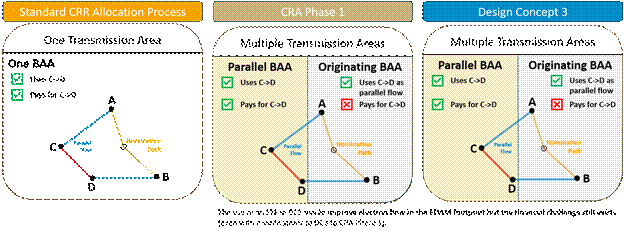
Figure 1. Comparison of different methods of allocating financial entitlements to congestion revenue (FTRs / CRRs).
An equitable solution for CRA Phase 2 would align who’s using the path and who’s paying for the path.
The rest of the DC3 design cannot proceed until we’ve resolved this fundamental issue.
There are many other elements to Design Concept 3 that need to be considered by stakeholders. However, all these secondary considerations cannot be addressed until we’ve resolved this fundamental issue of creating an equitable DC3.
Within the rest of these comments, PG&E provides additional feedback that can be summarized as:
- DC3 needs modifications that correct for the parallel flow issue.
- Not adjusting for parallel flow will be unfair to any EDAM BAA hosting parallel flows
- Adjusting for parallel flow aligns with market principles.
- PG&E Supports Design Concept 3 with modifications that correct for parallel flow.
Regardless of the final CRA Phase 2 design, CRA Phase 1 should be phased out on a clear timeline to eliminate any uncertainty.
[1] In the example, the “Parallel BAA” is the BAA through which the parallel flow is occurring.
[2] In the example, we’re defining the “Originating BAA” as the BAA from which parallel flow is coming.
2.
Please provide your organization’s feedback regarding the use of a common simultaneous feasibility test (incorporating CRRs and EDAM entity OATT rights) to establish congestion revenue entitlements.
- DC3 needs modifications that correct for the parallel flow issue.
Applying a common SFT to the EDAM footprint, without consideration for transmission planning boundaries, will lead to inequitable allocations. A portion of the rights that the common SFT allocates will only be feasible due to parallel flow in another EDAM BAA.
CAISO’s vision of a common SFT is essentially an extension of what CAISO does for the CISO BAA with CRRs. This does not work because a common SFT assumes all participants are sharing in the cost of the transmission; this is not the case across EDAM BAA boundaries and allowing for allocations dependent upon parallel flow creates a cross-subsidy that pays EDAM BAAs for causing parallel flows.
- Not adjusting for parallel flow will be unfair to the Parallel BAA customers
The optimization of the SFT inherently will curtail nominations in the Parallel BAA before the Originating BAA due to the higher shift factors between native nominations and the binding constraint. Even curtailing nominations equally is unfair as the native nominations have paid into that transmission system and the external nominations that are relying on parallel flow through the Parallel BAA have not.
- Adjusting for parallel flow aligns with market principles
EDAM is essentially a very complex and efficient seams agreement. Traditional seams agreements would pay the Parallel BAA for the loss of the transmission service and/or the cost of redispatch when congested. This aligns with market design principles as it prevents the Parallel BAA from subsidizing its neighbors and discourages its neighbors from planning to flow on transmission that they have not paid for.
- PG&E Supports Design Concept 3 with modifications that correct for parallel flow.
PG&E strongly believes that markets should respect transmission rights financially and not physically. From that perspective, DC3 is the most promising path forward as it should promote the most efficient market outcomes. However, efficiency should not trump equity and parallel flow in DC3 is inherently inequitable. The final CRA Phase 2 design should utilize DC3 but correct for this inequity.
3.
Please provide your organization’s feedback regarding the inputs into the common simultaneous feasibility test as discussed in the presentation. Should there be any extraneous constraints considered in the test that are not represented in the market constraints? If so, please describe them, their intended effects, and the rationale.
PG&E reiterates that the CAISO should run a version of the SFT with intertie constraints to limit uncontracted cross-boundary flow (i.e., parallel flow). At the very least, this will be informative to the initiative but could also provide an alternative path for CRA Phase 2.
4.
Please provide your organization’s feedback regarding incorporation of CRR nominations (as part of the CRR allocation process) for the CAISO balancing area within the common simultaneous feasibility test as part of Design Concept #3. Should there be additional considerations or inputs taken into account in representing the CAISO balancing area in the common simultaneous feasibility test? Please indicate these and the associated rationale.
PG&E believes that it is important that all nominations for this EDAM process (both for CRR on CAISO’s side and OATT nominations for other EDAM BAAs) reflect the physical usage of the transmission system. This is important because it ensures equity between participants and is verifiable. For the CAISO BAA, this could include nominations from load-serving entities, deliverable generation, ETC/TORs, Resource Adequacy imports, and wheel-throughs.
5.
Please provide your organization’s feedback regarding the eligible firm OATT rights to be considered within the simultaneous feasibility test as part of Design Concept #3. Aside from long-term firm point-to-point and network integration transmission service rights, should other types of OATT rights be considered? If so, please describe the rationale for inclusion of these.
PG&E believes that it is important that all nominations (both for CRR on CAISO’s side and OATT nominations for other EDAM BAAs) reflect the physical usage of the transmission system.
6.
Please provide your organization’s feedback regarding the structure of the annual simultaneous feasibility test and representation of CRRs and eligible firm OATT transmission rights across the identified three tiers. Should these inputs (CRRs, OATT rights) be represented differently across the three tiers? If so, please describe the rationale.
PG&E believes this topic needs further discussion given that other fundamental design considerations have not yet reached consensus.
7.
Please provide your organization’s feedback regarding the representation of 65% of the transmission system within the annual simultaneous feasibility test (also known as the global derate factor) to recognize uncertainty with system topology, outages, and loop flows from outside the market footprint. Should this amount be different, recognizing that modeling of the EDAM footprint will allow for accounting of parallel flows between EDAM balancing areas within the feasibility test itself, or for other reasons? If so, please describe the rationale.
PG&E believes this topic needs further discussion given that other fundamental design considerations have not yet reached consensus.
8.
Please provide your organization’s feedback regarding the structure of the monthly simultaneous feasibility test and representation of CRRs and eligible firm OATT transmission rights across the identified two tiers. Should these inputs (CRRs, OATT rights) be represented differently across the two tiers? If so, please describe the rationale.
PG&E believes this topic needs further discussion given that other fundamental design considerations have not yet reached consensus.
9.
Please provide your organization’s feedback regarding the representation of 82.5% of the transmission system within the monthly simultaneous feasibility test (also known as the global derate factor) to recognize uncertainty with system topology, outages, and loop flows from outside the market footprint. Should this amount be different, recognizing that modeling of the EDAM footprint will allow for accounting of parallel flows between EDAM balancing areas within the feasibility test itself, or for other reasons? If so, please describe the rationale.
PG&E believes this topic needs further discussion given that other fundamental design considerations have not yet reached consensus
10.
Please provide your organization’s feedback regarding the utilization of the weighted least squares methodology, as described in the presentation, to reduce or haircut the transmission rights input into the simultaneous feasibility test when necessary to achieve feasibility (and resulting congestion revenue entitlements). Should a different methodology be utilized? If so, please describe the methodology and rationale.
The “least squares” method is inherently unfair to native customers as it assumes each nomination has equal claim to congestion rent on each constraint. This is not the case for EDAM.
Least-squares works when every nomination has paid equally for the transmission. This is not the case for EDAM. The least squares method is equitable for nominations and rents within the same transmission planning area; PacifiCorp nominations may have equal claim to congestion within PacifiCorp. But the least squares method is not equitable when choosing between a native nomination and an external nomination: e.g., if a CAISO BAA nomination is chosen over a PacifiCorp nomination when the congestion accrues in PacifiCorp.
The least-squares method might be the most efficient method of finding a feasible set within a given transmission cost-allocation area, but it cannot address the inequity of curtailing a native nomination ahead of an external nomination.
11.
Please provide your organization’s feedback regarding the described approach for managing congestion underfunding, which would pay out the collected congestion revenues.
PG&E believes this topic needs further discussion given that other fundamental design considerations have not yet reached consensus.
12.
Please provide your organization’s feedback regarding the potential incentives that may be created by different aspects of Design Concept #3. Please provide the associated rationale for these incentives and potential ways to mitigate undesirable incentives.
PG&E agrees with CAISO’s assessments that, if done well, DC3 has the potential to align well with sound market principles and is one of the key reasons that it supports DC3. The ultimate goal of CRA Phase 2 should be to respect rights financially, not physically.
13.
Please provide your organization’s feedback regarding any additional information, data, or analysis – beyond the data analysis that the CAISO has already committed to undertaking as described in the slides – that may be helpful in evaluating Design Concept #3.
PG&E believes more discussion and data would be helpful. Specifically:
- RC West should provide data regarding historic loop / parallel flows in the West and how much loop / parallel flow EDAM BAAs currently experience.
- CAISO should run the SFT with and without intertie constraints and provide a meaningful comparison of the two results.
14.
Please provide any additional feedback not already captured.
Regardless of the final CRA Phase 2 design, CRA Phase 1 should be phased out on a clear timeline to eliminate any uncertainty.
The CRA Phase 1 design was necessary, but temporary measure to help get EDAM off the ground. CAISO’s analysis of EDAM CRA Phase 1 has shown just how inequitable it is. CRA Phase 1 is backwards from the standpoint of traditional seams agreements: the CAISO BAA pays EDAM participants when their sales create parallel flow through CAISO. This is an incentive to continue creating parallel flow. Whether or not stakeholders and CAISO are able to come up with a more durable design in EDAM CRA Phase 2, there needs to be a clear timeline for sunsetting CRA Phase 1.
PacifiCorp
Submitted 09/04/2026, 11:14 am
1.
Please provide your organization's overall feedback regarding the EDAM Congestion Revenue Allocation – Design Concept #3 discussions held on August 13, 2026 and August 20, 2026.
PacifiCorp appreciates CAISO's continued engagement with stakeholders and the additional detail provided regarding Design Concept #3 during the August 13 and August 20 stakeholder meetings. Based on the discussions to date, PacifiCorp believes the common Simultaneous Feasibility Test (SFT) framework remains the most promising of the congestion revenue allocation concepts presented and supports continued evaluation of the design. The proposed mock SFT analysis should provide valuable information to help stakeholders assess key design elements and better understand potential outcomes.
PacifiCorp observed that a significant portion of the stakeholder discussion focused on questions of comparability, equity, and incentives associated with the treatment of CAISO CRRs and EDAM entity transmission rights. In PacifiCorp's view, continued discussion would benefit from a common understanding of how firm transmission service is established, administered, and constrained under the OATT framework. Several stakeholder comments appeared to reflect differing understandings regarding the sale of firm transmission service, the limitations applicable to OATT transmission rights, and the relationship between transmission reservations and congestion revenue entitlements. Additional background on these topics may help stakeholders more effectively evaluate Design Concept #3 and focus future discussions on the remaining policy and design questions. PacifiCorp discusses these considerations and the limitations applicable to OATT transmission service in its response to Question 12.
2.
Please provide your organization’s feedback regarding the use of a common simultaneous feasibility test (incorporating CRRs and EDAM entity OATT rights) to establish congestion revenue entitlements.
PacifiCorp appreciates CAISO's continued development of Design Concept #3 and believes it remains the most promising of the congestion revenue allocation concepts presented to date. The common SFT framework appears to provide a viable path for integrating CAISO CRRs and EDAM entity transmission rights within a single congestion revenue allocation construct while avoiding some of the schedule-based complexities associated with other approaches. PacifiCorp supports continued evaluation of Design Concept #3 and believes the proposed mock SFT analysis will be valuable in helping stakeholders better understand the practical implications and outcomes of the design.
3.
Please provide your organization’s feedback regarding the inputs into the common simultaneous feasibility test as discussed in the presentation. Should there be any extraneous constraints considered in the test that are not represented in the market constraints? If so, please describe them, their intended effects, and the rationale.
No comment.
4.
Please provide your organization’s feedback regarding incorporation of CRR nominations (as part of the CRR allocation process) for the CAISO balancing area within the common simultaneous feasibility test as part of Design Concept #3. Should there be additional considerations or inputs taken into account in representing the CAISO balancing area in the common simultaneous feasibility test? Please indicate these and the associated rationale.
No comment.
5.
Please provide your organization’s feedback regarding the eligible firm OATT rights to be considered within the simultaneous feasibility test as part of Design Concept #3. Aside from long-term firm point-to-point and network integration transmission service rights, should other types of OATT rights be considered? If so, please describe the rationale for inclusion of these.
PacifiCorp generally understands the rationale for initially focusing on long-term firm PTP and NITS rights. However, because CRRs and OATT transmission rights are fundamentally different products, it is not clear what constitutes the most comparable representation of those rights within a common SFT. PacifiCorp would welcome additional discussion regarding whether limiting eligibility to long-term firm rights provides the most appropriate balance between comparability and equity across CAISO and EDAM entities, or whether consideration of other firm transmission products, such as monthly firm transmission service, may be warranted. Additional analysis, including the proposed mock SFT, could help stakeholders better understand the benefits, tradeoffs, and potential outcomes associated with alternative eligibility criteria.
6.
Please provide your organization’s feedback regarding the structure of the annual simultaneous feasibility test and representation of CRRs and eligible firm OATT transmission rights across the identified three tiers. Should these inputs (CRRs, OATT rights) be represented differently across the three tiers? If so, please describe the rationale.
PacifiCorp supports further discussion regarding the representation of CRRs and eligible firm OATT transmission rights across the three annual SFT tiers. Based on PacifiCorp's understanding, the CRR tier structure is tied to the existing annual CRR allocation process, where CRR nominations are evaluated through successive SFT runs. By contrast, it is not immediately apparent what the tiers are intended to represent for eligible firm OATT transmission rights. Under the current proposal, eligibility is already limited to certain long-term firm transmission rights, which generally share the same scheduling priority under the OATT. Additional discussion and examples would help stakeholders evaluate whether the existing CRR tier structure appropriately translates to eligible firm OATT transmission rights or whether an alternative representation may better reflect those rights within the annual SFT.
7.
Please provide your organization’s feedback regarding the representation of 65% of the transmission system within the annual simultaneous feasibility test (also known as the global derate factor) to recognize uncertainty with system topology, outages, and loop flows from outside the market footprint. Should this amount be different, recognizing that modeling of the EDAM footprint will allow for accounting of parallel flows between EDAM balancing areas within the feasibility test itself, or for other reasons? If so, please describe the rationale.
PacifiCorp does not have sufficient information regarding the historical performance of the existing 65% global derate factor to recommend a specific adjustment at this time. While the expanded EDAM footprint may reduce some of the uncertainty that the global derate factor is intended to address, the results of the proposed mock SFT analysis and additional information regarding the performance of the current global derate factor would help stakeholders evaluate whether a different value is warranted and better understand the impacts on congestion revenue entitlement allocations.
8.
Please provide your organization’s feedback regarding the structure of the monthly simultaneous feasibility test and representation of CRRs and eligible firm OATT transmission rights across the identified two tiers. Should these inputs (CRRs, OATT rights) be represented differently across the two tiers? If so, please describe the rationale.
PacifiCorp refers CAISO to its response to Question 6. PacifiCorp understands the rationale for applying a tiered structure within the monthly CRR process but is less certain how the two-tier construct translates to eligible firm OATT transmission rights. Additional discussion and examples would help stakeholders better understand the purpose of the monthly tiers for OATT rights and whether the proposed structure appropriately reflects those rights within the monthly SFT.
9.
Please provide your organization’s feedback regarding the representation of 82.5% of the transmission system within the monthly simultaneous feasibility test (also known as the global derate factor) to recognize uncertainty with system topology, outages, and loop flows from outside the market footprint. Should this amount be different, recognizing that modeling of the EDAM footprint will allow for accounting of parallel flows between EDAM balancing areas within the feasibility test itself, or for other reasons? If so, please describe the rationale.
PacifiCorp does not have sufficient information regarding the historical performance of the existing 82.5% global derate factor to recommend a specific adjustment at this time. While the expanded EDAM footprint may reduce some of the uncertainty that the global derate factor is intended to address, the results of the proposed mock SFT analysis and additional information regarding the performance of the current global derate factor would help stakeholders evaluate whether a different value is warranted and better understand the impacts on congestion revenue entitlement allocations.
10.
Please provide your organization’s feedback regarding the utilization of the weighted least squares methodology, as described in the presentation, to reduce or haircut the transmission rights input into the simultaneous feasibility test when necessary to achieve feasibility (and resulting congestion revenue entitlements). Should a different methodology be utilized? If so, please describe the methodology and rationale.
PacifiCorp understands the weighted least squares methodology has been utilized within the existing CRR framework and appears to be a reasonable starting point for a common SFT. The results of the proposed mock SFT analysis will be helpful in evaluating how the approach performs in the context of a common SFT incorporating both CRRs and eligible firm OATT transmission rights. PacifiCorp does not have a specific recommendation regarding an alternative methodology at this time but would welcome the opportunity to evaluate any alternatives CAISO may consider.
11.
Please provide your organization’s feedback regarding the described approach for managing congestion underfunding, which would pay out the collected congestion revenues.
Additional information is needed before PacifiCorp can provide detailed feedback on the proposed underfunding approach. In particular, examples illustrating how underfunding would be allocated among CRR and OATT-based entitlements, information regarding historical CRR underfunding, and the results of the proposed mock SFT would help stakeholders evaluate the proposal.
12.
Please provide your organization’s feedback regarding the potential incentives that may be created by different aspects of Design Concept #3. Please provide the associated rationale for these incentives and potential ways to mitigate undesirable incentives.
PacifiCorp believes further discussion regarding incentives under Design Concept #3 would benefit from a common understanding of how firm transmission service is established, administered, and constrained under the OATT framework. Several comments during the August 13 and August 20 working group discussions reflected questions regarding the limitations on firm transmission rights, the potential for transmission providers to expand transmission service to increase congestion revenue entitlements, and the treatment of reserved but unused transmission service within the proposed framework. In PacifiCorp's view, many of these questions relate to fundamental aspects of OATT transmission service and may be helpful to clarify before drawing conclusions regarding potential incentives created by Design Concept #3.
PacifiCorp offers the following:
- Transmission providers cannot simply increase congestion revenue entitlements by selling additional firm transmission service. Transmission service providers evaluate and grant firm transmission service pursuant to North American Energy Standards Board (NAESB) established Available Transfer Capability (ATC) methodologies and reliability requirements. Under 18 CFR § 38.1, FERC incorporates specified NAESB Wholesale Electric Quadrant (WEQ) business practice standards by reference into its regulations and requires applicable transmission service providers to comply with them. NAESB WEQ-023: Modeling Business Practice Standards specifies the methodologies for calculating ATC and evaluating transmission availability prior to the sale of firm transmission service. Long-term firm transmission service may only be granted when sufficient capability exists to support the reservation. In addition, NAESB-defined ATC methodologies account for transmission system conditions and flow impacts beyond the transmission service provider's own system when evaluating transmission availability. Transmission service providers also operate separately from marketing and merchant functions and are subject to standards designed to prevent preferential treatment or transmission sales intended to advantage a transmission service provider’s own commercial activity. It also important to distinguish between transmission service providers and the transmission customers that hold and pay for transmission rights. Congestion revenues allocated to an EDAM entity are sub-allocated to eligible transmission customers rather than retained by the transmission provider itself. Therefore, transmission providers do not have a direct financial incentive to expand firm transmission service for the purpose of increasing congestion revenue allocations as they do not keep the congestion revenue. For these reasons, long-term firm transmission rights cannot simply be created or expanded to increase congestion revenue allocations, nor does a direct incentive exist for transmission providers to do so.
- Reserved transmission rights may retain economic value even when not utilized. Long-term firm PTP customers pay for reserved transmission capacity regardless of the extent to which the reservation is utilized. The reservation itself represents a long-term contractual commitment supported by transmission capability, associated charges, and provides certainty to access the transmission system to transact bilaterally or to serve load. In addition, CAISO's proposed common SFT evaluates transmission rights rather than actual schedules, which is generally consistent with the treatment of CRRs as financial congestion hedges that do not depend on whether energy is ultimately scheduled or flows. The absence of transmission usage therefore does not mean the underlying transmission right is unpaid, unconstrained, or lacking economic value, nor does it necessarily provide a basis for excluding the right from consideration within the common SFT.
Several stakeholders have made statements related to the equitable use of the CAISO transmission system, cost responsibility, and fairness of congestion revenue allocations. In PacifiCorp's opinion, these discussions at times combine questions regarding transmission usage and cost responsibility with questions regarding the allocation of congestion revenue entitlements. More fundamentally, these discussions appear to reflect differing views regarding the basis for eligibility within the common SFT. It is not always clear whether eligibility is intended to reflect those customers that bear the costs of the transmission system, those rights that represent exposure to congestion, those rights that reflect long-term commitments to the transmission system, or some combination of these considerations. Additional discussion regarding the rationale for eligibility within the common SFT may help stakeholders more effectively evaluate Design Concept #3.
13.
Please provide your organization’s feedback regarding any additional information, data, or analysis – beyond the data analysis that the CAISO has already committed to undertaking as described in the slides – that may be helpful in evaluating Design Concept #3.
In addition to the analyses CAISO has already committed to undertake, PacifiCorp believes stakeholders would benefit from additional background regarding how firm transmission service is established, administered, and constrained under the OATT framework. Several comments during the working group discussions suggested differing understandings regarding the sale of firm transmission service, the limitations applicable to OATT transmission rights, and the relationship between transmission reservations and congestion revenue entitlements. Additional educational material or discussion on these topics may help stakeholders more effectively evaluate Design Concept #3 and distinguish between concerns related to congestion revenue allocation design and the underlying administration of firm transmission service.
14.
Please provide any additional feedback not already captured.
PacifiCorp encourages CAISO to carefully consider the process used to identify, validate, and represent eligible OATT transmission rights within the common SFT. To reduce administrative burden and improve consistency, CAISO could consider establishing a process to retrieve transmission reservation data directly from OATI OASIS. Because reservation data may not always translate directly into the network model used for the SFT, additional mapping between OATI OASIS reservation data and the CAISO network model may be required. For example, reservation source and sink points may not always correspond directly to elements (e.g. resource IDs) represented within the SFT. Transmission service providers could provide mapping information to support this translation process, and PacifiCorp believes transmission service providers should have an opportunity to review the resulting inputs and provide feedback or corrections prior to their use in the SFT.
PacifiCorp also notes several implementation considerations that may warrant further evaluation. For PTP service, not all long-term reservations are established using a specified source and sink, as some reservations are specified using points of receipt (POR) and points of delivery (POD). In addition, long-term reservation quantities may be modified through actions such as short-term redirects or resales. CAISO may wish to consider whether reviewing reservation data from a recent historical period would provide a more accurate representation of active long-term reservations by reflecting these types of adjustments.
For NITS service, aggregate designated network resource quantities may exceed coincident load obligations even though actual NITS usage remains constrained by load. PacifiCorp encourages CAISO to further evaluate how designated network resources should be represented within the common SFT, including potential approaches for determining which NITS rights are reflected in serving load, such as applying a basic merit order dispatch to determine which network resource rights are modeled in the SFT.
Renewable Northwest
Submitted 09/02/2026, 04:53 pm
1.
Please provide your organization's overall feedback regarding the EDAM Congestion Revenue Allocation – Design Concept #3 discussions held on August 13, 2026 and August 20, 2026.
Renewable Northwest appreciates CAISO’s continued work to develop a durable approach to congestion revenue allocation that treats transmission rights across the EDAM footprint equitably and reduces incentives for market participants to self-schedule rather than submit economic offers. We believe Design Concept #3, the Simultaneous Feasibility Test (SFT), merits continued consideration and may offer a promising framework for achieving these objectives.
At the same time, Renewable Northwest is concerned that participation in the detailed development of Concept #3 has not been equal across all stakeholder sectors which could lead to inequitable outcomes. EDAM Entities, OATT transmission customers, generators, consumer interests, and other stakeholders have participated less extensively, even as the discussion has begun to address issues that could materially affect the value of OATT transmission rights and the allocation of congestion revenues throughout the non-ISO West.
This imbalance is particularly important because several issues under consideration have potentially significant distributional consequences, including the treatment of parallel flows and the allocation of congestion revenues in the event of revenue shortfalls. Reasonable stakeholders may reach different conclusions on these questions. But decisions with significant consequences for customers and transmission rights holders across the West should be informed by meaningful participation from those affected parties. Using this initiative as the pilot for indicative voting, as is planned when the initiative moves into the proposal phase, will be important to fully understand the views of a broad range of stakeholders.
The timing is also important. The West is in the process of establishing independent regional governance for EDAM through the Regional Organization for Western Energy (“ROWE”). That effort reflects the importance Western stakeholders have placed on ensuring that regional market decisions represent the interests and perspectives of the broader West. It would be counterproductive if a significant EDAM market design issue were resolved through a process perceived by stakeholders as not being reflective of the EDAM stakeholder community at large.
Renewable Northwest does not recommend stopping work on congestion revenue allocation while ROWE becomes operational. There are legitimate reasons to improve the existing framework, and Concept #3 merits continued development. However, CAISO should proceed deliberately and provide sufficient time and outreach for substantially greater participation from stakeholders throughout the EDAM footprint before settling major questions with significant distributional consequences. A durable congestion revenue allocation framework will depend not only on sound technical design, but also on confidence among participants throughout the West that the framework treats their transmission rights and customers fairly.
2.
Please provide your organization’s feedback regarding the use of a common simultaneous feasibility test (incorporating CRRs and EDAM entity OATT rights) to establish congestion revenue entitlements.
Renewable Northwest believes the common simultaneous feasibility test merits continued consideration. An SFT may provide a promising means of separating congestion hedging from market scheduling decisions, thereby reducing incentives to self-schedule, while accounting for the physical capability of the regional transmission system.
Our support for continued development of the SFT should not be interpreted as support for all of the specific implementation choices discussed to date. Questions concerning eligible transmission rights, treatment of parallel flows, potential revenue shortfalls, and priority among different classes of rights remain consequential and unresolved. Renewable Northwest encourages CAISO to develop these elements with substantially greater participation from EDAM Entities and other non-California stakeholders before selecting a final design.
3.
Please provide your organization’s feedback regarding the inputs into the common simultaneous feasibility test as discussed in the presentation. Should there be any extraneous constraints considered in the test that are not represented in the market constraints? If so, please describe them, their intended effects, and the rationale.
Renewable Northwest does not have a specific recommendation regarding additional constraints at this time.
4.
Please provide your organization’s feedback regarding incorporation of CRR nominations (as part of the CRR allocation process) for the CAISO balancing area within the common simultaneous feasibility test as part of Design Concept #3. Should there be additional considerations or inputs taken into account in representing the CAISO balancing area in the common simultaneous feasibility test? Please indicate these and the associated rationale.
Renewable Northwest does not have a specific recommendation regarding the mechanics for representing CAISO CRR nominations at this time. More broadly, we encourage CAISO to ensure that the treatment of CRRs and OATT rights within the common SFT is developed through a process that adequately represents both CAISO and non-CAISO interests.
5.
Please provide your organization’s feedback regarding the eligible firm OATT rights to be considered within the simultaneous feasibility test as part of Design Concept #3. Aside from long-term firm point-to-point and network integration transmission service rights, should other types of OATT rights be considered? If so, please describe the rationale for inclusion of these.
Renewable Northwest encourages CAISO to consider eligibility for shorter-term firm OATT rights, including monthly firm point-to-point and network integration transmission service, rather than limiting eligibility to long-term firm rights.
In particular, Renewable Northwest encourages CAISO to further develop the factual and policy basis for distinguishing between long-term and shorter-term firm transmission rights based on the premise that long-term rights contribute toward the long-term cost and development of the transmission system while shorter-term rights do not. Shorter-term firm transmission service is used extensively throughout the West and can represent significant contributions toward transmission system costs. In some locations, long-term firm transmission service may also be difficult or impossible to obtain even where customers regularly purchase shorter-duration firm service. Payment for short-term service in these instances contributes to the overall cost and investment needed on the bulk transmission system, as the cost for short-term service is typically equal or greater than that of long-term service.
Renewable Northwest does not at this time recommend a specific eligibility standard. However, any distinction among otherwise firm transmission rights should be supported by a clear factual record and should reflect how OATT transmission service is actually obtained and used throughout the West, including how payments contribute to demonstrating transmission needs and development. This is another area where greater participation from EDAM Entities and their transmission customers would be particularly valuable.
6.
Please provide your organization’s feedback regarding the structure of the annual simultaneous feasibility test and representation of CRRs and eligible firm OATT transmission rights across the identified three tiers. Should these inputs (CRRs, OATT rights) be represented differently across the three tiers? If so, please describe the rationale.
Renewable Northwest does not have a specific recommendation regarding the three-tier structure at this time.
7.
Please provide your organization’s feedback regarding the representation of 65% of the transmission system within the annual simultaneous feasibility test (also known as the global derate factor) to recognize uncertainty with system topology, outages, and loop flows from outside the market footprint. Should this amount be different, recognizing that modeling of the EDAM footprint will allow for accounting of parallel flows between EDAM balancing areas within the feasibility test itself, or for other reasons? If so, please describe the rationale.
Renewable Northwest does not have a specific recommendation regarding the appropriate global derate factor at this time.
8.
Please provide your organization’s feedback regarding the structure of the monthly simultaneous feasibility test and representation of CRRs and eligible firm OATT transmission rights across the identified two tiers. Should these inputs (CRRs, OATT rights) be represented differently across the two tiers? If so, please describe the rationale.
Renewable Northwest does not have a specific recommendation regarding the two-tier structure at this time.
9.
Please provide your organization’s feedback regarding the representation of 82.5% of the transmission system within the monthly simultaneous feasibility test (also known as the global derate factor) to recognize uncertainty with system topology, outages, and loop flows from outside the market footprint. Should this amount be different, recognizing that modeling of the EDAM footprint will allow for accounting of parallel flows between EDAM balancing areas within the feasibility test itself, or for other reasons? If so, please describe the rationale.
Renewable Northwest does not have a specific recommendation regarding the appropriate global derate factor at this time.
10.
Please provide your organization’s feedback regarding the utilization of the weighted least squares methodology, as described in the presentation, to reduce or haircut the transmission rights input into the simultaneous feasibility test when necessary to achieve feasibility (and resulting congestion revenue entitlements). Should a different methodology be utilized? If so, please describe the methodology and rationale.
Renewable Northwest does not have a specific recommendation regarding the weighted least squares methodology at this time.
11.
Please provide your organization’s feedback regarding the described approach for managing congestion underfunding, which would pay out the collected congestion revenues.
Renewable Northwest does not have a specific recommendation regarding the ultimate methodology for allocating congestion underfunding at this time. We do, however, believe that this is precisely the type of issue for which broader regional participation is essential.
Rules governing the allocation of revenue shortfalls could have significant distributional consequences among CAISO CRR holders, EDAM Entities, and OATT transmission customers. CAISO should avoid establishing priorities among these interests based on a stakeholder record where the affected non-ISO parties have been underrepresented. Renewable Northwest encourages CAISO to provide sufficient opportunity for EDAM Entities and affected transmission customers to evaluate the implications of the proposed approach before settling this element of Concept #3.
12.
Please provide your organization’s feedback regarding the potential incentives that may be created by different aspects of Design Concept #3. Please provide the associated rationale for these incentives and potential ways to mitigate undesirable incentives.
One important potential benefit of Concept #3 is its ability to reduce the incentive under the existing framework for transmission customers to self-schedule in order to obtain a congestion hedge. Renewable Northwest supports development of an approach that allows market participants to submit economic offers without unnecessarily sacrificing the financial value associated with their transmission rights.
Beyond this general principle, Renewable Northwest does not have specific recommendations regarding other incentives created by the detailed design at this time.
13.
Please provide your organization’s feedback regarding any additional information, data, or analysis – beyond the data analysis that the CAISO has already committed to undertaking as described in the slides – that may be helpful in evaluating Design Concept #3.
In addition to CAISO’s planned analysis, Renewable Northwest encourages CAISO to provide information that allows stakeholders to understand the distributional consequences of the alternatives under consideration across the EDAM footprint. Where practicable, analysis should identify how significant design choices—including eligibility rules, treatment of parallel flows, and approaches to underfunding—would affect CAISO CRR holders, EDAM Entities, and different categories of OATT transmission customers.
CAISO should fully understand how different types of transmission categories and terms are used throughout the EDAM footprint by seeking input from EDAM Entities and transmission customers regarding how different categories of OATT rights are actually purchased and used throughout the West. Such information would help establish a stronger factual basis for determining which firm transmission rights should be eligible under Concept #3.
More broadly, additional analysis cannot substitute for broader regional participation. Renewable Northwest encourages CAISO to work proactively with EDAM Entities and other affected regional stakeholders to ensure they have sufficient opportunity and time to evaluate the proposal and its potential economic impacts before major design decisions are finalized.
14.
Please provide any additional feedback not already captured.
Renewable Northwest has no additional comments at this time.
San Diego Gas & Electric
Submitted 09/03/2026, 04:52 pm
1.
Please provide your organization's overall feedback regarding the EDAM Congestion Revenue Allocation – Design Concept #3 discussions held on August 13, 2026 and August 20, 2026.
SDG&E continues to support the use of a common simultaneous feasibility test (SFT) to establish congestion revenue entitlements for eligible OATT rights and CRRs. EDAM CRA Phase 2 deals with highly technical issues that will have a material effect on transmission cost allocation in CAISO and other EDAM BAAs. SDG&E therefore appreciates CAISO's efforts to explain the issues during the stakeholder working groups, including setting up additional meetings when topics are unresolved. This engagement is critical to providing stakeholders the information they need to evaluate the proposals and provide informed feedback. SDG&E provides further details below.
2.
Please provide your organization’s feedback regarding the use of a common simultaneous feasibility test (incorporating CRRs and EDAM entity OATT rights) to establish congestion revenue entitlements.
SDG&E recommends CAISO develop Design Concept #3 as the preferred solution to integrate the various transmission rights within EDAM into a durable system that can be used for all participants. The initiative will establish an initial strategy for the parameters used in the common SFT. A durable framework should allow entities to join EDAM without resulting in significant inequities for then-current participants. As stated below, additional information is needed to evaluate whether differences in methodology across EDAM entities could materially affect outcomes as more EDAM entities join the market.
In the future, however, it may be beneficial for CAISO to assess whether additional enhancements will be necessary after gaining actual experience with the modeling of transmission rights across the EDAM footprint. In other words, this effort does not preclude future enhancements to network modeling or eligible rights. On the contrary, the implementation of Design of Concept #3 should require periodic updates as the market footprint evolves.
3.
Please provide your organization’s feedback regarding the inputs into the common simultaneous feasibility test as discussed in the presentation. Should there be any extraneous constraints considered in the test that are not represented in the market constraints? If so, please describe them, their intended effects, and the rationale.
No comment.
4.
Please provide your organization’s feedback regarding incorporation of CRR nominations (as part of the CRR allocation process) for the CAISO balancing area within the common simultaneous feasibility test as part of Design Concept #3. Should there be additional considerations or inputs taken into account in representing the CAISO balancing area in the common simultaneous feasibility test? Please indicate these and the associated rationale.
SDG&E believes CAISO has taken appropriate steps in this stakeholder process to identify the challenges of equitably representing use of the CAISO transmission system within the proposed common SFT. Unlike other EDAM entities, the CAISO balancing area does not sell physical transmission rights, thus CRR nominations and OATT rights are not directly comparable. This distinction is important because CRR and OATT nominations would receive equal treatment in the common SFT. SDG&E generally supports the use of allocated CRR nominations as the starting point for representing the CAISO balancing area, but believes additional analysis is needed to ensure the common SFT provides a reasonably comparable representation of transmission system use, investment, and cost responsibility across all EDAM balancing areas. It is critical that the outcome of this design does not result in treating CRRs and CAISO transmission customers as secondary as compared to OATT rights holders.
We agree with PG&E's observation during the August 13 workshop that allocated CRR nominations may not represent the full extent of transmission system use within the CAISO balancing area. Allocated CRRs are limited by the CRR allocation framework, applicable CPUC compliance, and load-based nomination rules. Long-term firm point-to-point (PTP) and network integration transmission service (NITS) rights in other EDAM BAAs do not have the same restrictions and could be more widely subscribed relative to the size of their BAAs’ transmission capacity. Although there are practical, physical limitations to the sale of transmission rights within the EDAM BAAs, they may not be comparable to the relative quantity of allocated CRRs. SDG&E supports a full and transparent analysis comparing the different types of transmission rights across CAISO and other EDAM BAAs. As part of this analysis, SDG&E supports exploring inclusion of auctioned CRRs to ensure the common SFT produces an equitable result for transmission customers across all the EDAM BAAs.
SDG&E also supports analysis comparing auctioned and allocated CRRs, NITS, long-term firm PTP rights, and transmission capacity across the EDAM footprint. As a next step, CAISO should demonstrate that the rights included in the common SFT provide a reasonably comparable representation of transmission system use and do not unintentionally allow one type of rights to disproportionately reduce the congestion hedges available to another. More information on the overall subscription of the transmission system and the results of CAISO's planned common SFT simulations should help stakeholders evaluate whether refinements are needed to ensure equitable treatment among EDAM BAAs.
5.
Please provide your organization’s feedback regarding the eligible firm OATT rights to be considered within the simultaneous feasibility test as part of Design Concept #3. Aside from long-term firm point-to-point and network integration transmission service rights, should other types of OATT rights be considered? If so, please describe the rationale for inclusion of these.
SDG&E does not object to CAISO's proposal to include NITS and long-term firm PTP rights alongside allocated CRRs in the common SFT as the starting point for Design Concept #3. At this time, SDG&E does not have sufficient information to support inclusion of OATT rights beyond what has already been identified for eligibility. However, we are concerned that external transmission rights could reduce the feasibility of CRR nominations on shared constraints if the volume of rights represented in the common SFT is not reasonably comparable across BAAs. The methodology does not necessarily ensure equitable outcomes if the underlying rights being evaluated reflect different levels of system subscription. SDG&E reiterates its prior request for a comparison of allocated and auctioned CRRs, NITS, long-term firm PTP rights, and transmission capacity across the footprint. This analysis would be highly informative for evaluating whether the proposed set of eligible rights for the common SFT accomplishes the goal of comparable treatment among EDAM participants.
Stakeholders may also benefit from greater transparency regarding the methodologies used by EDAM entities to establish and sell long-term firm transmission rights, the extent to which those methodologies differ across EDAM BAAs, and the quantity of transmission rights that may ultimately be represented in the common SFT. While CAISO has indicated that there are limits on the sale of long-term firm point-to-point rights, additional information is needed to evaluate whether differences in methodology across EDAM entities could materially affect outcomes as more EDAM entities join the market.
6.
Please provide your organization’s feedback regarding the structure of the annual simultaneous feasibility test and representation of CRRs and eligible firm OATT transmission rights across the identified three tiers. Should these inputs (CRRs, OATT rights) be represented differently across the three tiers? If so, please describe the rationale.
SDG&E believes CAISO should further evaluate whether all rights are similarly situated for purposes of tier prioritization. Allocated CRRs and NITS rights are both tied to serving load and represent customers that bear the cost of the transmission system. In contrast, long-term firm PTP rights and potentially other non-load-serving rights are not directly linked to load obligations. While we do not propose an alternative prioritization at this time, we believe there is merit in exploring whether NITS or allocated CRRs should receive priority in earlier SFT tiers, with long-term firm PTP rights and auctioned CRRs considered in later tiers or subject to different nomination limits.
This approach would be consistent with SDG&E’s belief that congestion hedges should first support customers that fund and rely upon the transmission system to serve load. SDG&E is open to considering whether it may be appropriate for the tier structure to recognize the distinction between transmission rights associated with load service and those that are not. Before making any policy decisions, however, SDG&E encourages CAISO to use the results of its planned common SFT analyses to evaluate the impacts of alternative tier structures on feasibility, congestion hedge availability, and equity across EDAM balancing areas.
SDG&E requests clarification regarding the rationale for permitting nominations up to 100% of eligible rights in the final annual SFT tier and how that design interacts with the global derate factor and the goal of maintaining revenue adequacy.
7.
Please provide your organization’s feedback regarding the representation of 65% of the transmission system within the annual simultaneous feasibility test (also known as the global derate factor) to recognize uncertainty with system topology, outages, and loop flows from outside the market footprint. Should this amount be different, recognizing that modeling of the EDAM footprint will allow for accounting of parallel flows between EDAM balancing areas within the feasibility test itself, or for other reasons? If so, please describe the rationale.
In SDG&E’s view, starting with a 65% global derate factor is a reasonable starting point while Design Concept #3 is further developed and validated. This value is consistent with the existing global derate factor in the annual SFT for CRRs. However, because the common SFT would directly model parallel flows across participating EDAM balancing areas, potentially reducing some of the uncertainty that the global derate factor is intended to address, SDG&E is open to reassessing this value should there be compelling quantitative analysis or in light of actual operational experience. This process should be revisited in the future, and SDG&E is interested in knowing if CAISO plans to reevaluate periodically and specifically every time a BAA joins or leaves the EDAM footprint.
8.
Please provide your organization’s feedback regarding the structure of the monthly simultaneous feasibility test and representation of CRRs and eligible firm OATT transmission rights across the identified two tiers. Should these inputs (CRRs, OATT rights) be represented differently across the two tiers? If so, please describe the rationale.
No comment.
9.
Please provide your organization’s feedback regarding the representation of 82.5% of the transmission system within the monthly simultaneous feasibility test (also known as the global derate factor) to recognize uncertainty with system topology, outages, and loop flows from outside the market footprint. Should this amount be different, recognizing that modeling of the EDAM footprint will allow for accounting of parallel flows between EDAM balancing areas within the feasibility test itself, or for other reasons? If so, please describe the rationale.
SDG&E supports using 82.5% as a sensible starting point for the monthly common SFT. Because the monthly process benefits from more current information regarding system topology, outages, and operating conditions, a higher level of transmission capability than the annual process is justified. However, SDG&E believes the 82.5% value should ultimately be supported through quantitative analysis specific to the common EDAM-wide SFT.
10.
Please provide your organization’s feedback regarding the utilization of the weighted least squares methodology, as described in the presentation, to reduce or haircut the transmission rights input into the simultaneous feasibility test when necessary to achieve feasibility (and resulting congestion revenue entitlements). Should a different methodology be utilized? If so, please describe the methodology and rationale.
At this time SDG&E agrees with continuing to utilize the Weighted Least Squares (WLS) methodology and believes that a reduction allocation based on utilization of shift factors is good starting point to fairly limit transmission rights reductions to those who contributed to the curtailments. However, CAISO should commit to discussing shift factor thresholds and the alignment between the SFT and the day-ahead market model in an upcoming working group.
11.
Please provide your organization’s feedback regarding the described approach for managing congestion underfunding, which would pay out the collected congestion revenues.
SDG&E agrees that a methodology similar to the CRR 1B Initiative Policy is a good starting point at this time to fairly allocate underfunding. If implemented correctly, this method should allocate revenue shortfalls based on cost-causation principles by reducing payment based on the respective entities’ contribution to the identified constraint. At this time SDG&E believes the methodology CAISO uses for each part of the process should be consistent with allocations in the CRR process but would consider arguments for a variation in approach if applicable.
While SDG&E does not propose an alternative to the current allocation system, we emphasize further monitoring and refinement of congestion revenue collection that will reduce underfunding. If CAISO ultimately moves forward with a Tiered allocation system as discussed in Question 6, SDG&E believes it would be appropriate to examine if the same shortfall allocation approach should be applied to a tiered revenue distribution in a case where these revenues are underfunded, as to align with the simultaneous feasibility design.
SDG&E encourages CAISO to further explore this topic with stakeholders and more specifically to share examples of how shift factors and other inputs will determine who and how much revenue reduction will be allocated to individual EDAM entities in the event of underfunding.
12.
Please provide your organization’s feedback regarding the potential incentives that may be created by different aspects of Design Concept #3. Please provide the associated rationale for these incentives and potential ways to mitigate undesirable incentives.
See response to questions 10 and 11.
13.
Please provide your organization’s feedback regarding any additional information, data, or analysis – beyond the data analysis that the CAISO has already committed to undertaking as described in the slides – that may be helpful in evaluating Design Concept #3.
In addition to the data requests outlined in questions 4 and 5, SDG&E respectfully requests the following data to support policy development:
- Analysis comparing the amount of transmission capability represented by allocated CRRs, NITS rights, and long-term firm PTP rights across participating/potential EDAM BAAs.
- Data on the sources of CRR underfunding, including whether underfunding is concentrated on particular constraint paths, geographic regions, or under certain operating conditions as requested.
- Sensitivity analyses comparing SFT results under alternative assumptions, such as different global derate factors, treatment of eligible rights, or BAA-level baseline SFTs.
14.
Please provide any additional feedback not already captured.
SDG&E encourages CAISO to consider the impacts of any CRA system on overall costs to serve load and not allow California customers to be exposed to disproportionate risk in the market.
Six Cities
Submitted 09/03/2026, 02:52 pm
Submitted on behalf of
Cities of Anaheim, Azusa, Banning, Colton, Pasadena, and Riverside, California
1.
Please provide your organization's overall feedback regarding the EDAM Congestion Revenue Allocation – Design Concept #3 discussions held on August 13, 2026 and August 20, 2026.
The Six Cities continue to support further development of Design Concept #3 as the framework for Extended Day-Ahead Market (“EDAM”) Congestion Revenue Allocation based on discussions to date regarding that approach and urge the CAISO to focus on further refinement of that concept. Additional analysis and evaluation are necessary, however, to specify many of the detailed elements for implementing that approach.
2.
Please provide your organization’s feedback regarding the use of a common simultaneous feasibility test (incorporating CRRs and EDAM entity OATT rights) to establish congestion revenue entitlements.
At this time, the Six Cities do not support use of an EDAM-wide simultaneous feasibility test (“SFT”) as the sole basis for establishing congestion revenue entitlements. The Six Cities are concerned that relying entirely on an EDAM-wide SFT to establish congestion revenue entitlements could have the effect of “baking-in” the impacts of uncompensated parallel flows, resulting in inequitable treatment of Balancing Authority Areas (“BAAs”) affected by parallel flows. Instead, the Six Cities urge the CAISO to conduct SFTs separately for individual EDAM BAAs and then compare the results with an EDAM-wide SFT. The congestion revenue allocation methodology should not reward or prioritize parallel flows, and measures should be adopted to minimize the likelihood of such outcomes. Measures that could be considered could include establishing limitations on parallel flow impacts or compensation for parallel flow impacts or some combination of approaches.
3.
Please provide your organization’s feedback regarding the inputs into the common simultaneous feasibility test as discussed in the presentation. Should there be any extraneous constraints considered in the test that are not represented in the market constraints? If so, please describe them, their intended effects, and the rationale.
Please see the Six Cities’ response to Topic No. 2.
4.
Please provide your organization’s feedback regarding incorporation of CRR nominations (as part of the CRR allocation process) for the CAISO balancing area within the common simultaneous feasibility test as part of Design Concept #3. Should there be additional considerations or inputs taken into account in representing the CAISO balancing area in the common simultaneous feasibility test? Please indicate these and the associated rationale.
Further analysis and discussion are necessary regarding this element of the Design Concept #3 approach. A guiding principle should be comparability of treatment to the maximum extent possible among all transmission customers that pay to support the transmission systems of all BAAs participating in the EDAM, whether such payment takes the form of a transmission access charge, a payment for Network Integration Transmission Service (“NITS”), or payment for long-term firm transmission service under an Open Access Transmission Tariff (“OATT”).
5.
Please provide your organization’s feedback regarding the eligible firm OATT rights to be considered within the simultaneous feasibility test as part of Design Concept #3. Aside from long-term firm point-to-point and network integration transmission service rights, should other types of OATT rights be considered? If so, please describe the rationale for inclusion of these.
Please see the Six Cities’ response to Topic No. 4.
6.
Please provide your organization’s feedback regarding the structure of the annual simultaneous feasibility test and representation of CRRs and eligible firm OATT transmission rights across the identified three tiers. Should these inputs (CRRs, OATT rights) be represented differently across the three tiers? If so, please describe the rationale.
The Six Cities do not have a position on this topic at this time. Further analysis and evaluation are necessary.
7.
Please provide your organization’s feedback regarding the representation of 65% of the transmission system within the annual simultaneous feasibility test (also known as the global derate factor) to recognize uncertainty with system topology, outages, and loop flows from outside the market footprint. Should this amount be different, recognizing that modeling of the EDAM footprint will allow for accounting of parallel flows between EDAM balancing areas within the feasibility test itself, or for other reasons? If so, please describe the rationale.
The Six Cities do not have a position on this topic at this time. Further analysis and evaluation are necessary. However, it would make sense to provide for periodic re-evaluation of any such global derate factor adopted initially.
8.
Please provide your organization’s feedback regarding the structure of the monthly simultaneous feasibility test and representation of CRRs and eligible firm OATT transmission rights across the identified two tiers. Should these inputs (CRRs, OATT rights) be represented differently across the two tiers? If so, please describe the rationale.
The Six Cities do not have a position on this topic at this time. Further analysis and evaluation are necessary.
9.
Please provide your organization’s feedback regarding the representation of 82.5% of the transmission system within the monthly simultaneous feasibility test (also known as the global derate factor) to recognize uncertainty with system topology, outages, and loop flows from outside the market footprint. Should this amount be different, recognizing that modeling of the EDAM footprint will allow for accounting of parallel flows between EDAM balancing areas within the feasibility test itself, or for other reasons? If so, please describe the rationale.
Please see the Six Cities’ response to Topic No. 7.
10.
Please provide your organization’s feedback regarding the utilization of the weighted least squares methodology, as described in the presentation, to reduce or haircut the transmission rights input into the simultaneous feasibility test when necessary to achieve feasibility (and resulting congestion revenue entitlements). Should a different methodology be utilized? If so, please describe the methodology and rationale.
The Six Cities do not have a position on this topic at this time. Further analysis and evaluation are necessary.
11.
Please provide your organization’s feedback regarding the described approach for managing congestion underfunding, which would pay out the collected congestion revenues.
The Six Cities support the CAISO’s proposal to limit congestion entitlement payments to collected congestion revenues and would strongly oppose any proposal to provide “full funding” for congestion through uplift charges collected from load.
12.
Please provide your organization’s feedback regarding the potential incentives that may be created by different aspects of Design Concept #3. Please provide the associated rationale for these incentives and potential ways to mitigate undesirable incentives.
The Six Cities do not have a position on this topic at this time.
13.
Please provide your organization’s feedback regarding any additional information, data, or analysis – beyond the data analysis that the CAISO has already committed to undertaking as described in the slides – that may be helpful in evaluating Design Concept #3.
As indicated in the responses above, the Six Cities believe that additional analysis and discussion are needed to inform further development of many of the design details for the Design Concept #3 framework. The Six Cities would appreciate development of an issue paper that would provide additional explanation for the objectives of the different design elements and identify expected advantages and disadvantages of potential alternative approaches. Consistent with the analyses recommended in their response to Topic No. 2 above, the Six Cities also recommend that the CAISO perform: (i) SFT analyses for each participating BAA individually, (ii) SFT analyses with and without parallel flow limitations or constraints, (iii) further analysis and explanation of the relationships and any interactions between transfer revenues and congestion revenues, and (iv) further explanation regarding proposed treatment of auctioned CRRs within the CAISO BAA, including relationships with EDAM congestion revenue collection and allocation.
14.
Please provide any additional feedback not already captured.
As noted in the Six Cities’ previous comments in this initiative, submitted on August 10, 2026, the Six Cities encourage the CAISO and stakeholders to place a high priority on design concepts that will accomplish the following:
- Address and resolve the current asymmetries between the CAISO and other EDAM balancing authorities (“BAs”) in terms of eligibility to receive congestion revenues associated with parallel flows.
- Establish a durable design that can provide a strong framework for fair and equitable allocation of congestion revenues throughout the EDAM area (including the CAISO BA) in the long term.
- Require EDAM participating BAs (including the CAISO BA and other EDAM BAs) to employ the same financial hedging instruments throughout the markets.
- Mitigate, to the extent possible, opportunities or incentives for transmission providers to contribute to loop flow on neighboring transmission systems, including the CAISO system.
The Six Cities remain concerned that the impacts of the current asymmetrical design, which provides expanded congestion hedges to certain OATT customers in non-CAISO EDAM BAs, will increase as EDAM expands. The Six Cities therefore support the CAISO’s timely development and implementation of a durable approach to equitable allocation of congestion revenues consistent with the principles listed above.
Southern California Edison
Submitted 09/04/2026, 11:04 am
1.
Please provide your organization's overall feedback regarding the EDAM Congestion Revenue Allocation – Design Concept #3 discussions held on August 13, 2026 and August 20, 2026.
SCE appreciates the CAISO’s continued work with stakeholders on EDAM CRA and supports continued development of Design Concept #3 as the only design concept presented to date that attempts to provide a durable, flow-based solution to the loop-flow and congestion revenue allocation issues that prompted this initiative. The interim CRA mechanism was intended to provide a transition period, not a permanent market design. It should be replaced with a long-term framework that treats CAISO allocation CRRs and eligible firm OATT rights comparably, limits congestion revenue entitlements to simultaneously feasible rights, preserves revenue adequacy, and avoids creating incentives for uneconomic self-scheduling.
SCE also believes the discussion should be framed carefully and directly. Loop flow is not a new phenomenon and already affects CAISO CRR allocations and funding. Indeed, a key purpose of the existing global derate factor in the annual CRR allocation process is to account for uncertainty in actual system conditions, including outages, topology differences, and loop-flow effects that cannot be fully known at the annual allocation horizon. For that reason, the relevant question is not whether non-CAISO EDAM transactions affect CAISO constraints as CAISO CRR holders already absorb consequences of loop-flow uncertainty through reduced CRR availability and potential underfunding. Rather, the critical issue is whether Design Concept #3 would create incremental dilution of CAISO allocation CRRs or redirect congestion revenues associated with CAISO constraints to eligible firm OATT rights without a sufficient comparability and feasibility showing. CAISO should not ask CAISO LSEs to accept either of those outcomes based only on the general assertion that all rights are being evaluated through a common SFT. CAISO should provide simulated SFT results and related impact analysis before stakeholders are asked to conclude that the proposed design is equitable and revenue adequate.
2.
Please provide your organization’s feedback regarding the use of a common simultaneous feasibility test (incorporating CRRs and EDAM entity OATT rights) to establish congestion revenue entitlements.
SCE supports the development of common simultaneous feasibility test to establish congestion revenue entitlements. A common SFT is the appropriate tool for determining whether nominated CAISO allocation CRRs and eligible firm OATT rights can be supported simultaneously by the modeled transmission system. This is the only Design Concept that has the potential to treat the various BAAs and transmission customers equitably in terms of the loop flows they impose on other EDAM BAAs.
Before such a common SFT can be established the CAISO needs to explain how the differences between the CAISO’s CRRs and EDAM BAAs’ OATT transmission rights will be treated. The first question that must be answered is whether the SFT limits the amounts of transmission rights that can be offered or only limits the potential transfers of loop flow congestion revenues that are provided to the BAA causing the loop flow from the BAA with the specific constraint. If the intent is to limit the amounts of transmission rights that can be sold, then the SFT process must necessarily determine when those transmission rights can be sold and how that will be coordinated with the SFT.
At the same time, SCE’s support depends on CAISO demonstrating that the common SFT does not materially dilute CAISO allocation CRRs relative to the existing CAISO-only SFT without a clear and justified feasibility basis. It is not sufficient to state that CAISO allocation CRRs and eligible firm OATT rights are treated comparably because both are modeled in the same test. CAISO should provide a comparison of CAISO allocation CRR outcomes under the existing CRR allocation process and under the proposed common EDAM SFT, including the incremental effect of eligible OATT rights on CAISO CRR awards, constraint-level drivers of any reductions, and the amount of CAISO-constraint congestion revenue that would be allocated to non-CAISO rights and the amount of non-CAISO congestion revenue that would be allocated to the CAISO CRRs. This analysis is necessary to evaluate whether the design is truly comparable and equitable rather than merely pro rata.
Further, the CAISO must take care to ensure that the process doesn’t allow entities to take advantage of differences in the manner rights are treated in the SFT. The CAISO has developed its CRR SFT to treat all LSEs similarly, ensuring that the rights to congestion revenue are available to all LSEs on an equal basis. One potential pinch point is that the CAISO proposes to include PTP OATT transmission sales in the SFT but not include any requests for auction CRRs. This may be the correct choice, given the auction revenue inadequacies demonstrated in the CRR Enhancements stakeholder process, but it could be viewed as diluting the rights of existing CRR auction participants for the benefit of EDAM BAAs’ OATT transmission rights holders.
Overall, SCE believes that the SFT solution as proposed may prove more difficult to implement than it appears at first glance as it is not clear that the non-CAISO EDAM BAAs recognize that there may be resultant limitations to their respective OATT rights. CAISO should ensure that all current and future EDAM BAAs are aware of, and accepting of, any changes required in their OATT transmission rights definitions and sales.
3.
Please provide your organization’s feedback regarding the inputs into the common simultaneous feasibility test as discussed in the presentation. Should there be any extraneous constraints considered in the test that are not represented in the market constraints? If so, please describe them, their intended effects, and the rationale.
SCE generally supports using the same types of constraints that are reflected in the Integrated Forward Market to the extent practicable, including normal and emergency transmission ratings, contingency constraints, generalized group limits, interfaces, and nomograms. The SFT should reflect the transmission system and market constraints that will be used to produce day-ahead congestion revenues. Adding constraints not reflected in the market could bias the allocation of congestion revenue entitlements and could create underfunding or over-allocation concerns.
SCE does not support adding extraneous constraints unless CAISO demonstrates a specific reliability, modeling, or revenue-adequacy need. If CAISO or stakeholders propose any constraint that is not represented in the market, CAISO should identify the constraint, explain the intended effect, quantify the expected impact on CRRs and eligible OATT rights, and explain why the concern cannot be addressed through outage modeling, contingency assumptions, loop-flow modeling, or the applicable global derate factor.
SCE assumes that the SFT test will continue to take account of potential loop flow originating from outside of the EDAM footprint, similar to the recent tariff changes submitted to FERC that will allow the CAISO to account for loop flows in the annual CRR SFT process. SCE asks the CAISO to confirm this. SCE also asks the CAISO to address whether it is possible for loop flow to cause congestion at the internal EDAM transfer points and the possible impacts it may have on transfer system revenue when there is congestion at those transfer points which would show up not as congestion revenue but as transfer system revenue.
4.
Please provide your organization’s feedback regarding incorporation of CRR nominations (as part of the CRR allocation process) for the CAISO balancing area within the common simultaneous feasibility test as part of Design Concept #3. Should there be additional considerations or inputs taken into account in representing the CAISO balancing area in the common simultaneous feasibility test? Please indicate these and the associated rationale.
SCE supports incorporating CAISO allocation CRR nominations within the common SFT. CAISO allocation CRRs are nominated by LSEs that bear the embedded costs of the CAISO transmission system and rely on CRRs as a financial hedge against congestion in serving load. For purposes of a common feasibility framework, CAISO allocation CRRs are the most comparable CAISO instrument to long-term firm OATT rights held by transmission customers in other EDAM balancing areas.
SCE does not oppose treating allocation CRRs and eligible firm OATT rights within the same common SFT, but CAISO should not assume that the instruments are identical or that their cost-responsibility foundations are interchangeable. CAISO allocation CRRs are financial rights associated with LSEs that pay CAISO transmission costs, while OATT rights are physical transmission service rights sold under another transmission provider’s tariff. CAISO should therefore show whether inclusion of eligible OATT rights causes incremental dilution of CAISO allocation CRRs, particularly on constraints where CAISO load and CRR holders already bear loop-flow risk through reduced CRR availability and potential underfunding. This is necessary to ensure that expansion of the EDAM footprint proceeds on a durable basis that does not leave CAISO load or CRR holders bearing uncompensated allocation impacts. Auction CRRs should not be included in the common SFT because they are acquired after the allocation process and depend on residual capability after allocation CRRs are established.
Additionally, it can be assumed that CAISO LSEs requesting CRRs is similar to EDAM BAA NITs customers requesting specific transmission rights based on their NITs rights; as such the three round process should work for NITs customers as it does for the CAISO LSEs. This assumes that the NITs customer will be treated similar to the CAISO LSEs with options to bid for specific transmission paths in each of the rounds. The CAISO should clarify that this is what they expect. However, it is not clear how the process will work for PTP customers who have already procured their specific sources and sinks. Unless CAISO proposes that those rights be considered in the SFT before they are sold in order to determine whether they can be offered, it must be carefully spelled out how those rights are to be treated in the SFT and what happens if they have been oversold, or the combination of the PTP and NITs rights and the CAISO CRRs exceed the capacity of the system. The CAISO should also clearly specify the allocation process for any required reductions between the NITs, PTP, and CRR customers.
5.
Please provide your organization’s feedback regarding the eligible firm OATT rights to be considered within the simultaneous feasibility test as part of Design Concept #3. Aside from long-term firm point-to-point and network integration transmission service rights, should other types of OATT rights be considered? If so, please describe the rationale for inclusion of these.
SCE supports CAISO’s proposal to limit eligible OATT rights to long-term firm PTP and NITS rights, but CAISO should separately model, report, and evaluate the impacts of these two categories. NITS rights and long-term firm PTP rights are not identical. NITS is tied to serving network load from designated network resources and should be modeled no broader than the load-serving use it supports. Long-term firm PTP rights are defined source-to-sink reservations and should be modeled strictly based on the reserved source, reserved sink, MW quantity, and duration of the reservation. CAISO should not treat either category as a flexible portfolio hedge. As mentioned in the previous answer, the CAISO should explain how allocations will be made between PTP and NITs customers, and between those OATT customers and the CAISO CRR holders. For example, are the PTP rights to have priority relative to the NITs requests or will they both be reduced if necessary?
CAISO should also provide SFT results separately for NITS and PTP rights, including the amount of each category submitted, awarded, and reduced; the constraints on which each category is effective; and the extent to which each category contributes to any reduction in CAISO allocation CRRs. This information is necessary because NITS and PTP rights may have different cost-responsibility foundations, commercial uses, and impacts on CAISO constraints.
SCE does not support including short-term firm, conditional firm, or non-firm OATT rights in the common SFT at this stage. Expanding eligibility beyond long-term firm rights could dilute feasibility, reduce the effectiveness of CAISO allocation CRRs and eligible long-term rights, and increase incentives for entities to obtain or structure transmission rights to capture congestion revenue entitlements rather than to reflect long-term transmission needs. If CAISO later considers broader eligibility, that proposal should be supported by a separate quantitative showing and should not be folded into the initial Design Concept #3 implementation.
6.
Please provide your organization’s feedback regarding the structure of the annual simultaneous feasibility test and representation of CRRs and eligible firm OATT transmission rights across the identified three tiers. Should these inputs (CRRs, OATT rights) be represented differently across the three tiers? If so, please describe the rationale.
SCE generally supports using the existing three-tier annual structure as a starting point because it is familiar, reduces implementation risk, and provides a measured approach to testing feasibility as nominations move from partial to full requested quantities. The same tier percentages should apply comparably to CAISO allocation CRR nominations and eligible firm OATT rights. OATT rights may be carried through the tiers administratively to reduce burden, but they should not receive preferential treatment relative to CAISO allocation CRRs.
CAISO should provide annual SFT results showing awards and reductions by right type, BAA, and binding constraint. This information is particularly important for CAISO constraints affected by EDAM-area parallel flows. A tiered structure can be reasonable, but stakeholders need to understand whether the common SFT produces material incremental reductions to CAISO allocation CRRs beyond the effects already reflected in the existing CAISO CRR allocation process. If the common SFT would materially reduce CAISO allocation CRRs, CAISO should identify the magnitude, causes, and affected constraints before proposing that such reductions are an acceptable consequence of comparability.
Since the CAISO has indicated that CRR auction rights would not be part of the SFT the CAISO needs to explain how such rights would be treated. Is the CAISO planning on eliminating the auction or transitioning to willing buyer/willing seller auction which doesn’t require a separate SFT? Or will the CAISO attempt to perform the CRR auction for CAISO rights only after the initial SFT has been run for CRR allocations and OATT transmission rights? Will the CRR auction make use of the EDAM SFT to determine what can be sold, or will it continue to use the CAISO only SFT? For OATT transmission sales in the EDAM BAAs, what happens if an OATT customer comes to an EDAM BAA after the annual process and seeks to procure a long-term firm right? Will this be allowed, or will the EDAM BAAs be forced to follow a similar schedule for selling their OATT transmission rights? If this is a necessary change, CAISO must ensure that EDAM BAAs and their transmission customers are agreeable to the change.
One consideration might be to start the process with an independent SFT for each BAA to develop an initial estimate of the amounts of the transmission rights that each BAA can offer. This would result in a two-step process that first determines the amount of transmission rights that can be accommodated on each BAA’s system, and then potentially further reduces that amount to account for the loop flow impacts that are imposed on other BAAs in EDAM. Since each BAA remains responsible for its own transmission rights, and it is not possible to procure transmission rights, either CRRs or OATT rights, across the full EDAM footprint, this process might be the correct starting point. Ideally, LSEs and other market participants would be able to request CRRs, FTRs or OATT transmission rights across the entire EDAM footprint from any source or import to any sink, but the market is not ready for such a system and it is not clear when this might be possible. Currently, because of the treatment of Transfer System Revenue, it is not even possible to construct a fully hedged combined CRR/OATT path from a resource in an EDAM BAA to a load in the CAISO. SCE believes that this is something that should be a goal for EDAM.
7.
Please provide your organization’s feedback regarding the representation of 65% of the transmission system within the annual simultaneous feasibility test (also known as the global derate factor) to recognize uncertainty with system topology, outages, and loop flows from outside the market footprint. Should this amount be different, recognizing that modeling of the EDAM footprint will allow for accounting of parallel flows between EDAM balancing areas within the feasibility test itself, or for other reasons? If so, please describe the rationale.
SCE agrees with 65% global derate factor as a starting point. SCE recognizes that the existing annual derate reflects uncertainty regarding outages, topology differences, unscheduled flows, and loop-flow effects that cannot be fully known several months before the operating year. Because loop flow is already one reason CAISO does not allocate the full physical capability of the system as CRRs, the common EDAM SFT should not treat existing loop-flow impacts as if they were entirely new.
At the same time, if the common SFT directly models more of the EDAM footprint and provides better information about loop-flow impacts, it may be appropriate to evaluate whether the annual derate can be adjusted. CAISO should provide sensitivities at multiple annual GDF levels and should show the effect of each level on CAISO allocation CRRs, eligible OATT rights, residual congestion revenues, and underfunding risk. Any increase should be based on demonstrated improvements in modeling accuracy and revenue adequacy, not simply a desire to increase the volume of entitlements.
8.
Please provide your organization’s feedback regarding the structure of the monthly simultaneous feasibility test and representation of CRRs and eligible firm OATT transmission rights across the identified two tiers. Should these inputs (CRRs, OATT rights) be represented differently across the two tiers? If so, please describe the rationale.
The source of at least some of the monthly CRRs offered for sale in the monthly CRR auction are from entities which have procured longer term CRRs and find they don’t need them for specific months. Since these CRRs have already passed the SFT, they should not be subject to any reduction in the monthly SFT.
The monthly SFT should reflect more current information regarding expected topology, planned outages, and system conditions and should identify incremental congestion revenue entitlements that are feasible in light of those updated assumptions.
The monthly process should not become a mechanism to reallocate annual entitlements among BAAs or between CAISO allocation CRRs and eligible firm OATT rights. CAISO should clearly define how annual entitlements are carried forward, how remaining eligible quantities are calculated, and how new eligible rights are reflected. The same comparability principles that apply in the annual SFT should apply in the monthly SFT.
9.
Please provide your organization’s feedback regarding the representation of 82.5% of the transmission system within the monthly simultaneous feasibility test (also known as the global derate factor) to recognize uncertainty with system topology, outages, and loop flows from outside the market footprint. Should this amount be different, recognizing that modeling of the EDAM footprint will allow for accounting of parallel flows between EDAM balancing areas within the feasibility test itself, or for other reasons? If so, please describe the rationale.
Similar to the answer to Question 7, starting with a conservative estimate for the monthly GDF until we have more experience with the SFT for the entire EDAM grid makes sense. Because the monthly process occurs closer to the operating horizon, it is reasonable for the monthly GDF to reflect less uncertainty than the annual process. However, CAISO should evaluate whether 82.5 percent remains appropriate in a broader EDAM footprint with more explicit modeling of EDAM-area loop flow and more current outage information.
CAISO should provide monthly GDF sensitivities showing the tradeoff between incremental entitlement awards and underfunding risk. The analysis should identify whether a higher monthly GDF would materially improve hedge availability without creating a greater risk that collected congestion revenues will be insufficient to fund the awarded entitlements.
10.
Please provide your organization’s feedback regarding the utilization of the weighted least squares methodology, as described in the presentation, to reduce or haircut the transmission rights input into the simultaneous feasibility test when necessary to achieve feasibility (and resulting congestion revenue entitlements). Should a different methodology be utilized? If so, please describe the methodology and rationale.
SCE supports use of the weighted least squares methodology as the default reduction method, at least initially. WLS is preferable to a rule that automatically reduces rights outside the BAA where the constraint is located because such a rule could recreate a seams-based allocation rather than a common feasibility test. A common SFT should reduce nominations based on their modeled effectiveness on binding constraints, not simply on the location of the right holder.
However, SCE’s support for WLS depends on transparency regarding its practical effects. CAISO should provide examples showing how WLS treats major CAISO constraints affected by EDAM-area parallel flows, including the resulting reductions to CAISO allocation CRRs and eligible OATT rights. This is essential because a pro rata or shift-factor-based methodology can appear neutral while still producing asymmetric economic consequences if the underlying pattern of congestion and loop flow is structurally asymmetric. CAISO should not rely on methodological symmetry alone; it should demonstrate that the resulting allocation outcomes are reasonable, revenue adequate, and not unduly harmful to CAISO LSEs.
11.
Please provide your organization’s feedback regarding the described approach for managing congestion underfunding, which would pay out the collected congestion revenues.
SCE agrees that the congestion payouts should not exceed the congestion revenue collected and that the process should follow the protocols established in the CRR 1b process. If the EDAM BAAs feel the need to provide their transmission customers with the full notional congestion revenue, it must come from within their own BAA, likely through an uplift to their load. BAAs should not be forced to provided other BAAs with congestion revenue that they haven’t actually collected.
CAISO should also explain how underfunding would be allocated if the common SFT creates congestion revenue entitlements for both CAISO allocation CRRs and eligible firm OATT rights on the same constraints. In particular, CAISO should confirm that Design Concept #3 will not create new uplift to California load to support congestion revenue entitlements associated with OATT rights in other EDAM balancing areas.
12.
Please provide your organization’s feedback regarding the potential incentives that may be created by different aspects of Design Concept #3. Please provide the associated rationale for these incentives and potential ways to mitigate undesirable incentives.
SCE agrees that Design Concept #3 may improve incentives relative to the interim CRA because congestion revenue entitlements would be determined through a feasibility process rather than by whether a transmission rights holder self-schedules in the market. This incentive change only occurs if the EDAM BAA suballocates the congestion revenue to the OATT transmission right regardless of whether the owner of the transmission right has self-scheduled. This is important because the interim CRA can create incentives to self-schedule to receive congestion revenue allocation payments rather than submit economic bids. CAISO’s recent revisions to CRA payments for PacifiCorp during the first three months of EDAM further illustrate that the interim mechanism can produce both payments and charges: approximately a $360,000 payment to PacifiCorp for May and offsetting charges of roughly the same magnitude for June and July. That experience supports moving away from a schedule-based interim mechanism and toward a symmetrical, durable framework that works under both payment and charge conditions.
At the same time, Concept #3 could create new incentives if not carefully designed. EDAM entities and transmission providers may have incentives to structure, sell, or nominate long-term firm OATT rights in ways that maximize congestion revenue entitlements, particularly where those rights affect frequently congested CAISO constraints. CAISO should monitor whether the design changes transmission rights sales or nomination behavior and should consider safeguards if the common SFT results show material incremental dilution of CAISO allocation CRRs or systematic transfers of CAISO-constraint congestion revenues to non-CAISO rights holders. Those safeguards should be designed to protect existing CAISO load and CRR interests without creating unnecessary obstacles for new EDAM participants that are seeking to participate economically in the market.
13.
Please provide your organization’s feedback regarding any additional information, data, or analysis – beyond the data analysis that the CAISO has already committed to undertaking as described in the slides – that may be helpful in evaluating Design Concept #3.
CAISO should provide additional analysis before finalizing Design Concept #3. At a minimum, CAISO should provide:
- a side-by-side comparison of CAISO allocation CRR awards under the existing CAISO-only SFT and the proposed common EDAM SFT;
- the incremental reduction in CAISO allocation CRRs attributable to eligible firm OATT rights from other EDAM balancing areas;
- constraint-level results identifying which CAISO constraints drive those reductions;
- the amount of CAISO-constraint congestion revenue that would be allocated to non-CAISO OATT rights;
- the reductions in the amounts of OATT transmission, both PTP and NITs, receiving loop flow congestions from the CAISO;
- A comparison of the expected amounts of loop flow congestion revenue flowing from the CAISO to EDAM BAAs and also from the EDAM BAAs to the CAISO;
- the expected effect on CRR and OATT entitlement underfunding; and
- sensitivity results using different annual and monthly GDF values.
CAISO should also provide examples showing when eligible OATT rights would receive congestion revenue payments and when they would incur obligations or charges, including examples based on the first several months of EDAM experience. Finally, CAISO should provide a comparison of the aggregate magnitude of CAISO allocation CRR nominations and eligible long-term firm PTP and NITS rights, as well as BAA-level and constraint-level results for major constraints affected by EDAM-area parallel flows.
14.
Please provide any additional feedback not already captured.
SCE continues to support moving forward with Design Concept #3, but only with sufficient transparency and safeguards. The final design should be evaluated against four principles:
- comparable treatment of CAISO allocation and auction CRRs and eligible firm OATT rights;
- removal of self-scheduling incentives;
- limitation of congestion revenue entitlements to simultaneously feasible rights; and,
- protection of revenue adequacy without creating unsupported transfers or uplift to load.
These principles should provide a transparent and durable allocation framework to support confidence in EDAM expansion while ensuring that CAISO LSEs and CRR holders are not asked to bear incremental allocation impacts that have not been quantified or justified.
It should be more clearly acknowledged that loop flow already affects CAISO CRR holders and is one reason CAISO does not allocate the full physical capability of the system as CRRs. Thus, a more precise question to be addressed is whether the common EDAM SFT creates incremental dilution of CAISO allocation CRRs or allocates CAISO-constraint congestion revenues to eligible OATT rights without a sufficient feasibility and comparability showing. CAISO’s analysis should demonstrate that entitlements are limited to simultaneously feasible rights and that CAISO allocation CRRs are treated comparably. However, if the analysis shows material uncompensated dilution or systematic transfers from CAISO load to other EDAM entities, CAISO should evaluate targeted safeguards before moving forward.
TransAlta
Submitted 09/03/2026, 03:28 pm
1.
Please provide your organization's overall feedback regarding the EDAM Congestion Revenue Allocation – Design Concept #3 discussions held on August 13, 2026 and August 20, 2026.
TransAlta Energy Marketing (TEMUS) appreciates the CAISO’s continued efforts to develop a durable framework for Congestion Revenue Allocation (CRA) among Extended Day-ahead Market (EDAM) entities and this opportunity to offer comments. TEMUS recognizes that this initiative is difficult given the interdependency with the Congestion Revenue Rights (CRR) Enhancement initiative and the ongoing issue of underfunding in CISO, as well as the (EDAM) Intertie Scheduling initiative. TEMUS is an active participant in the CRR market and also is a rights holder of transmission in EDAM Balancing Areas (BAs) and so recognizes the equity question raised by the two initiatives.
TEMUS appreciates the additional information presented at the workshops held on August 13th and 20th. However, additional workshops are needed with market simulations and settlement examples under representative congestion conditions to understand how the design would be implemented and how current commercial practices would be impacted.
There were numerous questions from stakeholders during the workshops on how loop flows and intertie capability would be affected, and given that reported data on congestion revenue for EDAM as it currently operates has fluctuated widely,[1] these are valid concerns and have bearing on the value of OATT transmission.
One of the objectives for Phase 2 of this initiative is to reduce or eliminate the incentive to submit balanced self-schedules solely to obtain congestion protection. Concept #3 replaces self-schedules as the congestion hedge. Once that occurs, there is no longer a compelling reason to limit economic bidding at internal EDAM interfaces. Enabling (broader) economic bidding would:
- Align the congestion hedge with the energy market;
- Eliminate residual self-scheduling incentives;
- Improve price formation;
- Create symmetry between CAISO and EDAM entities, and;
- Reduce scheduling uncertainty that otherwise increases under Concept #3.
[1] See restated congestion revenue for PacifiCorp in the Extended Day-Ahead Market Performance July Report dated August 24, 2026.
2.
Please provide your organization’s feedback regarding the use of a common simultaneous feasibility test (incorporating CRRs and EDAM entity OATT rights) to establish congestion revenue entitlements.
On a high level, the use of a common Simultaneous Feasibility Test (SFT) appears to be a reasonable approach, there needs to be additional analysis to approximate the impact on intertie capability. While the SFT will better incorporate the impact of loop flow across the wider EDAM footprint, it is not clear how loop flow (and counter-flow) impacts revenue allocation.
3.
Please provide your organization’s feedback regarding the inputs into the common simultaneous feasibility test as discussed in the presentation. Should there be any extraneous constraints considered in the test that are not represented in the market constraints? If so, please describe them, their intended effects, and the rationale.
No comment.
4.
Please provide your organization’s feedback regarding incorporation of CRR nominations (as part of the CRR allocation process) for the CAISO balancing area within the common simultaneous feasibility test as part of Design Concept #3. Should there be additional considerations or inputs taken into account in representing the CAISO balancing area in the common simultaneous feasibility test? Please indicate these and the associated rationale.
No comment.
5.
Please provide your organization’s feedback regarding the eligible firm OATT rights to be considered within the simultaneous feasibility test as part of Design Concept #3. Aside from long-term firm point-to-point and network integration transmission service rights, should other types of OATT rights be considered? If so, please describe the rationale for inclusion of these.
TEMUS requests that the CAISO provide additional analysis supporting their proposed restriction that only long-term firm rights with a term greater than one year be eligible for congestion revenue.
The exclusion of monthly firm transmission rights is a departure from:
- Phase 1 of the CRA initiative;
- Transfer revenue allocation, and;
- OATT transmission frameworks.
In all three of the above, monthly firm transmission is also categorized as long-term firm transmission, as these products also contribute to the transmission revenue requirement. Exclusion of monthly firm rights would significantly erode the value of these OATT rights for non-CAISO EDAM entities.
6.
Please provide your organization’s feedback regarding the structure of the annual simultaneous feasibility test and representation of CRRs and eligible firm OATT transmission rights across the identified three tiers. Should these inputs (CRRs, OATT rights) be represented differently across the three tiers? If so, please describe the rationale.
TEMUS would appreciate additional information on how the three tiers (priority) of allocation be implemented under this design.
Subject to confirmation by the CAISO, TEMUS understands that Tier 1 would include existing CAISO CRRs, Tier 2 would include long-term firm OATT rights, and Tier 3 would be remaining transmission capability. Consequently, if the Simultaneous Feasibility Test becomes constrained, CAISO CRRs would be funded first before rights on non-CAISO EDAM balancing areas. If this is correct, this could potentially create an equity issue for non-CAISO EDAM entities and a disincentive for transmission sales.
EDAM was based on principles of reciprocity and comparability across all balancing areas, and the proposed prioritization would allocate residual capability to all non-CAISO EDAM entities after allocation CAISO CRRs. This would fully protect CRRs but significantly erode the hedging value of firm OATT rights.
7.
Please provide your organization’s feedback regarding the representation of 65% of the transmission system within the annual simultaneous feasibility test (also known as the global derate factor) to recognize uncertainty with system topology, outages, and loop flows from outside the market footprint. Should this amount be different, recognizing that modeling of the EDAM footprint will allow for accounting of parallel flows between EDAM balancing areas within the feasibility test itself, or for other reasons? If so, please describe the rationale.
It is not clear why an annual 65% Global Derate Factor (GDF) was chosen other than that is the threshold currently used to model the CAISO system. Given that the overall EDAM footprint is obviously very different, and will continue to evolve as new entities join, a defendable and reasonable methodology should be developed based on actual data. A cost-causal methodology will be important because the GDF could have a non-trivial impact on the value of firm long-term rights of non-CAISO EDAM transmission systems. The 65% GDF is a blunt risk management tool.
8.
Please provide your organization’s feedback regarding the structure of the monthly simultaneous feasibility test and representation of CRRs and eligible firm OATT transmission rights across the identified two tiers. Should these inputs (CRRs, OATT rights) be represented differently across the two tiers? If so, please describe the rationale.
See our comments to Question #6.
9.
Please provide your organization’s feedback regarding the representation of 82.5% of the transmission system within the monthly simultaneous feasibility test (also known as the global derate factor) to recognize uncertainty with system topology, outages, and loop flows from outside the market footprint. Should this amount be different, recognizing that modeling of the EDAM footprint will allow for accounting of parallel flows between EDAM balancing areas within the feasibility test itself, or for other reasons? If so, please describe the rationale.
This raises the more relevant question not addressed in the workshops as to whether monthly OATT rights receive the same quality of congestion hedge as annual rights?
-
- Will annual rights be prioritized over monthly rights?
- Will the monthly SFT include monthly long-term firm OATT rights, and if so;
- Will they then be eligible for congestion revenue?
- Will they be treated equivalent to annual rights?
10.
Please provide your organization’s feedback regarding the utilization of the weighted least squares methodology, as described in the presentation, to reduce or haircut the transmission rights input into the simultaneous feasibility test when necessary to achieve feasibility (and resulting congestion revenue entitlements). Should a different methodology be utilized? If so, please describe the methodology and rationale.
It is not clear whether the Weighted Least Squares (WLS) approach has been chosen over other methodologies simply because it is a commonly used engineering approach and currently used to model CRRs because no decision analysis has been presented. Further, it is not clear how the WLS will incorporate the OATT hierarchy of prioritization – unless Concept #3 will not respect that hierarchy.
11.
Please provide your organization’s feedback regarding the described approach for managing congestion underfunding, which would pay out the collected congestion revenues.
The reasonableness of the approach depends on how the shortfall is allocated and whether participants can predict the risk of underfunding. The owners of firm transmission rights must still be able to reasonably predict the value of congestion hedging it provides.
12.
Please provide your organization’s feedback regarding the potential incentives that may be created by different aspects of Design Concept #3. Please provide the associated rationale for these incentives and potential ways to mitigate undesirable incentives.
No comment.
13.
Please provide your organization’s feedback regarding any additional information, data, or analysis – beyond the data analysis that the CAISO has already committed to undertaking as described in the slides – that may be helpful in evaluating Design Concept #3.
No comment.
14.
Please provide any additional feedback not already captured.
TEMUS supports further exploration of Concept #3 if:
- There is no reduction in effective import capability;
- There is no reduction in scheduling flexibility;
- Congestion allocation is cost-causal to transmission usage;
- Additional transparency and testing is provided;
- Liquidity at the interties is protected (i.e., does not discourage imports).
WPTF
Submitted 09/04/2026, 08:51 am
Submitted on behalf of
Western Power Trading Forum
1.
Please provide your organization's overall feedback regarding the EDAM Congestion Revenue Allocation – Design Concept #3 discussions held on August 13, 2026 and August 20, 2026.
WPTF appreciates the opportunity to comment on the Design Concept #3 that was covered over the course of the last few meetings. WPTF supports continued evaluation of using a common simultaneous feasibility test (SFT) to determine congestion entitlement treatment for both CRRs and OATT rights. That being said, we want to make sure that the ultimate design is well vetted by all parties and the impacts on all impacted parties are fully understood. We believe the CAISO should take a moment and meaningfully engage with the EDAM entities so the EDAM entities can understand how this proposal may impact OATT customers, including potential negative impacts from congestion charges, and how OATTs and EDAM processes would need to change under the general approach of using a SFT. Additionally, this will allow the CAISO and EDAM entities to also get a more reasonable estimate of EDAM implementation effort from an IT perspective as well as if any Tariff changes are needed and to think through the sequencing of tariff changes and system updates required on the CAISO and EDAM entity-side. This will then help determine what a realistic timeline would be to have concept #3 implemented and help further evaluate whether further exploration of an interim solution is warranted.
In general, we believe Concept #3 can be a feasible long-term solution. But the proposed changes represent a significant shift from how transmission sales function and how OATTs are administered outside of CAISO today. And that significant shift needs to be appropriately accounted for in the ongoing stakeholder discussions and consideration of timelines for implementation. Ultimately, it is more important that the end design ensures equitable and reasonable treatment of CAISO CRRs and eligible OATT rights, than it is to move quickly into implementing a new congestion revenue allocation approach.
The best next step at this point would be for the CAISO engage with the EDAM Entities to ensure there is a common understanding of the proposal impacts and modifications that would be necessary, on the EDAM entity side (as well as the CAISO side), to accommodate Design Concept #3 within their OATTs and business structures and to understand the timelines for doing so. Once that is complete, CAISO should consider presenting that information along with simulation results that should show the amount of OATT rights that would receive congestion revenue entitlements and the resulting impact on allocated CRRs.
We also believe it would be helpful to facilitate discussions to help stakeholders fully understand how OATT rights are restricted in terms of the quantities of firm PTP and NITS rights that can be sold. There were some concerns raised during the last meeting that having all the OATT rights in the SFT may unduly reduce the amount of CRRs that are allocated to CAISO LSEs. Knowing how OATT rights are currently limited will help inform the discussions around those concerns. It is likely most appropriate for the entities that have these rights and sell them today (e.g., the EDAM entities) to provide this context for the broader stakeholder group.
2.
Please provide your organization’s feedback regarding the use of a common simultaneous feasibility test (incorporating CRRs and EDAM entity OATT rights) to establish congestion revenue entitlements.
WPTF supports continued evaluation of a common SFT as a potential means of treating CRRs and eligible OATT rights equitably based on their modeled impacts on constraints. The design should apply consistent treatment when rights must be reduced to achieve feasibility.
We believe it will be important that the CAISO receives accurate outage information from EDAM entities in a similar manner to the current reporting requirement for CAISO transmission outages to include in the CRR models. We ask that the CAISO discuss its expectations around collecting this information and what requirements EDAM entities will have to meet regarding outage reporting.
3.
Please provide your organization’s feedback regarding the inputs into the common simultaneous feasibility test as discussed in the presentation. Should there be any extraneous constraints considered in the test that are not represented in the market constraints? If so, please describe them, their intended effects, and the rationale.
WPTF believes CAISO should discuss whether additional transfer or interface constraints are needed to represent flows between balancing authority areas in a manner more closely aligned with market expectations. Differences between the CRR model and IFM model are knowingly a major contributing factor to CRR underfunding, thus we should aim to ensure constraints are included in the CRR model that will more closely align with the IFM model.
4.
Please provide your organization’s feedback regarding incorporation of CRR nominations (as part of the CRR allocation process) for the CAISO balancing area within the common simultaneous feasibility test as part of Design Concept #3. Should there be additional considerations or inputs taken into account in representing the CAISO balancing area in the common simultaneous feasibility test? Please indicate these and the associated rationale.
At this stage, WPTF believes stakeholders need a better understanding of how the amount of firm PTP and NITS rights is currently limited, including through load, available transfer capability, or other service and planning requirements.
CAISO should facilitate a discussion where those that operate under OATTs can explain these existing limits to stakeholders. And then CAISO should use actual or representative rights in the simulated SFT. This information will help determine whether additional limits are needed to provide for equitable treatment between OATT rights and CRRs.
5.
Please provide your organization’s feedback regarding the eligible firm OATT rights to be considered within the simultaneous feasibility test as part of Design Concept #3. Aside from long-term firm point-to-point and network integration transmission service rights, should other types of OATT rights be considered? If so, please describe the rationale for inclusion of these.
WPTF believes that additional discussions are warranted around allowing monthly firm PTP rights to have similar treatment. Those purchasing monthly firm PTP rights are also contributing in a meaningful way to funding the transmission system on which they have purchased their rights and, therefore, should be considered for congestion revenue entitlement. A firm PTP right that is valid for the relevant month could be considered in the monthly SFT, where feasibility is assessed closer to the operating horizon. We understand that these monthly firm PTP rights would have to be acquired in sufficient time for them to be included in the monthly process but are unsure why at this point they are being excluded from the Design Concept #3 proposal.
6.
Please provide your organization’s feedback regarding the structure of the annual simultaneous feasibility test and representation of CRRs and eligible firm OATT transmission rights across the identified three tiers. Should these inputs (CRRs, OATT rights) be represented differently across the three tiers? If so, please describe the rationale.
No comment at this time.
7.
Please provide your organization’s feedback regarding the representation of 65% of the transmission system within the annual simultaneous feasibility test (also known as the global derate factor) to recognize uncertainty with system topology, outages, and loop flows from outside the market footprint. Should this amount be different, recognizing that modeling of the EDAM footprint will allow for accounting of parallel flows between EDAM balancing areas within the feasibility test itself, or for other reasons? If so, please describe the rationale.
Generally, WPTF believes that it is important to ensure engagement from across the region before locking in any technical details around the SFT. Thus, it may be premature to delve into specifics on GDF, etc. That said, as the EDAM footprint expands, theoretically some flows represented today through loop-flow assumptions (represented by the GDF) may instead be associated with scheduled transactions and explicitly represented in the market model. The broader model and inclusion of OATT rights in the common SFT may therefore capture some flows that the 65% global derate factor (GDF) approximates today. Thus, it could make sense to reevaluate the GDF value.
However, any change to the GDF value should be supported by analysis. Given that the CAISO is planning on running some simulations, we support them running some sensitivities around the GDF value to start those discussions.
8.
Please provide your organization’s feedback regarding the structure of the monthly simultaneous feasibility test and representation of CRRs and eligible firm OATT transmission rights across the identified two tiers. Should these inputs (CRRs, OATT rights) be represented differently across the two tiers? If so, please describe the rationale.
WPTF recommends that CAISO develop clear rules for OATT rights that begin or end during a CRR season. WPTF believes entitlements should be limited to months when the underlying right is valid. If the annual SFT cannot represent month-specific eligibility within a season, one potential approach would be to include rights in the annual process only for full seasons and address partial-season rights through the monthly process. For example, a right in effect from September 2026 through August 2027 could be included in the annual SFT for Q4 2026 and Q1-Q2 2027, with September 2026 and July-August 2027 addressed through the monthly SFTs.
9.
Please provide your organization’s feedback regarding the representation of 82.5% of the transmission system within the monthly simultaneous feasibility test (also known as the global derate factor) to recognize uncertainty with system topology, outages, and loop flows from outside the market footprint. Should this amount be different, recognizing that modeling of the EDAM footprint will allow for accounting of parallel flows between EDAM balancing areas within the feasibility test itself, or for other reasons? If so, please describe the rationale.
Consistent with its response to Question 7, WPTF believes we should first ensure engagement from across the region before finalizing any technical details. That being said, any changes to the GDF should be supported by analysis. WPTF suggests that CAISO consider testing reasonable alternatives and base any change on simulation results and operating experience.
10.
Please provide your organization’s feedback regarding the utilization of the weighted least squares methodology, as described in the presentation, to reduce or haircut the transmission rights input into the simultaneous feasibility test when necessary to achieve feasibility (and resulting congestion revenue entitlements). Should a different methodology be utilized? If so, please describe the methodology and rationale.
No comment at this time.
11.
Please provide your organization’s feedback regarding the described approach for managing congestion underfunding, which would pay out the collected congestion revenues.
WPTF generally supports equitable treatment of CRR and OATT entitlements when the market under collects congestion to fully fund all rights. As WPTF has noted in the CRR policy process, changes to the CRR 1B underfunding allocation may be warranted. Setting that issue aside, WPTF believes using the same underfunding treatment would be appropriate for CRRs and OATT entitlements produced by the common SFT. We think that it would be useful in the next workshop to provide examples of how the current settlement functions. For example, show how rights would be settled when underfunding exists and also walk through how all the congestion revenue collected by the market is ultimately used/allocated between funding of rights and allocation back to load.
12.
Please provide your organization’s feedback regarding the potential incentives that may be created by different aspects of Design Concept #3. Please provide the associated rationale for these incentives and potential ways to mitigate undesirable incentives.
No comment at this time.
13.
Please provide your organization’s feedback regarding any additional information, data, or analysis – beyond the data analysis that the CAISO has already committed to undertaking as described in the slides – that may be helpful in evaluating Design Concept #3.
WPTF believes it would be helpful for CAISO to run the CRR model with actual or representative eligible OATT rights. While comparing aggregate volumes is useful, more detailed results would provide additional insight. The results could show the OATT rights found feasible and receiving entitlements, any reductions, binding constraints, and the change in allocated CRRs relative to a run without OATT rights.
WPTF recommends that CAISO bring in experts (those that operate under OATTs) to help also explain how the amount of OATT rights sold or nominated is currently limited. WPTF is not suggesting that a new load-based limit is necessarily needed; this information would help stakeholders understand the interaction between OATT rights and allocated CRRs and consider whether additional safeguards may be warranted. GDF and constraint sensitivities would also help inform the design.
14.
Please provide any additional feedback not already captured.
WPTF recommends early coordination between CAISO and current and prospective EDAM entities to identify the information technology, data, policy, and tariff changes that may be needed to implement Concept #3 and develop a realistic implementation schedule that includes the appropriate sequencing of tariff changes for CAISO and the EDAM Entities and considers EDAM onboarding dates.
Understanding the timing would help inform whether Concept #1 or another interim solution may be needed. WPTF believes the central objective should remain equitable and reasonable treatment of CAISO CRRs and eligible OATT rights.
Additionally, and more importantly, the CAISO should engage with entities now to help them understand if the proposal will have any impact on OATT customers that should be considered within the policy design phase. Thus, we are supportive of the CAISO taking the additional time to have those discussions and allow the EDAM entities to evaluate potential impacts. Given that the latest revised parallel flow impact numbers have been drastically reduced from when initially reported for May and June, taking the additional time at this junction seems to be reasonable.