1.
Please provide a summary of your organization’s comments on the March 16, 2026 stakeholder meeting and the Issue Paper and Straw Proposal on Mixed-Fuel Resources.
Comments on Storage Design and Modeling
Working Group Presentation on March 16, 2026
Department of Market Monitoring
April 3, 2026
Summary
The Department of Market Monitoring (DMM) appreciates the opportunity to comment on the Storage Design and Modeling working group presentation held on March 16, 2026.[1] DMM supports the ISO prioritizing enhancements to the storage default energy bid (DEB) and supports the ISO’s proposal to create a standardized storage DEB option for Western Energy Imbalance Market (WEIM) resources.
DMM has conducted significant analysis of the current storage DEB and finds that in most instances, the current storage DEB performs very well as an input to local market power mitigation and does not create inefficient market outcomes. Nonetheless, the storage DEB could be improved to better reflect the opportunity costs of storage resources and further improve market outcomes when storage resources are mitigated. In addition to having potential efficiency benefits, such enhancements could have significant reliability benefits during extreme conditions by helping to avoid discharging of batteries prior to the most crucial peak net load hours, while still providing protection against market power during those highest priced hours.
DMM recommends the ISO modify the software to allow the storage DEB to vary hourly to enable a new storage DEB formulation that could take on multiple values across the day to reflect intraday opportunity costs. Analysis presented in these comments shows that this simple software modification would allow implementation of a storage DEB framework that could improve market outcomes compared to scenarios using unmitigated bids or mitigation under the current DEB. DMM also recommends the ISO consider designing a scalar to adjust day-ahead prices used to develop the storage DEB to account for variability between day-ahead and real-time prices.
DMM supports the approach of using a simple multiplier to reflect changing intraday opportunity costs over a few time periods within the day. However, DMM does not believe this multiplier should be a function of price separation between day-ahead and real-time markets as described in the ISO’s March 16 presentation. While DMM acknowledges there may be a need for an additional adjustment that accounts for differences between day-ahead and real-time prices, this is a distinct issue from the need to capture variation in intraday opportunity cost. DMM is concerned that the ISO’s current proposal conflates these two issues, seemingly due to a coincidental correlation between day-ahead and real-time price spreads during some ramping hours. DMM recommends the ISO develop a multiplier that reflects changing intraday opportunity costs based on how those costs change across the day, and separately address instances where variability between day-ahead and real-time prices may warrant an additional adjustment.
DMM continues to recommend that it is a relatively high priority to develop DEBs for hybrid resources, as hybrid resources are not subject to local market power mitigation (LMPM). These resources should be subject to LMPM, and the ISO should develop an expedited default energy bid (DEB) approach to estimate the resources’ marginal costs. The hybrid DEB formulation could then be enhanced in future initiatives as necessary. Further, DMM recommends the ISO work with stakeholders to find a viable path to ensure hybrid dynamic limits are not used to limit ancillary service availability and delivery.
Comments
The ISO should prioritize incremental improvements to the storage DEB
DMM has previously noted how the current storage DEB design could be enhanced through some relatively simple changes. Most importantly, the current DEB is a single value for the entire day, and therefore does not account for how intraday opportunity costs change across the day. In addition, the utilization of day-ahead prices does not account for differences that can materialize between the day-ahead and real-time markets.[2] While DMM believes there are improvements that can be made to allow the storage DEB to more accurately reflect real-time conditions and varying intraday opportunity costs, DMM has also shown that the current storage DEB does not result in significant inefficient real-time dispatch caused by mitigation.[3] DMM continues to recommend that the ISO and stakeholders pursue an incremental approach to improving the storage DEB to address these two issues.[4]
To address the first issue of how intraday opportunity costs change across the day, DMM continues to recommend adjusting the storage DEB so that certain hours have a higher or lower DEB. DMM agrees with the ISO that this could be achieved by maintaining the current storage DEB framework, but having a multiplier that varies across different hours, where such a multiplier is derived from factors related to intraday opportunity cost. This multiplier would result in a higher DEB in the afternoon hours, and a lower DEB during the peak net load hours.
While the most accurate DEB would vary hourly to reflect intraday opportunity costs, DMM recognizes that such a design may involve significant complexity. Therefore, DMM recommends the ISO consider an incremental approach that would allow the storage DEB to take on three or four different values across the day. Analysis by DMM presented in these comments indicates that even a simple adjustment of this type could yield notable improvements over the current DEB.
To address the second issue of reliance on day-ahead prices to estimate opportunity costs in real-time, DMM recommends the ISO consider a real-time storage DEB framework similar to the scalar used to adjust distributed generation aggregation point (DGAP) prices for storage negotiated default energy bids (NDEBs) used by batteries in Western Energy Imbalance Market (WEIM) areas outside of the CAISO. Under the standard NDEB methodology for WEIM resources, a scalar is applied to adjust DGAP prices upward when average real-time prices for WEIM batteries exceed average DGAP prices over the prior three days. While a scalar or trigger that reflects more current market conditions may be preferable, implementing a more dynamic DEB may present feasibility challenges.
Simple adjustments that allow the storage DEB to vary across the day could yield notable benefits
To evaluate the potential benefits of a storage DEB that takes on multiple values per day, DMM estimated counterfactual schedules for storage resources using their unmitigated bids and compared the resulting net revenues to several scenarios in which bids were mitigated using the current DEB and several alternative storage DEB formulations. To model these schedules, DMM used the non-MIO framework described in previous comments.[5] This modeling approach utilizes resources’ bids, locational marginal prices (LMPs), state-of-charge, and ancillary state-of-charge constraint to determine dispatch based on the economics of the binding interval. While this approach does not capture all of the complexities of the market optimization, such as multi-interval optimization (MIO), comparing the net revenues of the different schedules provides insight into how efficiently battery resources are scheduled under different storage DEB formulations.
The analysis summarized in these comments includes all CAISO battery resources during August 2025. Currently, this analysis only calculates schedules for the fifteen-minute market (FMM) and compares estimated daily net revenues from energy schedules based on unmitigated bids to daily net revenues under the current DEB and several other DEB formulations. DMM evaluated six simple DEB formulations where a multiplier increased the storage DEB during hours 12-17 and lowered it by the same proportion during hours 18-24. These formulations are not meant to represent specific options for implementation, but are intended to illustrate the benefits of even simple adjustments to the storage DEB to better align with intraday opportunity costs in different hours. These DEB formulations were tested across three scenarios with different assumptions of when the storage resources’ bids would be replaced with the DEB.
These DEB formulations were specifically designed to test the impacts of higher DEBs in the ramp-up to the peak hours when opportunity costs are highest, and lower DEBs during the peak hours when opportunity cost is lower. The DEB formulations symmetrically increased DEBs in the pre-peak hours using multipliers ranging from 1.1 to 1.6, and decreased DEBs during peak net load hours using multipliers ranging from 0.9 to 0.4. Again, DMM is not recommending these specific designs, but is providing this analysis to help guide the development of a more sophisticated storage DEB.
Figure 1 shows the six adjusted DEBs used in this analysis along with the current DEB that was also used to model counterfactual schedules. DMM also considered variations of these six DEB formulations that decreased the DEBs beginning in other hours (17, 19, 20, 21). This additional analysis can be found in the appendix to these comments.
Figure 1 Range of different DEB multipliers used in analysis

Scenarios 1 and 2 focus on the effect of the DEB values themselves, independent of how often resources are subject to mitigation. Scenario 1 caps all bids at the DEB, while Scenario 2 caps all bids at the maximum of the DEB or the competitive locational marginal price in that interval. Figure 2 shows the ratio of net revenues under these two scenarios—using the current DEB and each of the six DEB formulations—to the net revenues using unmitigated bids.
Scenario 3 incorporates the frequency of mitigation by applying mitigation as usual. When the resource has a non-zero competitive congestion component and their bid exceeds both the DEB and the competitive LMP, bids are replaced with the maximum of the DEB or competitive LMP. Figure 3 shows the ratio of net revenues under this scenario—using the current DEB and each of the six DEB formulations—to the net revenues using unmitigated bids.
Figure 2 Ratio of net revenues under scenario 1 and 2 to unmitigated bid scenario
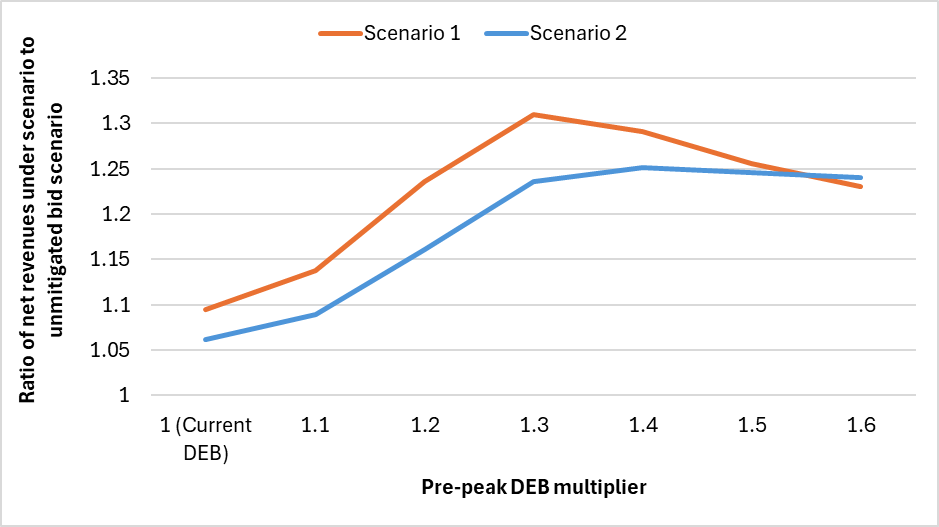
Figure 3 Ratio of net revenues under scenario 3 to unmitigated bid scenario

Several key conclusions emerge from the results in Figures 2 and 3.
- On average, battery resources’ schedules yielded higher net revenues when bids were mitigated, even when using the current storage DEB. This occurs because some storage resources may bid too high during peak hours, preventing them from receiving an efficient dispatch in high-priced intervals. Figure 2 indicates that if storage resources were never able to bid above their DEB, their net revenues would be around 10 percent higher under the current DEB compared to schedules using unmitigated bids.
- Under DEBs that vary across the day, storage resources’ schedules would earn 10 to 30 percent more net revenues compared to the unmitigated scenario, depending on the DEB formulation. With a pre-peak multiplier of 1.4 or higher, the adjusted DEB formulations result in net revenues that are around 15 percent higher than net revenues under the current DEB.
- As shown in Figure 3, the net revenue differences in Scenario 3 are smaller because mitigation is applied less frequently. However, the same pattern holds—net revenues are slightly higher when bids are mitigated using the current DEB compared to the counterfactual using unmitigated bids , and the DEBs that vary across the day yield higher net revenues than the current DEB.
- Figures 2 and 3 both indicate that the incremental benefit of higher multipliers diminishes after about 1.3 or 1.4. This is consistent with analysis DMM has done when evaluating proposals for battery negotiated default energy bids (NDEBs) submitted under the negotiated default energy bid option of the CAISO tariff.
Overall, this preliminary analysis suggests that incremental improvements to the storage DEB may support more efficient dispatch under mitigation. Allowing the storage DEB to take on multiple values per day helps prevent pre-dispatch in pre-peak hours when opportunity costs are higher while still protecting against potential exertion of market power during peak hours when opportunity costs are lower.
DMM recommends the ISO consider developing a multiplier with a shape similar to those analyzed here but grounded in a more theoretical basis. DMM will continue to evaluate more sophisticated DEB formulations using the framework provided in these comments. DMM recommends that future DEB formulations should focus on some degree of flexibility on which hours include more or less headroom, as these hours likely vary seasonally and may shift with longer-term market trends.
The storage DEB should vary in alignment with intraday opportunity costs, and any multiplier to reflect changing intraday opportunity costs should not be derived from differences between day-ahead and real-time prices
DMM supports the ISO’s approach of using a multiplier to increase the DEB during hours when the intraday opportunity costs are higher and decrease the DEB when those opportunity costs are lower. As DMM has previously explained, the opportunity costs are highest in the hours right before the highest priced hours of the day when there are limited opportunities to recharge before reaching those hours. During these ramp hours, a battery that discharges early forgoes the ability to discharge during upcoming high-priced intervals, making the opportunity cost of discharge the highest of the day. Once prices reach their peak, the opportunity cost of being available for a later discharge diminishes as prices decline after the peak and lower cost recharge opportunities exist before reaching additional high-priced hours.
The ISO presented two examples (A and B) for changing the storage DEB values across the day. Example A attempts to model changing costs by applying the current storage DEB formula to different subsets of hours within the day. The result of this approach as outlined in example A of the March 16 stakeholder presentation is a DEB curve that does not properly align with intraday opportunity costs over the day. For instance, the approach outlined in example A would establish the highest DEB values in the peak and later hours of the day, but these would actually be the hours with the lowest expected intraday opportunity cost. The highest opportunity cost would instead occur in the hours immediately preceding high priced peak hours, reflecting foregone profit if the resource were to discharge before reaching those hours with limited or no opportunity to recharge. During peak high priced hours, the intraday opportunity cost would fall as the highest expected prices of the day have already passed and the resource may expect lower cost recharging opportunities before again reaching the next set of high priced peak hours.
DMM understands that the results observed in example A are influenced by considering different blocks of hours within the day, but are also impacted by the inclusion of a cost for energy used to charge the battery as in the current DEB formulation. While DMM conceptually disagrees with the inclusion of any sunk charging cost in the storage DEB, interpretation of the results shown in example A is further confounded by the way in which charging costs appear to be incorporated. In example A, the charging cost appears to be calculated by summing the LMPs over the relevant charging hours.[6] However, the storage DEB as described in the CAISO Business Practice Manual (BPM) for Market Instruments uses the average charging cost over the relevant hours rather than the sum.[7] Therefore, in addition to simply including a sunk charging cost in the storage DEB as prescribed in the BPM, including the charging cost as done in example A significantly increases the DEB values for some hours to a level that is very unlikely to be a reasonable estimate of marginal cost. Although calculating the charging cost, as done in example A, will result in a much higher DEB in some hours, even using the approach outlined in the BPM in the “rolling window” framework results in a DEB curve that can have the highest values misaligned with the highest intraday opportunity cost.
Example B instead creates a multiplier that is based on the spread between day-ahead and real-time prices. While DMM agrees that there may be a need to include a scalar that accounts for this price spread, or some type of trigger that allows for storage DEBs to be raised during days/hours where real-time prices are higher, DMM cautions against using this type of design to shape storage DEBs in a way that intends to reflect intraday opportunity cost. Although there may be some correlation between day-ahead and real-time price spreads and the ramping hours when opportunity costs are higher, there is no theoretical basis linking hours with high intraday opportunity costs to hours with large day-ahead/real-time spreads. DMM recommends that the ISO address the variation between day-ahead and real-time prices separately and design a multiplier that shapes DEBs based on the hours when intraday opportunity costs are highest and lowest.
The ISO should place priority on creating a standard DEB option for WEIM storage resources
DMM agrees with the ISO’s statement that developing a WEIM-only storage DEB based on the approach used for most negotiated default energy bids could be readily implementable. DMM recommends the ISO prioritize this enhancement so that market participants do not have to use the NDEB process. DMM believes that the improvements being discussed with the CAISO storage DEB would translate well to the WEIM storage DEB.
Currently, the NDEB typically used by WEIM storage resources utilizes day-ahead default generation aggregation point (DGAP) prices, along with a scalar that captures volatility between day-ahead and real-time prices. DMM recommends the ISO could consider a similar type of scalar for the CAISO storage DEB that is aimed at reflecting instances where real-time prices may be higher than day-ahead prices.
DMM is completing an analysis of NDEBs in WEIM areas during Q3 2025, and will provide these results in follow-up comments for reference in this stakeholder process. Results show that NDEBs for batteries in WEIM areas were rarely less than the resource’s LMPs for more than 4 hours per day in Q3 2025. The main cause of these findings is that day-ahead DGAP prices used in setting battery NDEBs for WEIM areas tended to be significantly higher than real-time prices for battery resources in WEIM areas. These results are highly consistent with analysis DMM has done of NDEBs for batteries in WEIM areas for longer time periods.
DMM continues to place a high priority on the development of a hybrid resource DEB that will support mitigation of hybrid resources
Hybrid resources currently do not have a DEB, and as a result are not subject to local market power mitigation. In December 2024, the storage component of hybrid resources totaled about 1,500 MW of capacity, or about 12 percent of storage capacity on the system.[8] With such a large portion of the storage capacity exempt from local market power mitigation, DMM continues to place a high priority on the development of a hybrid resource DEB to facilitate local market power mitigation for hybrid resources.[9]
DMM reiterates support for development of a hybrid resource DEB in the near-term by calculating the maximum of the DEBs that apply to each of the generation components that make up the hybrid resource.[10] This initial approach should be easy to implement and should achieve the goal of subjecting hybrid resources to local market power mitigation. After a near-term solution for hybrid resource DEBs is implemented, the ISO should continue to enhance hybrid resource DEBs to more accurately reflect the costs of hybrid resources as a full system of different generation components. DMM recommends the ISO and stakeholders discuss potential issues with using the current storage DEB or any enhanced storage DEB developed for hybrid resources, and consider these issues in the ongoing refinements of a DEB for hybrid resources in the future.
Hybrid dynamic limits can limit deliverability of ancillary service awards
The Issue Paper detailed a concern DMM has raised with the use of the hybrid dynamic limit and the inability of hybrid resources to provide awarded ancillary services.[11] Standalone storage resources have the ancillary services state-of-charge (ASSOC) constraint to manage state-of-charge (SOC) to ensure deliverability of ancillary services schedules. However, hybrid resources with a storage component must actively manage their own SOC to ensure deliverability of ancillary service awards. Hybrid resources may need to use the dynamic limit to manage SOC within the close of the bidding window to ensure deliverability of ancillary service awards. However, the dynamic limit may also be used for many competing needs, and as a result the dynamic limit may reduce the operational range of the resource during ancillary service awards and render the awards partially or fully undeliverable.
For summer 2025, DMM analyzed the average megawatts of day-ahead regulation awards that were undeliverable in the real-time due to the hybrid dynamic limit. Figure 4 shows data on the average megawatts of regulation in the day-ahead market, from July to September 2025, that were unable to be provided in real-time. The calculation specifically takes the day-ahead regulation award minus the real-time availability from the hybrid dynamic limit, and averages the undeliverable regulation quantity over the day for the hybrid resource fleet.
Figure 4 Average undeliverable day-ahead regulation awards due to hybrid dynamic limit
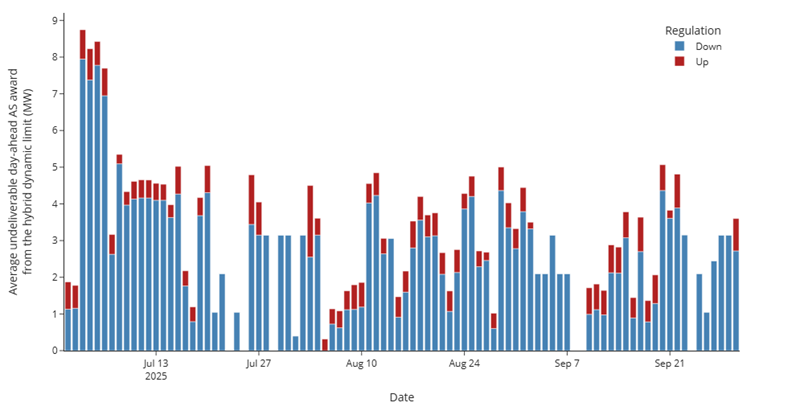
Over the period shown in Figure 4, there was an average of three megawatts undeliverable because of the hybrid dynamic limit use, with some level of undeliverability on 93 percent of days. Over the same period, the average daily maximum undeliverable regulation megawatts was 23 MW. Additionally, DMM found there are cases where hybrid dynamic limits cause undeliverable regulation in real-time after the real-time market can procure additional quantities of regulation.
In the Issue Paper, the ISO discusses improvements to the outage management system that may limit this behavior, but notes hybrid resources must continue to be fully responsible for meeting all their ancillary service requirements. While there are long-term improvements to limit the undeliverability of ancillary services, such as real-time ancillary service reoptimization or an ASSOC for hybrids, in the near-term, DMM continues to recommend that the ISO clarify it is not acceptable to use the dynamic limit to restrict the deliverability of ancillary services for economic reasons when it is physically possible for a hybrid resource to deliver their ancillary services schedule. Additionally, DMM recommends the ISO work with stakeholders to ensure the hybrid dynamic limit does not limit ancillary service availability and delivery.
Appendix: Sensitivity analysis of hour when lower DEB takes effect
Figure 5 Net revenues under scenario 1 – All bids capped at DEB

Figure 6 Net revenues under scenario 2 – All bids capped at max (DEB, competitive LMP)
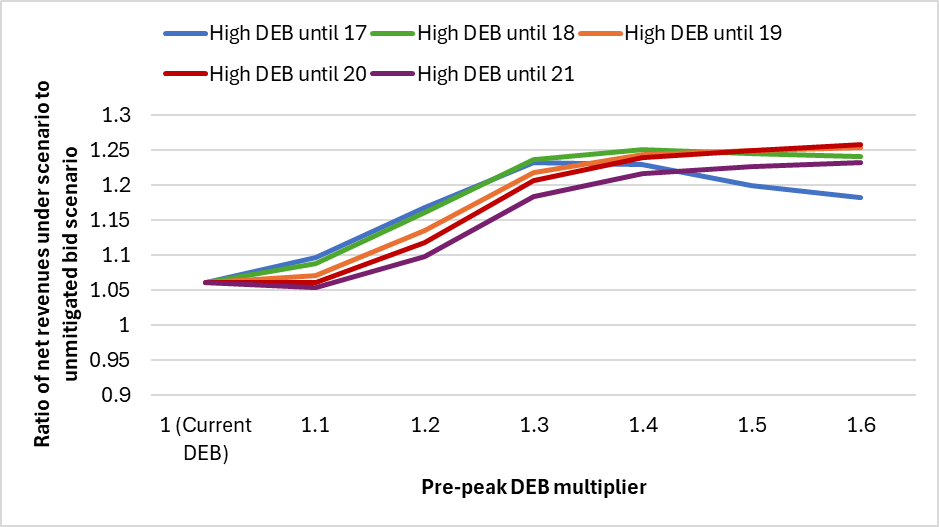
Figure 7 Net revenues under scenario 3 – Mitigation applied as usual

[1] Storage Design and Modeling: Working Group on Uplift and Default Energy Bid, Outage Management, and State-of-Charge Management presentation, California ISO, January 22, 2026: https://stakeholdercenter.caiso.com/InitiativeDocuments/Presentation-Storage-Design-Modeling-Jan-22-2026.pdf
[2] Comments on Storage Design and Modeling Working Group Presentation on November 12, 2025, Department of Market Monitoring, November 26, 2025: https://www.caiso.com/documents/dmm-comments-on-storage-design-and-modeling-nov-12-2025-working-group-presentation-nov-26-2025.pdf
[3] 2024 Special Report on Battery Storage, Department of Market Monitoring, May 29, 2025: https://www.caiso.com/documents/2024-special-report-on-battery-storage-may-29-2025.pdf
[4] Comments on Storage Design and Modeling Updated Discussion and Issue Paper on Uplift and Default Energy Bid, Department of Market Monitoring, January 8, 2026: https://www.caiso.com/documents/dmm-comments-on-storage-design-and-modeling-updated-discussion-and-issue-paper-on-uplift-and-default-energy-bid-jan-8-2026.pdf
[5] Comments on Storage Design and Modeling Working Group Presentation on September 29, 2025, Department of Market Monitoring, October 14, 2025: https://www.caiso.com/documents/dmm-comments-on-storage-design-and-modeling-sep-29-2025-working-group-presentation-oct-14-2025.pdf
[6] For example, the “En” component for hours 13-24 on slide 24 is calculated by summing the LMP for the lowest priced block of hours for a total of 4.44 hours: 10 + 11 + 12 + 13 + 0.44*14 = 52.16 https://stakeholdercenter.caiso.com/InitiativeDocuments/Presentation-Storage-Design-Modeling-Jan-22-2026.pdf
[7] Business Practice Manual Change Management – Market Instruments, California ISO, pp 307-311: https://bpmcm.caiso.com/BPM%20Document%20Library/Market%20Instruments/BPM_for_Market%20Instruments_V92_Redline.pdf
[8] 2024 Special Report on Battery Storage, Department of Market Monitoring, May 29, 2025: https://www.caiso.com/documents/2024-special-report-on-battery-storage-may-29-2025.pdf
[9] Comments on Storage Design and Modeling Working Group Presentation on September 29, 2025, Department of Market Monitoring, October 14, 2025: https://www.caiso.com/documents/dmm-comments-on-storage-design-and-modeling-sep-29-2025-working-group-presentation-oct-14-2025.pdf
[10] Ibid.
[11] Comments on Storage Design and Modeling Working Group Presentation on June 30, 2025, Department of Market Monitoring, July 16, 2025: https://www.caiso.com/documents/dmm-comments-on-storage-design-and-modeling-jun-30-2025-working-group-presentation-jul-16-2025.pdf
Supplemental Comments on Storage Design and Modeling
Working Group Presentation on March 16, 2026
Department of Market Monitoring
April 14, 2026
Summary
The Department of Market Monitoring (DMM) is providing these supplemental comments on the Storage Design and Modeling working group presentation held on March 16, 2026. As noted in DMM’s prior comments, DMM supports the ISO’s proposal to create a standardized storage DEB option for batteries in Western Energy Imbalance Market (WEIM) balancing areas. These supplemental comments provide analysis of the negotiated default energy bids (NDEBs) currently used by battery resources in WEIM balancing areas. Results of this analysis show that the current NDEBs used for WEIM battery resources are reasonable and have had extremely limited impact on the actual bids and dispatch of WEIM resources. DMM believes that the ISO should build on the same framework currently used to set NDEBs when creating a standardized storage DEB option for WEIM batteries. However, as with the standard storage DEB option currently in use for CAISO resources, DMM believes that this framework could be enhanced by allowing DEBs to be scaled up or down during different periods of the day to reduce the potential for uneconomic dispatch prior to the peak net load hours, while continuing to ensure effective market power mitigation during the highest priced net load hours.
Background
Since there are no day-ahead market prices for Western Energy Imbalance Market (WEIM) areas, default energy bids for batteries in WEIM areas must be established under the negotiated rate option of the ISO tariff. All real-time negotiated default energy bids that have been implemented for batteries in WEIM areas are based on the same framework as the standard opportunity cost default energy bid used for batteries in the ISO, but include two modifications:
- Day-ahead price. Instead of using each resource’s hourly locational marginal prices in the day-ahead market, negotiated default energy bids for WEIM batteries are based on day-ahead default generation aggregation point (DGAP) prices. These DGAP prices are a product of the full-network model and reflect prices for modeled aggregations of generating units (usually aggregated at a balancing area-wide level).
- Upward adjustment based on recent real-time prices. To account for any systematic differences between DGAP prices and real-time prices at each WEIM battery’s location, DMM includes an upward adjustment to the DGAP prices when calculating negotiated default energy bids. This adjustment scales up hourly DGAP prices based on the ratio of (1) the average hourly 15-minute real-time price for the WEIM area over the past three days, and (2) the hourly DGAP price from the ISO’s day-ahead model in the corresponding hours.[1]
Except for these two modifications, NDEBs for WEIM batteries are used in the same manner as DEBs for batteries in the CAISO area. For example, the opportunity cost component of the NDEB for batteries with 4 hours of storage is based on the fourth-highest hourly DGAP price (after any upward adjustments), and the overall DEB calculation includes a 110 percent multiplier.
As with the storage DEB for CAISO resources, DMM believes this framework could be enhanced by simply allowing DEBs to be scaled up or down during different periods of the day. The multiplier would be set above 1 prior to the peak net load hours to reduce the potential for uneconomic dispatch, and would be set below 1 during and after the highest priced peak net load hours to reflect the lower opportunity costs of battery resources during these hours.
Analysis of NDEBs
To help assess potential changes in DEBs for WEIM batteries and provide additional transparency on this issue, DMM conducted analysis of the NDEBs for all batteries in the WEIM with a four hour storage duration during 2025. This analysis compares the NDEBs resulting from the current methodology to actual 15-minute prices for each battery, and calculates the number of hours each day that each resource’s 15-minute locational marginal prices (LMPs) are higher than the resources’ NDEBs.
This metric approximates the number of hours that a battery would be dispatched each day if their bid was capped due to mitigation at the NDEB. When this metric is less than or equal to four hours, then mitigation using the NDEB would not cause the unit to be dispatched uneconomically. When this metric exceeds four hours, it also provides a measure of the magnitude on the potential impact of mitigation in terms of causing a unit to be discharged prior to the highest priced or more critical hours.
For this analysis, this metric is calculated for hours-ending 10 through 24. This reflects an assumption that if a battery is discharged in other hours, it will have the opportunity to re-charge prior to the peak net load hours. The analysis also excludes batteries with storage durations of less than four hours in order to simplify presentation of results.
The analysis includes four different scenarios which show the sensitivity of results to different factors (i.e., the impact of the WEIM real-time price scalar and the frequency that units are actually subject to mitigation).
- NDEB without real-time scalar, using all hours during 10-24 period.
- NDEB with real-time price scalar, using all hours during 10-24 period.
- NDEB without real-time scalar, only using hours when units were subject to mitigation.
- NDEB with real-time scalar, only using hours when units were subject to mitigation.
As shown above, metrics for scenarios 1 and 2 include all hours between 10-24, regardless of whether or not each resource was actually subject to mitigation (i.e., could have had its bids mitigated if they were in excess of the NDEB). These scenarios reflect a bookend that reflects scenarios in which resources were always or usually subject to bid mitigation. In practice, however, resources in the WEIM are subject to mitigation very infrequently (i.e., usually only when transfer constraints into a WEIM area are congested). Therefore, scenarios 3 and 4 only count hours when resources were subject to mitigation due to congestion on transfer constraints into the WEIM area in which they are located. During these intervals, batteries could have their bids mitigated if they exceeded the NDEB.
Results
Results of this analysis for 2025 are provided in the following table and charts. These results show that NDEBs for batteries in WEIM areas were rarely less than the resource’s LMPs for more than 4 hours per day in 2025. The main cause of these findings is that day-ahead DGAP prices used in setting battery NDEBs for WEIM areas tended to be significantly higher than real-time prices for battery resources in WEIM areas (see Figure 1).
Figure 1. Average hourly prices and NDEBs
Aggregated results for all WEIM balancing areas (2025)
.png)
Table 1. Summary results for all WEIM balancing areas (2025)
|
|
Percent of days when NDEB <= LMP
more than 4 hours
|
Percent of hours subject to mitigation
|
Percent of days when NDEB <= LMP more than 4 hours (only counting hours with mitigation)
|
|
Total for 8 BAAs
|
|
|
|
|
WEIM
|
1.3%
|
1.4%
|
0%
|
|
BAA
|
|
|
|
|
AZPS
|
1.2%
|
.2%
|
0%
|
|
EPE
|
1.6%
|
0%
|
0%
|
|
NEVP
|
2.0%
|
.4%
|
0%
|
|
PGE
|
1.9%
|
17.0%
|
.6%
|
|
PNM
|
1.1%
|
.3%
|
0%
|
|
SRP
|
1.1%
|
.6%
|
0%
|
|
TEPC
|
.5%
|
0%
|
0%
|
| |
|
|
|
|
Figure 2. Hours per day with NDEB <= LMP (all hours 11-24)
Aggregated results for all WEIM balancing areas (2025)

Figure 3. Hours per day with NDEB <= LMP (mitigated hours only from 11-24)
Aggregated results for all WEIM balancing areas (2025)

[1] For example, if the average real-time price at the battery’s location over the last three days was $33/MW for hour t and the default generation aggregation point price for hour t from the ISO day-ahead model is $30/MW, then the default generation aggregation point price for hour t is scaled up by 10 percent. The scalar has a floor of 1. Calculating the scalar based on the three day average of real-time prices was originally proposed by a WEIM entity, and has subsequently been included in negotiated default energy bids for all other WEIM batteries.