1.
Please provide your organization’s perspective on the Intertie Schedule Modeling Enhancements stakeholder workshop presentation on August 24, 2026.
Comments of Powerex Corp. on
Intertie Schedule Modeling Enhancements
August 24, 2026 Stakeholder Meeting
Powerex appreciates the opportunity to submit comments on the California ISO’s August 24, 2026 meeting on the Intertie Schedule Modeling Enhancements stakeholder process.
Topic 1 – Proposal to Replace Modeling of Intertie Bids as Injections at CAISO Boundary with Modeling as Aggregate Generation in Adjacent BAA
The meeting focused primarily on the California ISO’s proposal to replace the current representation of intertie bids as generation located at the boundary tie point with a representation of intertie bids as the aggregate generation sources of a balancing authority area (BAA) on the “other side” of that boundary tie point.
Powerex appreciates that the California ISO’s rules regarding intertie bidding lead to specific challenges. Namely, intertie bids can be submitted as “system resources,” and are not required to identify a specific generating resource or even a BAA that is the source of the imported electricity. The California ISO has also repeatedly declined to require intertie bids that receive a day-ahead market award to submit an e-Tag on a day-ahead basis, meaning that the source of intertie imports may remain unknown even through the real-time market. Given these rules, assumptions are made regarding how to represent the generation of electricity—and the resulting flows on the grid—associated with a cleared intertie bid.
The GAP-Tie Proposal Should Not Move Forward Until Analysis Clearly Indicates That a Material Problem Exists, and that the Proposal Would Lead to Significant Improvements
Currently, the California ISO models an intertie import as a generator located at the specific intertie. The California ISO’s presentation explained that this representation can be inaccurate, and described some of the implications that could occur as a result. However, no comprehensive analysis has been provided on the actual frequency, magnitude, or consequences of the current approach. It is therefore not yet clear whether the current SP-Tie representation is leading to material adverse consequences for reliability, efficiency or pricing accuracy.
The California ISO is proposing to replace the existing SP-Tie representation (as generation at an intertie) with a different representation (as aggregated generation in an adjacent BAA). This representation will also be inaccurate; it will even apply to imports offered by Scheduling Coordinators that have no connection to the adjacent BAA where the source is assumed to be. How inaccurate this assumption will be, or how frequently, is unclear, as there has been no analysis presented on the anticipated outcomes under the GAP-Tie approach, including whether accuracy may actually decline in certain circumstances.
Any change to the representation of how supply flows on the California ISO grid has the potential to have significant impacts on which resources clear the market and the prices determined in that market. Such changes should only be considered after a careful analysis showing that the existing approach leads to material challenges, and that an alternative approach has been identified that leads to significantly improved outcomes. Until then, it is unclear whether the benefits of replacing one assumption with a different assumption warrants dedicating limited California ISO and stakeholder resources, given the several other initiatives that are underway. Powerex appreciates that California ISO staff have indicated that an analysis is already in progress, and looks forward to continued engagement on this topic.
The GAP-Tie Proposal Would Be Patently Inaccurate for Imports on DC Interties
Imports delivered on Direct Current (DC) interties, including deliveries to NOB using the Pacific DC Intertie (PDCI), pose a unique circumstance that is not properly addressed under the GAP-Tie framework. DC interties are controllable devices: the scheduled quantities determine the electricity physically injected into the grid at the terminal. This makes them different from imports scheduled to AC interties, where the electricity flows are primarily determined by the location of generation and load in the interconnected grid, and are generally not impacted by the choice of delivery point.
It would be highly inaccurate and inappropriate to represent deliveries at NOB as injections in Bonneville’s BAA. In the absence of a binding scheduling limit, such a representation would mean that electricity imports at Malin receive the same price as electricity imports at NOB, even under conditions where the California ISO needs electricity delivered to its SP15 region (as occurs with imports at NOB) more than to its NP15 region (as occurs with imports at Malin).
The California ISO’s own indicative data shows this problem clearly. The table below shows the marginal cost of congestion (MCC) component for deliveries at Malin and at NOB in the Fifteen Minute Market for August 26, 2026 HE22. The left-hand columns show the MCC under the current SP-Tie methodology, while the right-hand columns show the MCC under the indicative GAP-Tie combinations:
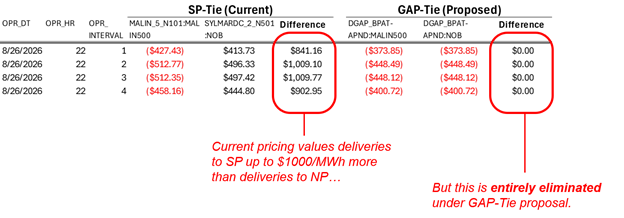
Under the current SP-Tie approach, deliveries on the PDCI to NOB were recognized as providing roughly $1,000/MWh more value to the California ISO than deliveries at Malin. OASIS data confirms that the scheduling limits were not binding at either location; the entire MCC difference was due to internal physical flow congestion (largely across Path 15). Under the proposed GAP-Tie approach, however, this difference in value would be entirely eliminated. This is because deliveries at NOB would be modeled identically to deliveries at Malin; as injections in Bonneville’s BAA. Both deliveries are therefore modeled as having the same flow impact on constraints in the California ISO. The flows on the California ISO grid resulting from the two deliveries are unambiguously not the same.
Powerex requests that the California ISO provide a detailed description and discussion regarding how it intends to model deliveries on DC interties, and to fully account for the significantly different circumstance that such deliveries present compared to deliveries scheduled on AC interties.
Greater Clarity is Needed Regarding Proposed Changes and Impacts to CRRs
At the August 24 workshop, the California ISO explained that its GAP-Tie proposal would have implications for CRRs. The discussion with stakeholders indicated the need for greater clarity on the extent of these implications, and the anticipated changes that the California ISO intends to pursue. In particular, there appears to be a need for greater clarity regarding the following topics:
- Whether the GAP-Tie proposal would create new congestion exposure between locations that are currently not covered by existing CRRs;
- Whether existing CRRs sourcing or sinking at an intertie are moved to the adjacent DGAP or whether new CRRs will be required from adjacent DGAP to the intertie.
- Will the DGAPs and interties be biddable locations in future the CRR Auctions.
Topic 2: Eliminating Day-Ahead Intertie Bidding at CAISO Interties with Other EDAM Entities
The August 24 workshop briefly introduced the California ISO’s second proposal, which is to eliminate intertie bidding at “EDAM Internal Interties,” referring to the interties between the California ISO and a BAA participating in EDAM. This proposal raises significant concerns, and Powerex believes that the California ISO should reconsider this proposal until such time as it can be undertaken without causing significant loss of economic supply participation for the California ISO and for the EDAM area.
Intertie bidding has been the principal mechanism through which supply located outside of the California ISO participates in the day-ahead market. This supply is extensive, at times exceeding 9,000 MW or more of imports into the California ISO BAA. In addition, this includes a substantial amount of clean, carbon-free supply including supply from hydro resources in the Northwest. The ability of the California ISO to access supply from a range of different geographic areas also provides it with resource diversity, tapping into sources of supply from parts of the West that may not be experiencing the same conditions or challenges as the California ISO.
With the launch of EDAM, it would perhaps be understandable that the California ISO would seek to encourage or even require supply that is located in EDAM BAAs to participate in the day-ahead market directly—by economically bidding or scheduling the output of specific generation resources—rather than by offering that supply through the intertie bidding framework. But the California ISO’s proposal is far broader than that, and would eliminate intertie bidding at all EDAM internal interties, even for entities delivering supply from a BAA that does not—and may not ever—participate in EDAM.
Under the California ISO’s proposal, the day-ahead market (including both the California ISO and other EDAM BAAs) would lose access to price-responsive external supply offered under the intertie bidding framework. To date, no EDAM entity has indicated that it will enable intertie bidding at its external interties. This means that external supply will no longer be able to be economically offered, and will instead need to be scheduled in fixed quantities, driven largely by the expectation of its value in EDAM. This undermines the often-expressed desire to encourage participation with economic offers rather than through self-schedules. By requiring suppliers to commit to a quantity without knowing the market price, such transactions will now entail significantly greater price risk, which can be expected to reduce the quantity and increase the price of external supply that is made available. It is also not clear whether EDAM entities will support self-scheduling of external supply into their BAAs, to be settled directly through EDAM, or whether external supply will need to be transacted bilaterally with a customer inside the BAA. This could introduce yet another source of inefficiency and friction in accessing external supply.
Moving forward with the California ISO’s proposal at this time would be a major step backward for all involved, reducing the California ISO’s (and EDAM’s) access to external supply, and restricting market access for entities that do not wish to join EDAM.
If the California ISO seeks to eliminate intertie bidding from its EDAM internal interties, Powerex believes it must first ensure that there is a fully comparable intertie bidding framework in place at all EDAM external interties. This includes not only requiring all EDAM entities to enable intertie bidding on their external interties. It also requires EDAM to adopt and implement a durable framework to allocate congestion value to firm OATT transmission service. This is because “pushing out” the location of intertie bidding can change the prices that external supply is paid, reflecting the cost of congestion between the “old” and “new” intertie bidding locations. This congestion-related value currently is received by entities that use firm OATT transmission service to physically deliver to the California ISO boundary, and the California ISO’s proposal should not be bundled with an attempt to shift how this value is allocated. The California ISO and stakeholders are currently grappling with this issue in the EDAM Congestion Revenue Allocation stakeholder process, and many of the same principles are relevant here.
Given that there is no comparable intertie bidding opportunity available to replace the intertie bidding options that the California ISO is proposing to eliminate, Powerex strongly recommends that this proposal be withdrawn. If the California ISO wishes to encourage supply located in an EDAM BAA to participate by submitting generator offers rather than through intertie bids, a proposal more narrowly tailored to that specific goal could be explored.