1.
Please provide your organization’s feedback on the decision to remove the CRR auction bid and price floor concept from the Phase 1 scope.
Comments on Congestion Revenue Rights Enhancements
Phase 1 Draft Final Proposal on Auction Efficiency and Revenue Adequacy
Department of Market Monitoring
July 2, 2026
Summary
The Department of Market Monitoring (DMM) appreciates the opportunity to comment on the Phase 1 Draft Final Proposal on Auction Efficiency and Revenue Adequacy.[1] In phase 1, the ISO proposes to “…retain the modeling improvements under the existing tariff and expanded ISO authority to model loop flow.”[2] The expanded loop flow modeling “will consist of targeted, manual adjustments to some high-market-impact constraints based on historical loop flow information.”[3] The proposal does not indicate if this loop flow modeling will be made in addition to or in place of Global Derate Factors that are already used to limit the amount of transmission capacity in the congestion revenue rights (CRR) model used in the allocation and auction.
DMM does not expect these limited changes to have significant effects on reducing ratepayer losses in the CRR auctions. DMM also has concerns that the ISO may not be able to carry out analysis needed to effectively implement such loop flow modeling in time for the 2027 annual CRR auction. If not based on accurate modeling of actual loop flows (and any appropriate adjustments to Global Derate Factors), these changes could even have detrimental impacts, including a reduction in CRRs available to load serving entities (LSEs) in the allocation process.
The ISO also proposes to continue discussing the auction bid and price floor in another phase of this initiative alongside other proposals. DMM does not believe the ISO should continue with work on a single uniform minimum price for all CRR point-to-point paths now or in a future phase of this initiative. The proposed single minimum price would suffer from adverse selection problems, where auction participants could pick CRR paths that have a minimum price below the value of that path, and avoid paths where the minimum price was above the CRR value. Further, this minimum price could interfere with the ability of parties wanting to trade CRRs with each other in the auction, among other issues. A single minimum price for all CRR paths is not a solid foundation for an effective fix to the CRR auction.
If the ISO wants to continue exploring reserve prices, they should consider constraint-specific reserve prices. This approach would provide an efficient and accurate foundation for introducing reserve prices that reflect the actual value of every possible source-to-sink path, and would not interfere with parties wanting to trade with each other. In these comments, we describe the benefits of constraint-specific reserve prices, and an approach to implementation that derives from a generalized version of the current auction model.
DMM continues to recommend the willing seller auction design. The ISO should consider this design, and any potential measures to provide additional liquidity deemed appropriate, in the second phase of this initiative. DMM has offered suggestions for addressing the main concerns expressed by stakeholders about the willing seller design through (1) enhancements to the allocation process (to reduce the need for load serving entities to rely on the auction for procuring the CRRs needed to hedge their energy procurement) and (2) including a backstop mechanism to ensure that entities needing CRRs to hedge actual energy transactions have access to CRRs.
Comments
Incorporating loop flows into CRR model
The only specific change being proposed by the ISO is “expanded ISO authority to model loop flow”, which “will consist of targeted, manual adjustments to some high-market-impact constraints based on historical loop flow information.”[4] The proposal does not indicate if this loop flow modeling will be made in addition to or in place of Global Derate Factors that are already used to limit the amount of transmission capacity in the CRR model used in the allocation and auction.
DMM is not aware of any extensive analysis that has been performed by the ISO of actual loop flows—and the ISO’s ability to accurately model and predict loop flows in advance, as will be required to incorporate these into the CRR model. Some data on loop flows that DMM has observed suggest that loop flows may be difficult to accurately predict and represent in the level of granularity of the CRR model (i.e., 16-hour blocks by season and month). For instance, DMM suspects that loop flows may vary significantly over the 16 peak hours, with loop flows during the peak solar hours being much different than during the peak net load hours (18-22).
Consequently, DMM recommends that prior to incorporating any loop flows into the CRR model, the ISO conduct and provide analysis to stakeholders for review and discussion. DMM has concerns that the ISO may not be able to carry out analysis needed to effectively implement such modeling in time for the 2027 annual CRR auction. The ISO should also clarify if this loop flow modeling will be made in addition to or in place of Global Derate Factors that are already used in the allocation and auction. If estimated loop flows are simply applied on top of these Global Derate Factors, these changes could even have detrimental impacts, including a reduction in CRRs available to LSEs in the allocation process.
Uniform bid/reserve price limits
In the short time since a uniform minimum bid/reserve price approach was proposed by the ISO, a variety of theoretical and practical problems with this approach have been identified. One of these concerns was that placing minimum bid limits on source-to-sink paths could prevent transactions between willing counterparties offering to sell/buy CRRs at prices outside of these uniform bid limits.
Another major problem with the uniform minimum bid/reserve price approach is that in practice, the value of all possible source-to-sink CRRs varies tremendously, so that any uniform bid/price limits selected will be significantly over or under the actual value of most CRRs. The ISO has indicated that the sheer number of all possible source-to-sink pairs in the ISO market model would make setting CRR-specific reserve prices administratively infeasible.
DMM believes these problems with the uniform bid/reserve price approach proposed by the ISO can be avoided through an alternative approach based on constraint-specific reserve prices, as described in the following section.
Constraint-specific reserve prices
CRRs are settled based on the nodal price difference on specific source-to-sink paths. However, the value of each CRR is actually the sum of congestion shadow prices on a bundle of different transmission constraints (taking into account the shift factors of these constraints relative to the CRR source and sink). Thus, each different source-to-sink CRR has a value that varies based on congestion and shift factors for a bundle of different transmission constraints.
The limits on these transmission constraints are set by the ISO in the CRR model, but additional transmission capacity on each constraint can also be available in the CRR model from counterflows created by CRRs offered by other participants in the auction. These counterflow CRRs include CRRs allocated to LSEs being resold in the auction as well as counterflows created by CRRs bid into the auction by financial entities and traders.
For example, a participant could bid to buy a CRR sourcing from A→B that is bought in full from another participant offering a CRR from B→A without using any CRR product purchased from the ISO. Placing a minimum bid price on this A↔B path would affect the price at which these two participants can trade without being a reserve price on anything the ISO sold.
Removing this misalignment by placing reserve prices on the specific constraints being offered would be a much more efficient and effective way to implement reserve prices. Constraint-specific reserve prices would:
- align with the product that the ISO offers in the auction (the constraint limits),
- not restrict what bid prices auction participants could submit,
- allow trades between market participants even if their bids are below the reserve price,
- not create a mismatch between path flow and counterflow prices,
- significantly reduce adverse selection problems relative to both single path price and status quo,
- likely reduce transmission ratepayer losses in the CRR auction, and
- provide all entities with the ability to procure CRRs being used as hedges at a reasonable cost that reflects the expected value of these hedges.
The ISO could implement constraint-specific reserve prices similar to how it relaxes constraints for penalty prices in the energy markets. For each constraint, there could be a relaxation resource (R) that only provides counterflow to one constraint. The relaxation resource R would enter the objective function as a choice variable with a bid equal to the reserve price (r) and a max bid quantity equal to the constraint limit. The constraint limit used in the optimization would then be set to zero. With the inclusion of the relaxation resource, the ISO is still offering to sell up to the constraint limit, but only if the reserve price is met.
As an example, consider a constraint with a 100 MW limit. The ISO calculates a reserve price of $2 per MW. The current auction would model:

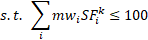
Where bid quantities (mwi ) and price (pi
 ) are submitted by market participants and the shift factors (SFik
 ) map the bids to constraints.
Implementing the constraint-specific reserve price would change the model to:
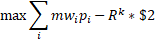
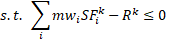

Thus, the ISO still offers 100 MW of constraint k “capacity” but at a reserve price of $2 rather than $0.
The current auction model is equivalent to this formulation with the reserve price set at $0. In the current auction model, the full transmission constraint limit of 100 MW is used with no cost assigned to awarding CRRs that impact this constraint. The formulation with the constraint-specific reserve price is simply a generalized version of the current auction model that allows the reserve price to differ from $0, and for this reserve price to enter the objective function when determining what portion of the transmission constraint limit is used to award CRRs.
Illustrative example
This section provides a simplified example of an auction that uses constraint-specific reserve prices. This example has only one constraint and bidding only takes place at two nodes (A and B). The ISO offers 30 MW of capacity on this constraint at different reserve price levels. This 30 MW of transmission capacity is represented by a reserve resource that allows the transmission constraint to be relaxed at the reserve price used in each scenario. CRRs from A→B have a shift factor of .67 relative to this constraint while CRRs from B→A have a shift factor of -.67 to this constraint.
Figure 1 shows four cases with different reserve prices and bids to buy/sell CRRs by market participants. Each scenario assumes that participants submit bids for 100 MW of CRRs from A→B and from B→A at different prices. The reserve price enters the optimization as a “bid price” the same way that the CRRs are bid into the auction. The examples assume that the shadow price on this constraint has an expected value of $4 over the CRR period.[5]
Figure 1. Simplified single constraint auction with reserve resource
.png)
The examples illustrate that with this approach, CRRs can clear against the ISO constraint, against willing counterparties, or from a mix of the constraint and willing counterparties.
- Case 1 is equivalent to the current auction with the reserve price set at $0. Participants submit bids for 100 MW of CRRs from A→B at $.05 and 100 MW from B→A at -$2.50. In this case, 45 MW of CRRs from A→B would clear at a price of $.05. For this 45 MW to clear, the reserve resource would reach its maximum limit of 30 MW.[6] None of the CRRs bid in the counterflow direction from A→B at -$2.50 clear. At a $0 reservation price, the auction clears at prices well below the average payouts of the CRRs.
- Case 2 assumes the reserve price is set at $4. Participants submit bids for CRRs from A→B at $3 and CRRs from B→A at -$3.25. In this case, 45 MW of CRRs from A→B would continue to clear, but the price would be $3. This case illustrates how the constraint-specific approach can be designed to ensure that all participants could purchase CRRs at a price that reflects the value of these CRRs, even if no participants offer CRRs in the counterflow direction at a price that would clear.
- Case 3 assumes the reserve price is set at $4, but participants submit bids for CRRs from A→B at $2.50 and counterflow CRRs from B→A at -$2.00. In this case, no capacity from the reserve resource would clear at the $4 reserve price, but all 100 MW of CRRs from A→B and from B→A would clear at a price of $2.50, representing the price at which market participants were willing to transact. This case illustrates that participants can trade with each other below the reserve price which they could not do under the uniform minimum bid/reserve price approach proposed by the ISO.
- Case 4 assumes the reserve price is set at $4, with participants submitting bids for CRRs from A→B at $3.25 and CRRs from B→A at -$3.00. In this case, the reserve resource would clear at is maximum constrained value 30 MW. The full 100 MW of CRRs from A→B would clear as a result of a combination of the capacity from the reserve resource sold by the ISO and 55 MW of counterflow CRRs from B→A clearing at the $3 price.
If the ISO wants to continue exploring reserve prices, DMM believes an approach based on constraint-specific reserve prices would provide an efficient and accurate foundation for introducing reserve prices that reflect the actual value of every possible source-to-sink path, and would not interfere with parties wanting to trade with each other.
[1] Congestion Revenue Rights Enhancements: Phase 1 Draft Final Proposal on Auction Efficiency and Revenue Adequacy, California ISO, June 1, 2026: https://stakeholdercenter.caiso.com/InitiativeDocuments/Draft-Final-Proposal-Auction-Efficiency-Revenue-Adequacy-Congestion-Revenue-Rights-Enhancements-2026-06-23.pdf
[2] Ibid, p 4
[3] Ibid, p 12
[4] Ibid, p 4, 12
[5] This equates to an expected value of CRRs from A→B of about $2.68 ($4 x 0.67)
[6] 45 MW x .67 shift factor = 30 MW, therefore the A→B CRR is buying 30 MW from the ISO constraint.